

Contents
show
Virtual Medical Assistant Services
A virtual medical assistant is becoming a practical support solution for U.S. healthcare practices that need stronger administrative capacity without adding unnecessary in-office workload. In 2026, medical practices are handling more digital records, more patient communication channels, more billing complexity, more telehealth workflows, and more pressure to keep clinicians focused on care instead of paperwork.
The need is clear across the healthcare labor market. The U.S. Bureau of Labor Statistics projects employment of medical assistants to grow 12% from 2024 to 2034, much faster than the average for all occupations, with about 112,300 openings each year on average over the decade. That demand reflects a larger operational reality: healthcare organizations need trained support staff to keep patient intake, documentation, billing, scheduling, and follow-up moving.
At the same time, U.S. healthcare spending continues to rise. CMS reports that national health expenditures grew 7.2% to $5.3 trillion in 2024, or $15,474 per person, and accounted for 18.0% of GDP. When costs are this high, practices cannot afford inefficient workflows, preventable billing delays, missed calls, incomplete records, or avoidable administrative burnout.
Virtual medical assistant services help solve that problem by giving healthcare providers remote support for non-clinical and workflow-adjacent tasks such as appointment scheduling, patient intake coordination, EMR updates, billing support, insurance follow-up, medical records organization, call answering, telehealth admin, and remote patient monitoring workflow support. The best use of a virtual medical assistant is not to replace licensed clinical care; it is to protect clinical time, improve administrative consistency, and help patients move through the practice experience more smoothly.
What Is a Virtual Medical Assistant?
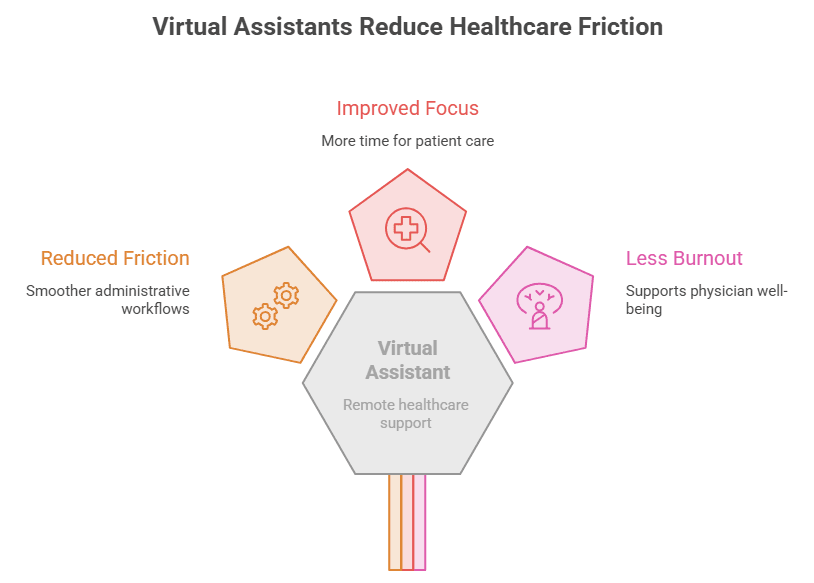
A virtual medical assistant is a remote healthcare support professional who helps medical practices, clinics, telehealth providers, dental offices, veterinary practices, and specialty care businesses manage administrative and operational workflows. The role is similar to an in-office medical assistant in some administrative areas, but the work is performed remotely through secure systems, approved communication channels, electronic medical records, scheduling platforms, billing tools, and practice-management software.
1. Definition of a Virtual Medical Assistant
A virtual medical assistant supports healthcare teams by handling remote administrative tasks that do not require the assistant to be physically present in the practice. These tasks may include answering calls, scheduling appointments, updating patient records, managing intake forms, coordinating referrals, preparing billing information, supporting telehealth visits, organizing medical documentation, and following up on routine administrative requests.
The role should be clearly distinguished from licensed clinical practice. A virtual medical assistant should not diagnose, prescribe, interpret clinical findings, provide independent medical advice, or perform duties that state law, professional licensing rules, payer requirements, or practice policy reserve for licensed clinicians. Instead, the virtual assistant supports the administrative and documentation workflows around patient care.
For practices exploring the broader role, the existing article on virtual medical assistant services can serve as the main pillar page that connects to specialized support areas such as billing, call answering, records management, EMR assistance, telehealth, and HIPAA compliance.
2. How Virtual Medical Assistants Support Healthcare Practices
Virtual medical assistants help practices reduce administrative friction. They can answer routine calls, confirm appointments, send reminders, collect missing intake information, update EMR fields, organize documents, prepare billing queues, follow up on insurance details, and keep patient communication moving.
These tasks may look small individually, but they create major pressure when they pile up. A doctor who has to chase missing forms, clarify scheduling issues, manage patient messages, check insurance details, and review disorganized records has less time and attention for care delivery. A virtual medical assistant creates a support layer that helps the practice run more predictably.
This support is especially important because physicians continue to face burnout risk. The American Medical Association reported that 41.9% of physicians experienced at least one symptom of burnout in 2025, down from 43.2% in 2024 and 48.2% in 2023, but still a substantial burden. Reducing unnecessary administrative load is one practical way to support better clinician focus.
3. Virtual Medical Assistant vs. In-Office Medical Assistant
An in-office medical assistant may perform both administrative and clinical support tasks depending on state law, certification, employer policy, and supervision. They may assist with rooming patients, taking vitals, preparing exam rooms, managing supplies, and supporting clinicians directly in the physical office.
A virtual medical assistant, by contrast, is best suited for remote-friendly workflows. These include scheduling, phone support, records updates, billing support, prior administrative coordination, telehealth setup, documentation organization, and patient communication routing. The virtual model works well when the practice uses digital systems and has clear rules for access, privacy, escalation, and task ownership.
The two roles can also work together. An in-office assistant may focus on rooming, patient flow, and clinical-adjacent tasks, while a virtual medical assistant manages calls, inboxes, EMR cleanup, billing queues, and documentation support. This division can reduce bottlenecks inside the office.
Key Benefits of Hiring a Virtual Medical Assistant
The main benefit of a virtual medical assistant is operational leverage. Instead of asking doctors, nurses, front-desk staff, or office managers to handle every administrative detail, the practice can delegate recurring support tasks to trained remote staff. This can improve responsiveness, documentation quality, revenue-cycle consistency, and patient experience.
1. More Time for Physicians and Care Teams
- A virtual medical assistant can reduce the number of routine administrative tasks that interrupt clinicians and in-office staff throughout the day.
- Common delegated tasks include phone messages, appointment confirmations, missing form follow-ups, basic record updates, referral coordination, and documentation preparation.
- The value is not only time saved; it is also fewer interruptions during work that requires clinical focus and careful judgment.
- Healthcare work often becomes fragmented when clinicians and staff constantly switch between care delivery, patient messages, scheduling, and documentation issues.
- When a trained assistant handles routine work consistently, clinicians can spend more attention on patient encounters, care planning, chart review, and clinical decision-making.
- A virtual medical assistant cannot solve burnout alone, but they can support a healthier workflow by removing tasks that do not require the clinician’s direct involvement.
2. Better Patient Communication and Front-Desk Coverage
- Patient communication is one of the most visible parts of a medical practice, and it strongly affects how patients experience the office before they see a provider.
- Missed calls, long hold times, slow appointment confirmations, and unclear instructions can frustrate patients and create avoidable administrative backlogs.
- A virtual medical assistant can help manage call volume, message routing, reminder workflows, scheduling support, and routine patient communication.
- For busy phone lines, a medical call answering service can help reduce missed calls and improve responsiveness.
- This support can be especially useful for smaller practices where front-desk staff are also managing check-ins, records, billing questions, and provider requests.
- Virtual support can also help with overflow coverage, voicemail follow-up, appointment request processing, and patient inquiry routing outside peak office hours.
3. Stronger Administrative Consistency
- Medical practices depend on consistency because small administrative gaps can create scheduling delays, billing issues, documentation problems, and patient frustration.
- A missed insurance detail can slow billing, a missing intake form can delay an appointment, and an incomplete record can create confusion for the care team.
- Virtual medical assistants help standardize recurring workflows so fewer details fall through the cracks.
- BLS projects employment of medical records specialists to grow 7% from 2024 to 2034, with about 14,200 openings each year on average. (bls.gov)
- This reflects continued demand for health information support as records, coding, compliance, and documentation systems remain central to healthcare operations.
- A virtual assistant should not replace certified coding or specialized records professionals when those roles are required, but they can support the surrounding administrative process.
Medical Administrative Tasks a Virtual Assistant Can Handle
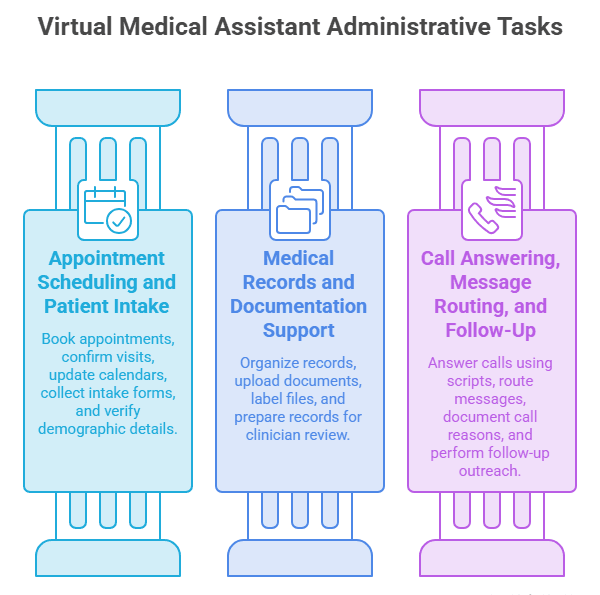
A virtual medical assistant can support many recurring administrative tasks, but delegation must be clear, compliant, and appropriate for the assistant’s training. The safest starting point is non-clinical, repeatable work that has defined instructions, approved templates, clear escalation rules, and secure system access.
1. Appointment Scheduling and Patient Intake
Scheduling is one of the most common virtual medical assistant tasks. A VA can help book appointments, confirm visits, reschedule when needed, send reminders, update calendars, collect intake forms, verify missing demographic details, and route scheduling questions to the right staff member.
Patient intake support may include sending forms, checking whether required fields are complete, confirming insurance details for review, uploading documents, and flagging missing information before the visit. This helps reduce same-day delays and improves patient flow.
The assistant should follow practice-approved scripts and escalation rules. For example, urgent symptoms, medication questions, clinical concerns, and emergency issues should be routed to licensed staff or appropriate emergency instructions according to practice policy.
2. Medical Records and Documentation Support
A virtual medical assistant can help organize medical records, upload documents, label files, check for missing forms, update administrative fields, and prepare records for clinician or office-manager review. They can also help manage records requests according to practice policy and applicable privacy rules.
A medical records virtual assistant is especially useful for practices dealing with high documentation volume. Records support can improve retrieval speed, reduce administrative backlog, and help staff find the information they need more quickly.
However, records work must be handled carefully. Patient data is sensitive, and the assistant should only access the minimum necessary information for assigned tasks. The practice should use secure systems, role-based permissions, and documented workflows for any records-related delegation.
3. Call Answering, Message Routing, and Follow-Up
Call answering and message routing are important because patients often judge a practice by how easy it is to reach someone. A virtual medical assistant can answer calls using approved scripts, collect callback details, route messages, confirm appointments, document call reasons, and escalate urgent concerns.
This does not mean the VA should handle clinical triage unless properly trained, authorized, and supervised under applicable rules. The safer model is administrative routing: identify the reason for the call, document it clearly, and send it to the appropriate team member.
Follow-up support may include reminder calls, missed appointment outreach, post-visit administrative check-ins, referral status updates, or billing-related callbacks. The key is to define what the assistant can say, what they cannot say, and when they must escalate.
Billing, Revenue Cycle, and Insurance Support
Billing and revenue-cycle support are high-value areas for virtual medical assistant services because delayed, incomplete, or disorganized billing workflows can affect cash flow. A virtual assistant can help with administrative pieces of billing, but practices should distinguish billing support from certified coding, payer contracting, and specialized revenue-cycle management.
1. Medical Billing Support Tasks
- A virtual medical assistant may help prepare billing queues, verify patient demographic information, check insurance details, and organize superbills for review.
- They can track claim status, follow up on missing documentation, coordinate with billing specialists, and help keep revenue-cycle information moving.
- A medical VA may also help answer routine billing questions using approved scripts or route complex billing questions to the appropriate team.
- For practices with larger or more complex billing needs, 24/7 medical billing services may be more appropriate than a general medical VA.
- Around-the-clock billing support can help organizations process work across extended hours, especially when claims volume is high.
- The goal is to reduce bottlenecks and ensure billing teams receive complete information faster, which can support cleaner claims and fewer avoidable delays.
2. Virtual Medical Assistant vs. Medical Billing Service
- A virtual medical assistant and a medical billing service are not the same, even though both can support the administrative side of healthcare operations.
- A virtual medical assistant may support billing-adjacent tasks such as collecting missing patient details, organizing documentation, monitoring queues, and routing questions.
- A medical billing service typically specializes in claims submission, coding-related workflows, denial management, payment posting, accounts receivable follow-up, and payer processes.
- The right choice depends on the practice’s main problem and the level of revenue-cycle expertise required.
- If the practice has general admin overload, patient communication issues, and scattered documentation, a virtual medical assistant may help.
- If the practice has claim denials, aging accounts receivable, coding issues, or revenue-cycle complexity, a comparison of virtual medical assistant vs. medical billing service can help determine whether specialized billing support is needed.
3. Insurance Verification and Prior Authorization Support
- Insurance workflows can be time-consuming because staff often need to collect, confirm, document, and track payer-related information.
- A virtual medical assistant may help collect insurance information, check eligibility through approved systems, document payer details, and flag missing information for staff review.
- They may also help prepare prior authorization packets, track status updates, organize required documents, and follow up on pending administrative items.
- Prior authorization support must be handled carefully because clinical information, payer rules, and documentation requirements can be complex.
- The assistant can organize and track the workflow, but licensed or qualified staff should review clinical content and payer-sensitive submissions when required.
- The benefit is coordination: a VA can help prevent insurance tasks from sitting unnoticed in inboxes, spreadsheets, or portals.
EMR, EHR, and Medical Records Workflow Support
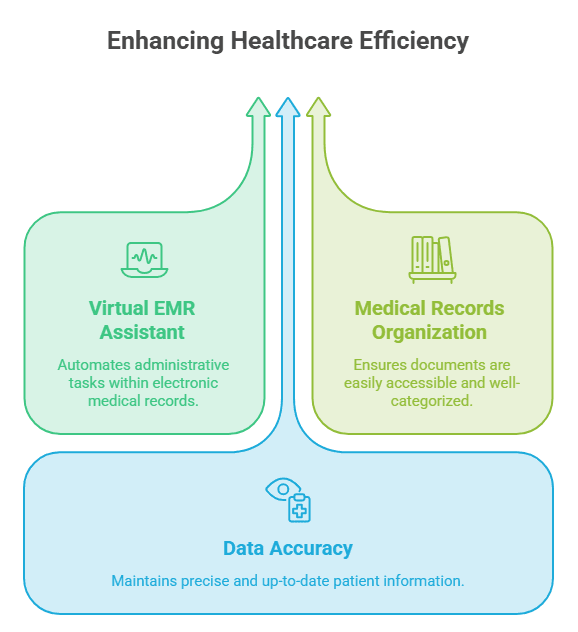
Electronic records are central to modern healthcare operations. A virtual medical assistant can support EMR and EHR workflows by keeping administrative information organized, updating non-clinical fields, preparing charts for review, and helping practices reduce records-related backlog.
1. Virtual EMR Assistant Support
A virtual EMR assistant helps with administrative tasks inside electronic medical record systems. This may include updating demographics, uploading forms, labeling documents, preparing charts, checking missing intake details, organizing referral records, and routing messages.
ONC reported that office-based physician EHR adoption continued to grow through 2024 and described EHR adoption among office-based physicians as broad and nearly ubiquitous. This means most medical practices now rely heavily on digital documentation systems, which creates more need for accurate record management and workflow support.
A virtual EMR assistant can help practices use these systems more consistently, but access should be limited to the assistant’s role. The VA should not edit clinical judgment, alter provider notes, or make decisions that belong to licensed staff.
2. Medical Records Organization
Medical records organization includes making sure documents are uploaded, named, categorized, and easy to retrieve. A VA may help organize lab reports, referral documents, intake forms, insurance cards, consent forms, and patient-submitted files according to practice policy.
Good organization reduces wasted time. If staff cannot find documents quickly, patient visits may be delayed, billing may stall, and clinicians may lack context. A virtual assistant can help create consistent naming conventions and checklist-based workflows.
Records support also helps with continuity. When documentation is organized, the practice is less dependent on one staff member’s memory. This is especially useful when teams are remote, hybrid, or spread across locations.
3. Data Accuracy and Quality Control
Data quality matters because inaccurate records can create downstream problems. Incorrect demographics, missing insurance details, duplicate records, incomplete forms, and outdated contact information can affect scheduling, billing, patient communication, and reporting.
A virtual medical assistant can help run quality-control checks against approved checklists. For example, before a visit, they can confirm whether required forms are complete, insurance information is present, and referral documents have been uploaded.
Quality control should be systematic. The practice should define which fields the VA may update, which fields require review, and which errors must be escalated. Clear rules protect both efficiency and compliance.
Telehealth and Remote Patient Support Workflows
Telehealth has become a normal part of healthcare delivery, even as usage varies by specialty, payer, patient demographics, and practice model. Virtual medical assistants can support telehealth by preparing patients, managing scheduling, organizing documentation, and helping remote workflows feel smoother.
1. Telehealth Appointment Support
- A telehealth VA can help schedule virtual visits, send appointment links, confirm technology requirements, remind patients about forms, and collect missing intake details.
- They can also document administrative issues and route patients who have trouble joining a virtual appointment.
- CDC/NCHS data from the National Health Interview Survey found that in 2021, telemedicine use increased with age, from 17.2% among children under 10 to 45.5% among adults aged 70–79.
- The same CDC/NCHS data showed telemedicine use decreased to 39.3% among adults aged 80 and older, showing that support needs may vary across patient groups.
- This shows that telehealth is relevant across age groups, but patients may need different levels of administrative and technical support.
- A telehealth virtual assistant can help reduce friction before and after virtual appointments so providers spend less time solving administrative or technical issues.
2. Patient Admin for Telehealth Practices
- Telehealth practices often rely heavily on digital intake, online scheduling, patient portals, e-prescribing workflows, insurance verification, and message-based communication.
- A VA can help keep these systems organized by confirming forms, updating records, routing messages, and tracking outstanding patient tasks.
- This support helps telehealth providers avoid delays caused by incomplete forms, missing insurance details, or unclear patient instructions.
- A guide on how telehealth practices use VAs can be useful for practices that want to improve the non-clinical side of virtual care.
- The assistant can support the administrative layer while clinicians remain responsible for medical decisions.
- Telehealth admin also requires clear escalation rules so severe symptoms, medication concerns, or urgent clinical issues are routed according to approved procedures.
3. Remote Patient Monitoring Workflow Support
- Remote patient monitoring creates ongoing administrative work because practices may need to track enrollment, device setup, readings, reminders, reports, and exceptions.
- A VA can help enroll patients administratively, confirm device setup steps, track missing readings, send reminders, and organize reports for review.
- A remote patient monitoring assistant can support the non-clinical coordination around RPM programs.
- This support may improve consistency and reduce the burden on in-office teams managing recurring monitoring workflows.
- RPM workflows must be carefully designed because patient-generated data may require timely review and clear escalation paths.
- A VA should not interpret clinical data or make care decisions unless they are properly licensed and authorized; their role is to support communication, documentation, tracking, and escalation.
Specialized Virtual Medical Assistant Services
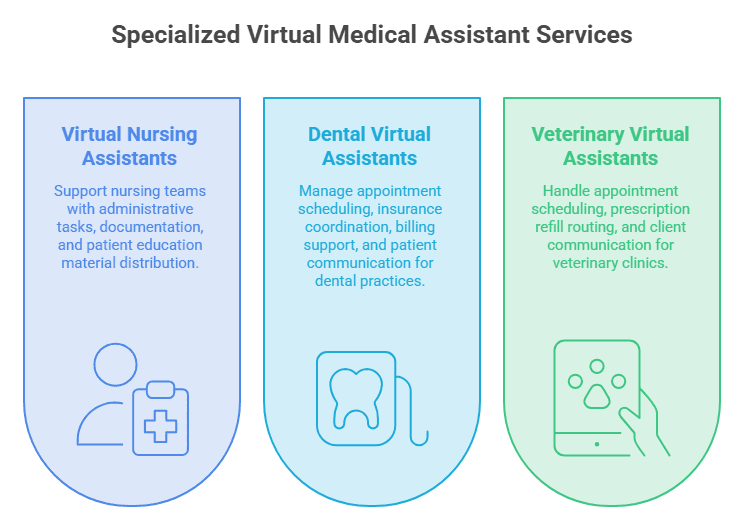
Virtual medical assistant services can be adapted to different healthcare settings. Dental practices, veterinary clinics, telehealth companies, and nursing-adjacent support operations may all use remote assistants, but the scope of work should match the practice type, regulatory environment, and patient or client needs.
1. Virtual Nursing Assistants
Virtual nursing assistants can support nursing teams with administrative and coordination tasks, but the term must be used carefully. A virtual assistant should not represent themselves as a nurse or perform nursing duties unless they hold the proper license and are working within the applicable scope of practice.
In healthcare operations, a virtual nursing assistant may help with care-team messages, appointment follow-up, documentation support, patient education material distribution, and routine administrative coordination. Licensed nurses should remain responsible for clinical judgment, patient assessment, triage, and care planning.
A page on virtual nursing assistants can support this section as long as the content clearly respects licensing boundaries and emphasizes workflow support rather than independent clinical care.
2. Dental Virtual Assistants
Dental practices have their own administrative needs, including appointment scheduling, treatment plan follow-up, insurance coordination, recall reminders, patient communication, billing support, and records organization. A dental VA can help reduce front-desk overload and keep patient communication moving.
A dental virtual assistant may be especially useful for hygiene recall, appointment confirmations, missed appointment follow-up, insurance information collection, and treatment plan reminders.
The assistant should follow the dental practice’s approved scripts and privacy policies. A VA should escalate clinical questions about pain, treatment options, procedures, or complications to the dentist or qualified clinical staff.
3. Veterinary Virtual Assistants
Veterinary practices also face heavy administrative demands. A veterinary VA can support appointment scheduling, client reminders, prescription refill routing, records organization, follow-up messages, billing coordination, and general client communication.
A veterinary virtual assistant can help clinics manage phone volume and administrative backlogs while veterinarians and technicians focus on animal care.
As with human healthcare, role boundaries matter. A veterinary VA should not provide medical advice about diagnosis, treatment, medication, or urgent symptoms unless properly qualified and authorized. They should route clinical concerns to the veterinary team.
HIPAA Compliance, Security, and Privacy

HIPAA compliance is one of the most important considerations when hiring a virtual medical assistant. Any remote assistant who creates, receives, maintains, or transmits protected health information on behalf of a covered entity or business associate must be managed through appropriate agreements, safeguards, training, and access controls.
1. What HIPAA Compliance Means for a Virtual Medical Assistant
- HIPAA compliance for a virtual medical assistant means the practice must control how protected health information is accessed, used, disclosed, stored, and transmitted.
- This usually includes secure systems, role-based permissions, privacy training, confidentiality rules, audit practices, and clear procedures for reporting incidents.
- HHS states that business associate contracts must establish permitted and required uses and disclosures of PHI.
- HHS also states that business associate contracts must require appropriate safeguards, breach reporting, subcontractor protections, and return or destruction of PHI at termination when feasible.
- This is directly relevant when a remote assistant or VA company handles patient information for a healthcare practice.
- A dedicated guide to HIPAA-compliant virtual assistants can help practices understand that compliance requires policies, contracts, safeguards, and ongoing management.
2. Business Associate Agreements and Access Controls
- If a virtual assistant vendor handles PHI for a covered healthcare practice, a Business Associate Agreement may be required.
- HHS guidance explains that a covered entity would be required to enter into a business associate agreement before allowing a software company or similar vendor access to protected health information in covered situations.
- Access controls should follow the minimum necessary principle so the assistant only accesses the systems and information required for assigned tasks.
- Separate user accounts, strong passwords, multi-factor authentication, secure messaging, and role-based permissions are practical safeguards.
- The practice should regularly review access, especially when a VA no longer needs a system or changes responsibilities.
- When a VA leaves or changes roles, access should be removed promptly, shared credentials should be changed, and any files or PHI access should be reviewed.
3. Secure Communication and Data Handling
- Virtual medical assistants should use secure, approved communication channels for patient and practice information.
- Patient details should not be shared through personal email, unsecured messaging apps, or unapproved file-sharing tools.
- The practice should define where patient messages are documented and how sensitive information is routed.
- Data handling rules should cover downloads, screenshots, printing, storage, device use, remote work locations, and incident reporting.
- If the VA works through a vendor, the vendor should also have privacy and security practices that align with the practice’s requirements.
- Security should support workflow, not block it; the goal is to let the VA work efficiently while reducing the risk of unauthorized disclosure, lost information, or inconsistent documentation.
How Much Does a Virtual Medical Assistant Cost?
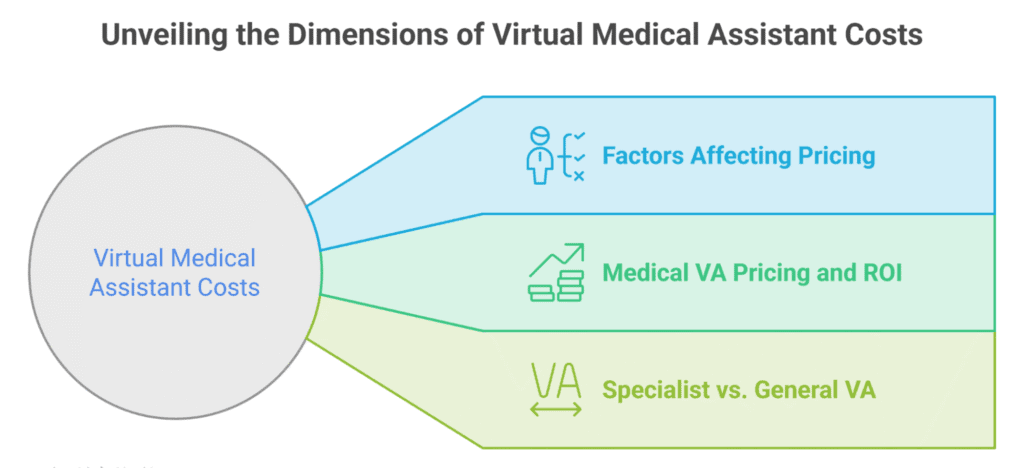
Virtual medical assistant pricing depends on task complexity, experience, hours, provider model, compliance requirements, specialty knowledge, and whether the assistant is independent, agency-managed, domestic, offshore, part-time, or full-time. Practices should evaluate cost based on value, risk, and workflow impact, not hourly rate alone.
1. What Affects Virtual Medical Assistant Pricing?
Pricing is influenced by the assistant’s healthcare experience, knowledge of EMR systems, billing familiarity, call answering skills, telehealth workflow experience, and HIPAA training. A general admin VA may cost less than someone with medical billing, EMR, call center, or records-management experience.
The provider model also matters. A managed medical VA service may include screening, supervision, backup support, replacement assistance, quality checks, and compliance support. An independent assistant may cost less but require the practice to handle more recruitment, training, oversight, and backup planning.
Task sensitivity affects pricing too. Work involving patient communication, PHI access, billing workflows, or complex scheduling often requires stronger training and tighter controls than simple data formatting.
2. Medical VA Pricing and ROI
The ROI of a virtual medical assistant should be evaluated through practical outcomes: fewer missed calls, faster scheduling, cleaner records, reduced admin backlog, better billing support, improved patient communication, and more protected clinician time.
A page on medical VA pricing can help practices compare service models, but pricing should always be tied to scope. A low-cost assistant who needs constant correction may be more expensive than a higher-quality assistant who works accurately and independently.
The practice should also consider opportunity cost. If office staff spend hours on repetitive calls, missing forms, EMR cleanup, or routine follow-ups, they have less time for in-office patient flow and higher-priority work.
3. When to Choose a Specialist Instead of a General VA
A general virtual medical assistant is useful for scheduling, intake, records organization, call routing, and routine admin. However, practices may need a specialist for billing, coding, revenue-cycle management, complex prior authorizations, compliance consulting, or clinical support.
For example, if claim denials and accounts receivable are the main problem, a medical billing service may be better than a general VA. If records are disorganized, a records-focused VA may be appropriate. If the practice runs virtual visits, telehealth admin support may be the priority.
The best model may combine roles. A general medical VA can handle daily admin, while specialists support billing, EMR optimization, or compliance-sensitive workflows.
How to Hire and Onboard a Virtual Medical Assistant

Hiring a virtual medical assistant should start with role clarity, compliance planning, and workflow documentation. A practice should define the tasks, systems, access levels, scripts, escalation rules, schedule, performance standards, and training process before the assistant starts.
1. Define the Role Before Hiring
- The first step is to decide exactly what the virtual medical assistant will do.
- Group tasks into scheduling, call answering, intake, EMR support, records management, billing support, telehealth admin, patient follow-up, or reporting.
- Identify which category creates the biggest bottleneck before trying to delegate every healthcare workflow at once.
- Do not hire one assistant and expect them to handle every healthcare function at an expert level.
- Billing, records, EMR, telehealth, and call support require different skills, even when one assistant is versatile.
- The role definition should include required tools, working hours, patient communication rules, privacy expectations, turnaround times, and escalation policies.
2. Vetting Questions for Medical VAs
- Vetting should test healthcare familiarity, communication skills, accuracy, privacy awareness, and judgment.
- Ask candidates which EMR or practice-management systems they have used and how they handle patient information.
- Ask how they manage unclear instructions, document completed work, and protect patient information while working remotely.
- Useful questions include: “How would you handle a patient asking for medical advice?” and “What would you do if a caller reports urgent symptoms?”
- You can also ask: “How do you manage appointment reminders and no-shows?” and “How do you document call outcomes?”
- A paid test task can be useful, such as organizing a sample schedule, formatting intake data, identifying missing information from a mock patient form, or drafting a non-clinical appointment reminder using an approved script.
3. First 30 Days of Onboarding
- The first 30 days should focus on secure access, training, simple workflows, and quality review.
- Start with low-risk tasks such as appointment confirmations, inbox organization, records labeling, basic scheduling support, and missing-form follow-up.
- Week one should cover practice background, privacy rules, tools, scripts, and communication channels.
- Week two can add recurring workflows, while week three can assign a small process with supervision.
- Week four should review performance and decide the safe expansion of any responsibilities.
- Onboarding should include SOPs, screen recordings, sample scripts, escalation rules, and examples of correct work so the VA becomes consistent before handling complex or sensitive tasks.
Managing Performance and Quality Control
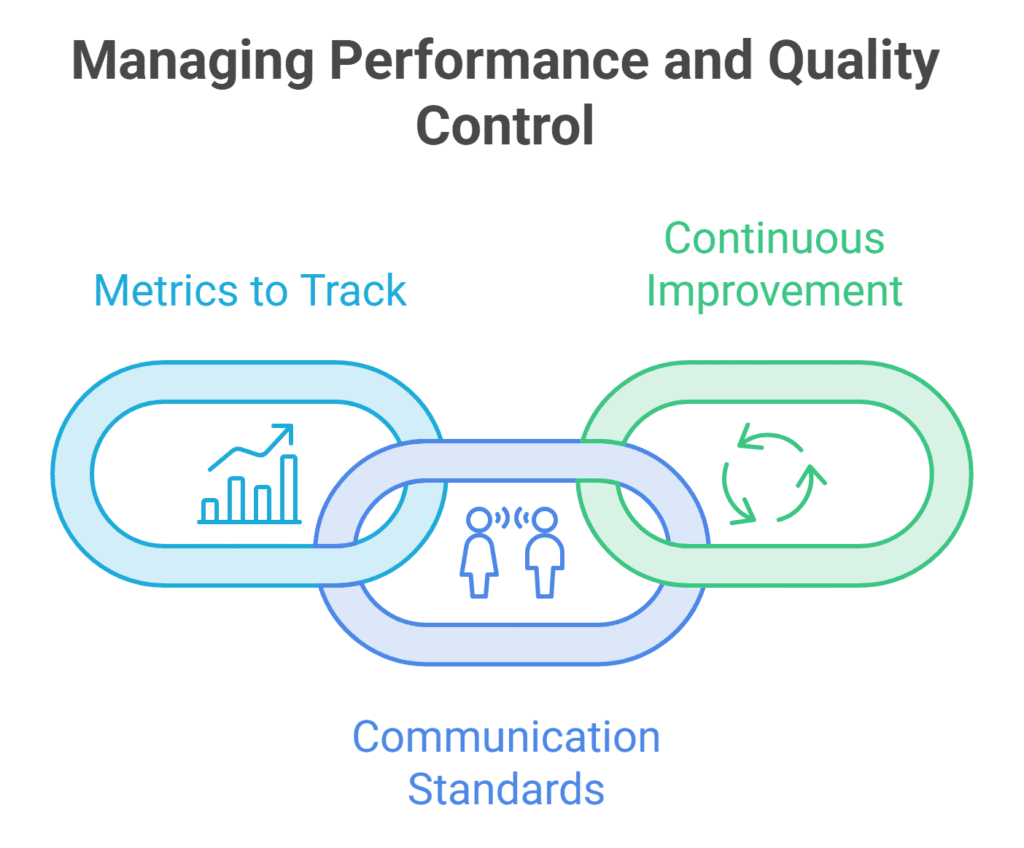
A virtual medical assistant should be managed through clear expectations and measurable outcomes. Healthcare workflows require accuracy, confidentiality, responsiveness, and timely escalation. Performance should be reviewed regularly, especially during the first months.
1. Metrics to Track
Useful metrics include calls answered, missed calls reduced, appointment confirmations completed, intake forms collected, records updated, billing queues organized, response time, task turnaround, error rate, escalation accuracy, and patient communication quality.
For billing-related support, practices may track missing information resolved, claim-prep tasks completed, denial follow-up support, or documentation gaps identified. For telehealth, they may track link confirmations, patient readiness, completed forms, and technical issue routing.
A VA is valuable when the practice becomes more responsive, organized, and efficient.
2. Communication Standards
The virtual assistant should provide regular updates on completed tasks, pending items, blockers, and questions. A daily or end-of-shift summary can help the practice manager see what moved forward and what needs attention.
Communication standards should define response windows, urgent escalation channels, approved scripts, patient-message documentation, and who approves sensitive responses. Clear communication reduces micromanagement and protects patient experience.
A VA should never guess on clinical or compliance-sensitive issues. When in doubt, they should escalate according to policy.
3. Continuous Improvement
A strong VA relationship improves over time. The practice should update SOPs, refine scripts, add examples, and review errors. Feedback should be specific and tied to the desired outcome.
Continuous improvement also protects compliance. As workflows change, a VA must review the access permissions, scripts, and documentation standards. Healthcare operations are not static, so virtual support should evolve with the practice.
The goal is to move from task-by-task delegation to dependable workflow ownership while keeping appropriate supervision in place.

FAQ
1. What does a virtual medical assistant do?
A virtual medical assistant supports healthcare practices with remote administrative tasks such as scheduling, patient intake, call answering, EMR updates, records organization, billing support, telehealth coordination, and follow-up communication.
2. Is a virtual medical assistant HIPAA compliant?
A virtual medical assistant can support HIPAA-compliant workflows if the practice uses proper safeguards, role-based access, secure communication, privacy training, and required agreements such as a Business Associate Agreement when applicable.
3. Can a virtual medical assistant provide clinical advice?
No. A virtual medical assistant should not diagnose, prescribe, interpret symptoms, or provide independent clinical advice unless they have proper licensure and authorization. One should escalate clinical concerns to qualified healthcare staff.
4. What tasks should a medical practice delegate first?
Start with low-risk administrative tasks such as appointment confirmations, patient intake follow-up, call routing, records organization, missing form collection, basic EMR updates, reminder workflows, and routine scheduling support.
5. How much does a virtual medical assistant cost?
Cost depends on experience, specialty knowledge, hours, provider model, compliance requirements, and task complexity. Billing, EMR, telehealth, and records-focused support may cost more than general administrative assistance.
6. What is the difference between a virtual medical assistant and a medical billing service?
A virtual medical assistant supports general admin and workflow tasks, while a medical billing service specializes in claims, coding-related workflows, denials, payment posting, and revenue-cycle management. Some practices need both.
Conclusion: Build a More Efficient Healthcare Support System
A virtual medical assistant can help healthcare practices manage the administrative work that often pulls attention away from patient care. The right assistant can support scheduling, intake, call answering, EMR updates, records organization, billing coordination, telehealth admin, and follow-up workflows while keeping licensed clinicians focused on clinical decisions.
The key is using virtual medical assistant services responsibly. Practices should define the role clearly, protect patient information, follow HIPAA requirements, use secure systems, document workflows, and create escalation rules for clinical or compliance-sensitive issues.
For doctors, dentists, telehealth providers, veterinary clinics, and healthcare administrators, the opportunity is practical: delegate recurring administrative work, reduce bottlenecks, improve patient communication, and build a more scalable support system.
CTA: Ready to explore virtual medical assistant support for your practice? Start by listing your most repetitive administrative tasks, then decide which workflows you can safely delegate with secure access, clear SOPs, and proper compliance controls.
Sources List
- U.S. Bureau of Labor Statistics — Medical Assistants: job outlook, projected growth, and annual openings.
- Centers for Medicare & Medicaid Services — National Health Expenditure Fact Sheet, 2024 U.S. healthcare spending.
- American Medical Association — 2025 physician burnout rate and trend data.
- U.S. Bureau of Labor Statistics — Medical Records Specialists: projected growth and annual openings.
- Office of the National Coordinator for Health Information Technology — office-based physician EHR adoption, 2008–2024.
- CDC / National Center for Health Statistics — telemedicine use by age group from the National Health Interview Survey.
- HHS Office for Civil Rights — HIPAA business associate contract requirements.
- HHS Office for Civil Rights — business associate agreement requirement before vendor access to protected health information in covered situations.
- HHS Office for Civil Rights — business associate direct liability under HIPAA.
 Siddhartha Basu is a Technical Writer at Task Virtual. He loves online games, e-book reading, and Yoga.