
Contents
show
How a Medical Records Virtual Assistant Supports Businesses
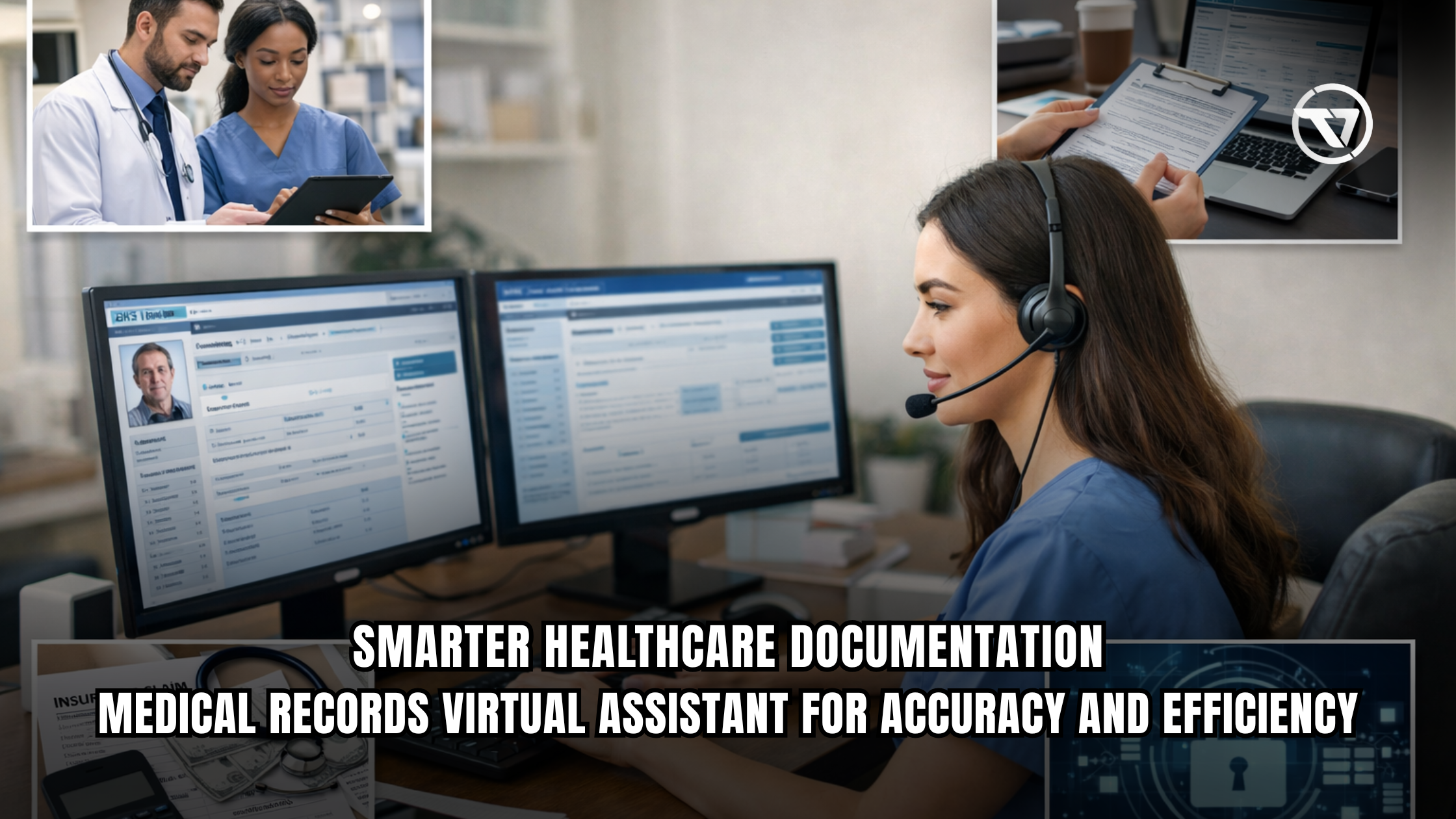
A medical records virtual assistant is a remote professional who manages, organizes, updates, and maintains patient and healthcare documentation digitally. They support clinics, hospitals, and healthcare businesses by handling administrative record-keeping tasks while ensuring compliance, accuracy, and efficiency.
Healthcare providers and related businesses face persistent administrative overload—especially when managing patient records, documentation, and compliance requirements. Studies show that clinicians spend around 35% of their time on documentation tasks, highlighting how resource-intensive record management has become. Maintaining accurate records across systems like EHR/EMR platforms is time-intensive and prone to error when handled manually or in-house with limited staff. This is where a medical records management virtual assistant becomes operationally valuable, allowing organizations to outsource record-handling workflows to trained remote professionals who specialize in healthcare documentation processes.
What This Means for Businesses
Hiring a virtual assistant for medical records allows businesses to delegate repetitive administrative tasks while maintaining accuracy and compliance. This reduces internal workload and helps teams focus on core operations, while keeping documentation organized and consistent.
For:
- Clinics and hospitals can improve patient record organization for better accuracy and access. Moreover, a Medical Records Virtual Assistant streamlines documentation and reduces errors.
- Billing teams can achieve faster claims processing through accurate documentation. Moreover, a virtual assistant for medical documentation helps reduce errors and improve efficiency.
- Startups in healthcare tech can scale backend support efficiently. Moreover, a medical administrative virtual assistant streamlines operations.
- Agencies can benefit from reliable remote administrative support. Moreover, a remote medical records assistant helps streamline tasks and improve efficiency.
A remote medical records assistant integrates into existing workflows without requiring physical infrastructure.
Why Companies Outsource This Task

Businesses outsource medical documentation to address operational inefficiencies and reduce costs, with research indicating that over 60% of healthcare organizations outsource at least some administrative functions to improve efficiency. This approach helps streamline workflows while ensuring consistent and accurate record management.
Key drivers:
- Healthcare providers face rising administrative workloads that impact efficiency. Moreover, a healthcare records virtual assistant helps manage tasks and reduce burden.
- There is a growing need for consistent and accurate patient records. Moreover, a virtual assistant for patient records helps maintain accuracy and organization.
- Healthcare organizations face high costs for in-house administrative staff. Moreover, an affordable medical records virtual assistant helps reduce expenses and improve efficiency.
- Healthcare providers require HIPAA-compliant processes to ensure data security. Moreover, a virtual assistant for EHR records helps maintain compliance and accuracy.
- There is a growing demand for scalable operations in healthcare. Moreover, a dedicated medical records virtual assistant supports flexible and efficient workflows.
A dedicated medical records virtual assistant provides specialized support without long-term hiring commitments.
Tasks Virtual Assistants Perform
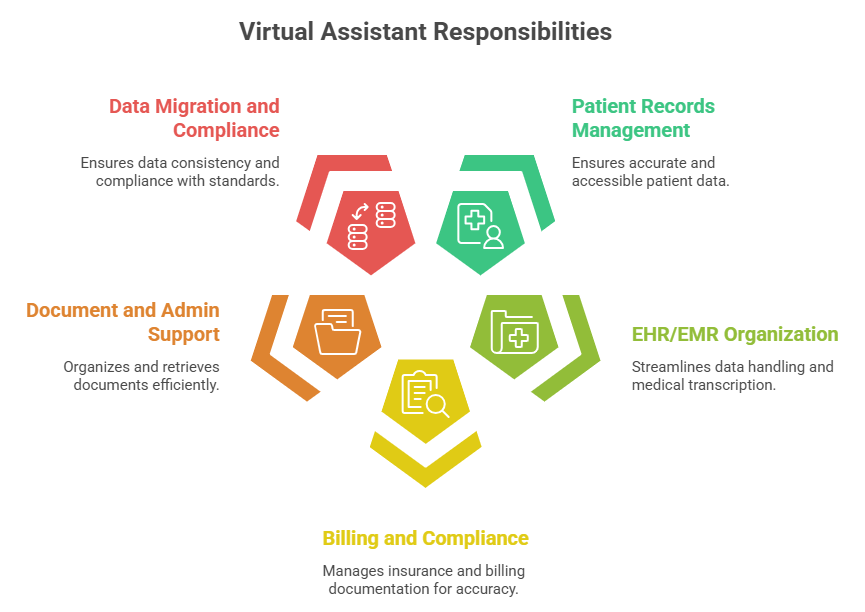
A medical administrative virtual assistant manages various documentation and record-related tasks to support healthcare operations. This ensures patient data is organized, accurate, and consistently maintained across systems.
1. Patient Records Management
Patient data entry and updates ensure accurate records; moreover, a virtual assistant for EMR records supports timely documentation. Managing digital patient records improves accessibility; moreover, a virtual assistant for patient records maintains efficiency.
2. EHR/EMR Organization
EHR/EMR data organization enhances accuracy; moreover, a virtual assistant for EMR records streamlines data handling. Medical transcription support ensures proper documentation; moreover, a virtual assistant for medical documentation reduces errors.
3. Billing and Compliance
Insurance and billing documentation ensure compliance; moreover, a medical records virtual assistant for billing support improves efficiency. Record auditing and error checking ensure accuracy; moreover, a medical records management virtual assistant identifies discrepancies.
4. Document and Admin Support
Uploading and indexing documents improves organization; moreover, a remote medical records assistant streamlines retrieval. Appointment-related documentation ensures updated records; moreover, a medical administrative virtual assistant enhances workflow.
5. Data Migration and Compliance
Data migration ensures consistency; moreover, a virtual assistant for EHR records reduces transfer errors. Compliance-ready records meet standards; moreover, a healthcare records virtual assistant minimizes risks.
Tools Professional Virtual Assistants Use
Professional healthcare records virtual assistants use industry-standard tools to maintain accuracy and ensure compliance, especially as over 85% of healthcare providers have adopted EHR systems to manage patient data digitally. These tools help streamline workflows and support secure, consistent data management.
1. Common Systems
Professional healthcare records virtual assistants use EHR/EMR platforms such as Epic, Cerner, and Athenahealth, along with practice management software and medical billing systems. Moreover, these systems enable efficient patient data handling and support accurate administrative workflows.
2. Supporting Tools
They also rely on secure cloud storage like Google Workspace and OneDrive, along with document management systems and OCR tools for digitizing records. Moreover, task management tools such as Asana and Trello, along with communication platforms like Slack and Zoom, help maintain organized and collaborative workflows.
3. Why Tools Matter
These tools reduce manual errors and enable real-time collaboration across healthcare teams. Moreover, they ensure secure data handling and standardize workflows for consistent performance.
Step-by-Step Workflow Used by Virtual Assistants
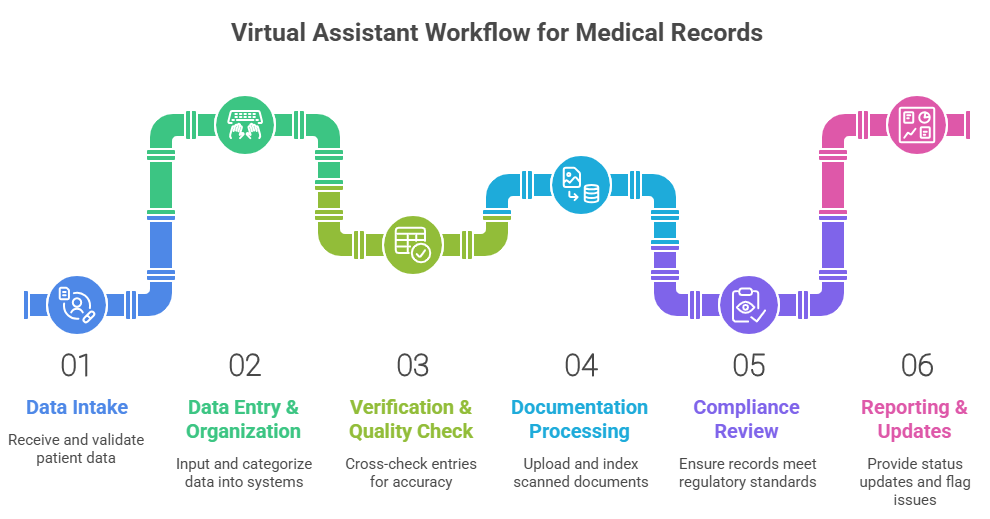
1. Data Intake
Virtual assistants receive patient data from clinics or systems and ensure all required information is collected. Moreover, they validate the completeness of records to prevent gaps in documentation.
2. Data Entry & Organization
They input data into EHR/EMR systems and ensure proper structuring of patient information. Moreover, records are categorized correctly to maintain consistency and easy retrieval.
3. Verification & Quality Check
Entries are cross-checked to ensure the accuracy and reliability of patient data. Moreover, missing or inconsistent information is identified and flagged for correction.
4. Documentation Processing
Scanned files are uploaded into the system for centralized access. Moreover, documents are tagged and indexed to improve organization and searchability.
5. Compliance Review
Records are reviewed to ensure they meet regulatory and compliance standards. Moreover, documentation is maintained in an audit-ready format for accountability.
6. Reporting & Updates
Regular status updates are provided to keep clients informed about progress. Moreover, any issues requiring attention are flagged promptly to ensure timely resolution.
Common Challenges Businesses Face

Before outsourcing, businesses often face challenges in managing medical documentation efficiently. These issues can lead to errors, delays, and compliance risks. As workloads increase, maintaining accuracy and consistency becomes difficult.
- Inconsistent data entry practices can lead to errors in patient records. Moreover, this reduces accuracy and reliability.
- Backlogs in patient documentation can delay record updates. Moreover, this affects workflow efficiency and accuracy.
- Difficulty managing multiple systems can lead to inefficiencies. Moreover, this increases the risk of errors.
- Compliance risks due to incomplete records can lead to regulatory issues. Moreover, this increases the likelihood of errors and penalties.
- High turnover in administrative staff can disrupt workflow continuity. Moreover, this leads to inconsistencies and reduced efficiency.
- Limited scalability during peak periods can strain operations. Moreover, this reduces efficiency and delays workflows.
Benefits of Outsourcing to Virtual Assistants
| Benefit | In-House Staff | Virtual Assistant |
|---|---|---|
| Cost | High (salary + benefits) | Lower, flexible pricing |
| Scalability | Limited | Easily scalable |
| Availability | Fixed hours | Extended/24-7 options |
| Training Time | High | Pre-trained professionals |
| Infrastructure | Required | Not required |
| Turnaround Time | Moderate | Faster with dedicated support |
Key Advantages
- Access to trained professionals ensures accurate and reliable workflows. Moreover, this improves efficiency and consistency.
- Reduced operational overhead lowers overall costs. Moreover, this improves efficiency and resource allocation.
- Faster processing times improve workflow efficiency. Moreover, this ensures quicker task completion.
- Improved data accuracy ensures reliable records. Moreover, this reduces errors and inconsistencies.
- Flexibility in workload management allows better resource allocation. Moreover, this improves efficiency during varying demand.
How a Virtual Assistant Company Helps Businesses

A professional virtual assistant provider offers more than just assigning a remote worker. They bring structured processes, trained talent, and ongoing support to ensure efficiency. This results in consistent, reliable, and compliant operations.
1. Structured Onboarding
The provider understands client workflows and maps tasks to virtual assistant responsibilities. Moreover, compliance requirements are clearly defined to ensure accurate and secure operations.
2. Talent Matching
They assign a US-based medical records virtual assistant if required and align expertise with specific industry needs. Moreover, this ensures the right skills are matched to the business requirements.
3. Process Standardization
Standard Operating Procedures (SOPs) are created to guide workflows and task execution. Moreover, this ensures consistency and reliability across all operations.
4. Performance Monitoring
Accuracy and turnaround time are continuously tracked to maintain service quality. Moreover, reporting and accountability measures ensure transparency and performance improvement.
5. Security & Compliance
Secure data handling protocols are implemented to protect sensitive information. Moreover, HIPAA-aligned workflows ensure compliance with industry regulations.
TaskVirtual: Your Partner in Medical Records Virtual Assistant Services
Managing patient records, maintaining compliance, and handling large volumes of healthcare documentation can quickly overwhelm internal teams. From organizing EHR/EMR data to ensuring accurate billing documentation, these processes demand precision and consistency. TaskVirtual supports healthcare businesses by delivering structured and reliable medical records virtual assistant services, enabling organizations to streamline documentation workflows without expanding in-house staff.
1. Expert Consultation and Workflow Alignment
TaskVirtual’s trained virtual assistants understand healthcare documentation requirements and assist in setting up efficient record management workflows. They help standardize data entry processes, organize patient records, and ensure compatibility with existing EHR/EMR systems.
2. Affordable and Flexible Pricing
Hiring in-house administrative staff for medical records management can be costly. TaskVirtual offers a cost-effective alternative, with pricing plans starting from just $3.12/hour to $14.99/hour, making it accessible for clinics, healthcare startups, and agencies seeking scalable support.
3. Comprehensive Medical Records Support
TaskVirtual covers the full spectrum of documentation needs, including patient data entry, record organization, billing documentation support, and data migration. Whether you need a virtual assistant for hospital records or ongoing support for clinics, services are adaptable to different operational requirements.
4. Ongoing Support and Quality Assurance
Consistency is critical in healthcare documentation. TaskVirtual provides continuous monitoring, regular updates, and quality checks to ensure records remain accurate, compliant, and audit-ready. Their assistants proactively flag discrepancies and maintain structured reporting.
5. Proven Track Record of Excellence
With 364 positive reviews and a 4.7-star rating on trusted VA platforms, TaskVirtual has established itself as a dependable partner for businesses worldwide. Clients rely on their expertise to maintain accurate medical records and improve administrative efficiency.
Conclusion
Managing healthcare documentation is operationally critical but resource-intensive. A medical records virtual assistant offers a practical solution by handling data entry, organization, and compliance tasks remotely. For businesses evaluating outsourcing, the key advantage lies in combining cost efficiency with process reliability. Whether you need a virtual assistant for EMR records, billing support, or patient documentation, outsourcing enables scalable and structured operations without expanding internal teams.
Managing medical records is one of many administrative responsibilities that can be handled remotely. Explore how virtual medical assistants support healthcare practices with essential administrative and operational tasks.
Key Takeaways
- Medical records virtual assistants handle documentation, compliance, and data management remotely
- Outsourcing reduces costs while improving accuracy and efficiency
- Virtual assistants use EHR/EMR systems and structured workflows
- Businesses benefit from scalability and faster turnaround times
- Professional VA companies provide trained, compliant, and managed support
FAQ Section
1. What does a medical records virtual assistant do?
They manage patient records, handle data entry, organize documentation, and support compliance using healthcare systems.
2. Is it secure to outsource medical records tasks?
Yes, when working with trained professionals who follow HIPAA-compliant processes and secure systems.
3. How much does a medical records virtual assistant cost?
Costs vary based on experience and location, but outsourcing is generally more affordable than hiring full-time staff.
4. Can virtual assistants work with EHR/EMR systems?
Yes, experienced assistants are trained in platforms like Epic, Cerner, and Athenahealth.
5. Do I need a US-based medical records virtual assistant?
Not always. However, US-based assistants may be preferred for regulatory familiarity and time zone alignment.
 Siddhartha Basu is a Technical Writer at Task Virtual. He loves online games, e-book reading, and Yoga.