

Contents
show
Customer Support Outsourcing for Growing Businesses: When to Start, What to Delegate
Growing American businesses face a familiar pressure point: customer inquiries climb while internal bandwidth stays flat. Founders and small teams often handle support themselves until response times stretch, quality dips, and core work suffers. Customer support outsourcing for small businesses has become a practical lever—not just for cost control, but for reclaiming focus and delivering consistent experiences as volume scales. The pressure is becoming more pronounced: 70% of executives say customer expectations are evolving faster than their companies can adapt, according to PwC’s 2025 Customer Experience Survey. In 2026, with rising expectations for faster, seamless omnichannel service alongside ongoing labour market pressures, the decision to outsource is increasingly about timing, scope, and measurement rather than simply whether to do it.
This guide gives small teams a clear decision framework that prioritises customer experience while addressing capacity and quality triggers. Many growing companies already rely on specialised external help for other operational areas, so extending that approach to support creates natural synergies without overloading internal resources. By treating support as a scalable function rather than an afterthought, businesses can maintain service standards even as inquiry volumes fluctuate with marketing campaigns, seasonal demand, or product launches—ultimately protecting both team capacity and long-term customer loyalty.
Capacity and Quality Triggers for Outsourcing
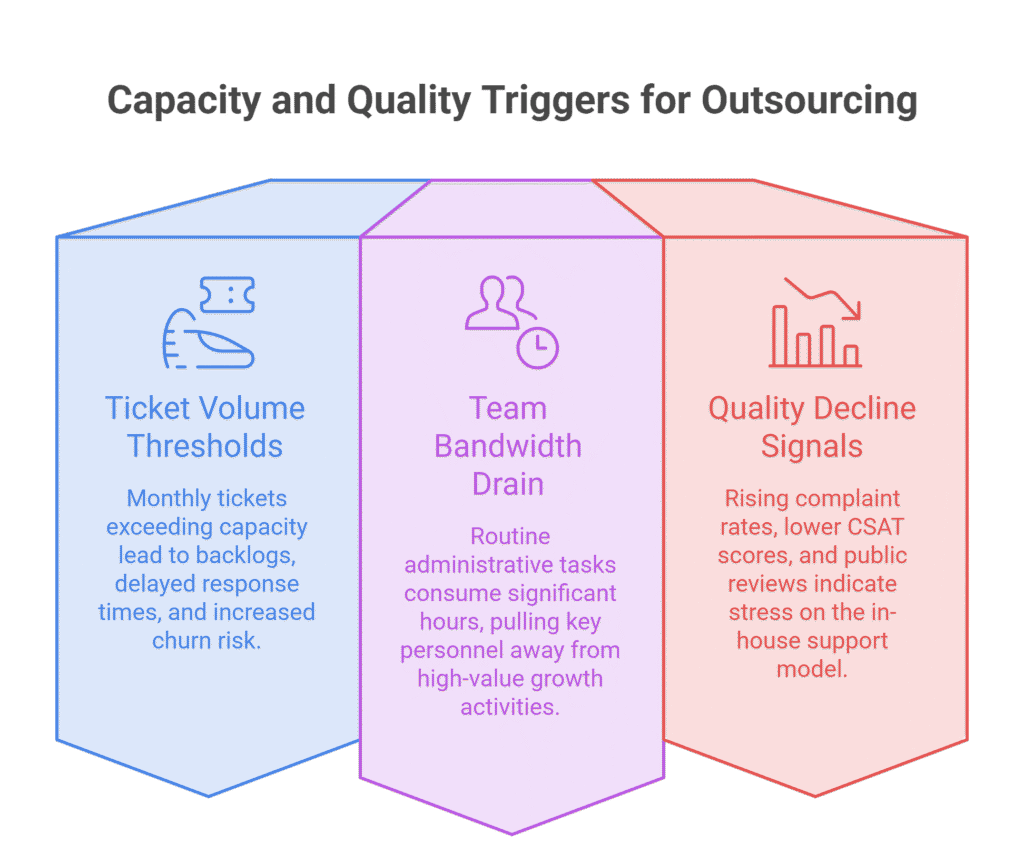
Knowing when to outsource starts with measurable signals rather than vague feelings of overwhelm. Growing teams often reach this decision point when internal resources can no longer keep pace with rising ticket volumes without sacrificing response quality or diverting focus from core business activities. Recognising these early indicators allows leaders to act before customer satisfaction declines or employee burnout sets in, creating a smoother transition to external support while preserving the brand experience customers expect.
1. Ticket Volume and Response Time Thresholds
When monthly tickets consistently exceed what one or two people can handle without backlog, the tipping point arrives. Many small teams notice trouble around several hundred interactions per month, especially if first-response times stretch beyond a few hours on email or longer on other channels. Customers increasingly expect quick replies; delays compound frustration and raise churn risk. Track average first-response time weekly. If it regularly exceeds industry norms for your channels and volume keeps rising, capacity is constrained. Seasonal spikes or product launches can accelerate this pressure. A dedicated Virtual Assistant can absorb overflow during these peaks while internal staff stay focused.
2. Founder and Team Bandwidth Drain
Routine operational work can consume a significant share of a business owner’s week. A survey of 251 U.S. entrepreneurs found that 36% of an average 45.5-hour workweek was spent on administrative tasks, equivalent to more than 16 hours per week. When customer support and other repetitive responsibilities regularly pull key people away from higher-value work, the opportunity cost can affect product development, sales, and operations. Outsourcing becomes a capacity solution when this workload leads to delayed replies, inconsistent service, or reduced focus on growth. Monitor internal time logs or simple self-tracking for a few weeks to quantify the drain. Pairing this with a reliable Personal Assistant for scheduling and follow-ups further protects leadership time.
3. Quality Decline and Customer Feedback Signals
Rising complaint rates, lower CSAT scores, or public reviews mentioning slow or incomplete answers signal quality strain. According to research cited across industry reports, poor customer service has historically cost U.S. companies tens of billions annually in lost revenue. When internal quality assurance reviews show frequent errors or when escalation volume climbs, the in-house model is under stress. Early intervention prevents longer-term brand damage. Companies that already invest in Digital Marketing often notice support quality issues surface first in customer feedback channels.
Tier 1 vs. Escalation Work: What to Delegate
Not every support interaction belongs with an external team. Clear boundaries protect specialised knowledge and complex problem-solving. Defining these lines carefully ensures that routine volume is handled efficiently while sensitive or technical matters stay with people who have deeper product expertise and direct access to internal systems. This approach reduces risk, maintains consistency, and allows outsourced partners to focus on the work they do best.
1. Defining Tier 1 Routine Inquiries
- Tier 1 covers high-volume, low-complexity work such as order status checks, shipping updates, password resets, basic product questions, returns initiation, and FAQ-driven issues.
- These inquiries follow scripts or knowledge-base articles and typically resolve quickly without needing deep system access.
- Outsourcing this layer frees internal staff while giving customers faster answers across email, chat, and sometimes phone or social channels.
- Teams running Facebook Marketing & Ads campaigns frequently see a surge in related Tier 1 questions that benefit from external coverage.
2. Escalation Paths and Complex Cases
- Keep Tier 2 and higher issues in-house or with specialised partners, including technical troubleshooting, billing disputes that require account access, product defects needing engineering input, and sensitive complaints.
- Define clear handoff rules using specific keywords, customer sentiment signals, or issue categories that automatically route to internal specialists.
- Document the escalation criteria thoroughly so outsourced agents know exactly when and how to transfer without frustrating the customer.
- Businesses active in Instagram Marketing & Ads often escalate creative or campaign-related issues that require deeper brand knowledge.
3. Hybrid Models for Growing Teams
- Many successful small businesses run hybrid setups where outsourced agents manage Tier 1 during extended hours or peaks while internal staff handle escalations and relationship-heavy accounts.
- This model balances cost, control, and expertise effectively for most growing companies.
- Start by mapping current ticket categories and calculating what percentage is truly routine to size the outsourced portion accurately.
- Parallel efforts in LinkedIn Marketing & Ads can generate professional inquiries that fit neatly into hybrid routing.
Support Workflow and Knowledge Base Setup
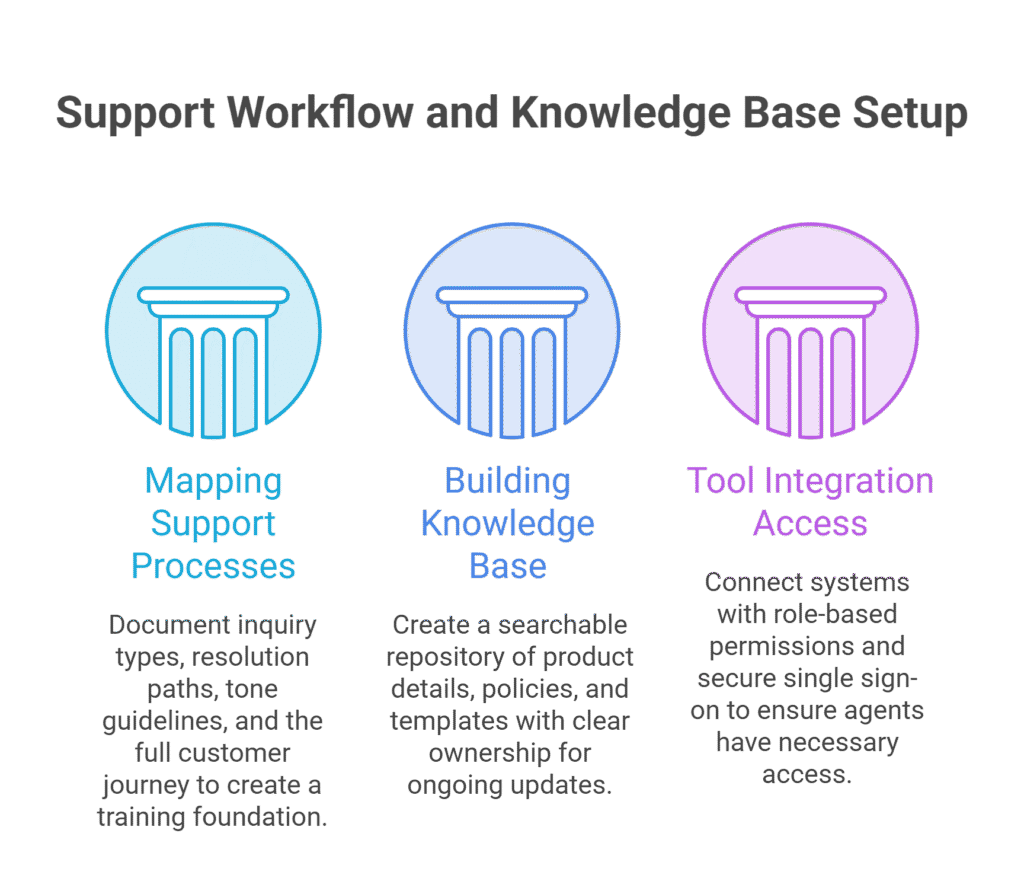
Successful outsourcing depends on preparation. A messy handoff creates more problems than it solves. Before transferring any volume to an external team, businesses must document processes, organise information, and establish secure tool access so agents can resolve issues accurately and consistently from day one. Investing time in these foundations reduces training friction, lowers error rates, and helps maintain brand voice across every interaction.
1. Mapping Current Support Processes
-
Document common customer inquiry types and map the steps agents should follow to resolve them, including required tools, routing rules, decision points, and escalation paths.
-
Establish clear communication guidelines covering tone, brand voice, response style, approved language, and topics or wording agents should avoid.
-
Map the customer journey from the initial inquiry through routing, resolution, escalation, and follow-up so outsourced agents have a consistent framework to follow.
-
Turn these documented workflows into practical onboarding and training resources. When processes are complex, external Video Editing Services can also help transform walkthroughs, demonstrations, and support procedures into reusable training videos.
2. Building and Maintaining a Living Knowledge Base
- Build a strong, searchable knowledge base that includes product details, policy documents, troubleshooting trees, response templates, and helpful screenshots or videos.
- Structure the content so agents can find accurate answers in under a minute during live interactions.
- Assign clear ownership for updates so product changes, policy shifts, or new FAQs flow into the base quickly.
- Consistent documentation supports broader online Marketing Services by ensuring messaging alignment across all customer touchpoints.
3. Tool Integration and Access Controls
- Connect your helpdesk, CRM, order management system, and any relevant platforms with proper role-based permissions.
- Give outsourced agents only the read or limited-write access needed to resolve tickets without exposing unnecessary sensitive data.
- Set up secure single sign-on and test all integrations thoroughly during onboarding to avoid workarounds.
- Strong integration practices also benefit teams managing Social Media Marketing across multiple platforms.
Key Support KPIs: Response, Resolution, CSAT, and QA

Measurement turns outsourcing from a cost experiment into a managed performance system. Focus on a balanced set of support KPIs that cover speed, effectiveness, customer perception, and process quality. Tracking these metrics consistently against both pre-outsourcing baselines and contractual SLAs provides objective evidence of success or the need for adjustments, ensuring the partnership delivers real value rather than simply shifting work off the internal team’s plate.
1. First Response Time and Resolution Metrics
First response time (FRT) measures speed to the initial meaningful reply. Benchmarks vary by channel: chat often targets under a minute, email under a few hours for strong performers. Average resolution time tracks end-to-end closure. First contact resolution (FCR)—the share of issues solved without follow-up—averages around 70% across industries, with world-class performance higher. Track these weekly and compare against your pre-outsourcing baseline. Reliable metrics help teams that also use SEO Services evaluate the full customer journey from search to resolution.
2. Customer Satisfaction and Effort Scores
CSAT surveys after interactions remain the most direct quality signal. Aim for consistent scores in the mid-to-high 80s or better depending on your sector. Pair with Customer Effort Score where relevant to understand friction. According to multiple industry analyses, a substantial share of companies that outsource report improved CSAT when processes and training are solid. Monitor trends rather than single data points and dig into low scores promptly. High CSAT often correlates with smoother Website Design Services experiences that reduce support volume upstream.
3. Quality Assurance and Process Adherence
Implement structured QA scoring: accuracy, tone, completeness, policy adherence, and soft skills. Sample a set percentage of tickets or calls regularly—both randomly and by agent. Share feedback loops with the provider so coaching happens in near real time. Track reopen rates and escalation rates as leading indicators of quality gaps. Regular joint reviews of QA results keep standards aligned. Thorough QA processes complement Website Development projects by ensuring post-launch support quality matches the site’s polish.
Building a Pilot Plan and Spotting Red Flags
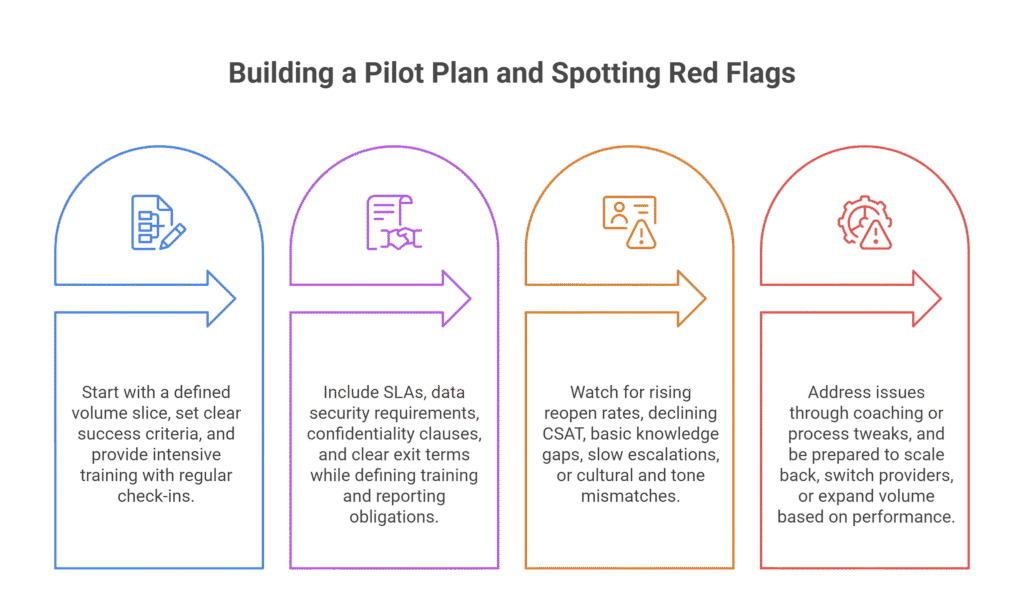
A controlled pilot reduces risk and builds confidence before full commitment. Rather than handing over large volumes immediately, most growing businesses benefit from a limited, time-bound test that validates performance, surfaces process gaps, and allows both sides to refine workflows. Clear success criteria, regular check-ins, and predefined exit conditions turn the pilot into a low-risk learning period that informs whether and how to scale the partnership.
1. Designing a Structured Pilot
- Start with a defined volume slice—perhaps 20–40% of Tier 1 tickets or specific channels during certain hours.
- Set clear success criteria in advance: target FRT, CSAT floor, resolution rates, and cost per ticket.
- Provide intensive training and shadow periods, then schedule weekly check-ins and a formal midpoint review.
2. Contract Essentials and Partnership Safeguards
- Include SLAs tied to the KPIs above, data security requirements, confidentiality clauses, and clear exit terms.
- Define training obligations, knowledge-base access, and reporting cadence.
- Prefer partners experienced with small or growing businesses who offer flexible scaling rather than rigid enterprise minimums. Nearshore options can ease time-zone and cultural alignment for U.S. audiences while still delivering cost advantages. Many providers also offer Virtual Receptionist coverage that pairs well with support pilots.
3. Identifying and Addressing Red Flags
- Watch for rising reopen rates, declining CSAT, agents repeatedly asking basic questions that the knowledge base should answer, or slow escalation handling.
- Cultural or tone mismatches that surface in customer feedback also warrant attention.
- Address issues early through coaching, additional training, or process tweaks. If metrics fail to improve after reasonable adjustments, be prepared to scale back or switch providers. Conversely, strong performance justifies expanding volume or hours. Coordinating with existing IT Support Services ensures technical escalations remain seamless. Effective pilots often incorporate secure Data Handling protocols from day one.
Additional Considerations for U.S. Small Businesses
Cost remains a major driver. Fully loaded U.S. customer service representative costs often range from the mid-$40,000s in base median pay (per Bureau of Labor Statistics data) into the $60,000–$80,000 range once benefits, training, tools, management time, and turnover are included. Outsourcing commonly delivers 40–60% savings on comparable Tier 1 volume depending on location and model, while converting fixed headcount costs into more variable ones. The global outsourced customer care market reached approximately $77 billion in 2024 and continues growing, reflecting broad adoption.
Cultural fit and brand voice matter for American customers. Nearshore partners in Latin America or specialized U.S.-facing teams often provide stronger alignment than pure offshore options for certain brands. Combine outsourcing with AI tools for deflection of the simplest queries to further improve economics and speed. Always retain ownership of the customer relationship and final accountability for experience quality. Businesses already using Bookkeeping Services find that support outsourcing follows a similar scalable model for non-core functions.
TaskVirtual: Your Partner in Customer Support Outsourcing

As growing businesses reach capacity limits with rising ticket volumes, response-time pressure, and the need to protect internal focus, finding a reliable partner for Tier 1 support becomes essential. For companies already exploring outsourced business operations, customer support is a natural function to delegate because routine inquiries can be handled externally while internal teams retain control of complex issues and strategic priorities. TaskVirtual delivers flexible virtual assistance that helps small teams manage these day-to-day customer inquiries, maintain consistent service quality, and scale coverage without the overhead of full-time hires. Their approach aligns directly with the decision framework of knowing when to start, what to delegate, and how to measure results.
1. Tailored Support Capacity Planning
TaskVirtual’s experienced virtual assistants help evaluate ticket patterns, identify high-volume Tier 1 workloads, and design coverage that matches your business hours and peak periods. They assist with knowledge-base organisation and escalation handoff rules so routine questions are resolved efficiently while complex cases stay with your internal team.
2. Affordable and Flexible Pricing
Hiring a full-time support agent can be expensive, but TaskVirtual makes it cost-effective. With pricing plans starting from just $3.12/hour to $14.99/hour, their services are budget-friendly and accessible to individuals, families, and businesses.
3. End-to-End Tier 1 Handling Solutions
From order-status updates and shipping questions to basic product inquiries and returns initiation, TaskVirtual covers the everyday interactions that consume the most time. Their scalable model adapts whether you need part-time overflow support, extended-hour coverage, or a full pilot program that tests performance against your key metrics.
4. Continuous Quality Monitoring and Coaching
TaskVirtual provides ongoing updates, regular performance reviews, and proactive adjustments. Their quality-focused approach helps maintain first-response targets, resolution rates, and CSAT scores while giving your team clear visibility into results throughout any pilot or ongoing engagement.
5. Proven Track Record of Excellence
With 364 positive reviews and a 4.7-star rating on trusted VA platforms, TaskVirtual is recognised as a reliable partner worldwide. Clients count on their expertise to simplify customer support operations and free internal resources for higher-value work.
FAQ
1. When should a small business start outsourcing customer support?
Start when ticket volume creates consistent backlogs, response times degrade, or internal time spent on support crowds out higher-value work. Capacity and quality metrics provide clearer signals than revenue size alone.
2. What types of support work should be outsourced first?
Begin with high-volume Tier 1 inquiries that follow clear scripts or knowledge-base answers. Keep complex, technical, or relationship-sensitive cases internal initially.
3. How do you measure the quality of outsourced customer support?
Track first response time, resolution time, first contact resolution, CSAT, reopen rates, and structured quality assurance scores. Compare against your pre-outsourcing baseline and agreed SLAs.
4. What are typical cost savings from outsourcing support?
Many businesses achieve 40–60% lower costs on Tier 1 volume versus fully loaded U.S. in-house agents, though exact figures depend on location, volume, channels, and contract terms.
5. How long should a pilot program last?
A 30- to 90-day pilot with defined volume, success metrics, and regular reviews allows meaningful data collection without long-term risk.
6. What are the biggest risks and how can they be mitigated?
Risks include quality inconsistency, knowledge gaps, and cultural mismatches. Mitigate with thorough documentation, strong knowledge bases, clear escalation paths, robust QA, and a limited pilot before scaling.
Conclusion and Call to Action
Customer support outsourcing for small business works best as a deliberate extension of your team rather than a pure cost cut. By watching capacity and quality triggers, carefully scoping Tier 1 versus escalation work, investing in workflow and knowledge base readiness, measuring the right support KPIs, and running a disciplined pilot, growing U.S. companies can scale service without sacrificing experience. The goal is sustainable coverage that frees internal talent while customers still feel heard and helped.
If your current support load is stretching the team or response quality is slipping, map your ticket categories and baseline metrics this week. Use that data to evaluate whether a controlled outsourcing pilot makes sense for your stage of growth. Strong partners and clear measurement turn outsourcing into a competitive advantage rather than a gamble.
Sources
- U.S. Bureau of Labor Statistics, Occupational Outlook Handbook: Customer Service Representatives (median pay data)
- Grand View Research/industry reports on outsourced customer care services market size ($77.12B in 2024)
- McKinsey customer care surveys (outsourcing adoption rates)
- Industry analyses citing NewVoiceMedia on the annual cost of poor customer service to U.S. companies
- American Customer Satisfaction Index (ACSI) national scores
- Various benchmarking sources on first contact resolution averages and CSAT improvements post-outsourcing (including reports summarising 62% of companies seeing CSAT gains)
- Clutch and related small business outsourcing surveys on adoption rates among SMEs
For more such content, visit our website.
 Siddhartha Basu is a Technical Writer at Task Virtual. He loves online games, e-book reading, and Yoga.