Contents
show
HIPAA-Compliant Virtual Assistants: What Compliance Means For Your Practice
Healthcare practices face mounting administrative burdens amid staffing shortages, rising costs, and escalating cybersecurity threats. Virtual assistants (VAs) offer a powerful solution for tasks like scheduling, billing, insurance verification, and patient communication—freeing clinicians to focus on care. However, when these assistants access Protected Health Information (PHI), HIPAA-compliant virtual assistants become essential, not optional.
HIPAA (Health Insurance Portability and Accountability Act of 1996) establishes national standards for safeguarding PHI through the Privacy Rule, Security Rule, and Breach Notification Rule. Non-compliance risks severe fines, reputational damage, and loss of patient trust. With healthcare data breaches averaging high costs and frequent occurrences, understanding true HIPAA compliance for virtual assistants is critical for practices of all sizes.
This guide explores what compliance entails, implementation strategies, benefits, challenges, and actionable steps. By prioritizing robust safeguards like Business Associate Agreements (BAAs), training, encryption, and audits, practices can leverage virtual support securely while enhancing operations.
Understanding HIPAA Compliance for Virtual Assistants
HIPAA compliance forms the foundation for safely integrating virtual assistants into healthcare workflows. It ensures that remote professionals handling sensitive patient data adhere to federal standards designed to protect privacy and security. Practices that invest in proper compliance not only avoid penalties but also build stronger patient relationships through demonstrated trustworthiness.
1. What HIPAA Requires from Virtual Assistants
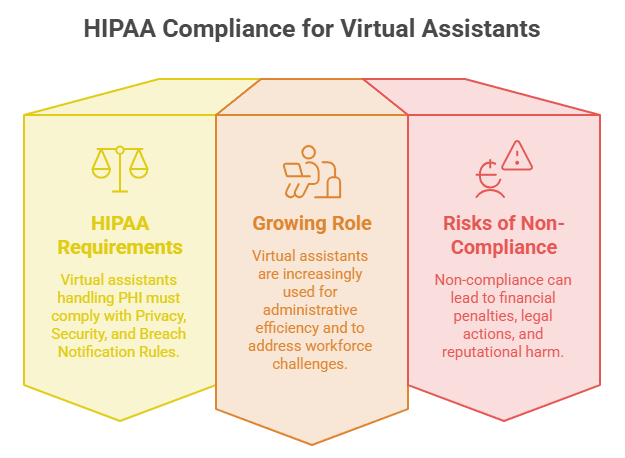
HIPAA applies to any entity (Covered Entity or Business Associate) that creates, receives, maintains, or transmits PHI. Virtual assistants handling scheduling, EHR updates, billing, or patient intake qualify as Business Associates, requiring a signed BAA that outlines responsibilities for privacy, security, and breach reporting. Key components include the Privacy Rule limiting uses and disclosures of PHI to the minimum necessary standard, the Security Rule mandating administrative, physical, and technical safeguards for electronic PHI, and the Breach Notification Rule requiring timely notifications.
Compliance is ongoing with regular risk assessments, policies, training, and monitoring being mandatory. HIPAA-ready tools or basic certifications alone do not suffice without proper contracts, configuration, and oversight from the practice and provider. This comprehensive approach helps mitigate risks associated with remote access to sensitive health information.
2. The Growing Role of Virtual Assistants in Healthcare
Practices increasingly adopt remote support to address workforce challenges. According to industry insights, a significant portion of healthcare providers use or consider virtual solutions for administrative efficiency. This trend aligns with broader remote staffing adoption, helping reduce overhead while maintaining service levels.
Virtual assistants handle diverse tasks securely when compliant, including patient scheduling and reminders, insurance verification and prior authorizations, medical billing and claims follow-up, EHR documentation support, and secure patient communications. These responsibilities allow practices to streamline operations without compromising care quality or data protection. The flexibility of virtual support also enables scaling during peak periods or expansions, making it a practical solution for modern healthcare demands.
3. Risks of Non-Compliance in Remote Settings
Remote work introduces unique vulnerabilities such as unsecured home networks, personal devices, or inconsistent protocols. Human error remains a leading breach cause. In 2025, OCR resolved multiple enforcement actions with substantial penalties, underscoring shared liability for Covered Entities even when breaches originate with vendors.
These risks can lead to significant financial penalties, legal actions, and long-term reputational harm that affects patient retention. Practices may also face operational disruptions during investigations or corrective action periods. Proactive compliance measures are therefore essential to safeguard both patient data and the practice’s viability in a high-stakes regulatory environment.
Key Requirements for True HIPAA Compliance

Achieving HIPAA compliance with virtual assistants demands a multi-layered approach beyond surface-level claims. As hacking/IT incidents accounted for 78% of November 2025 healthcare breaches, providers and practices must collaborate on administrative, physical, and technical controls, ensuring adherence to evolving regulations while supporting remote workflows.
1. Signing and Enforcing Business Associate Agreements (BAAs)
- Execute a comprehensive BAA before granting any PHI access, with obligations extending to subcontractors.
- Detail permitted PHI uses, required safeguards, breach reporting timelines, and termination rights.
- Verify the provider assumes full organizational liability and compliance responsibility.
2. Administrative, Physical, and Technical Safeguards
- Administrative: Implement training, policies, risk analysis, sanctions, and role-based least privilege access.
- Physical: Enforce private workspaces, device controls, clean-desk policies, and secure disposal.
- Technical: Require encryption, MFA, VPN access, audit logging, and endpoint protection.
3. Ongoing Training and Monitoring
- Deliver initial and annual HIPAA training with role-specific refreshers and phishing simulations.
- Conduct regular audits of access logs, workflows, and risk assessments.
- Monitor for anomalies and perform periodic compliance reviews.
Benefits of HIPAA-Compliant Virtual Assistants for Your Practice
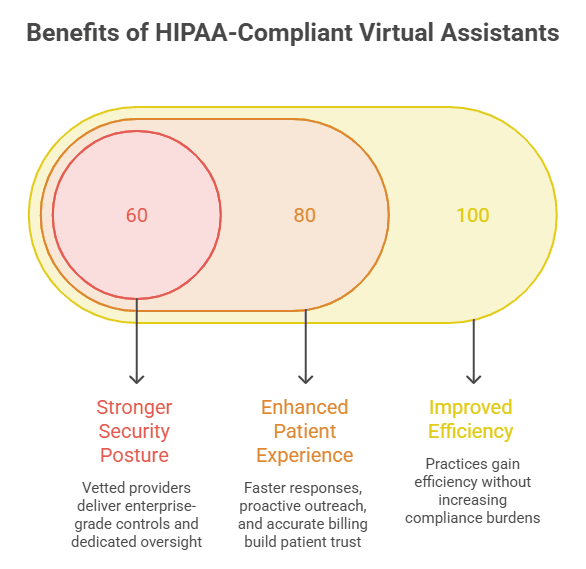
HIPAA-compliant virtual assistants deliver substantial value by combining operational support with rigorous data protection standards. Practices gain efficiency without increasing compliance burdens when working with vetted providers. This balanced approach ultimately supports better clinical outcomes and financial health.
1. Improved Efficiency and Cost Savings
Compliant VAs reduce no-shows via timely reminders, accelerate revenue cycles through accurate verification and claims processing, and alleviate administrative overload. Practices report lower overhead compared to traditional hiring, with flexibility to scale hours as needed. This optimization improves cash flow and resource allocation.
2. Enhanced Patient Experience and Focus on Care
Faster responses, proactive outreach, and accurate billing build patient trust and satisfaction. Clinicians gain time for direct interactions, reducing burnout and improving care quality. Secure channels further reassure patients about data protection.
3. Stronger Security Posture and Risk Mitigation
Vetted providers deliver enterprise-grade controls and dedicated oversight, often beyond small practices’ capabilities. This professional layer reduces exposure to common threats.
Challenges and Common Pitfalls to Avoid

Navigating HIPAA compliance with virtual assistants requires careful due diligence to avoid costly oversights. Many practices underestimate the operational commitment needed beyond initial setup. Awareness of common issues helps ensure successful, secure integrations through medical virtual assistants.
1. Verifying Claims vs. Reality
- Scrutinize training records, access controls, and audit capabilities during evaluation.
- Watch for reluctance to sign a full BAA or reliance on personal devices.
- Request references from similar healthcare clients and review security policies.
2. Integration and Oversight Demands
- Develop clear SOPs, test EHR compatibility, and define tailored workflows.
- Provide ongoing supervision through check-ins and performance metrics.
- Use pilot programs to identify and fix gaps before full rollout.
3. Evolving Regulations and Threats
- Monitor HHS resources for regulatory updates and adjust protocols accordingly.
- Address cybersecurity threats like ransomware and phishing with vigilance.
- Perform regular risk assessments for remote environment vulnerabilities.
Best Practices for Implementing HIPAA-Compliant Virtual Assistants
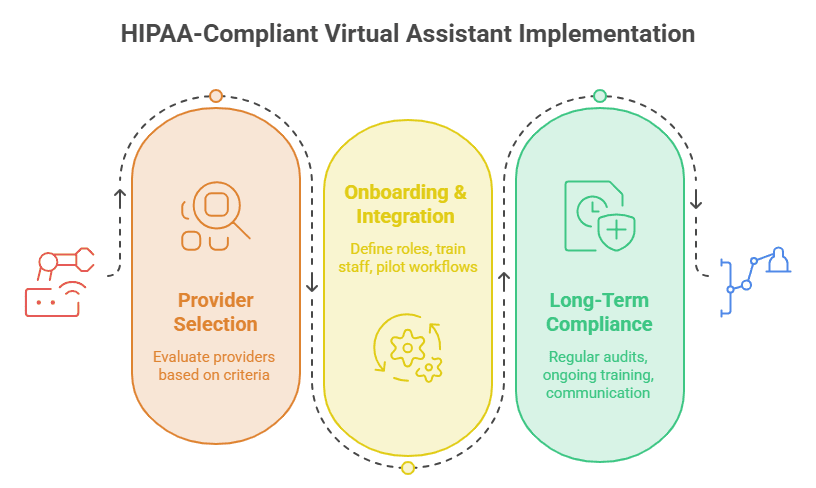
Successful implementation of HIPAA-compliant virtual assistants requires planning, provider collaboration, and consistent oversight. With 76% of HIPAA enforcement actions citing risk-analysis failures, practices should treat integration as a strategic project; following proven steps minimizes risk while maximizing returns on investment.
1. Selecting the Right Provider
Evaluate providers on healthcare experience, client references, security documentation, and BAA terms. Confirm EHR compatibility, transparent pricing, and proactive compliance programs. Prioritize those with strong audit support and relevant practice references.
2. Onboarding and Integration Steps
Execute the BAA first, then define roles, minimum necessary access, and secure setup. Deliver practice-specific training and SOPs while piloting workflows. Establish monitoring and communication protocols before expanding responsibilities.
3. Maintaining Compliance Long-Term
Schedule regular audits of logs and workflows alongside risk assessments. Provide ongoing training and include assistants in security drills. Maintain provider communication for regulatory updates and continuous improvement.
Future Trends in HIPAA-Compliant Virtual Support
AI-assisted tools and hybrid models are emerging to further automate administrative tasks in healthcare. These innovations require the same rigorous BAA, configuration reviews, and oversight as traditional virtual assistants. Practices must demand transparency regarding data handling, model training, and de-identification processes.
Automation holds potential to enhance efficiency when properly integrated with compliance frameworks. However, human supervision remains essential for complex decisions and accountability. Staying informed about regulatory developments will help practices adopt these advancements securely.
TaskVirtual: Your Partner in HIPAA-Compliant Virtual Assistance

Healthcare practices juggle complex administrative demands while maintaining strict patient data protection. From managing schedules and billing to handling insurance verifications and EHR updates, these tasks can divert focus from core clinical responsibilities. TaskVirtual delivers specialized HIPAA-compliant virtual assistant services that streamline operations securely and efficiently for medical practices.
1. Expert Consultation and Review
TaskVirtual’s trained virtual assistants support healthcare-specific workflows, including secure patient scheduling, insurance verification, billing follow-up, and compliant EHR documentation while strictly adhering to HIPAA safeguards.
2. Affordable and Flexible Pricing
Hiring dedicated in-house staff can strain budgets, but TaskVirtual offers cost-effective solutions. With pricing plans starting from just $3.12/hour to $14.99/hour, their services are accessible for solo practices, clinics, and larger healthcare organizations.
3. Comprehensive Support Solutions
TaskVirtual handles key administrative and revenue cycle tasks such as prior authorizations, claims management, secure patient communications, and records coordination. Their scalable services adapt to varying practice needs, from occasional support to full-time virtual team integration.
4. Ongoing Support and Quality Assurance
TaskVirtual provides continuous monitoring, regular compliance updates, and proactive issue resolution. Their support ensures smooth daily operations while maintaining the highest standards of PHI protection and regulatory adherence.
5. Proven Track Record of Excellence
With 364 positive reviews and a 4.7-star rating on trusted VA platforms, TaskVirtual is recognized as a reliable partner for HIPAA-compliant virtual assistance. Practices rely on their expertise to enhance efficiency while safeguarding patient information.
FAQ Section
1. What makes a virtual assistant HIPAA-compliant?
They operate under a signed BAA, complete ongoing training, use encrypted secure tools with MFA and audit logs, follow minimum necessary access, and adhere to documented policies monitored by their provider.
2. Do I need a BAA for every virtual assistant?
Yes, if they handle PHI. The agreement must be with the organization providing the service for proper liability coverage.
3. Can virtual assistants access my EHR?
Yes, with role-based, least-privilege access via secure methods like VPN, and full audit logging enabled.
4. What are the penalties for HIPAA violations involving VAs?
Fines vary by tier (up to $71,162+ per violation, with annual caps), plus potential reputational and legal costs. OCR has enforced numerous cases with millions in penalties recently.
5. How do I monitor a virtual assistant’s compliance?
Review audit logs, conduct periodic access reviews and audits, use activity monitoring, and maintain open communication with the provider.
6. Are offshore virtual assistants compliant?
Possible with strong controls, BAAs, and oversight, but verify legal enforceability, data flows, and equivalent safeguards. Many practices prefer providers with robust U.S. compliance programs.
Conclusion
HIPAA-compliant virtual assistants represent a strategic opportunity for healthcare practices to enhance efficiency, reduce costs, and improve patient care—provided compliance is treated as a comprehensive program rather than a marketing claim. By understanding requirements, selecting vetted partners, implementing strong safeguards, and maintaining vigilance, practices can mitigate risks while reaping substantial benefits.
Compliance is a critical consideration when delegating healthcare-related administrative tasks. Learn more about virtual medical assistant services and the important factors practices should consider when choosing remote support.
Prioritize patient trust and regulatory adherence in an era of sophisticated threats. Start with a compliance assessment and pilot a qualified service to transform your administrative operations securely.
Sources
- LinkedIn/Global Medical VA articles on HIPAA and MVAs.
- MedVirtual.ai blogs on compliance and VMAs.
- Wishup, Virtual Rockstar, Accountable HQ, DoctorPapers, VA Health Plus, and Paubox resources.
- HIPAA Journal breach statistics.
- IBM Cost of a Data Breach Report insights.
- HHS/OCR enforcement data.
For more such content, visit our website.
 Siddhartha Basu is a Technical Writer at Task Virtual. He loves online games, e-book reading, and Yoga.