

Contents
show
Medical VA Pricing: What Does a Virtual Medical Assistant Cost
Running a medical practice today means managing rising costs, administrative overload, and the constant pressure to deliver excellent patient care, which directly impacts Virtual Medical Assistant Cost considerations. Physicians and practice owners often spend far too much time on paperwork, scheduling, insurance verifications, and follow-ups—time that could instead be dedicated to patients.
A virtual medical assistant (VMA) offers a flexible, cost-effective solution. But the big question remains: What does a virtual medical assistant cost? Pricing varies widely based on experience, scope, provider model, and location. In 2026, expect hourly rates from $8–$20+ or monthly retainers of $1,200–$3,000 for full-time support, often delivering 50–70% savings compared to in-house hires when factoring in all overhead.
This comprehensive guide draws from industry providers like MedGather, Staffing For Doctors, HelpSquad, Wing Assistant, and others. It breaks down real 2026 pricing, factors influencing costs, comparisons to traditional staffing, and strategies to maximize ROI. Whether you’re a solo practitioner or managing a group practice, you’ll find actionable insights to make an informed decision.
What Factors Influence Virtual Medical Assistant Cost?
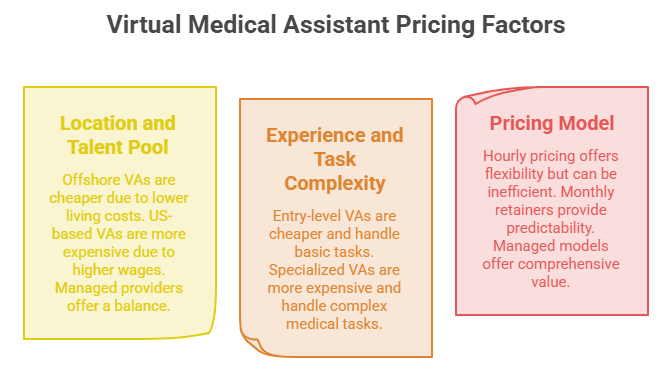
Several key variables determine pricing for virtual medical assistants. Understanding them helps practices avoid under- or over-investing while aligning support with operational needs. Location, experience, task complexity, and provider models significantly influence final cost up to 60%, with a variation observed.
1. Location and Talent Pool
Offshore or nearshore VAs, often based in the Philippines, typically offer rates between $8 and $15 per hour due to differences in living costs and competitive labor markets. This model allows practices to access skilled talent while maintaining quality through structured training programs. US-based options, by contrast, command higher rates ranging from $20 to $55 per hour, reflecting domestic wage expectations and reduced time zone friction.
Managed providers effectively balance affordability and reliability by combining vetted international professionals with US-based oversight and compliance support. This hybrid approach ensures consistent performance without the full expense of purely domestic hiring. Practices benefit from scalability and reduced overhead while still meeting rigorous healthcare standards.
2. Experience, Specialization, and Task Complexity
Entry-level or general administrative virtual medical assistants usually fall in the $6 to $12 per hour range and focus on straightforward tasks like basic scheduling or reminders. These roles suit practices with lower complexity needs but may require additional supervision for healthcare-specific workflows.
Healthcare-specific or specialized VAs handling insurance verification, prior authorizations, patient intake, or scribing command $10 to $25 or more per hour. Higher rates reflect clinical background knowledge, EHR proficiency, and the ability to manage detailed medical documentation accurately. Task complexity directly impacts pricing, as advanced responsibilities demand greater expertise and reduce error risks in sensitive environments.
3. Pricing Model: Hourly, Monthly Retainer, or Managed
Hourly pricing provides flexibility for variable workloads but often introduces administrative overhead for tracking and can misalign incentives around task efficiency. Many practices find it less ideal for ongoing healthcare administrative needs where predictability matters. Monthly retainers address these issues by offering fixed costs and encouraging ownership of defined scopes of work.
Managed service models bundle additional value, such as training, quality assurance, backups, and compliance infrastructure, into the rate. This comprehensive approach delivers better long-term outcomes for medical practices compared to basic hourly arrangements. The choice ultimately depends on practice volume, budget predictability preferences, and the desire for reduced internal management burden.
2026 Virtual Medical Assistant Pricing Breakdown
Market rates for virtual medical assistants in 2026 have stabilized amid growing demand for HIPAA-compliant and EHR-trained support across various practice settings. Providers offer competitive structures that emphasize value through compliance, training, and operational integration while remaining more affordable than traditional staffing.
1. Hourly Rates by Role and Model
- Freelance/general: $8–$15/hour for basic administrative tasks with limited healthcare specialization.
- Agency/managed (offshore with US support): $8–$17/hour, as seen with providers like HelpSquad ($8–$13) and Staffing For Doctors (~$14 flat).
- Specialized/clinical: $14–$25+/hour for roles requiring clinical backgrounds or advanced EHR mastery.
- US-based: $35–$55/hour, reflecting higher domestic labor costs and minimal time zone issues.
2. Monthly Retainer Options
- Entry/mid-level support: $1,000–$2,200 per month for consistent coverage.
- Premium managed services: $1,500–$3,000+ monthly with full QA, training, and backups.
- Full-time dedicated arrangements: $1,200–$3,000 overall, depending on scope (around 40 hours/week).
3. Real-World Examples from Providers
- Staffing For Doctors: $14/hour flat rate (~$2,425/month full-time) including US account management and specialty matching.
- HelpSquad: Patient-facing roles at $10–$13/hour and back-office at $8–$10/hour with strong compliance features.
- MedGather, Wing Assistant, and similar providers: Custom monthly pricing focused on outcomes, compliance, and seamless workflow integration.
Virtual Medical Assistant Cost vs. In-House Staff
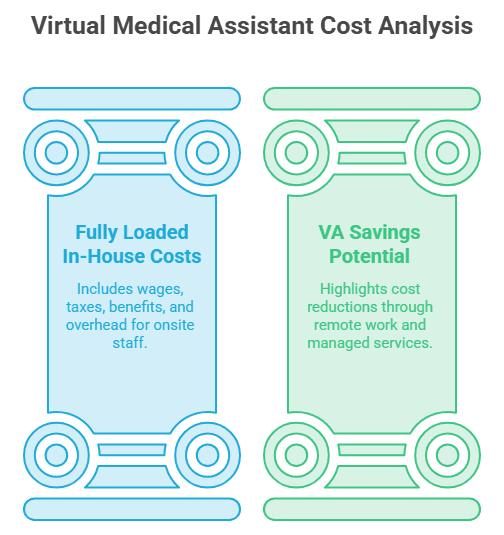
Comparing virtual medical assistants to traditional in-house staffing reveals substantial opportunities for cost optimization in medical practices. The fully loaded expenses of employing onsite personnel often far exceed headline salaries when all factors are considered. Virtual options provide predictable pricing and eliminate many hidden overhead categories.
1. Fully Loaded In-House Costs
BLS data indicate that median annual wages for medical secretaries and administrative assistants hover around $40,000–$45,000. Additional costs—including payroll taxes (approximately 7.65%), health benefits ($6,000–$12,000), PTO, recruiting, and workspace—can elevate the total to $56,000–$81,000 per year.
These figures highlight how base compensation represents only part of the true employment expense for practices. Turnover events further increase costs through repeated hiring and onboarding cycles. In-house models also require ongoing management and facility-related investments.
2. VA Savings Potential
A typical full-time virtual medical assistant at $2,000–$2,500 per month (roughly $24,000–$30,000 annually) frequently delivers $20,000–$50,000+ in yearly savings per role. Practices commonly achieve 50–70% overall cost reductions by avoiding benefits, taxes, and physical infrastructure expenses.
Managed VA models also incorporate built-in coverage for absences and replacements, minimizing disruption-related losses. This structure supports better budget predictability compared to variable in-house staffing costs. Many providers report significant long-term advantages once all factors are accounted for.
ROI and Benefits Beyond Direct Costs
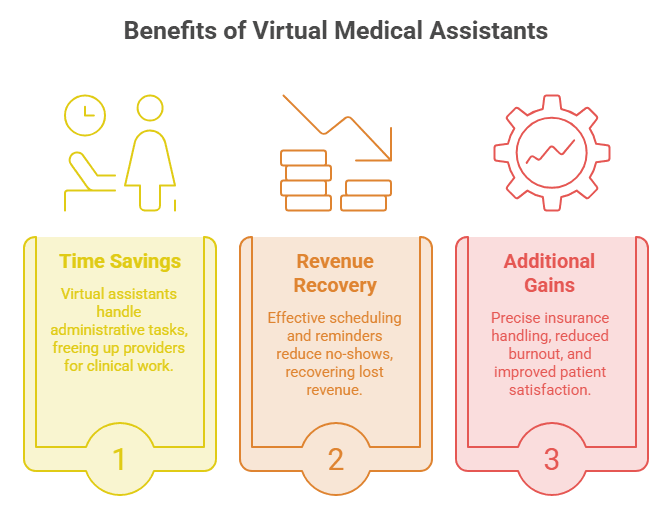
Virtual medical assistants deliver value that extends well beyond simple salary comparisons. They enable practices to redirect resources toward core clinical activities while improving operational flow. These indirect benefits often accelerate return on investment substantially.
1. Time Savings for Providers
Physicians frequently dedicate around two hours of administrative work for every hour of direct patient care, or roughly 16–20% of their working hours, according to studies. A capable virtual medical assistant absorbs many of these responsibilities, freeing providers for higher-value clinical time. This shift can translate into meaningful revenue gains given typical billing rates of $150–$300 or more per hour.
2. Revenue Recovery from Reduced No-Shows
Patient no-show rates commonly range from 5–30% and represent a significant source of lost revenue for practices. Effective scheduling, reminders, and follow-up processes managed by virtual medical assistants can reduce these rates by 20–30% in many cases. For moderate-volume practices, this improvement may recover hundreds to thousands of dollars weekly.
3. Additional Gains
Virtual medical assistants contribute to fewer claim denials through precise insurance and prior authorization handling. They also help lower staff burnout and turnover while supporting scalable operations without expanding physical space. Overall, patient satisfaction improves via more consistent and timely communications.
Choosing the Right Virtual Medical Assistant: Key Considerations

Selecting an appropriate virtual medical assistant requires careful evaluation of compliance, integration capabilities, and long-term support structures. Practices should prioritize providers that align with their specific EHR systems, specialty workflows, and risk management needs. A thorough assessment helps ensure the partnership enhances rather than complicates daily operations.
1. HIPAA Compliance and Security
- Require a signed Business Associate Agreement (BAA) at the company level, along with secure virtual desktops and encrypted access protocols.
- Verify comprehensive HIPAA training and strict controls on protected health information handling.
- Prioritize providers with established audit-ready infrastructure to minimize compliance exposure.
2. Onboarding, Training, and Integration
- Seek services offering EHR-specific training, documented SOPs, and rapid ramp-up periods, often within 1–2 weeks.
- Look for dedicated account managers who facilitate smooth workflow embedding and ongoing support.
- Confirm clear escalation paths and performance monitoring tools for sustained success.
3. Red Flags in Low-Cost Options
- Absence of a BAA or robust compliance infrastructure for any PHI-related tasks.
- Over-reliance on shared resources, lacking dedicated focus or backup coverage.
- Lack of clinical background requirements, oversight mechanisms, or replacement guarantees.
4. Best Practices for Success
- Begin with high-impact tasks such as scheduling, insurance verification, and patient follow-ups.
- Provide detailed SOPs and maintain regular communication through dashboards or QA reviews.
- Scale support gradually as demonstrated ROI justifies expansion across additional responsibilities.
Common Virtual Medical Assistant Tasks and Their Value
Virtual medical assistants manage a wide array of responsibilities that directly support practice efficiency. Common duties include appointment scheduling with reminders, insurance verification, and prior authorization processing. Patient intake coordination, communication, and follow-up activities also form core parts of their contributions.
These tasks reduce front-desk workload and minimize errors in critical areas like documentation and revenue cycle management. By handling EHR data entry and referral coordination, VAs enable smoother operations overall. Practices experience improved patient flow and satisfaction when these functions are professionally supported.
How Virtual Medical Assistants Are Helpful in the Medical Industry

Virtual medical assistants have become essential partners for modern healthcare practices by addressing persistent administrative challenges while supporting better patient outcomes. They allow providers to focus more on clinical care by offloading time-consuming tasks in a compliant and efficient manner. Their integration leads to measurable improvements in practice operations and financial performance.
- Reduce physician administrative burden and free up clinical time previously lost to paperwork.
- Streamline revenue cycle management and lower claim denial rates through accurate verifications.
- Decrease patient no-show rates with proactive scheduling and follow-up communications.
- Enhance compliance and data security within HIPAA-approved frameworks and secure systems.
- Support practice scalability without physical office space, benefits, or high turnover costs.
- Improve patient satisfaction through timely responses and consistent communication.
TaskVirtual: Your Partner in Healthcare Administrative Support

Managing daily medical practice tasks like appointment scheduling, insurance verifications, prior authorizations, and patient communications can often be overwhelming. From navigating complex EHR systems to ensuring timely follow-ups and compliance, these responsibilities can consume valuable clinical time and impact practice performance. Taskvirtual provides expert virtual medical assistant services that simplify operations by handling administrative workflows, supporting revenue cycle tasks, and coordinating patient care logistics with precision.
1. Expert Medical Consultation and Review
TaskVirtual’s skilled virtual medical assistants assist in selecting optimal EHR workflows, organizing patient schedules, and ensuring accurate documentation. They also help manage insurance processes, recurring tasks, and specialty-specific requirements to keep your practice running smoothly without interruptions.
2. Affordable and Flexible Pricing
Hiring a full-time personal assistant can be expensive, but TaskVirtual makes it cost-effective. With pricing plans starting from just $3.12/hour to $14.99/hour, their services are budget-friendly and accessible to individuals, families, and businesses.
3. Comprehensive Medical Support Solutions
From creating efficient scheduling protocols and verifying insurance details across payers to handling patient intake and follow-up coordination, TaskVirtual covers it all. Their scalable services adapt to whether you need occasional help or consistent full-time administrative management support.
4. Ongoing Support and Quality Assurance
TaskVirtual goes beyond basic task execution by offering constant updates, compliance monitoring, and performance reporting. Their proactive support ensures administrative processes run reliably and align with your practice’s standards without added stress.
5. Proven Track Record of Excellence
With 364 positive reviews and a 4.7-star rating on trusted VA platforms, TaskVirtual is recognised as a reliable partner worldwide. Clients count on their expertise to simplify medical administrative tasks and streamline practice operations.
FAQ Section
1. How much does a virtual medical assistant cost per month in 2026?
Typically $1,200–$3,000 for full-time dedicated support, depending on scope and provider.
2. Is a virtual medical assistant cheaper than hiring in-house?
Yes—often 50–70% savings after benefits, taxes, and overhead. A VA avoids $18k–$30k+ in annual extras per role.
3. What tasks can a medical VA handle effectively?
Scheduling, insurance, prior auth, patient comms, intake, basic scribing, and more—trained on your EHR and workflows.
4. Are virtual medical assistants HIPAA compliant?
Reputable managed providers are, with company-level BAAs, secure access, and training. Always verify.
5. How long does it take to onboard a VA?
Usually 1–2 weeks for vetted, trained candidates from good providers, sometimes faster.
6. What ROI can I expect?
Many see full payback in months via time savings, reduced no-shows, and lower staffing costs. Revenue gains from reclaimed physician time are substantial.
Conclusion
A virtual medical assistant represents one of the smartest investments for modern medical practices facing staffing shortages and administrative burdens. With 2026 costs ranging from affordable hourly rates to predictable monthly retainers, the value—lower overhead, better compliance, and reclaimed clinical time—far outweighs the price for most practices.
Cost is an important factor when evaluating remote healthcare support, but services and responsibilities can vary significantly. Explore virtual medical assistant services to understand the range of support available for healthcare practices.
Don’t let administrative tasks hold your practice back. Evaluate your needs, compare providers, and start with a high-ROI task set. Many offer consultations or trials to prove fit.
Sources
- MedGather pricing and cost guides.
- Staffing for Doctors pricing.
- HelpSquad and similar provider sites.
- Bureau of Labor Statistics (BLS) occupational data.
- AMA and related administrative burden studies.
- Additional industry analyses from Wing Assistant, Physician Side Gigs, etc.
For more such content, visit our website.
 Siddhartha Basu is a Technical Writer at Task Virtual. He loves online games, e-book reading, and Yoga.