

Contents
show
How to Choose an Outsourcing Partner: Due Diligence Questions, KPIs, and Security Checks
Choosing the right outsourcing partner can accelerate growth, cut costs, and free your team to focus on core strategy. Choosing poorly can create quality gaps, security exposures, and governance headaches that take years to unwind. In 2026, U.S. companies face tighter talent markets, rising third-party cyber risk, and higher expectations for measurable outcomes. The global IT outsourcing market alone reached roughly $485 billion in 2023 and is projected to climb toward $813 billion by 2029, according to Statista. At the same time, Verizon’s 2025 Data Breach Investigations Report showed third-party involvement in breaches doubling from 15% to 30%.
This guide gives American business leaders a practical, checklist-driven framework for selecting a BPO vendor or outsourcing provider. It covers scope and ownership, quality and handoffs, security and NDAs, KPI/governance templates, and a scoring rubric plus pilot approach—exactly the areas most checklists treat too lightly. Whether you need support for specialized functions or broader operational scale, this process helps you evaluate partners with greater precision and confidence.
Defining Scope and Ownership Clearly
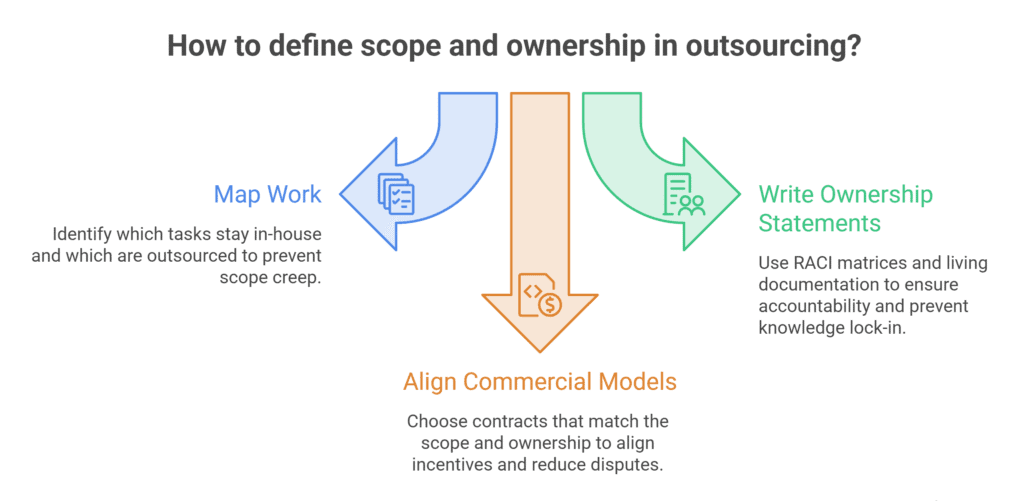
Clear boundaries form the foundation of every successful outsourcing relationship. Ambiguous scope almost always leads to disputes, scope creep, and unexpected costs. Defining ownership early protects both parties and keeps accountability transparent throughout the engagement.
1. Map the work and decide what stays in-house.
List every process, decision right, and system access the partner will handle. Distinguish transactional work such as payroll processing or ticket resolution from judgment-heavy work like strategy, final customer escalations, or product roadmap decisions. Keep ownership of intellectual property, brand voice, final approvals, and regulatory accountability inside your organization. Document who owns the “source of truth” for data and process documentation so that handoffs never become blame games.
Many organizations begin by outsourcing discrete roles such as a Virtual Assistant for administrative coordination. Without this detailed map, even well-intentioned partners struggle to stay within agreed limits, and internal teams lose visibility into critical workflows.
2. Write ownership statements that survive personnel changes.
Use RACI (Responsible, Accountable, Consulted, Informed) matrices for every major workflow. Explicitly state that the client retains ultimate accountability for compliance, customer outcomes, and strategic direction. Require the provider to maintain living process documentation that your team can take over if the relationship ends. This prevents knowledge lock-in—a common risk when partners become the only people who understand how work actually gets done.
Strong ownership statements also clarify escalation paths and decision rights so that new team members on either side can step in without confusion. These documents should be reviewed and updated at regular intervals to reflect process changes or organizational shifts.
3. Align commercial models with ownership.
Fixed-price contracts suit well-defined, stable scope. Time-and-materials or outcome-based models work better when volume or complexity will shift. Deloitte’s 2024 Global Outsourcing Survey found that 67% of executives are moving toward outcome-based relationships. Tie payment triggers to the ownership model, so incentives stay aligned, and both parties share responsibility for results.
When the commercial structure mirrors the ownership framework, disputes over extra work decrease and continuous improvement becomes a shared goal rather than a source of friction.
Evaluating Quality, Coverage, and Handoffs

Quality is not a single metric; it is the combination of coverage depth, process discipline, and seamless transitions between teams. A partner that delivers strong results in one area but fails at handoffs or capacity planning will create ongoing operational drag. Thorough evaluation in these three areas separates reliable providers from those that look good only on paper.
1. Assess end-to-end process coverage.
- Ask candidates to walk through a complete process map—from intake to closure—and identify every handoff point.
- Probe for single points of failure, language or time-zone gaps, and backup capacity during peak periods.
- Confirm coverage includes escalation paths, continuity planning, and the ability to absorb sudden volume changes.
- Request anonymized examples of how they handled spikes or process changes for similar U.S. clients, including any experience with Digital Marketing campaigns that require rapid scaling.
2. Scrutinize quality systems and continuous improvement.
- Look for documented quality frameworks such as Six Sigma, ISO standards, or proprietary scorecards.
- Require evidence of regular calibration sessions and disciplined root-cause analysis.
- Ask for historical defect rates, first-contact resolution figures, and rework percentages on comparable work.
- Verify that the partner treats quality as a system rather than a final inspection step, especially when supporting functions like Facebook Marketing & Ads that demand consistent creative and targeting standards.
3. Design handoffs that protect institutional knowledge.
- Define explicit transition playbooks for onboarding, knowledge transfer, and offboarding.
- Require dual-running periods, shadowing, and recorded walkthroughs so knowledge is not lost.
- Specify response-time expectations for knowledge-transfer requests and include retention clauses in the contract.
- Test handoff processes during evaluation to ensure they work for specialized services such as Instagram Marketing & Ads where creative assets and campaign history must transfer cleanly.
Prioritizing Security, Access Controls, and NDAs
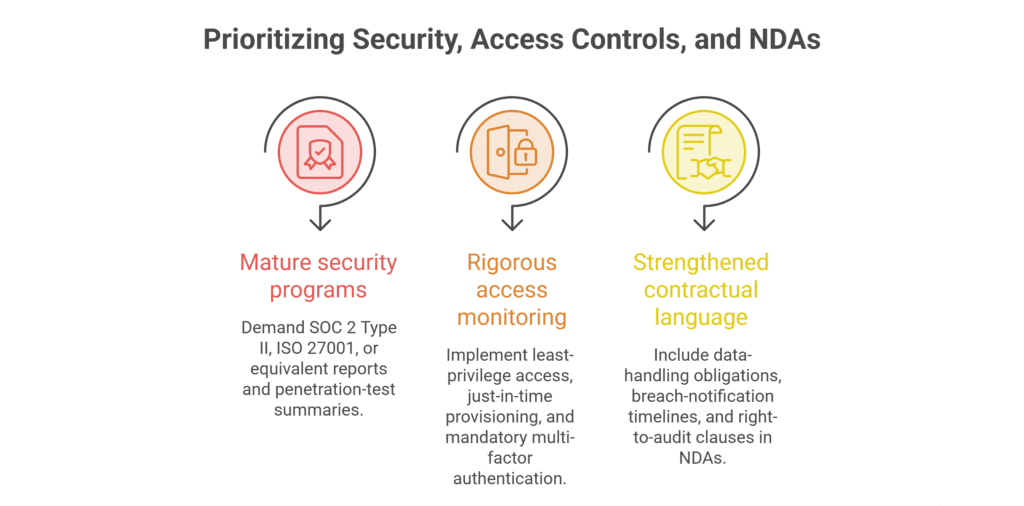
Security and data protection can no longer be secondary checklist items. Third-party risk has become a primary board-level concern for U.S. companies. A single weak link in access controls or contractual language can expose sensitive customer data, intellectual property, and regulatory compliance. Rigorous scrutiny here is non-negotiable.
1. Require evidence of mature security programs.
Demand current SOC 2 Type II, ISO 27001, or equivalent reports, plus recent penetration-test summaries. Ask how they handle zero-trust architecture, privileged access management, and continuous monitoring of their own supply chain. Given that third-party involvement in breaches doubled to 30% in the latest Verizon DBIR, treat any reluctance to share recent audit results as a red flag. Partners supporting LinkedIn Marketing & Ads or other customer-facing channels must demonstrate the same rigor applied to internal systems.
2. Limit and monitor access rigorously
Implement least-privilege access, just-in-time provisioning, and mandatory multi-factor authentication across every system the partner touches. Require the provider to maintain an up-to-date inventory of every person and system that can reach your data and insist on the right to audit access logs with the ability to revoke credentials immediately. For regulated industries, confirm that data residency and processing locations meet U.S. requirements, particularly when the engagement involves Video Editing Services that handle brand assets or customer footage.
3. Strengthen NDAs and contractual security language
Go beyond a standard mutual NDA by including specific data-handling obligations, breach-notification timelines of 24–72 hours, right-to-audit clauses, insurance minimums, and clear liability allocation for security incidents. Require all subcontractors to be bound by the same terms and disclosed in advance. Make security performance part of the scorecard that can trigger remedies or termination rights, especially for providers delivering online Marketing Services where campaign data and customer lists are involved.
Building a KPI and Governance Template

SLAs keep the lights on; KPIs and governance drive continuous value. Without a clear measurement framework and disciplined review cadence, even strong operational performance can drift away from business priorities. Building these elements early turns the outsourcing relationship into a managed performance system rather than a set of transactional tasks.
1. Separate operational SLAs from business KPIs.
- SLAs typically cover response times, availability, and resolution percentages that keep daily work moving.
- Business KPIs measure outcomes that matter to leadership, such as cost-per-transaction trends, customer satisfaction impact, and cycle-time reduction.
- Move toward a balanced scorecard that includes both leading and lagging indicators.
- Ensure the framework can accommodate specialized work streams like Social Media Marketing, where 50% of the executives now outsource front-office functions.
2. Create a lightweight but disciplined governance cadence.
- Establish daily or weekly operational huddles for immediate issue resolution.
- Hold monthly performance reviews that examine the full scorecard with named owners on both sides.
- Conduct quarterly business reviews focused on continuous improvement and roadmap alignment.
- Document escalation paths and decision rights so issues do not linger, including clear ownership when the partner manages SEO Services that affect organic traffic and lead generation.
3. Build the measurement infrastructure early.
- Agree on data sources, calculation methods, and reporting formats before go-live.
- Automate as much of the scorecard as possible to reduce manual effort and disputes.
- Include a short list of leading indicators such as training completion and process adherence alongside lagging results.
- Review the KPI set itself every six to twelve months so it stays relevant as the relationship and business needs evolve, particularly when Website Design Services form part of the scope.
Using a Scoring Rubric and Pilot Program
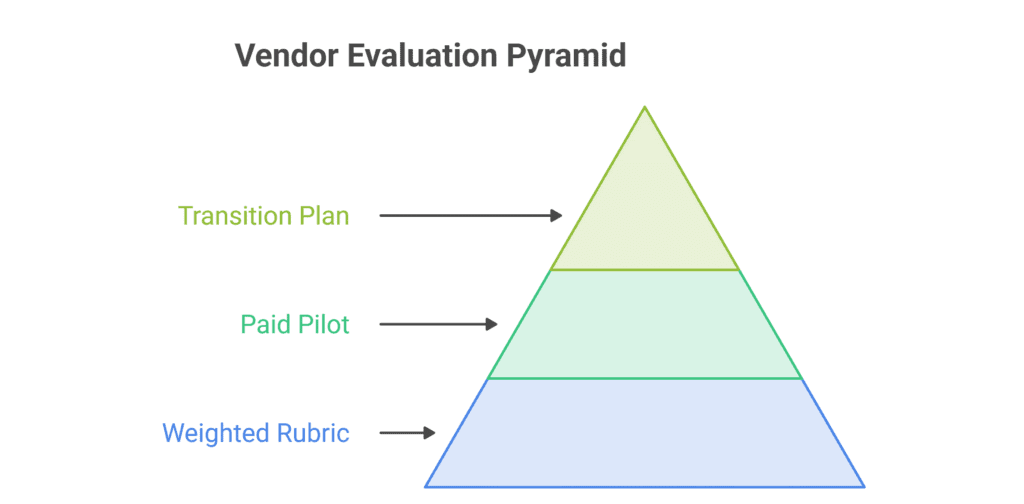
A structured evaluation process reduces bias and surfaces true differences among vendors. Relying solely on proposals, demos, or reference calls leaves too much room for subjective judgment. A weighted rubric combined with a real pilot provides objective evidence before you commit to a long-term contract.
1. Build a weighted scoring rubric
Evaluate candidates across key criteria such as security, operational expertise, cultural alignment, commercial flexibility, governance, and relevant experience. Use a structured scoring approach with clear benchmarks, supported by evidence, demonstrations, and input from stakeholders across functions like security, operations, finance, and legal. This ensures a balanced assessment based on capability, reliability, and overall fit rather than individual opinions.
2. Run a paid pilot before full commitment
- Design a 60- to 90-day pilot on a discrete but meaningful slice of work that includes production-level security and access controls.
- Define success criteria in advance and instrument the same KPIs you will use later so results are comparable.
- At the end, score the pilot against the same rubric and hold a formal go/no-go review that also evaluates performance on Website Development tasks if they form part of the test scope.
3. Plan the transition and exit from day one
Define the knowledge-transfer and exit plan during partner selection to ensure transition responsibilities are clearly established from the start. Include key contractual requirements around data return, transition support, and continuity protections while validating the partner’s documentation quality during the pilot phase. This helps ensure smooth handovers and reduces operational risk if responsibilities need to be transferred in the future.
Additional Considerations: Cost Structure and Cultural Alignment
Total cost of ownership extends far beyond the quoted hourly or monthly rate. Management overhead, quality rework, transition effort, technology integration, and the opportunity cost of internal attention all affect the true economics of the relationship. Many U.S. companies still achieve meaningful savings—ISG has reported average BPO cost reductions around 15% – yet those savings disappear quickly if quality or security problems surface later. Ask for transparent pricing models and scenario analysis that show how costs behave under volume changes, and evaluate whether the partner can support specialized needs such as a Personal Assistant role or Virtual Receptionist coverage without inflating the overall investment.
Cultural and communication fit often determines whether the relationship feels collaborative or constantly strained. Schedule working sessions rather than pure sales presentations so you can observe how the team handles disagreement, surfaces risks, and adapts to your tools and processes. Time-zone overlap, English proficiency for any customer-facing work, and willingness to adopt your existing systems matter more than most buyers initially realize. Partners delivering IT Support Services or Bookkeeping Services succeed longest when communication styles and decision-making rhythms align with the client organization.
TaskVirtual: A Reliable Outsourcing Partner for Flexible Online Support

When applying the due diligence framework outlined above, many U.S. organizations look for partners that combine clear scope ownership, measurable quality systems, strong security practices, and transparent pricing. TaskVirtual offers a practical illustration of how a specialized outsourced business operations team can meet these standards while delivering flexible online assistance that scales with business needs.
1. Clear Scope Definition and Ownership Alignment
TaskVirtual works with clients to map responsibilities precisely, ensuring that decision rights, process ownership, and escalation paths remain with the client organization. Their teams focus on execution within agreed boundaries, which reduces scope creep and supports clean knowledge transfer if the engagement evolves or ends.
2. Transparent Pricing That Supports Cost Control
Hiring dedicated full-time support can strain budgets, yet TaskVirtual provides accessible options with pricing plans starting from just $3.12/hour to $14.99/hour. This range allows organizations to match investment levels to actual workload while maintaining visibility into total cost of ownership.
3. Quality Systems and Consistent Delivery Standards
The provider emphasizes structured workflows, regular performance reviews, and continuous improvement practices. Clients benefit from reliable execution across administrative and operational tasks outsourcing, backed by documented processes that align with the quality and handoff expectations discussed earlier in this guide.
4. Security-Conscious Access and Ongoing Oversight
TaskVirtual incorporates controlled access practices and proactive communication so clients retain visibility into work progress. Their approach supports the security and governance principles recommended for any outsourcing relationship, including clear accountability and timely updates.
5. Established Client Confidence
With 364 positive reviews and a 4.7-star rating on trusted VA platforms, TaskVirtual has built a recognized record of dependable service. Organizations evaluating partners can use this track record as one data point within a broader scoring rubric and pilot process.
FAQ
1. What is the most important factor when choosing an outsourcing partner?
Security posture and clear ownership of outcomes usually rank highest for U.S. companies in regulated or customer-facing work. Cost is rarely the decisive factor among short-listed vendors.
2. How long should a pilot last?
Sixty to ninety days is typical for most process work. Complex or highly regulated functions may need longer to generate reliable performance data.
3. Should SLAs include financial penalties?
Yes, but keep them focused and reasonable. Pair service credits with earn-back opportunities so the relationship stays collaborative rather than purely punitive.
4. How do I protect against knowledge lock-in?
Require living process documentation, dual-running periods, recorded knowledge transfers, and contractual transition assistance. Test the documentation during the pilot.
5. What security certifications should I require?
At minimum, SOC 2 Type II for most U.S. companies. ISO 27001, HITRUST, or industry-specific attestations may be necessary depending on your sector and data types.
6. How often should we review the outsourcing relationship?
Operational reviews monthly, strategic business reviews quarterly, and a full commercial and performance reset annually or when material scope changes occur.
Conclusion and Call to Action
Selecting an outsourcing partner is no longer a pure cost exercise. In 2026, it is a strategic decision that touches security posture, operational resilience, talent strategy, and measurable business outcomes. By defining scope and ownership tightly, probing quality systems and handoffs, insisting on rigorous security and contractual protections, installing clear KPIs and governance, and validating everything through a scored rubric and pilot, U.S. companies dramatically improve their odds of success.
Start with the scope map and security questionnaire this week. Use the scoring rubric to evaluate your current short list or to structure the next RFP. The organizations that treat vendor selection as a disciplined due-diligence process – not a price negotiation – consistently extract more value and experience fewer surprises.
If you are preparing an RFP or evaluating current partners, adapt the templates in this article to your specific functions and risk profile. The investment in rigorous selection pays for itself many times over in avoided remediation costs and accelerated results.
Sources
- Statista – IT Outsourcing market data and forecasts
- Verizon 2025 Data Breach Investigations Report
- Deloitte 2024 Global Outsourcing Survey
- ISG BPO studies on cost and quality outcomes
- Gartner Magic Quadrant and related outsourcing research (various years)
- Additional industry reports from Grand View Research and related market analyses referenced for BPO market sizing
For more such content, visit our website.
 Siddhartha Basu is a Technical Writer at Task Virtual. He loves online games, e-book reading, and Yoga.