

Contents
show
Outsourced Bookkeeping and Admin Support: What a Growing Business Can Safely Delegate
Growing a business in the United States often means juggling multiple responsibilities, from bookkeeping and invoice follow-ups to expense tracking and financial reporting. For small business owners, these administrative duties can consume valuable time that could otherwise be invested in sales, customer relationships, and business growth. According to the U.S. Bureau of Labour Statistics, the median annual wage for bookkeeping, accounting, and auditing clerks was $49,210 in May 2024, highlighting the financial commitment involved in hiring dedicated in-house support. Beyond salaries, businesses must also account for employee benefits, training, and operational overhead. By hiring a skilled Virtual Assistant for bookkeeping and administrative support, growing businesses can delegate routine financial tasks, reduce administrative workloads, and maintain better control over day-to-day operations.
Outsourced bookkeeping and administrative support have become practical solutions for American businesses seeking flexible and scalable financial management. According to research published by Clutch, 22% of small businesses with accounting staff employ a full-time or part-time outsourced accountant, demonstrating the role of external accounting professionals in business operations. Professional Bookkeeping Services, combined with clear financial controls and approval processes, can help business owners reduce administrative workloads while maintaining accuracy and oversight. This guide explores which financial tasks can be safely delegated, how to establish approval workflows, what a typical month-end process looks like, and how to choose a reliable outsourcing provider that supports sustainable business growth.
Separate bookkeeping support from professional advice
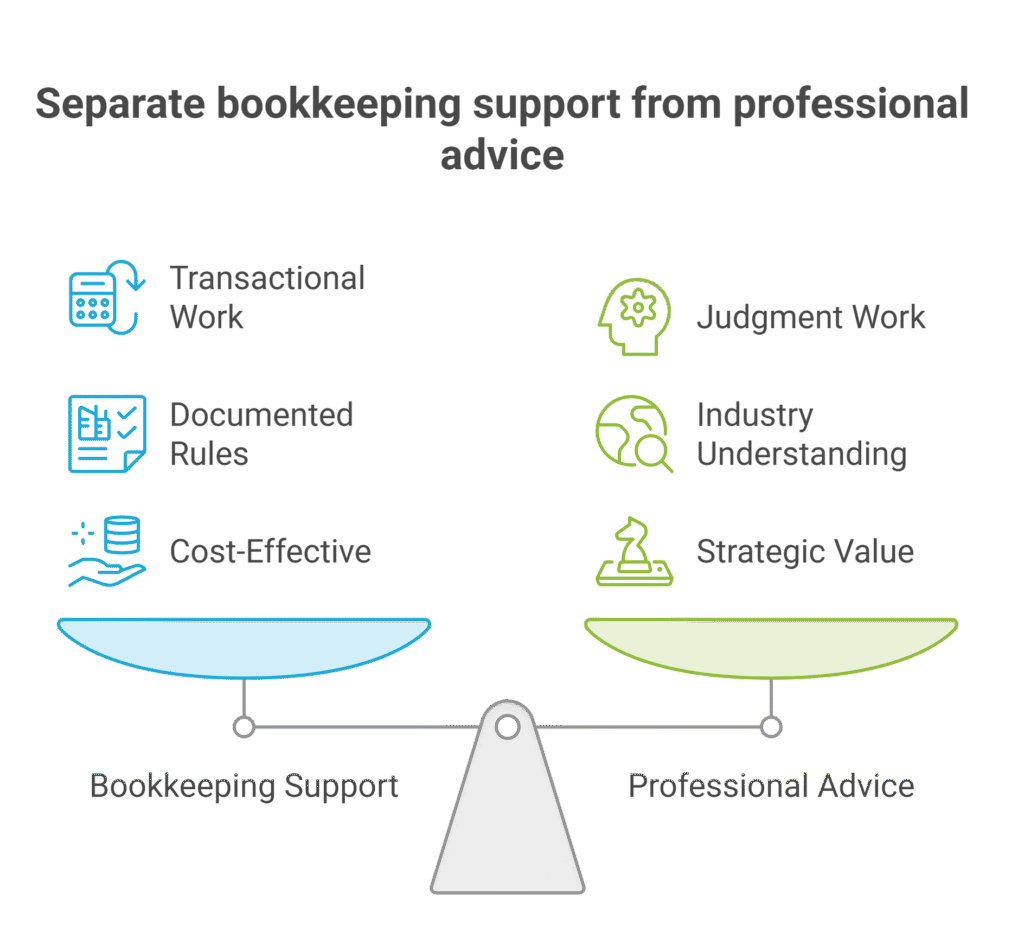
Bookkeeping captures and organizes what has already occurred in the business. Professional advice interprets those records and shapes future decisions. Keeping the two roles distinct prevents costly confusion and protects both accuracy and regulatory posture.
1. Transactional work versus judgment work
Bookkeeping support centres on capturing, classifying, and organizing data: entering bills, matching payments, coding expenses, and preparing draft reports. A bookkeeping team or Personal Assistant follows documented rules and chart-of-accounts guidelines. Professional advice- tax planning, entity structure recommendations, cash-flow forecasting under uncertainty, or audit representation-requires a licensed CPA or qualified advisor who understands your industry and goals.
Owners who try to extract strategic counsel from pure bookkeeping providers often receive incomplete answers. Conversely, paying CPA rates for data entry wastes money. Clear separation keeps costs appropriate and accountability clear.
2. Why the distinction protects your business
U.S. tax and regulatory requirements make accurate financial recordkeeping essential for businesses of all sizes. According to the IRS recordkeeping guidelines, businesses must maintain records that support reported income, expenses, and tax deductions. Properly organised financial records help reduce documentation errors, support tax compliance, and allow CPAs to focus on strategic financial planning rather than correcting bookkeeping mistakes.
Employment trends further highlight the changing role of bookkeeping professionals. According to the U.S. Bureau of Labor Statistics, employment of bookkeeping, accounting, and auditing clerks is projected to decline by 6% between 2025 and 2035, representing approximately 85,600 fewer jobs. As automation transforms routine accounting tasks, growing businesses can benefit from outsourced bookkeeping support while retaining professional oversight for complex financial decisions.
3. Practical boundary rules
Document what the outsourced team may do without further input (standard expense coding, bank feeds, recurring invoice generation) and what requires owner or CPA sign-off (unusual transactions, new vendor setup above a threshold, changes to the chart of accounts). Review these boundaries quarterly as the business scales. This structure lets admin outsourcing scale with transaction volume while keeping judgment calls inside the company or with licensed professionals.
Delegable workflows: invoicing, reconciliation prep, expense tracking, reporting

The highest-return delegations follow clear rules and produce measurable outputs. As highlighted in QuickBooks’ guide to outsourcing bookkeeping, businesses can save time, maintain accurate financial records, and access financial reporting without the overhead of hiring full-time bookkeeping staff. When invoicing, reconciliation, expense tracking, and reporting workflows operate together, businesses can improve financial visibility and streamline month-end processes. Growing companies can also coordinate these financial activities with Digital Marketing campaigns to ensure that revenue generation and financial records remain aligned.
1. Outsource invoicing and accounts receivable support
- Generate invoices from approved sales data, attach supporting documents, and send reminders according to a defined cadence.
- Flag past-due accounts for owner review while the provider handles routine follow-up.
- Keep the customer relationship under company control by requiring owner or internal approval for exceptions and write-offs.
2. Reconciliation support and expense tracking
- Match cleared bank and credit-card transactions, flag discrepancies, and prepare a clean reconciliation package for exception-only review.
- Code receipts, match purchase orders or charges, and queue bills for payment using standardised categories and approval thresholds.
- Supply the provider with an updated chart of accounts and written coding examples to prevent drift.
3. Draft reporting and management package preparation
- Prepare monthly draft financial statements, aged receivables and payables reports, and basic variance notes.
- Deliver the package ready for owner and CPA review so the owner’s role shifts from data assembly to decision-making.
- Form an integrated admin-to-invoice cycle that frees the owner for higher-value work while online Marketing Services continue to drive top-line activity.
Controls and approval paths
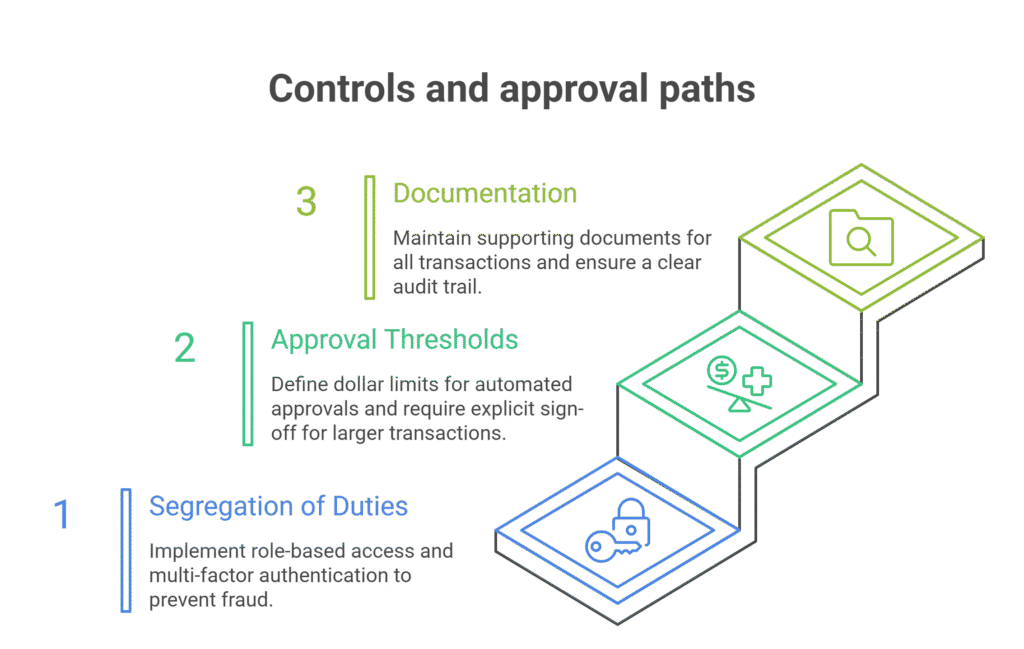
Delegation without controls creates exposure. Effective structures keep final authority inside the company while still allowing outside support to move quickly. Clear approval paths also make it easier to coordinate financial work with broader operational needs such as Social Media Marketing initiatives that generate additional transaction volume.
1. Segregation of duties and access limits
The outsourced team should not have the ability both to enter transactions and to release payments or change bank details. Use role-based access in the accounting software. Providers typically receive data-entry and report-generation rights; payment authorisation and bank account changes stay with the owner or designated internal staff. Multi-factor authentication, activity logs, and regular access reviews are standard expectations in 2026. SEO Services that drive web traffic can increase transaction counts, making these access limits even more important.
2. Approval thresholds and exception handling
Define dollar thresholds. Expenses or invoices under a set amount follow automated or batch approval; larger items require explicit owner sign-off. Unusual transactions route to a designated reviewer before posting. Document the exception process so the provider knows exactly when to pause and escalate.
3. Documentation and audit trail requirements
Every material transaction should carry supporting documentation-invoice, receipt, or approval note-attached in the system. Providers maintain the trail; owners and CPAs can review it at any time. Written service-level agreements should specify response times for questions and turnaround for monthly packages.
Month-end scenario

A well-run outsourced process turns month-end from a scramble into a predictable sequence that protects accuracy and keeps the close on schedule.
1. Pre-close preparation
- Complete bank and credit-card reconciliations in the first few days after month-end.
- Post recurring entries, code open expenses, and generate draft aged reports.
- Limit the owner’s review to exceptions only so time is spent on decisions rather than data hunting.
2. Draft package delivery and review
- Deliver the profit-and-loss statement, balance sheet, cash-flow summary, and key ageing reports by an agreed date.
- Provide the package ready for owner and CPA review with clear notes on any open items.
- Capture and reflect revenue spikes from Facebook Marketing & Ads or Instagram Marketing & Ads campaigns without delaying the timeline.
3. Finalisation and handoff
- Lock the books for the period once approvals are complete.
- Archive the package and prepare any schedules needed for tax or financing purposes.
- Maintain continuity so the next month begins with clean opening balances and documented processes.
Provider checklist
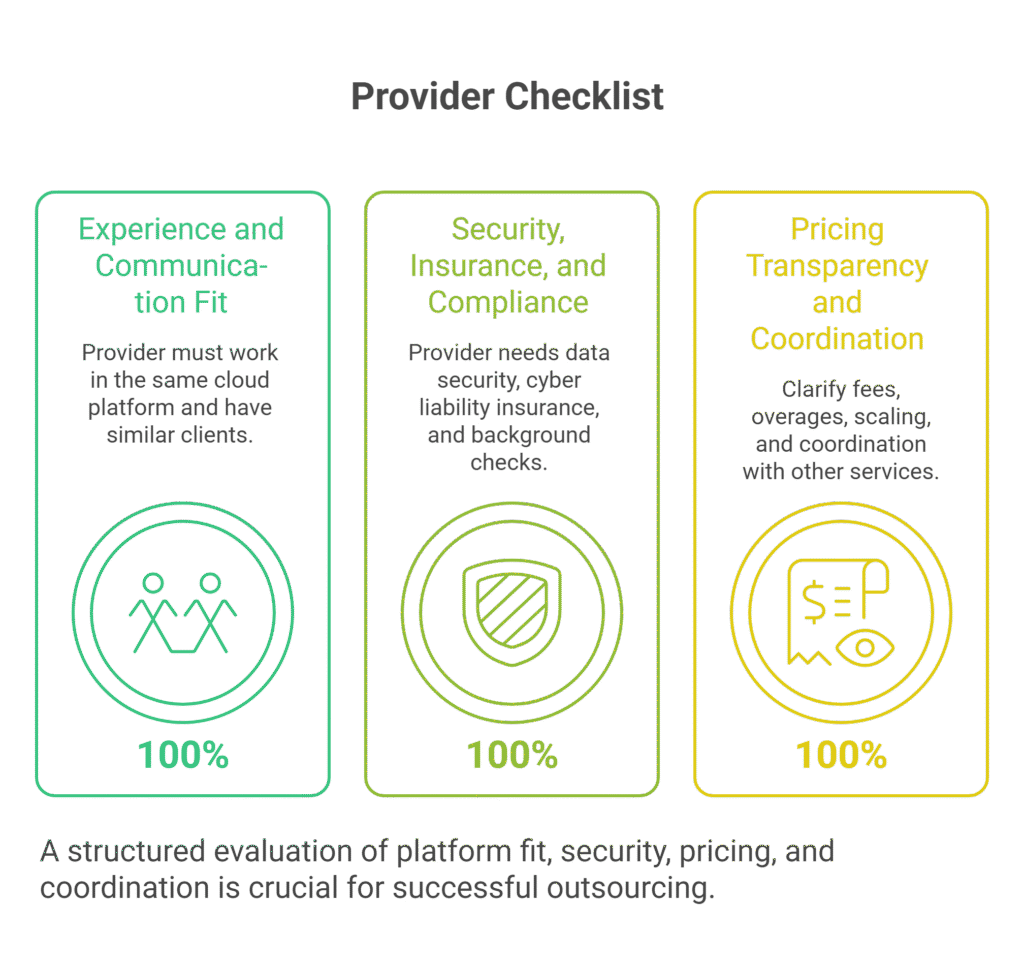
Selecting the right partner determines whether outsourcing reduces friction or creates new problems. A structured evaluation that covers platform fit, security, pricing, and coordination capability protects the business and sets clear expectations from the start.
1. Experience and communication fit
Confirm that the provider works daily in the same cloud platform the business uses and can supply examples of similar-sized clients. Evaluate communication cadence, including weekly status notes and a dedicated point of contact, so questions and exceptions are handled without delay.
2. Security, insurance, and compliance posture
Require evidence of data security practices, cyber liability insurance, and background checks for staff with system access. The provider should be willing to sign appropriate data-processing agreements and demonstrate that access controls align with the segregation-of-duties rules already established inside the company.
3. Pricing transparency and coordination capability
Clarify what is included in the monthly fee, how overages are handled, and how the arrangement scales as transaction volume grows. Speak with current client references, consider a short pilot period with defined deliverables, and note whether the provider can coordinate cleanly with related needs such as LinkedIn Marketing & Ads tracking or Video Editing Services documentation when those activities generate financial records.
Additional considerations for sustainable delegation
Sustainable outsourcing depends on clear process documentation, realistic expectations, and ongoing communication. Growing businesses succeed when they treat external support as an extension of internal systems rather than a complete hand-off. Starting with well-defined tasks and expanding gradually produces better results than attempting to outsource everything at once.
Beyond the core financial workflows, many companies coordinate bookkeeping support with Website Design Services so that customer-facing systems and back-office records remain consistent. Technology continues to lower the cost of clean data capture through receipt apps, bank feeds, and automated matching, allowing providers to focus on exceptions. Owners who invest modestly in these tools before outsourcing typically see smoother handoffs and lower monthly fees.
Risk remains real if boundaries blur. Never grant unrestricted payment authority to an external party. Maintain personal or internal control over bank logins, tax filings, and final financial statement approval. Treat the outsourced team as an extension of process, not a replacement for ownership judgment. As the business expands into Website Development projects, Data Handling requirements, Virtual Receptionist coverage, or IT Support Services, keep the same control principles in place so every outsourced function stays aligned with company standards.
TaskVirtual: Your Partner in Outsourced Bookkeeping and Admin Support

Delegating invoicing, reconciliation, expense tracking, and month-end reporting through outsourced business operations can free up valuable owner time while improving financial efficiency. Yet many growing businesses struggle to find reliable support that maintains accuracy and control. TaskVirtual provides structured virtual assistance and outsourced business operations support tailored to the workflows outlined in this guide, helping U.S. companies strengthen financial accuracy, maintain segregation of duties, establish clear approval processes, and reclaim valuable hours for higher-value business activities.
1. Expert bookkeeping consultation and process mapping
TaskVirtual’s trained virtual assistants help map your current invoicing, bank reconciliation, and expense-coding processes, identify handoff points, and document clear rules so transactional work stays clean, and judgment calls remain with you or your CPA.
2. Affordable and flexible pricing
Hiring a full-time bookkeeper can be expensive, but TaskVirtual makes professional support cost-effective. With pricing plans starting from just $3.12/hour to $14.99/hour, their services remain budget-friendly and accessible to small and growing businesses.
3. Comprehensive admin and bookkeeping support solutions
From generating invoices and matching bank transactions to coding expenses, preparing draft reports, and organising supporting documentation, TaskVirtual covers the core delegable workflows. Their scalable model adapts whether you need light monthly help or consistent month-end coverage.
4. Ongoing support and quality assurance
TaskVirtual provides regular status updates, exception flags, and documented audit trails so you retain full visibility. Proactive communication ensures reconciliations stay current and month-end packages arrive on schedule without last-minute surprises.
5. Proven track record of excellence
With 364 positive reviews and a 4.7-star rating on trusted VA platforms, TaskVirtual is recognised as a reliable partner worldwide. Clients count on their expertise to simplify bookkeeping and admin tasks while protecting control and compliance.
FAQ
1. What tasks should never be fully outsourced?
A. Final payment approval, bank account changes, tax return signing, and strategic financial decisions should remain under owner or licensed CPA control.
2. How much time can a typical owner reclaim?
A. Many owners recover 5–15 hours per month once invoicing, reconciliation support, and expense coding run through an external team, depending on prior manual effort.
3. Is a bookkeeping virtual assistant the same as a fully outsourced firm?
A. A virtual assistant often handles narrower transactional work under closer direction. A firm usually provides broader coverage, standardised processes, and backup coverage.
4. What software works best with outsourced teams?
A. Cloud platforms such as QuickBooks Online and Xero dominate because they support secure multi-user access and real-time collaboration.
5. How do I measure success after outsourcing?
A. Track close timeline, number of unreconciled items at month-end, days sales outstanding, and hours the owner spends on financial admin. Improvement in these metrics indicates the arrangement is working.
6. When should a growing business consider bringing bookkeeping back in-house?
A. When transaction volume and complexity justify a full-time role with benefits still lower than outsourced cost, or when the business needs same-day physical presence that remote support cannot provide.
Conclusion and call to action
Outsourced bookkeeping and admin support lets growing U.S. businesses delegate the repeatable work of invoicing, reconciliation support, expense tracking, and draft reporting while retaining control over approvals and strategy. Clear boundaries between transactional support and professional advice, documented workflows, strong controls, and a structured month-end process turn what once felt like a constant drain into a managed system. The provider checklist above gives a practical starting point for evaluation.
If your current process still consumes evenings and weekends, map your highest-volume tasks against the delegable workflows described here. Identify one or two processes that can move first—often outsource invoicing or bank reconciliation support—then expand once the controls prove reliable. The result is more owner time for growth and cleaner financial data for every decision that follows.
Sources
- U.S. Bureau of Labour Statistics, Occupational Outlook Handbook: Bookkeeping, Accounting, and Auditing Clerks (2025 median pay and projections). https://www.bls.gov/ooh/office-and-administrative-support/bookkeeping-accounting-and-auditing-clerks.htm
- U.S. Bureau of Labour Statistics, Occupational Employment and Wage Statistics (May 2025 data).
- Industry reports synthesising Deloitte and related surveys on finance function outsourcing prevalence (commonly cited ~70% of companies outsourcing at least one finance process).
- SCORE and related small-business time-use surveys on owner hours spent on administrative and financial tasks.
- IBISWorld and related market sizing for U.S. payroll and bookkeeping services.
For more such content, visit our website.
 Siddhartha Basu is a Technical Writer at Task Virtual. He loves online games, e-book reading, and Yoga.