

Contents
show
Outsource CRM Management: How Clean Data and Consistent Follow-Up Protect Revenue
Dirty CRM records quietly drain revenue every day. Gartner has estimated that poor data quality costs organisations an average of $12.9 million annually, highlighting how quickly inaccurate information can become a financial problem. Outdated contacts, duplicate accounts, and inconsistent lead handoffs turn promising pipelines into expensive dead ends. American sales and revenue operations teams feel this pressure acutely as buyer data decays faster than internal teams can keep up and as AI tools amplify every underlying error. Outsourcing CRM management—covering CRM data entry outsourcing, CRM cleanup, sales operations support, and outsourced lead follow-up—offers a practical fix that shifts routine hygiene and persistence work to specialists so internal teams can focus on selling while the system stays reliable.
This operational approach fills a clear gap: most CRM advice stays tool-centric, yet the real cost sits in stale records and broken follow-up workflows. A Virtual Assistant can handle the high-volume data tasks that free sellers from administrative drag, while a coordinated Personal Assistant model supports consistent cadence execution. The result is cleaner records, faster response times, and measurable protection of pipeline value without expanding headcount. Teams that adopt this model also gain clearer visibility into data health trends and reduce the silent friction that otherwise slows every stage of the revenue process.
Revenue Leakage from Dirty CRM Data
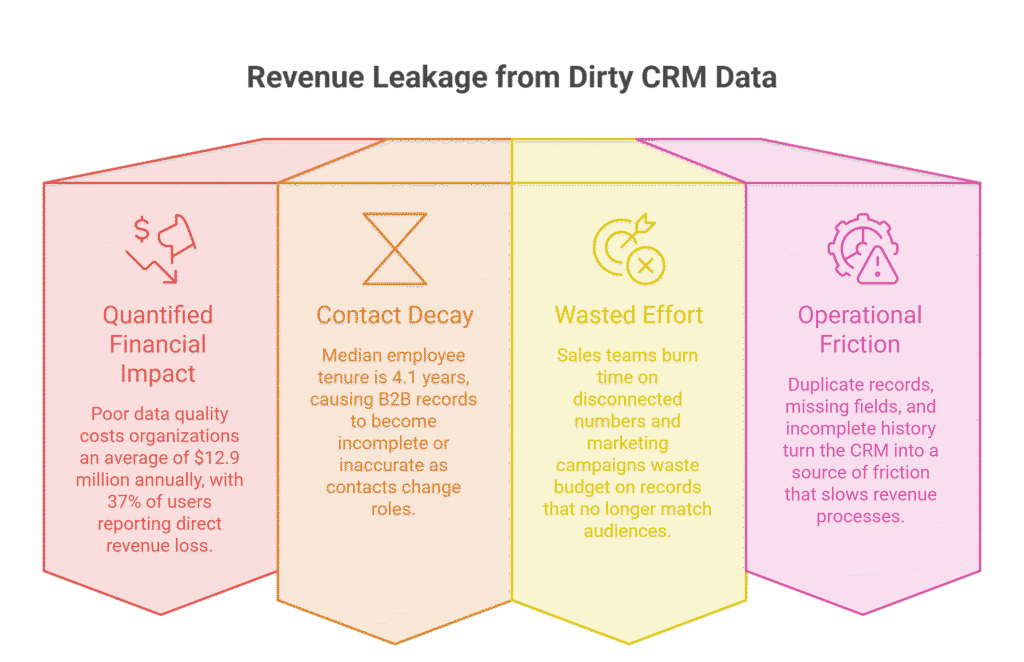
Poor CRM data does not announce itself as a line item on any financial report. According to the U.S. Bureau of Labour Statistics, median employee tenure with a current employer was 4.1 years in January 2026, illustrating how frequently the people, roles, and contact details stored in B2B databases can change. As contacts move companies or change positions, outdated CRM records can contribute to missed renewals, wasted outreach, inaccurate forecasts, and stalled deals. The damage accumulates quietly, making continuous data validation and cleanup essential for revenue teams that want to protect pipeline accuracy and growth.
1. Quantified Financial Impact
Gartner has estimated that poor data quality costs organisations an average of $12.9 million annually. Validity’s State of CRM Data Management in 2025 found that 76% of CRM users say less than half of their organization’s CRM data is accurate and complete, while 37% reported direct revenue loss from data quality problems and companies lost an average of 16 sales deals per quarter for the same reason. A 2026 Validity survey of marketers showed 62% saying poor CRM data probably or definitely cost their organisation revenue through missed renewals, lost deals, and misdirected campaigns.
2. Contact Decay and Wasted Effort
Contact data decays rapidly. Median employee tenure with a current employer stood at 4.1 years in January 2026, according to the U.S. Bureau of Labour Statistics, with private-sector tenure lower. Job changes, title shifts, and email turnover mean a meaningful share of B2B records become incomplete or inaccurate within a year. When sales teams dial disconnected numbers or email departed contacts, they burn time that should go to live opportunities. Forecasts built on inflated or stalled stages lose credibility with leadership, and marketing campaigns target the wrong accounts. Digital Marketing efforts suffer when lists contain outdated firmographics, and even targeted Facebook Marketing & Ads campaigns waste budget on records that no longer match the intended audience.
3. Compounding Operational Friction
The leakage compounds as duplicate records create conflicting ownership, missing required fields break routing rules, and incomplete activity history hides stalled deals until it is too late. Over time, the CRM stops functioning as a reliable system of record and becomes a source of friction that slows every revenue process, from lead response to forecast accuracy.
Tasks Suitable for Outsourcing

Not every CRM activity belongs outside the company. Strategic decisions, complex deal strategy, and relationship ownership stay internal. High-volume, rules-based work transfers cleanly and protects specialised internal knowledge while letting external partners focus on the work they do best.
1. CRM Data Entry Tasks
- CRM data entry outsourcing covers new lead and contact creation from forms, lists, and event scans.
- Standardisation of titles, company names, and address formats keeps records consistent.
- Enrichment with firmographic fields occurs when approved sources are available.
2. CRM Cleanup Tasks
- CRM cleanup includes scheduled deduplication and identification of incomplete records.
- Flagging of bounced or inactive emails and systematic updates when contacts change roles keep the database current.
- These tasks follow clear rules and typically resolve quickly without needing deep system access or strategic judgment. Instagram Marketing & Ads performance improves when the underlying contact data stays accurate through consistent cleanup.
3. Sales Operations and Follow-Up Support
- Sales operations support often includes maintaining stage definitions, ensuring required fields are populated before stage advances, and producing basic pipeline hygiene reports.
- Outsourcing lead follow-up works well for first-response sequences on inbound leads, multi-touch cadence execution on early-stage opportunities, and appointment-setting support under clear scripts and escalation rules.
- Teams also outsource routine activity logging verification and periodic data audits that feed the weekly health scorecard. LinkedIn Marketing & Ads targeting becomes more precise once duplicates and stale titles are removed, and Video Editing Services can support internal training modules that document the new hygiene rules for the outsourced team.
These tasks share common traits: they follow documented rules, generate measurable outputs, and free higher-value sellers from administrative drag. Clear scope documents prevent scope creep and protect sensitive processes.
Definitions, Permissions, and QA
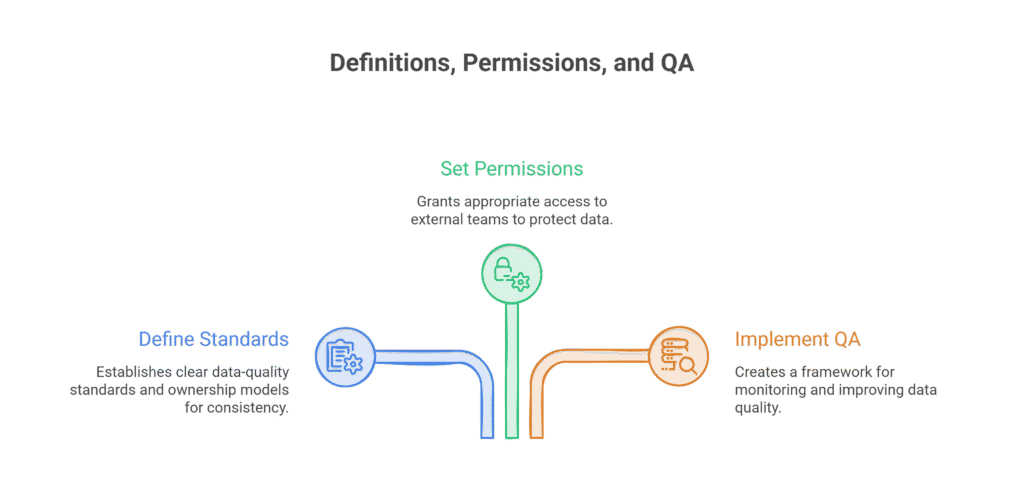
Successful outsourced CRM management rests on precise definitions before any work begins. Establishing clear data-quality standards and ownership responsibilities helps create a consistent framework for managing CRM records. Documenting clean-record requirements, ownership models, and handoff triggers ensures external team members follow the same procedures, reducing the risk of inconsistent data entry or unauthorised changes.
1. Clean-Record Standards and Ownership Models
Define what constitutes a complete contact, account, and opportunity record, including required fields, acceptable source lists, and rules for merging duplicates. Establish clear ownership so every record has an assigned owner and handoff triggers are unambiguous. These standards become the foundation for both internal teams and outsourced partners.
2. Permissions and Access Controls
Grant external teams the minimum access needed—typically create/edit permissions on leads and contacts, limited opportunity visibility, and no delete rights on closed records. Use role-based access, IP restrictions, and audit logging. Data processing agreements and security questionnaires should cover encryption, employee background checks, and breach notification timelines. U.S. companies must also align with applicable privacy expectations even when records are primarily B2B. Online Marketing Services and Social Media Marketing campaigns rely on the same clean data foundation, so the definitions created here protect downstream channels as well.
3. Quality Assurance Frameworks
Quality assurance turns the arrangement from transactional to reliable. Establish sample audit rates (for example, 10–20% of new records or all high-value accounts), define error categories (missing field, wrong value, duplicate, formatting), and set service-level targets for correction turnaround. Weekly or bi-weekly review meetings examine error trends and process adjustments. Scorecards track completeness rates, duplicate ratios, and time-to-update metrics. When QA is treated as a shared process rather than a gotcha, data quality improves steadily, and trust builds on both sides. SEO Services benefit indirectly because accurate company and contact fields improve the quality of any content or landing-page personalisation that draws from the CRM.
Lead-Routing and Follow-Up Scenario

Consider a mid-market B2B software company generating 400–600 inbound leads monthly from content, demos, and paid campaigns. Without disciplined routing and follow-up, many leads may sit unclaimed or receive only one generic email before going cold. Clear boundaries and structured processes help ensure routine lead volumes are handled efficiently while complex or high-value cases stay with internal experts.
1. Initial Capture and Field Validation
- A practical outsourced workflow starts with automated capture into the CRM.
- The external team validates and completes missing fields within defined SLAs.
- Territory or product routing rules are applied, and ownership is assigned.
2. Speed-to-Lead and First Response
- First response occurs within minutes where possible—Harvard Business Review research showed firms contacting leads within an hour were nearly seven times more likely to qualify them than those waiting even an hour longer, and more than 60 times more likely than those waiting 24 hours.
- Website Design Services and Website Development projects often generate form fills that feed this same routing engine.
- Clean handling of those leads protects the investment in the site itself.
3. Cadence Execution and Escalation
- The outsourced team then executes a multi-touch cadence (email, call, LinkedIn) under approved templates and scripts for a set number of attempts.
- Research consistently shows most sales require multiple follow-ups; many internal teams stop after one or two attempts and leave the majority of potential revenue unaddressed. Progress and outcomes log automatically or via structured notes.
- High-intent responses or qualified opportunities escalate immediately to internal account executives with full context. Unresponsive leads return to nurture sequences or are marked for later re-engagement after data refresh.
This model protects speed-to-lead without requiring internal reps to monitor every new form submission around the clock. It also ensures consistent persistence that most sales organisations struggle to maintain under quota pressure.
Weekly CRM Health Scorecard
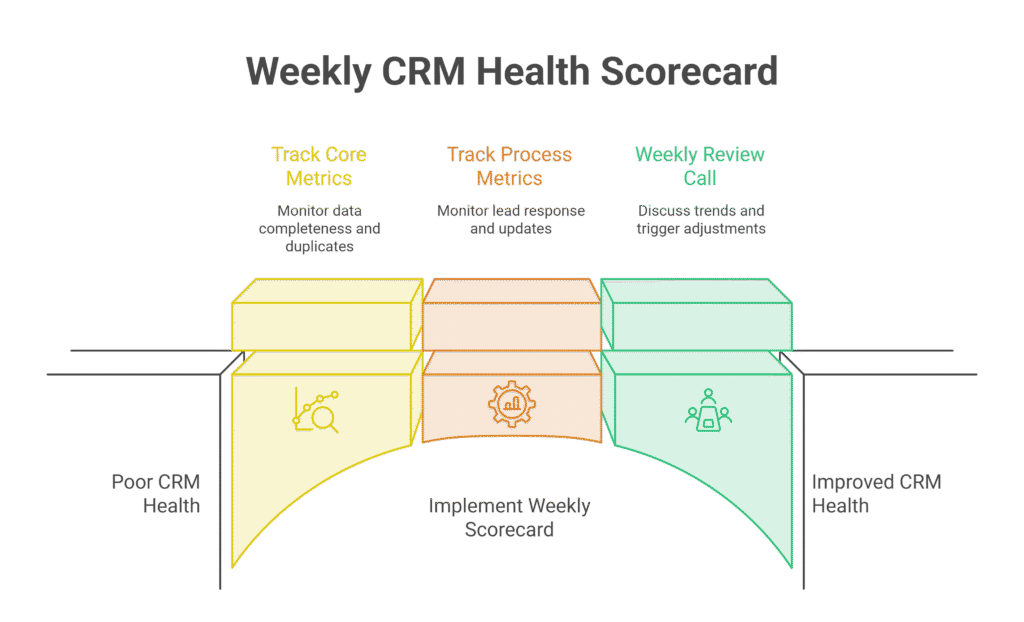
A simple, shared scorecard keeps outsourced work visible and accountable. Tracking a short list of leading indicators each week creates an objective view of data health and process performance while making trends easy to spot and act on before small issues become costly leakage.
1. Core Data Quality Metrics
Completeness rate for new leads and contacts (percentage with all required fields populated), duplicate rate (new duplicates created or percentage of database flagged), and bounce or invalid contact rate on recent outreach form the foundation of the scorecard. Data Handling protocols defined in the QA process feed directly into these metrics and keep the numbers reliable week after week.
2. Process and Response Metrics
Average time from lead creation to first human or system response, percentage of opportunities with a defined next step and future activity, volume of records updated or cleaned versus target, and escalation volume with resolution time complete the operational picture. These indicators reveal whether routing and follow-up workflows are functioning as designed.
3. Review Cadence and Continuous Improvement
Review the scorecard in a short weekly call. Trends matter more than single-week perfection. A rising completeness rate and falling duplicate rate signal that CRM cleanup and data entry outsourcing are working. Persistent gaps trigger process adjustments or additional training. Over months, the scorecard becomes the objective record of improved data health and reduced revenue leakage. A Virtual Receptionist layer can manage the initial inbound call volume that would otherwise interrupt the sales team’s focus on scorecard-driven priorities.
Choosing an Outsourcing Partner and Measuring ROI
Selecting the right partner and tracking return on investment require the same disciplined approach used for the weekly health scorecard. A clear introduction to both evaluation criteria and measurement methods helps leadership move from concept to pilot with confidence and keeps expectations aligned across sales, operations, and finance.
1. Partner Evaluation Criteria
- Prioritise demonstrated experience with your specific CRM platform and documented security and compliance practices.
- Look for clear communication cadences and the ability to work inside your existing definitions rather than imposing theirs.
- Request sample scorecards and references from similar U.S. sales organisations before committing.
2. Pilot and Integration Approach
- Start with a limited pilot—one region, one lead source, or a focused cleanup project—before expanding scope.
- IT Support Services ensure the technical integration stays stable throughout the engagement.
- Bookkeeping Services can later incorporate the cost-versus-revenue impact into financial reporting for leadership.
3. ROI Measurement Approach
- Calculate baseline costs of internal time spent on data entry, cleanup, and basic follow-up, plus estimated revenue impact from delayed or missed leads.
- After outsourcing, compare reduced administrative hours, improved response times, higher data completeness, and any lift in conversion or pipeline velocity.
- Many teams recover the outsourcing investment through reclaimed selling time and fewer wasted marketing dollars alone. Track the weekly health scorecard metrics against those baseline figures for continuous proof.
TaskVirtual: Your Partner in CRM Management Support
 Keeping CRM data clean and follow-up consistent requires ongoing attention that many sales teams struggle to maintain alongside quota pressure. As part of outsourced business operations, TaskVirtual provides specialised virtual support for CRM data entry, database cleanup, lead routing, and structured follow-up. This helps businesses maintain accurate, reliable CRM systems while allowing internal sales teams to focus their time and energy on nurturing prospects and closing deals.
1. Expert CRM Consultation and Process Review
TaskVirtual’s skilled virtual assistants help define clean-record standards, map required fields, set ownership rules, and design practical QA checkpoints. They review existing data structures, identify common error patterns, and recommend workflows that keep completeness high and duplicates low.
2. Affordable and Flexible Pricing
Hiring a full-time internal resource for routine CRM hygiene can be expensive, but TaskVirtual makes it cost-effective. With pricing plans starting from just $3.12/hour to $14.99/hour, their services are budget-friendly and accessible to growing sales teams and mid-market organisations.
3. Comprehensive CRM Support Solutions
From new lead and contact creation and systematic deduplication to multi-touch cadence execution and weekly health-scorecard reporting, TaskVirtual covers the full range of outsourced CRM management tasks. Their scalable services adapt whether you need focused cleanup projects or ongoing data entry and follow-up support.
4. Ongoing Support and Quality Assurance
TaskVirtual goes beyond basic data entry by providing regular progress updates, error-trend reviews, and proactive corrections. Their structured QA approach ensures records stay complete, routing rules function correctly, and response-time targets are met without adding internal administrative burden.
5. Proven Track Record of Excellence
With 364 positive reviews and a 4.7-star rating on trusted VA platforms, TaskVirtual is recognised as a reliable partner worldwide. Clients count on their expertise to maintain clean CRM data, protect pipeline accuracy, and keep follow-up consistent across high-volume lead flows.
FAQ
1. What is outsourced CRM management?
It is the practice of assigning routine CRM hygiene, data entry, cleanup, and selected follow-up tasks to specialised external teams while retaining strategic ownership and high-value selling inside the company.
2. How does CRM data entry outsourcing differ from full CRM management?
Data entry outsourcing focuses on accurate creation and updating of records according to rules. Full management often adds cleanup, routing support, cadence execution, and ongoing health monitoring.
3. Is it safe to outsource access to our CRM?
Yes, when permissions are limited, contracts include strong data protection clauses, audit logs are reviewed, and the partner meets security standards. Most reputable providers operate under strict access controls.
4. What volume of leads makes outsourced lead follow-up worthwhile?
Teams generating consistent inbound volume or running multi-touch outbound sequences usually see the fastest return. Even moderate volumes benefit when internal capacity is stretched.
5. How quickly can we expect cleaner data after starting CRM cleanup?
Initial high-priority cleanup often shows measurable improvement in completeness and duplicate rates within 4–8 weeks. Sustained weekly processes prevent decay from returning.
6. Does outsourcing replace the need for internal sales operations?
No. It augments internal teams by handling volume and consistency so sales operations can focus on process design, tooling, forecasting, and strategic analysis.
Conclusion
Clean data and consistent follow-up are not optional hygiene tasks. They are revenue protection mechanisms. Dirty records and abandoned leads create silent leakage that no new tool fully solves. Outsource CRM management—through disciplined CRM data entry outsourcing, systematic CRM cleanup, sales operations support, and reliable outsourced lead follow-up—gives American revenue teams a scalable way to keep the system trustworthy while sellers stay focused on closing.
Start with a clear audit of current completeness and response times, define the rules and permissions, select a partner that works inside those rules, and install a simple weekly health scorecard. The combination of clean records and persistent, well-timed follow-up turns the CRM from a source of friction into a reliable engine that protects and grows revenue.
If your team is ready to stop the leakage, begin with a focused pilot on the highest-volume or highest-value segment of your database. The operational clarity and measurable lift in data health usually appear faster than expected.
Sources
- Gartner research on cost of poor data quality (widely cited $12.9 million average annual cost)
- Validity, State of CRM Data Management in 2025 (PR Newswire release)
- Validity, State of CRM Data Report 2026 findings on marketer revenue impact
- U.S. Bureau of Labour Statistics, Employee Tenure in 2026
- Harvard Business Review, “The Short Life of Online Sales Leads” (2011)
For more such content, visit our website.
 Siddhartha Basu is a Technical Writer at Task Virtual. He loves online games, e-book reading, and Yoga.