Contents
show
How Telehealth Practices Use VAs to Handle Patient Admin
Telehealth has transformed healthcare delivery, offering convenient virtual visits that expanded dramatically during the pandemic and remain integral today. Yet, behind the screens, administrative burdens threaten to overwhelm providers. Telehealth practices use VAs—skilled remote professionals—to handle patient admin tasks, freeing clinicians to focus on care while scaling operations efficiently.
With telehealth visits stabilizing at high levels (around 30% of U.S. adults reported use in recent years, down from pandemic peaks but far above pre-2019 levels), practices face surging demand for coordination, documentation, and compliance. Virtual assistants address this by managing scheduling, insurance verification, EHR updates, patient communication, and more—often HIPAA-compliant and integrated with telehealth platforms.
This case study–driven guide explores how telehealth practices leverage VAs for patient admin. Drawing from real implementations, it highlights workflows, benefits, challenges, and proven results. Expect actionable insights to optimize your practice amid ongoing physician burnout rates of around 45% and administrative overload.
The Rise of Telehealth and Administrative Challenges
Telehealth practices use VAs extensively to manage the growing administrative demands that accompany virtual care delivery. As patient volumes increase through remote platforms, efficient handling of backend tasks becomes essential for maintaining smooth operations and high-quality service. These virtual assistants provide scalable support tailored to the unique needs of telehealth environments.
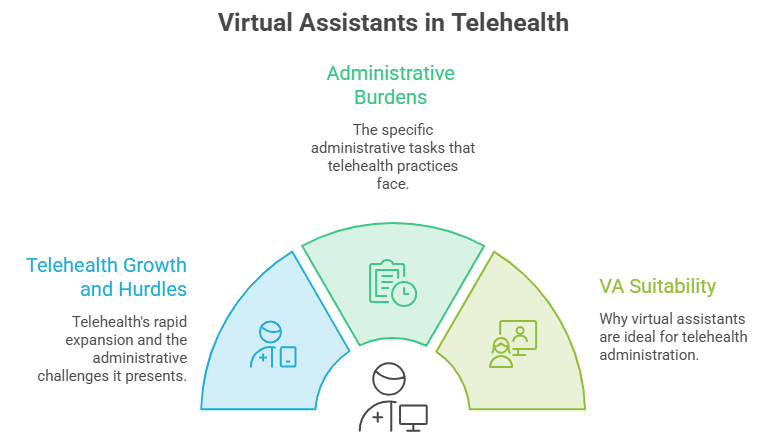
1. Understanding Telehealth’s Growth and Persistent Hurdles
Telehealth adoption surged from about 15% of physician visits pre-pandemic to over 86% at peak, with weekly use by physicians now at ~71%. This shift enables broader access, especially for chronic care, mental health, and rural patients, but introduces unique admin demands such as multi-state licensing coordination, digital intake across time zones, and seamless platform integration.
Practices often struggle with high no-show rates, billing delays, and provider burnout from paperwork that accumulates rapidly in virtual settings. VAs help mitigate these ongoing challenges by offering dedicated remote expertise that aligns with telehealth’s flexible yet complex operational model.
2. Key Administrative Burdens in Telehealth Practices
Telehealth practices use VAs to tackle scheduling and reminders across time zones while reducing no-show rates that frequently reach 15-20% without proper support. Insurance verification and billing require constant attention to telehealth-specific codes and prior authorizations to prevent revenue loss. Patient intake, follow-up coordination, and compliance with data management standards add layers of complexity that demand reliable handling.
These burdens pull providers away from clinical focus and heighten overall stress levels. Effective VA integration streamlines these processes without compromising security or accuracy. Practices benefit from consistent execution that supports both daily operations and long-term scalability.
3. Why VAs Are Ideal for Telehealth Admin
Telehealth practices use VAs because they deliver scalable and cost-effective support compared to traditional in-house staffing models. These professionals often provide specialized telehealth training and integrate seamlessly with HIPAA-compliant tools and existing platforms. This approach avoids fixed overhead while allowing practices to adjust capacity based on fluctuating patient demand.
VAs maintain high reliability in handling volume spikes and multi-state coordination requirements. Their remote nature fits perfectly with virtual care workflows, enabling 24/7 coverage without physical office constraints. Overall, this model enhances efficiency and allows providers to prioritize patient interactions over routine administrative duties.
Case Studies: Telehealth Practices Transforming with VAs

Telehealth practices use VAs successfully across settings to overcome administrative hurdles and achieve sustainable growth, especially as 45.2% of physicians reported burnout symptoms in 2023. These examples demonstrate measurable operational improvements.
1. Case Study 1: Phoenix Nurse Practitioner’s Concierge Telehealth Scaling
- Cheyenna Kopacz launched At Your Doorstep Medical in 2022, blending house calls and telehealth.
- Overwhelmed by ~100 daily tasks, she partnered with Elite Resource Services.
- Two VAs were added: front-office for calls/billing and medical assistant for labs/charts.
- Onboarding via Loom videos achieved independence in two weeks.
- Marketing VAs were later added for website and social media.
- Results: Supported 3 providers, handled crises smoothly, boosted website traffic, and reduced burnout.
2. Case Study 2: Behavioral Health Practice Efficiency Boost
- IPMG handled 60-70 daily visits with rising no-shows and staff strain.
- VirtualCare Assistants managed scheduling, reminders, intake, and follow-ups.
- VAs are integrated with telehealth platforms and EHR systems.
- No-show rates dropped significantly.
- Patient satisfaction and provider efficiency improved.
3. Case Study 3: Multi-Location and Specialty Practices
- A plastic surgery practice used VAs after losing an on-site MA for scheduling and records.
- Valley Diabetes relied on VAs for chronic care follow-ups.
- Mobile IV services optimized dispatch and scheduling.
- Outcomes: Faster responses, fewer errors, and better satisfaction.
4. Lessons from TMA Solutions Remote Monitoring Client
- Remote health app integrated AI/health VA for queries and reminders.
- Addressed delays, high costs, and older people’s user issues.
- VA handled knowledge-base responses and appointment management.
- Achieved 25% cost reduction and higher satisfaction.
How Telehealth Practices Use VAs: Core Workflows and Best Practices
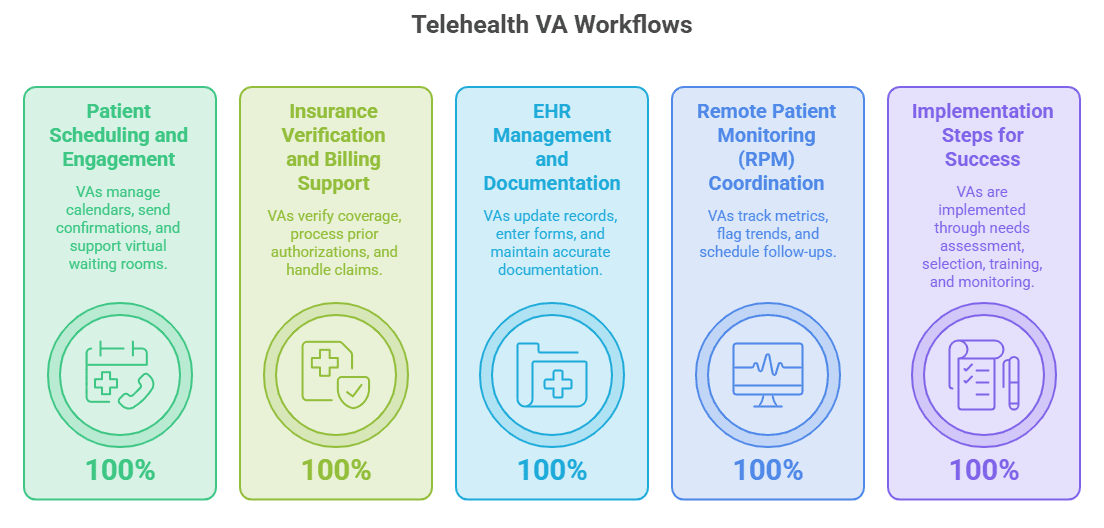
Telehealth practices use VAs to create efficient, patient-centered administrative systems supporting virtual care, as 74.4% of physicians reported telehealth use in practices. These professionals handle repetitive, time-sensitive tasks, integrating with platforms while best practices emphasize compliance, protocols, and optimization.
1. Patient Scheduling and Engagement
Telehealth practices use VAs to manage calendars, handle rescheduling requests, and send confirmations and reminders that effectively reduce no-shows. VAs coordinate across time zones and support virtual waiting rooms while troubleshooting technical issues for patients. This engagement ensures higher attendance and smoother session starts.
2. Insurance Verification and Billing Support
Telehealth practices use VAs for pre-appointment coverage verification, prior authorization processing, and claims handling to minimize denials and payment delays. VAs stay current with evolving telehealth reimbursement rules and flag potential issues early in the workflow. This support protects revenue streams and reduces administrative friction for providers.
3. EHR Management and Documentation
Telehealth practices use VAs to update patient records, enter intake forms, and maintain accurate documentation across EHR platforms. These professionals ensure compliance standards are met while reducing the documentation burden on clinicians. Efficient data management leads to better continuity of care in virtual settings.
4. Remote Patient Monitoring (RPM) Coordination
Telehealth practices use VAs to track health metrics, flag concerning trends, and schedule timely follow-ups for RPM patients. VAs coordinate data sharing and support interpretation to enable proactive interventions. This approach enhances efficiency and improves outcomes for chronic care management.
5. Implementation Steps for Success
Telehealth practices use VAs effectively by first assessing specific needs and identifying suitable delegable tasks. Practices select HIPAA-compliant professionals with telehealth experience and provide training through screen recordings and detailed protocols. Ongoing monitoring with performance metrics and feedback ensures continuous improvement and alignment with practice goals.
Benefits and Measurable Impacts

Telehealth practices use VAs to achieve significant operational and clinical improvements across multiple areas. These benefits extend to providers, patients, and overall practice sustainability in a competitive virtual care landscape.
1. Reducing Clinician Burnout
- Offloads admin tasks, a top burnout driver.
- Improves work-life balance and reduces stress.
- Boosts provider retention in telehealth.
2. Improving Patient Experience and Outcomes
- Delivers faster responses and fewer care gaps.
- Boosts treatment adherence and satisfaction.
- Supports more accessible care options.
3. Operational Efficiency and Scalability
- Enables 24/7 coverage and lower error rates.
- Supports volume growth with low added cost.
- Enhances resilience for new services.
Challenges and Considerations for Telehealth VA Integration
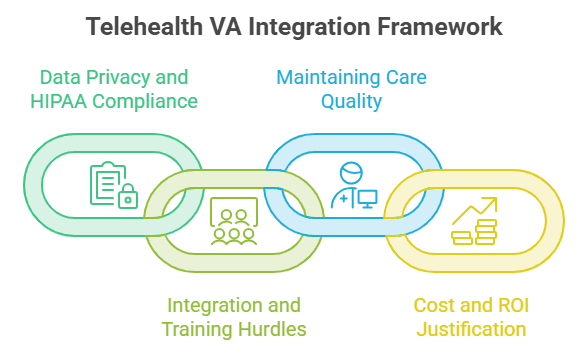
Telehealth practices use VAs while carefully navigating implementation obstacles, including data privacy, as hacking caused 79.7% of healthcare breaches in 2023. Addressing these considerations proactively ensures smoother adoption, sustained benefits, and stronger VA partnerships.
1. Data Privacy and HIPAA Compliance
Telehealth practices use VAs with robust training on PHI handling and require signed Business Associate Agreements for all involved parties. Secure communication tools and regular system audits help prevent breaches and maintain patient trust. Compliance remains an ongoing priority through updated protocols and monitoring.
2. Integration and Training Hurdles
Telehealth practices use VAs after initial workflow adjustments and platform familiarization periods that require dedicated planning. Screen-based training and gradual rollout help minimize early disruptions during onboarding. Iterative feedback allows practices to refine processes over time for optimal fit.
3. Maintaining Care Quality
Telehealth practices use VAs as complementary support with clear escalation protocols for any clinical concerns. Transparent communication with patients about VA roles helps build confidence in the hybrid model. Regular quality checks ensure administrative efficiency enhances rather than detracts from care standards.
4. Cost and ROI Justification
Telehealth practices use VAs, recognizing that initial investments yield rapid returns through time savings and increased patient capacity. Flexible scaling options avoid unnecessary fixed costs associated with traditional hires. Tracking key metrics such as error reduction and revenue impact confirms strong long-term value.
Future Trends in Telehealth and VAs
Telehealth practices use VAs that will increasingly incorporate AI enhancements for predictive task handling and deeper personalization. These advancements promise more sophisticated symptom triage support and seamless EHR integrations while maintaining human oversight for complex matters. As technology matures, VAs will become even more integral to efficient virtual care delivery.
Practices adopting advanced VA solutions early position themselves competitively in the evolving healthcare landscape. Continued focus on compliance and patient-centered design will guide the successful integration of these tools. Overall, the combination of telehealth and VAs points toward more accessible, scalable, and high-quality care options for American patients.
TaskVirtual: Your Partner in Telehealth Virtual Assistant Services

Telehealth practices use VAs to manage complex patient admin tasks such as scheduling, insurance verification, EHR updates, and follow-up coordination. These responsibilities can quickly overwhelm providers and staff, diverting focus from clinical care. TaskVirtual delivers expert virtual assistant services that simplify telehealth operations, helping practices handle patient admin efficiently while maintaining HIPAA compliance and high care standards.
1. Expert Telehealth VA Consultation and Review
TaskVirtual’s skilled virtual assistants support telehealth practices by optimizing scheduling, verifying insurance, managing EHR documentation, and coordinating patient follow-ups. They help select the right tools and workflows tailored to your platform and specialty needs.
2. Affordable and Flexible Pricing
Hiring a full-time personal assistant can be expensive, but TaskVirtual makes it cost-effective. With pricing plans starting from just $3.12/hour to $14.99/hour, their services are budget-friendly and accessible to individuals, families, and businesses.
3. Comprehensive Telehealth Admin Support Solutions
From patient intake and appointment management to billing support and remote monitoring coordination, TaskVirtual covers essential telehealth workflows. Their scalable services adapt to whether you need occasional help or full-time administrative support for growing practices.
4. Ongoing Support and Quality Assurance
TaskVirtual provides continuous monitoring, proactive updates, and performance reviews to ensure seamless integration with your telehealth systems. Their dedicated support minimizes disruptions and keeps patient admin running smoothly.
5. Proven Track Record of Excellence
With 364 positive reviews and a 4.7-star rating on trusted VA platforms, TaskVirtual is recognised as a reliable partner worldwide. Clients count on their expertise to simplify patient admin and streamline telehealth operations.
FAQ Section
1. How do telehealth practices use VAs for patient admin?
VAs handle scheduling, insurance verification, EHR updates, reminders, and communication—streamlining operations while ensuring compliance.
2. What tasks can telehealth VAs not perform?
Clinical diagnosis, treatment decisions, or tasks requiring licensure. They support admin and coordination only.
3. Are VAs cost-effective for small telehealth practices?
Yes—often 50-70% savings vs. in-house, with flexible scaling and quick onboarding.
4. How do VAs impact patient satisfaction in telehealth?
Positively, via faster responses, fewer no-shows, and consistent follow-up, leading to better engagement.
5. What training is needed for telehealth VAs?
HIPAA, specific EHR/telehealth platforms, workflow shadowing, and ongoing updates.
6. Can VAs support remote patient monitoring?
Yes—tracking data, scheduling, and coordination to enhance efficiency and outcomes.
Conclusion
Telehealth practices use VAs to master patient admin, turning operational challenges into strengths. Real cases—from concierge scaling to specialty efficiency—demonstrate reduced burnout, cost savings, higher satisfaction, and sustainable growth. As telehealth evolves, strategic VA partnerships will be key to delivering high-quality, accessible care.
Virtual assistants can help telehealth practices manage scheduling, patient communication, documentation, and other administrative responsibilities. Learn more about how virtual medical assistants support healthcare practices.
CTA: Ready to optimize your telehealth practice? Assess your admin bottlenecks and explore specialized VA support today for measurable results. Contact experts or start with a workflow audit.
Sources
- Helpsquad.com healthcare VA insights
- TMA Solutions case study
- Keragon AI VA in healthcare
- Vivian.com virtual assistants trends
- AMA Telehealth Playbook
- Elite Resource Services Phoenix NP case
- Wing Assistant telemedicine VA guide
- Staffingly RPM with VAs
- VirtualMedicalAssistant.us case studies
- Authoritative stats: CDC, AMA, Statista, Medscape reports (linked inline where applicable)
For more such content, visit our website.
 Siddhartha Basu is a Technical Writer at Task Virtual. He loves online games, e-book reading, and Yoga.