

Contents
show
One Team vs. Five Freelancers: The Hidden Cost of Fragmented Business Support
American businesses increasingly turn to freelancers for specialised skills without the overhead of full-time hires. Platforms make talent easy to find, and the flexibility looks attractive on paper. Yet many companies quietly discover that managing five separate freelancers creates more friction than value. Briefings multiply, handoffs break, quality varies, and internal managers spend hours each week just keeping projects aligned. The smarter path for growing operations is often to replace freelancers with one team—an integrated, manager-led group that owns outcomes end to end. This approach reduces coordination debt, improves coverage, and delivers clearer accountability while preserving the flexibility companies originally sought from the gig economy.
According to the U.S. Bureau of Labour Statistics, 11.9 million people worked as independent contractors on their sole or main job in July 2023, representing 7.4 per cent of total employment. Broader estimates of independent work reach far higher. The challenge is not the existence of freelance talent; it is the operational cost of stitching that talent together yourself. This post quantifies those hidden costs, compares the models, walks through real before-and-after scenarios, and provides a practical migration checklist so you can decide whether a single outsourced operations team is the better long-term solution.
The Fragmentation Problem in Multi-Freelancer Operations
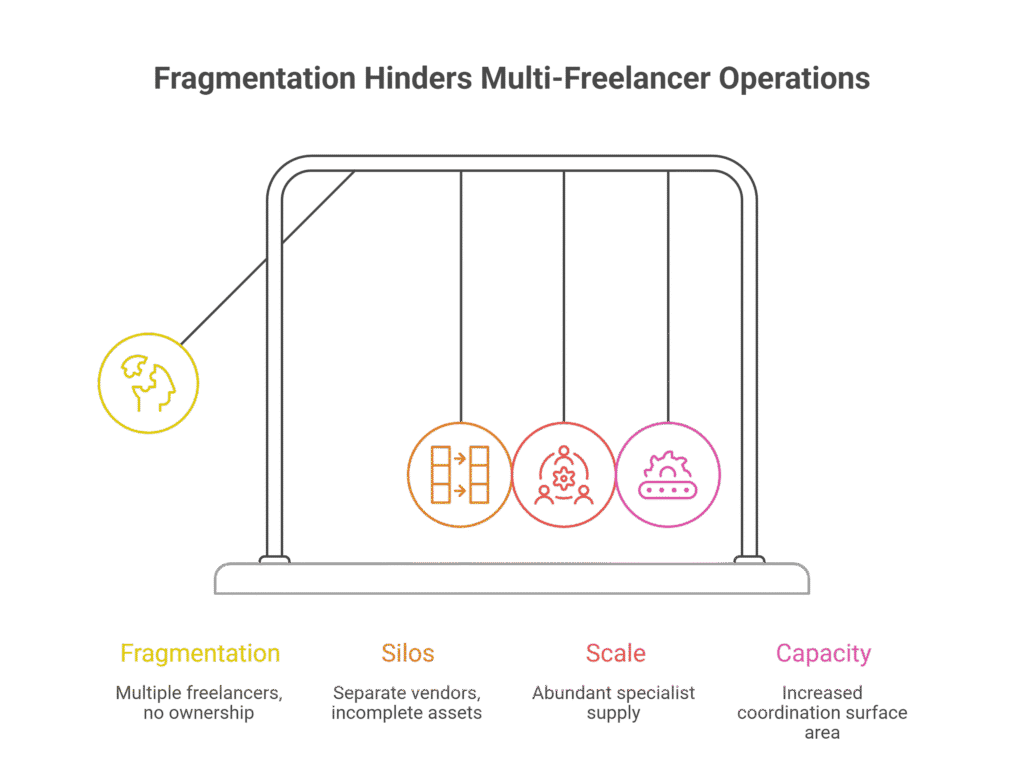
Fragmentation starts small. A marketing lead hires a copywriter on one platform, a designer on another, a developer through a referral, and a media buyer via a marketplace. Each relationship begins efficiently. Over time, the number of relationships grows, tools multiply, and no single person owns the full workflow.
1. How Multiple Freelancers Create Operational Silos
Each freelancer operates as a separate vendor with their own contract, preferred communication channel, file-naming conventions, and revision process. Information that should flow freely instead travels through the client’s project manager. When the designer finishes a landing-page mockup, the developer may receive incomplete assets or outdated brand guidelines. The media buyer launches campaigns without knowing the latest copy changes. These gaps are not usually malicious; they are structural.
Without a shared backlog or single source of truth, every handoff becomes a potential failure point. Internal teams absorb the translation work. Managers rewrite briefs for each specialist, chase status updates across Slack threads and email chains, and reconcile conflicting priorities. The result is slower cycle times and rising opportunity cost. Work that could move in parallel instead moves sequentially because the coordinating layer is thin and overloaded. Many organisations first notice the strain when they try to layer a Virtual Assistant into an already fragmented stack and realise the new resource only adds another coordination node.
2. The Scale of Independent Work in the U.S. Economy
Independent contractors form a meaningful share of the U.S. labour market. BLS data show 11.9 million independent contractors in 2023. Other research estimates that tens of millions of Americans earn at least some income from freelance or gig activity in a given year. For businesses, this means abundant specialist supply across almost every function, from creative production to technical support. It also means that the default response to a skills gap is often “hire another freelancer” rather than redesign the delivery model. That reflex compounds fragmentation as the number of active vendors grows from two or three to five, eight, or more, especially when companies begin adding specialised roles such as a Personal Assistant for executive support or campaign specialists.
The growth of independent work has been steady rather than explosive, yet its impact on internal operations is outsized. When a company already relies on multiple external contributors for Digital Marketing initiatives, the administrative surface area expands faster than the productive capacity. Each new contractor requires onboarding, access rights, style-guide training, and ongoing relationship maintenance. The result is that management bandwidth becomes the real constraint long before talent scarcity does.
3. Why “Just Hire Another Specialist” Rarely Solves Capacity Issues
Adding another freelancer increases total capacity on paper, but it also expands the surface area for coordination. Each new relationship requires onboarding, access provisioning, style-guide training, and ongoing maintenance. A 2025 Deloitte survey found that employees estimate 41% of their work time goes to activities that don’t contribute to the value their organisation creates—a broad workplace finding that highlights how much time can be absorbed by internal overhead. The marginal cost of the fifth or sixth freelancer may therefore extend well beyond their hourly rate to include the internal hours spent keeping everyone aligned. This pattern can arise when teams scale Facebook Marketing & Ads or similar channel-specific work by simply adding more independent specialists.
The same dynamic plays out across other disciplines. A request for Instagram Marketing & Ads support may seem like a clean addition, yet it introduces new briefing cycles, new reporting formats, and new points of failure in the handoff chain. Without a unifying operational layer, every incremental hire multiplies friction rather than relieving it. Capacity appears to grow while throughput and quality remain constrained by the invisible tax of coordination.
The Real Cost of Briefing, QA, and Missed Handoffs
The invoice line items for freelancers rarely capture the full expense. The higher costs live in the hours internal staff spend preparing work, reviewing it, and repairing what falls through the cracks. These hidden expenses accumulate quietly until they begin to limit growth and stretch internal teams beyond sustainable limits. Understanding the true cost requires looking beyond hourly rates to the full operational burden.
1. Quantifying Coordination Overhead
- Studies of multi-vendor and multi-freelancer environments consistently show substantial management time, with creative teams working with eight to twelve external contributors often spending 18–25 hours per week solely on relationship management, feedback consolidation, and asset coordination.
- Agency freelancer workflows frequently require 60–120 hours per month of internal coordination for organisations running dozens of assignments.
- At blended internal rates of $75–$100 per hour, that overhead quickly reaches five or six figures annually.
- Context switching itself carries a measurable penalty; research associated with Microsoft and University of California, Irvine findings indicates that recovering from an interruption can take roughly 23 minutes.
- Every status ping, clarification request, or file chase extracts a productivity tax from the people trying to keep the work moving, especially when LinkedIn Marketing & Ads campaigns require frequent cross-specialist alignment.
2. Quality Assurance Friction and Rework Cycles
- When specialists work in isolation, quality gates become sequential rather than integrated, so a designer may deliver pixels that technically meet the brief yet fail accessibility or brand standards the developer was never told about.
- The copywriter’s tone may clash with the media buyer’s audience data, triggering revision rounds that no single freelancer owns.
- Rework rates in fragmented setups commonly climb into the 15 – 20 per cent range of project effort, versus far lower rates when a coordinated team shares definition of done and joint accountability.
- Video Editing Services delivered without shared context often require multiple correction cycles that delay campaign launches.
- The cumulative effect is longer timelines, higher effective costs, and declining confidence in external delivery partners.
3. Missed Handoffs and Their Downstream Impact
- Missed or incomplete handoffs create cascading delays; a campaign launch slips because tracking parameters were never confirmed.
- A product update ships without updated support documentation because the technical writer was never looped in.
- Clients experience these failures as “the freelancers dropped the ball,” even when the root cause was the absence of a single operational owner.
- The commercial impact includes extended timelines, emergency rush fees (often 40–60 per cent premiums), and eroded trust that makes future scope expansions harder to win.
- When online Marketing Services span multiple independent contributors, these gaps become systemic rather than isolated incidents.
Accountability, Coverage, and Flexibility: Side-by-Side Comparison

Choosing between five freelancers and one integrated team is not purely a cost decision. It is a decision about risk allocation, continuity, and operational design. The differences become clearest when examined across three dimensions that matter most to growing businesses. Each dimension reveals why consolidation often outperforms fragmentation for ongoing work.
1. Single Point of Accountability Versus Diffused Ownership
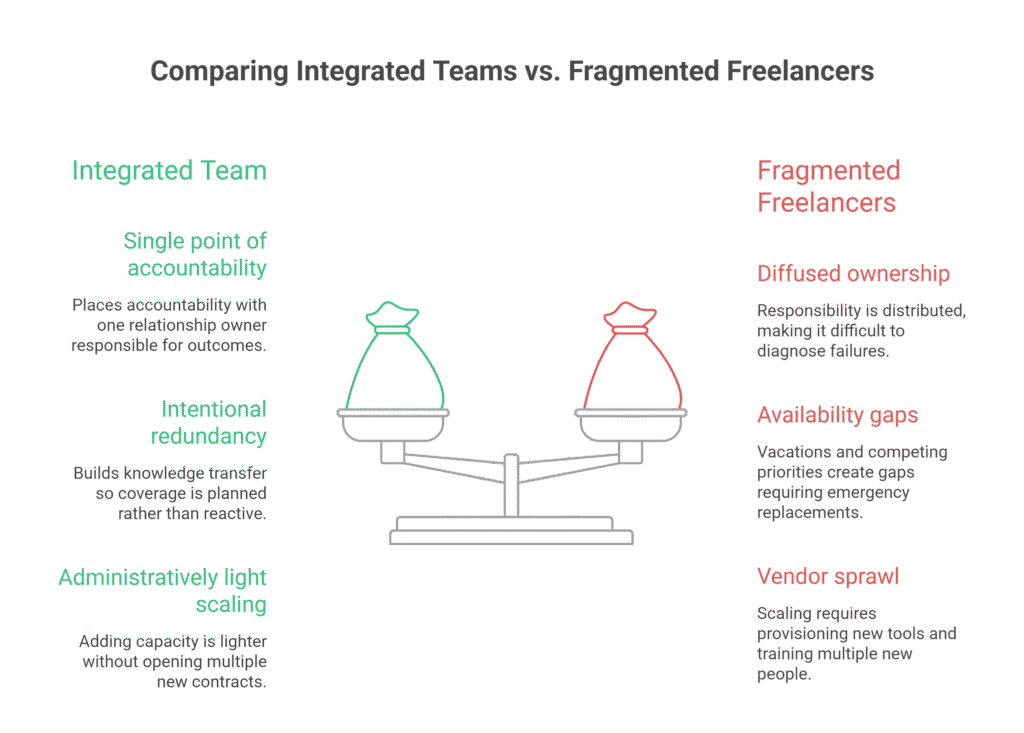
With multiple freelancers, responsibility is distributed. When a deliverable is late or incomplete, the client must diagnose which vendor failed and negotiate remedies with each party separately. An outsourced operations team or managed multi-specialist group places accountability with one relationship owner who is contractually and operationally responsible for outcomes, not merely for individual tasks. Escalation paths become clearer, performance reviews are consolidated, and root-cause analysis becomes possible instead of perpetual finger-pointing. This single-point structure proves especially valuable when Social Media Marketing efforts involve several specialists whose work must remain tightly synchronised.
2. Coverage Continuity and Backup Capacity
Freelancers have other clients. Vacations, illness, or competing priorities create availability gaps that force emergency replacements, often at premium rates, and still require fresh onboarding. A properly structured team builds intentional redundancy and knowledge transfer so coverage is planned rather than reactive. For business-critical functions such as SEO Services or recurring analytics, this difference is decisive because continuity protects both delivery quality and internal team focus.
3. Flexibility Without the Chaos of Vendor Sprawl
Both models can scale up or down. The difference lies in the friction of that scaling. Adding capacity through a single vendor relationship is administratively lighter than opening three new contracts, provisioning three new tool seats, and training three new people on institutional knowledge. Flexibility remains; the coordination tax does not scale linearly with headcount. Teams that consolidate Website Design Services under one accountable partner experience this advantage most clearly when demand fluctuates.
Before-and-After Scenarios: What Changes When You Consolidate
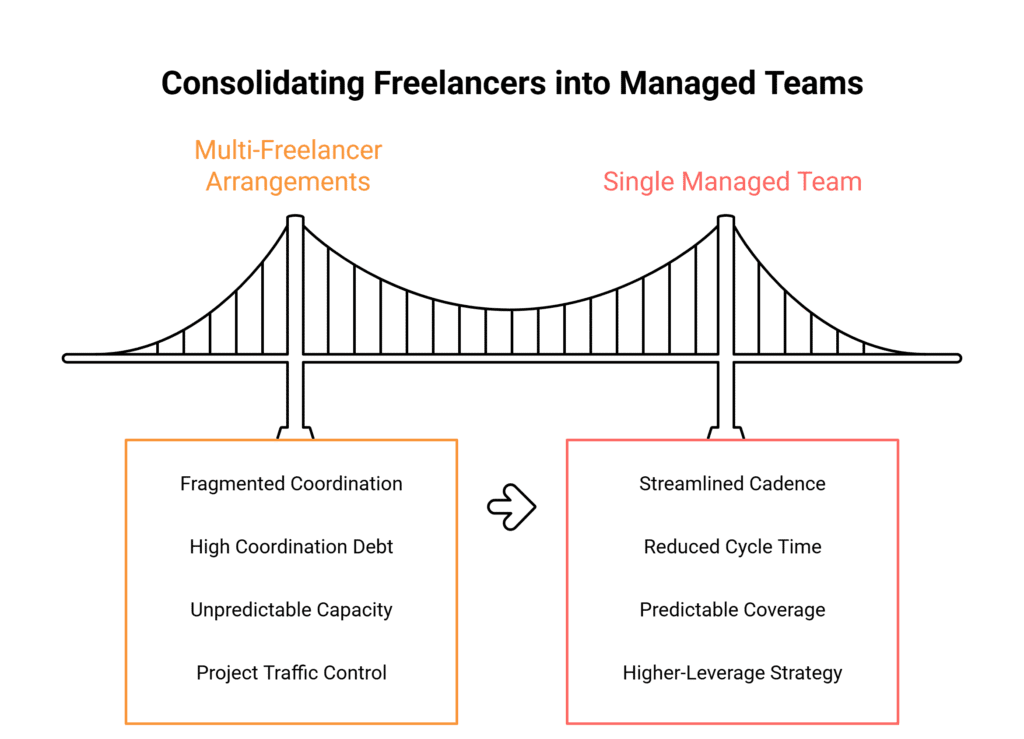
Concrete examples illustrate the shift more clearly than abstract claims. The following scenarios draw from patterns observed across mid-market companies that moved from multi-freelancer arrangements to a single managed team. In each case, the visible rate cards changed modestly while operational outcomes improved substantially. The common thread is the reduction of coordination debt and the concentration of accountability.
1Scenario 1: Mid-Sized SaaS Marketing Operations
- Before: A 40-person SaaS company used five freelancers for content, design, paid social media, SEO, and email; internal marketing managers spent roughly one full day per week coordinating.
- Campaign launches averaged three weeks of calendar time with frequent last-minute revisions and chaotic asset versioning that undermined brand consistency.
- After consolidating to one managed creative and growth operations team, briefing became a single weekly cadence, and shared tools reduced handoff friction.
- Launch cycle time dropped by nearly 40 per cent; internal managers reclaimed most of the coordination hours and redirected them to strategy, while total external spend remained comparable and effective output rose because rework and waiting time fell, including smoother delivery of Website Development tasks.
Scenario 2: E-Commerce Operations Support
- Before: An e-commerce brand relied on separate freelancers for customer support overflow, product data entry, and social community management; response-time SLAs were missed during peak seasons because no one coordinated surge capacity, and product knowledge remained uneven across vendors.
- After moving to a single outsourced operations team with shared training and a dedicated account lead, support coverage became predictable, and product knowledge was centralised and updated in one place.
- Seasonal scaling happened through the same relationship rather than emergency marketplace searches.
- Customer satisfaction scores stabilised, and internal operations staff spent less time firefighting, with Data Handling processes becoming consistent rather than vendor-dependent.
Common Patterns Across Transitions
- In both cases, the visible rate cards did not change dramatically; what changed was the ratio of productive output to total effort.
- Coordination debt declined and institutional knowledge accumulated inside the delivery team rather than remaining trapped in the client’s head.
- Managers gained time for higher-leverage work instead of perpetual project traffic control.
- The same pattern holds when companies consolidate functions such as a Virtual Receptionist role or IT Support Services under one accountable partner rather than multiple independent contributors.
Migration Checklist: Moving from Fragmented Freelancers to One Team

Transitioning does not require a big-bang switch. A deliberate sequence reduces risk and allows the organisation to validate benefits before full commitment. Begin by listing every active freelancer and the functions they cover, then estimate the internal hours spent briefing, reviewing, chasing, and reconciling work, including tool seats, contract administration, and rework. This baseline makes the business case concrete rather than anecdotal. Next, define the outcomes the new team must own—cycle time, quality thresholds, coverage hours, response SLAs, or revenue-linked KPIs—using outcome language rather than task-level statements so the vendor designs the right mix of specialists and processes.
Evaluate manager-led multi-specialist providers that supply a single accountable lead plus the necessary specialists under one commercial relationship. Assess their onboarding process, knowledge-management practices, backup coverage model, and willingness to operate inside your tools and workflows. Request references that speak specifically to coordination quality. Run a controlled pilot with one high-visibility but contained workstream, measure the same metrics tracked in the audit, and compare cycle time, revision volume, internal management hours, and stakeholder satisfaction. Use the pilot data to refine the full migration plan, document institutional knowledge currently held only by individual freelancers, sequence the handoff to preserve continuity, and provide clear offboarding timelines to existing freelancers. Companies that follow this sequence typically discover that consolidating Bookkeeping Services or similar recurring functions yields the fastest and most measurable gains.
Additional Advantages of an Integrated Outsourced Operations Team
Beyond the core comparison of cost and coordination, two further benefits often appear once fragmentation is removed. These advantages compound over time and become more valuable as the volume and complexity of work increase. They also reduce operational risk in ways that pure cost comparisons tend to overlook.
- Institutional knowledge compounds instead of resetting every time a freelancer rotates off a project; process refinements, brand nuances, customer insights, and technical decisions remain inside the delivery team.
- A stable team retains context that would otherwise leave with each departing independent contributor, turning accumulated knowledge into a competitive asset rather than a recurring onboarding cost.
- Multiple independent contractors multiply classification, data-security, and contract-compliance exposure.
- A single professional vendor typically carries stronger insurance, standardised contracts, and clearer worker-classification practices.
- For companies that have already experienced an audit scare or a data-access incident involving a short-term contractor, this consolidation reduces surface area significantly.
- The combination of retained knowledge and reduced compliance risk makes the integrated model especially attractive for ongoing operational functions that require both continuity and accountability.
TaskVirtual: Your Partner in Unified Business Operations Support

Managing multiple freelancers for daily business functions often creates more complexity than capacity. From coordinating specialists across marketing, administrative, and operational tasks to chasing updates and resolving handoff gaps, the fragmented approach drains internal resources. TaskVirtual delivers a single, manager-led outsourced business operations team that consolidates these needs into one accountable relationship, helping companies replace scattered freelancers with coordinated support that reduces friction and improves outcomes.
1. Integrated Team Oversight and Coordination
TaskVirtual’s dedicated leads manage specialists under one roof, ensuring consistent briefing, shared context, and clear ownership of results. This structure eliminates the silos that arise when separate freelancers handle different parts of the same workflow, allowing projects to move forward without constant internal mediation.
2. Affordable and Flexible Pricing
Hiring multiple independent contractors quickly adds up in both rates and management time, but TaskVirtual makes professional support accessible. With pricing plans starting from just $3.12/hour to $14.99/hour, their services remain budget-friendly for businesses of all sizes seeking reliable coverage without the overhead of full-time staff or multi-vendor complexity.
3. End-to-End Operational Coverage
From administrative coordination and recurring process management to specialised support across business functions, TaskVirtual provides scalable solutions that adapt to changing demands. Their team-based model covers the full spectrum of needs that would otherwise require juggling several freelancers, delivering continuity and accountability in one place.
4. Continuous Support and Quality Assurance
TaskVirtual maintains ongoing communication and proactive quality checks rather than treating each task as an isolated transaction. Regular updates, shared knowledge retention, and built-in backup capacity ensure work continues smoothly even when individual team members are unavailable, protecting timelines and standards.
5. Proven Track Record of Excellence
With 364 positive reviews and a 4.7-star rating on trusted VA platforms, TaskVirtual is recognised as a reliable partner worldwide. Clients rely on their integrated approach to simplify operations, reduce coordination debt, and achieve more predictable results from external support.
FAQ
1. How much internal time does managing multiple freelancers usually consume?
Typical ranges run from several hours per week for light setups to 18–25 hours per week for teams coordinating eight or more external contributors. The exact figure depends on project complexity and process maturity.
2. Is an outsourced team more expensive than hiring freelancers directly?
Direct rates can appear lower, but once coordination overhead, rework, tool seats, and emergency coverage are included, the total cost of ownership often favours the integrated model for ongoing work.
3. Will I lose flexibility if I consolidate to one vendor?
Well-structured teams scale capacity up and down through the same relationship. The flexibility remains; the administrative friction of opening new contracts and onboarding strangers decreases.
4. What functions are best suited for a single-team model?
Recurring operations, multi-disciplinary campaigns, customer support, content production pipelines, and any workstream that requires frequent handoffs between specialists.
5. How long does a typical migration take?
A controlled pilot can begin in weeks. Full transition of multiple workstreams usually spans one to three months depending on knowledge complexity and existing contract terms.
6. What should I measure to know the switch succeeded?
Track internal management hours, cycle time from brief to delivery, revision volume, coverage reliability, and stakeholder satisfaction before and after the change.
Conclusion and Next Step
Fragmented freelancers solve short-term capacity gaps at the price of long-term coordination debt. The hidden costs—briefing time, quality friction, missed handoffs, and management bandwidth—accumulate quietly until they constrain growth. Replacing freelancers with one team restores a single point of accountability, improves coverage continuity, and lets institutional knowledge compound. The model preserves the agility companies originally sought while eliminating the operational tax of vendor sprawl.
If your current setup already requires a full day or more of internal coordination each week, or if launch timelines keep slipping because of handoff gaps, the economics have already shifted. Audit your true costs, define the outcomes you need, and run a focused pilot with a manager-led multi-specialist team. The companies that make this transition cleanly free their internal talent for strategy and growth instead of perpetual project traffic control.
Sources
- U.S. Bureau of Labour Statistics, Contingent and Alternative Employment Arrangements — July 2023
- U.S. Bureau of Labour Statistics, Contingent jobs and alternative work arrangements overview
- WorkGenius analysis of multi-vendor hidden costs
- Creative operations research on coordination overhead (Perpetual)
- Multi-vendor coordination cost multipliers
- Context-switching recovery time research referenced in productivity studies (Microsoft / UC Irvine lineage)
- Additional industry benchmarks on freelancer utilisation and admin burden drawn from publicly reported surveys consistent with 2024–2026 data sets.
For more such content, visit our website.
 Siddhartha Basu is a Technical Writer at Task Virtual. He loves online games, e-book reading, and Yoga.