• info@taskvirtual.com
  • +1 (347) 284 6666
    Contents show

    Bookkeeping Virtual Assistant Services: Complete Guide

    Accurate books are no longer a once-a-month administrative concern. In 2026, American businesses move money through bank accounts, credit cards, payment processors, ecommerce platforms, payroll systems, expense apps, and subscription tools. Owners need current records to manage cash, approve spending, price services, prepare taxes, answer lenders, and make decisions before a small discrepancy becomes a costly problem. An Accounting & Bookkeeping VA gives a business remote capacity for the recurring work behind dependable financial records.

    Depending on training and scope, the assistant may collect source documents, categorize transactions, reconcile accounts, track receivables and payables, prepare payroll inputs, maintain accounting software, assemble month-end schedules, and produce draft management reports. They support the financial process; they do not automatically replace a certified public accountant, tax professional, controller, payroll specialist, or financial adviser.

    The audience for structured support is substantial. The U.S. Small Business Administration reports that the country has 36,207,130 small businesses, employing 62.3 million people and representing 45.9% of private-sector employment. For many of those companies, the practical challenge is not whether bookkeeping matters; it is how to maintain an accurate, reviewable workflow without forcing the owner to become the accounting department.

    This guide explains what a bookkeeping and accounting virtual assistant can do, where professional boundaries belong, how QuickBooks and Xero support fits, what happens during month-end close, how payroll and tax preparation should be controlled, what pricing depends on, and how to hire safely. It is designed for U.S. founders, small-business owners, professional firms, ecommerce operators, agencies, and finance teams that want more consistent execution without surrendering financial oversight.

    What Are Bookkeeping & Accounting VA Services?
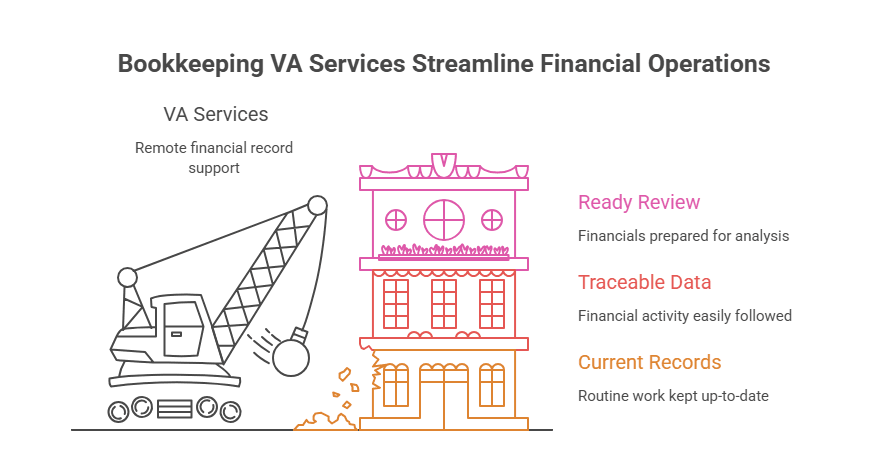
    Bookkeeping and accounting VA services provide remote operational support for a company’s financial records, workflows, and reporting cycle. The exact scope depends on the assistant’s education, experience, software skills, access, and supervision. A well-designed role begins with a written chart of responsibilities rather than a vague request to “handle the finances.”

    Definition and Daily Role of a Bookkeeping VA

    A bookkeeping VA is a remote professional who helps maintain the records showing what a business earned, spent, owns, and owes. Typical daily work includes importing transactions, applying approved categories, attaching receipts, issuing invoices, recording bills, matching payments, clearing bank-feed questions, and documenting exceptions. A detailed guide to hiring a bookkeeping virtual assistant can help owners compare providers, but the task list should be defined before the provider is selected.

    The role is process-driven. The VA follows the company’s chart of accounts, cash-versus-accrual policy, approval matrix, closing calendar, document-retention rules, and escalation procedures. They should not invent classifications, change accounting policies, move money, or interpret tax consequences without authorization. Their value comes from keeping routine work current, traceable, and ready for qualified review.

    Bookkeeping, Accounting, and Finance Support Are Different

    Bookkeeping records and organizes financial activity. Accounting applies policies, makes judgments, prepares or reviews financial statements, and interprets results. Finance looks forward through cash planning, budgets, forecasts, capital decisions, and performance analysis. A capable accounting virtual assistant may support all three workflows administratively, but that does not mean one person should own every professional decision.

    For example, a VA may collect invoices, reconcile accounts, and prepare a draft variance schedule. An accountant may determine the correct treatment for revenue, depreciation, inventory, leases, or an unusual transaction. A controller or owner may then decide whether to reduce spending, extend credit, or change the forecast. Separating execution from review gives the business speed without erasing accountability.

    Businesses That Benefit Most

    Bookkeeping VA services are often useful for owner-led companies whose transaction volume has outgrown spreadsheets but not yet justified a large internal finance department. Ecommerce stores, agencies, consultants, property businesses, healthcare practices, legal firms, contractors, nonprofits, and subscription companies can all benefit when their procedures are documented. Multi-entity, inventory-heavy, regulated, or rapidly scaling companies may still need specialized accounting leadership alongside the VA.

    The strongest signal is recurring backlog: unreconciled accounts, missing receipts, late invoices, unclear vendor bills, inconsistent reports, or a month-end close that depends on the owner’s memory. A virtual financial assistant can organize that workload, but outsourcing will not repair undefined policies automatically. The business must first identify its systems, decision owners, approval limits, and expected outputs.

    Core Bookkeeping Tasks You Can Delegate

    The safest first assignments are repetitive, rule-based, and independently reviewable. Each workflow should specify the source documents, accounting period, naming standard, approver, deadline, and treatment of exceptions. This allows the VA to work efficiently while keeping unusual or consequential items visible.

    Transaction Entry and Categorization

    • Import approved financial activity from bank, card, cash, sales, expense, and payment sources while attaching the relevant receipt, invoice, or settlement.
    • Confirm transaction details by checking the vendor, customer, date, amount, account, tax treatment, class, location, project, and required reporting dimensions.
    • Follow the approved chart of accounts instead of relying blindly on bank-feed suggestions, remembered treatment, or outdated software rules.
    • Apply exception rules to personal, duplicate, intercompany, owner, loan, fixed-asset, transfer, refund, and unclear transactions outside ordinary operations.
    • Maintain consistent classifications so recurring costs do not move among categories without a documented, approved reason.
    • Keep a question log that groups uncertain entries, records evidence, and routes decisions to the accountant or owner without hiding assumptions in the ledger.

    Accounts Receivable, Payable, and Cash Administration

    • Administer receivables by creating approved invoices, applying payments, maintaining aging reports, documenting disputes, and escalating overdue balances.
    • Control customer communications through an approved cadence without changing prices, extending credit, waiving fees, or making unauthorized collection promises.
    • Prepare payable records by collecting bills, checking required fields, finding duplicates, matching purchase documents, coding expenses, and routing approvals.
    • Separate bill preparation from payment release so one person cannot independently enter, approve, and pay the same obligation.
    • Keep cash data current because 77% of employer firms reported rising input costs, tariff-related costs, or both as financial challenges in the Federal Reserve’s 2026 survey.
    • Maintain a cash calendar for receipts, vendor payments, payroll, taxes, debt, and transfers while leaving funding decisions to management.

    Bank, Credit Card, and Payment-Processor Reconciliation

    • Compare each assigned ledger account with the corresponding bank, card, loan, payroll, processor, or ecommerce statement for the same period.
    • Perform routine reconciliation by matching activity, finding missing or duplicate entries, recording approved fees, tracing transfers, and documenting differences.
    • Explain differences rather than forcing agreement because an adjustment may hide timing, duplication, omission, misclassification, unauthorized activity, or integration failure.
    • Reconstruct processor settlements across gross sales, refunds, disputes, taxes, fees, reserves, and net deposits rather than recording only bank receipts.
    • Escalate persistent exceptions such as stale checks, unexplained deposits, negative balances, processor differences, or unsupported adjustments.
    • Match frequency to activity and risk: High-volume accounts may need daily attention, but every material month-end balance requires current support and review.

    Payroll, Tax Preparation, and Compliance Support
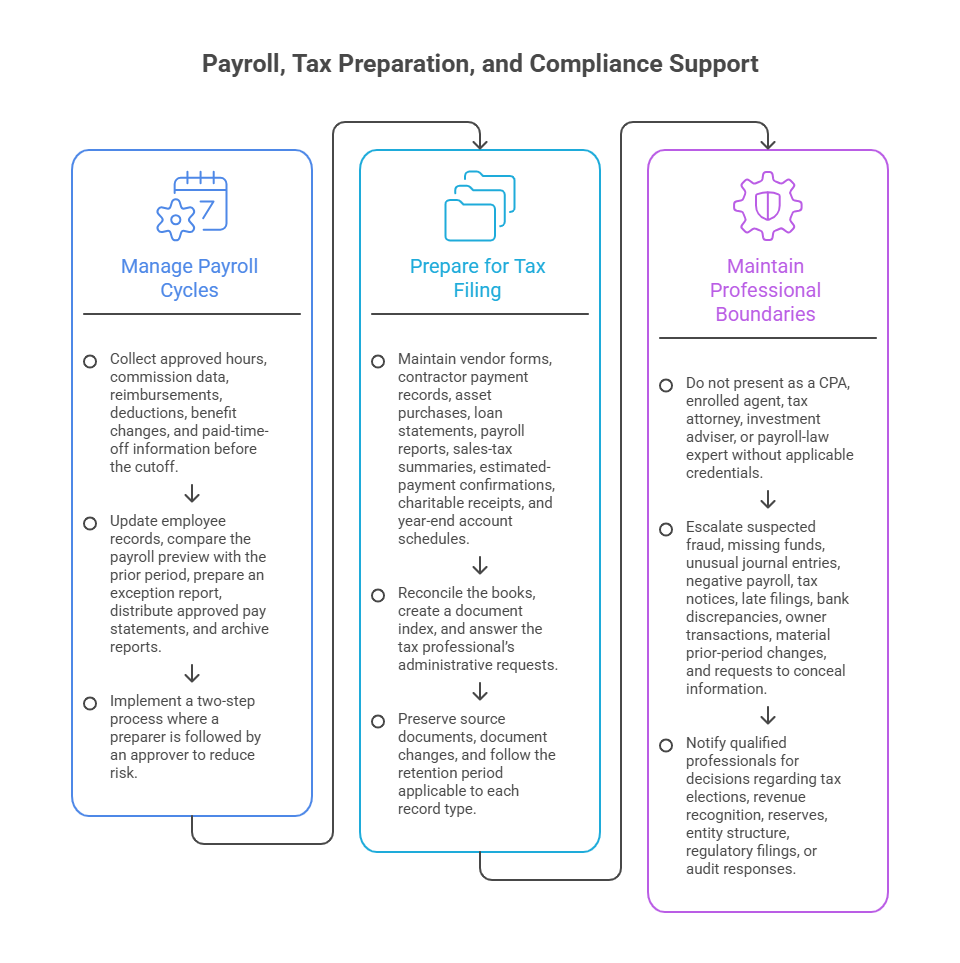
    Payroll and tax workflows combine deadlines, sensitive data, legal obligations, and cash movement. A VA can organize inputs and administer approved procedures, but qualified decision-makers must retain control over classifications, filings, elections, tax positions, and payment authorization. The distinction should be explicit in contracts and standard operating procedures.

    How a Payroll VA Supports the Pay Cycle

    A payroll virtual assistant can collect approved hours, commission data, reimbursements, deductions, benefit changes, and paid-time-off information before the cutoff. They may update employee records, compare the payroll preview with the prior period, prepare an exception report, distribute approved pay statements, and archive reports. New hires, terminations, garnishments, bonuses, retroactive changes, and unusually large variances need defined review.

    The VA should not decide whether a worker is an employee or independent contractor, choose tax withholding, interpret wage-and-hour rules, or release payroll funds without authorization. Access to Social Security numbers, bank data, and compensation should be limited. A two-step process—preparer followed by approver—reduces the risk that one mistake or compromised account changes both the records and the payment.

    Business Tax Preparation Readiness

    Tax preparation support is primarily about organized evidence. A VA can maintain vendor forms, contractor payment records, asset purchases, loan statements, payroll reports, sales-tax summaries, estimated-payment confirmations, charitable receipts, and year-end account schedules. They can reconcile the books, create a document index, and answer the tax professional’s administrative requests. A business tax preparation service still needs qualified professionals to determine tax positions and prepare or sign returns where required.

    The IRS states that a business may use any recordkeeping system suited to its operations if it clearly shows income and expenses. That flexibility does not remove the need for support. The VA should preserve source documents, document changes, and follow the retention period applicable to each record type rather than deleting files after a return is submitted.

    Boundaries, Approvals, and Professional Escalation

    A bookkeeping VA should not present themselves as a CPA, enrolled agent, tax attorney, investment adviser, or payroll-law expert unless they hold the applicable credential and are acting within its scope. They may prepare data and working schedules, but decisions about tax elections, revenue recognition, reserves, entity structure, regulatory filings, or audit responses belong with qualified professionals. State rules and licensing requirements also vary.

    The escalation list should cover suspected fraud, missing funds, unusual journal entries, negative payroll, tax notices, late filings, bank discrepancies, owner transactions, material prior-period changes, and requests to conceal information. The VA should know who can approve each response and how quickly to notify them. A business protects itself when asking questions is rewarded, not treated as a failure to work independently.

    QuickBooks, Xero, and the Financial Technology Stack

    Cloud accounting tools make remote support practical, but software does not create accounting discipline. The platform should reflect the business’s entity structure, reporting needs, tax basis, transaction sources, and approval process. A VA needs role-based access, training, and a clean system configuration before automation is expanded.

    QuickBooks Virtual Assistance

    • Support routine QuickBooks workflows through QuickBooks virtual assistance covering bank feeds, records, invoices, bills, reconciliations, reports, and close checklists.
    • Monitor connected applications by documenting which systems feed each account and investigating failed or duplicated syncs.
    • Escalate specialist implementations involving cleanup, conversion, inventory, payroll setup, complex integrations, or other advanced changes.
    • Obtain required setup inputs including the chart of accounts, opening balances, accounting method, reporting dimensions, closing policy, and permission plan.
    • Control high-impact changes with approval and a backup before merging accounts, deleting transactions, closing periods, changing rules, or making bulk edits.
    • Preserve the audit trail with separate logins, limited permissions, explanations for material changes, and periodic review of unusual activity.

    QuickBooks vs. Xero for VA-Supported Workflows

    • Compare shared capabilities first: Both platforms support bank feeds, invoices, bills, reconciliation, reporting, integrations, and accountant collaboration.
    • Evaluate company requirements across geography, accountant preferences, payroll, inventory, reporting, integrations, access, entities, transaction volume, and historical data.
    • Look beyond interface preference because an easier demo may not support the required controls, reporting dimensions, integrations, or review process.
    • Use a focused comparison of QuickBooks and Xero support before changing software or assigning the VA.
    • Verify configuration-specific proficiency because generic familiarity does not prove the VA understands the company’s platform structure and procedures.
    • Reconcile every migration by proving customers, vendors, tax settings, opening balances, unpaid items, account totals, and reports transferred accurately.

    Integrations, Automation, and Data Governance

    • Map the complete finance stack connecting accounting software with banking, payroll, payments, ecommerce, expenses, time tracking, inventory, customer relationship management, and reporting systems.
    • Monitor integrations operationally by checking feeds, investigating sync failures, identifying duplicates, maintaining approved mapping tables, and documenting the source of each reported number.
    • Assign a system of record for every customer, vendor, product, tax setting, account, and transaction type before an integration is activated or redesigned.
    • Use automation to reduce repetition, not oversight, because changed mappings, expired connections, duplicate feeds, and silent errors can create financial records that look plausible but remain inaccurate.
    • Protect integration administration with limited permissions, multifactor authentication, approved change requests, controlled testing, connection reviews, and qualified approval for changes affecting financial treatment.
    • Maintain an integration register showing each connection’s owner, purpose, systems, data exchanged, access level, mapping rules, failure alert, review date, and offboarding procedure.

    Month-End Close and Financial Reporting

    Month-end close converts daily activity into a dependable reporting period. A successful close has a calendar, assigned owners, evidence requirements, review checkpoints, and a definition of final. The VA can coordinate much of the work, but management and qualified accounting personnel must approve judgments and results.

    The Month-End Close Workflow

    A standard close may begin with confirming that sales, bills, expenses, payroll, merchant activity, and bank transactions are complete. The VA then reconciles cash, cards, loans, processors, receivables, payables, and other assigned balance-sheet accounts; updates schedules; resolves routine exceptions; and prepares the review package. Cutoff procedures determine which transactions belong in the closing period.

    A practical guide to how bookkeeping VAs handle month-end close can help a team sequence dependencies. The checklist should show the preparer, reviewer, due date, evidence, status, and unresolved issue for each account. Locking the period after approval prevents accidental changes, while a documented reopen process preserves flexibility when a legitimate correction is required.

    Financial Statements and Management Reports

    The core package often includes a profit and loss statement, balance sheet, cash-flow statement or cash summary, accounts-receivable aging, accounts-payable aging, and budget comparison. The VA can run standardized reports, confirm the period and accounting basis, add supporting schedules, and assemble a concise management deck. Reports should display comparative periods and explain material exceptions rather than overwhelm the owner with every available metric.

    A financial report analysis service goes beyond exporting statements. Qualified reviewers assess profitability, liquidity, working capital, margins, trends, and unusual relationships. The VA supports that analysis by ensuring the underlying data is reconciled, the report definitions are stable, and every adjustment or management comment is traceable to evidence.

    Exceptions, Adjustments, and Accountant Review

    Open items should be visible, ranked by impact, and assigned to an owner. Examples include unmatched deposits, stale checks, negative customer balances, vendor credits, uncategorized expenses, suspense-account activity, inventory differences, loan imbalances, or intercompany mismatches. The VA can research facts and prepare support, but should not clear a difference with an arbitrary entry simply to finish the close.

    Journal entries involving accruals, deferrals, depreciation, amortization, inventory, revenue recognition, foreign exchange, taxes, equity, or material estimates generally require an accountant’s policy and review. The close binder should retain reconciliations, source reports, approvals, entries, and explanations. That record reduces repeated questions, supports audit readiness, and makes the next month easier to execute.

    Budgeting, Forecasting, and Financial Analysis
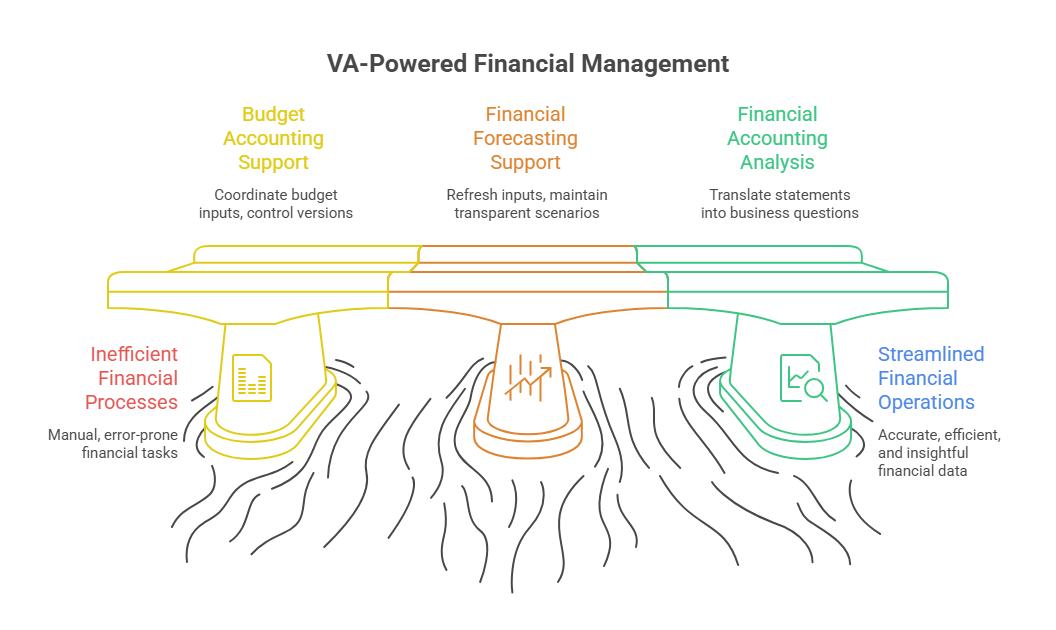
    Clean historical books explain what happened; planning connects those records to what may happen next. A VA can maintain the inputs, models, schedules, and reporting cadence that support management decisions. Assumptions and recommendations should remain visible so leaders can distinguish recorded facts from estimates.

    Budget Accounting Support

    • Coordinate budget inputs by using a virtual assistant for budget accounting to collect department requests, supporting schedules, approved assumptions, and responsible-owner confirmations.
    • Control every budget version by recording its period, scenario, preparer, approval status, assumption sources, effective date, and changes from the prior authorized plan.
    • Map actual accounts consistently to budget lines so monthly comparisons remain meaningful and management is not reviewing differences created merely by changing definitions or classifications.
    • Maintain the operating drivers behind revenue, payroll, contractors, marketing, software, occupancy, capital purchases, and other categories at the level where leaders can take action.
    • Prepare evidence-based variance reports that identify material favorable and unfavorable differences, the accountable owner, the known operational explanation, and any information still needed.
    • Leave planning judgments with management, which determines whether each variance is temporary, structural, controllable, unavoidable, or significant enough to revise the approved plan.

    Financial Forecasting Support

    • Begin with a reliable financial baseline built from reconciled records, documented timing assumptions, approved commitments, and operational drivers that can be updated as conditions change.
    • Refresh the forecast inputs for sales pipelines, customer payment timing, recurring expenses, payroll calendars, vendor commitments, debt service, taxes, and planned investments.
    • Maintain multiple transparent scenarios such as base, upside, and downside cases, ensuring every version clearly identifies the assumptions changed and the person who approved them.
    • Compare forecasts with actual performance to identify where revenue, cost, timing, collection, or spending assumptions were inaccurate and improve the next forecasting cycle.
    • Support rolling cash visibility through a structured method for using a VA for financial forecasting that shows opening cash, inflows, outflows, financing, and the lowest projected balance.
    • Reserve consequential decisions for owners while the VA supplies current information for choices involving hiring, borrowing, investment, distributions, discretionary spending, or cost reductions.

    Financial Accounting Analysis

    • Translate statements into business questions about margins, receivable days, spending behavior, inventory investment, customer profitability, working capital, and other factors management can investigate.
    • Calculate only approved measures while preparing trend tables, segmented results, ratio schedules, and operational context that help qualified reviewers understand what changed.
    • Keep metric definitions stable because a margin, aging, liquidity, or productivity measure that changes methodology between periods cannot support a trustworthy comparison.
    • Trace every figure to reconciled records so financial accounting analysis supported by virtual assistants remains connected to verified source data and documented adjustments.
    • Require management or analyst interpretation of materiality, causation, seasonality, unusual events, and nonfinancial factors before a reported relationship becomes the basis for action.
    • Disclose analytical limitations clearly because correlation does not prove causation, and a polished dashboard should never conceal incomplete data, one-time events, changed assumptions, or unresolved exceptions.

    Security, Internal Controls, and Bookkeeping Accuracy

    Financial records contain bank details, payroll data, customer information, vendor records, tax identifiers, and commercially sensitive results. Remote work can be secure when access is intentional, monitored, and limited. A confidentiality clause is useful, but it is not a substitute for technical safeguards and divided responsibilities.

    Segregation of Duties and Approval Controls

    No individual should control the entire path from creating a vendor to entering a bill, approving it, releasing payment, and reconciling the bank. Small teams may not achieve perfect separation, but they can use compensating controls such as owner approvals, bank alerts, payment limits, independent statement review, and monthly exception reports. Vendor bank-detail changes should be verified through a trusted channel.

    The responsibility matrix should distinguish preparation, approval, payment, reconciliation, and review. A VA may prepare the payment batch without permission to release it, or reconcile the account without authority to edit bank transactions. Recurring payments, refunds, credits, write-offs, manual checks, journal entries, and payroll changes deserve specific thresholds. Control design should match the company’s size and risk rather than imitate a large corporation mechanically.

    Access, Devices, and Financial Data Protection

    Each user should have a unique account, multifactor authentication, and the minimum role needed for assigned tasks. Passwords and one-time codes should not be shared through email or chat. Approved devices should use encryption, current software, endpoint protection, automatic locking, and controlled downloads. Public computers, personal cloud storage, unapproved browser extensions, and unsanctioned AI tools should be prohibited for financial data.

    The FTC advises businesses to limit sensitive information to a need-to-know basis and only for as long as a vendor needs it. The company should review active users, connected applications, bank permissions, shared folders, and exported files regularly. Offboarding requires disabling accounts, transferring open work, rotating shared secrets, recovering devices, and confirming how locally stored or cached data will be deleted.

    Quality Assurance and Audit Trails

    Quality control should operate at three levels. The preparer follows a checklist and attaches support; the reviewer checks reconciliations, exceptions, and high-risk entries; management approves the reporting package and unresolved items. Automated rules can reduce manual effort, but sample testing confirms that the rule still produces the intended result after vendors, systems, or business activity change.

    Useful controls include duplicate detection, period locks, balance-sheet reconciliations, variance thresholds, sequential invoice review, change logs, and documented corrections. Errors should be logged by type and root cause, not merely fixed silently. The objective is to improve the process and preserve an audit trail, not punish the person who identified a problem. Repeated workarounds often indicate that the procedure or system configuration needs redesign.

    Continuity is part of quality as well. Reconciliations, recurring entries, report definitions, and open exceptions should be understandable to a backup worker or reviewer. A finance workflow that exists only in one person’s inbox remains fragile even when that person performs it accurately.

    Benefits, Limitations, and Role Comparisons

    A bookkeeping VA can create meaningful leverage, but the benefit depends on a realistic scope. Businesses should compare the role with their actual needs rather than assuming remote support is always cheaper or that an accountant should perform every administrative task. A layered finance team often delivers the best balance.

    Benefits of a Bookkeeping and Accounting VA

    • Create recurring ownership for transactions, document collection, receivable and payable follow-up, reconciliation, close preparation, and other fragmented financial work.
    • Address activity while context is available so receipts, invoices, settlements, questions, and differences do not accumulate into month-end cleanup.
    • Improve consistency through scheduled bills and invoices, grouped questions, current reconciliations, visible close dependencies, and assigned exceptions.
    • Release senior time from document chasing, repetitive processing, status follow-up, and record repair for analysis and decisions.
    • Add flexible capacity for growth, seasonal volume, cleanup, or broader coverage; BLS reports a May 2024 median annual wage of $49,210 for related clerks.
    • Respond to labor-market change: Although BLS projects a 6% decline from 2024 to 2034, it expects 170,000 openings each year, largely for replacement.

    Bookkeeping VA vs. Hiring an Accountant

    • Use a VA for recurring execution including transaction processing, document collection, account maintenance, reconciliation, coordination, and standardized reporting.
    • Use an accountant for professional judgment involving policy, complex entries, tax treatment, statement review, controls, assurance, estimates, and interpretation.
    • Compare capability and risk, not price alone, using a bookkeeping VA versus accountant comparison based on the work and qualifications.
    • Recognize the labor-cost difference: Accountants and auditors earned a median annual wage of $81,680 in May 2024, according to BLS.
    • Plan for professional demand: Employment is projected to grow 5% from 2024 to 2034, with approximately 124,200 openings annually.
    • Build a complementary team: The VA maintains records and questions while the accountant handles review, policy, compliance, and consequential decisions.

    Limitations and Work That Requires Escalation

    • Do not expect delegation to repair missing policies, conflicting instructions, undocumented owner transactions, delayed approvals, or other management problems that must be resolved before routine work can stabilize.
    • Correct the accounting foundation first when the chart of accounts is poorly designed, opening balances are unsupported, prior periods contain errors, or system configuration produces unreliable records.
    • Assign specialized projects appropriately, including historical cleanup, conversions, inventory accounting, consolidations, revenue recognition, multi-state taxes, or other work requiring deeper accounting experience.
    • Escalate urgent financial warning signs such as suspected fraud, missing cash, altered vendor details, payroll irregularities, tax notices, material misstatements, unusual contracts, legal demands, or audit requests.
    • Reject instructions to conceal or manipulate activity, including requests to backdate entries, remove support, misclassify transactions, bypass approvals, or hide information from owners, accountants, lenders, or authorities.
    • Reserve regulated and consequential work such as investment advice, lending decisions, tax opinions, attestation, and professional interpretations for qualified people while rewarding the VA for documenting uncertainty.

    Bookkeeping VA Pricing and Service Models

    Pricing varies with transaction volume, complexity, software, cleanup needs, reporting expectations, schedule, location, security, and provider model. The business should compare a complete scope and control environment rather than treat the hourly rate as the only cost. Rework, delayed close, weak documentation, and excessive owner supervision all affect value.

    What Affects Virtual Accounting Assistant Pricing?

    Simple transaction entry from clean source data usually costs less than multi-account reconciliation, ecommerce settlement accounting, inventory support, payroll coordination, entity-level reporting, or historical cleanup. Experience with a particular industry or platform can also affect price. After-hours coverage, short deadlines, bilingual service, background checks, managed devices, and higher insurance or compliance requirements may add legitimate cost.

    A virtual accounting assistant pricing guide helps establish questions, but every proposal should define included hours, deliverables, transaction limits, software, communication, review, corrections, rollover, rush work, replacement coverage, and termination. Ask whether onboarding, supervision, and quality assurance are included. A low rate can become expensive if the owner must redesign every task or the accountant repeatedly repairs preventable errors.

    Freelancer, Managed Service, and In-House Models

    An independent freelancer can offer continuity and direct communication when the business has a clear scope and can provide supervision. A managed service may add sourcing, training, team oversight, security standards, backup coverage, and easier replacement. An in-house employee may be preferable when work requires constant collaboration, physical records, broad institutional ownership, or full-time capacity. Each model has different fixed costs and management demands.

    A hybrid structure is often practical: a bookkeeping VA handles routine processing, a manager approves cash movement, and an accountant reviews the close and complex issues. The company should know who employs the worker, whether subcontractors are used, where data is accessed, how coverage works, and who corrects errors. Contracts should address confidentiality, service levels, work ownership, access, incident reporting, and offboarding.

    Measuring ROI Without Relying on Vanity Metrics

    Return should be measured through operational outcomes: fewer overdue reconciliations, a shorter and more predictable close, lower transaction backlog, faster invoice issuance, improved documentation, timely exception resolution, and fewer accountant cleanup hours. Track the owner time released and whether reports arrive early enough to influence decisions. Raw transaction volume is not useful if speed increases errors.

    Establish a baseline before onboarding. Record current close days, unreconciled accounts, outstanding questions, billing delays, error rates, and management hours spent on bookkeeping. Review progress after the workflow stabilizes, not after a few days. The VA’s contribution may be indirect but valuable: reliable books improve the conditions for budgeting, tax preparation, lender conversations, cash planning, and management accountability.

    Include total operating cost in the comparison: service fees, software licenses, management time, professional review, corrections, and unused capacity. The financially attractive model is the one that produces dependable records and timely decisions at an acceptable risk level, not automatically the option with the smallest invoice.

    How to Hire, Onboard, and Manage a Bookkeeping VA
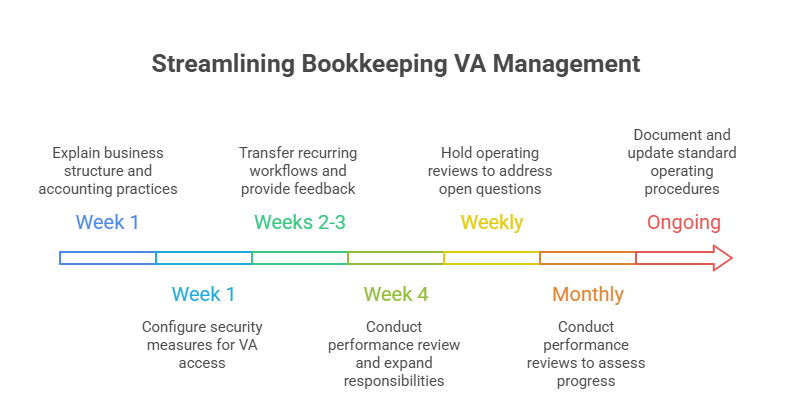
    Successful hiring starts with an inventory of work, systems, deadlines, risks, and review needs. A generic job description attracts generic claims. A specific role allows the business to test the exact capabilities needed and gives the assistant a fair definition of success.

    Skills, Vetting Questions, and Paid Test Tasks

    • Verify relevant operating experience by asking which industries, accounting methods, platforms, processors, payroll systems, reporting structures, and month-end close activities the candidate has supported directly.
    • Test foundational bookkeeping knowledge at the level the role requires, including debits and credits, reconciliation logic, documentation, chart-of-accounts use, period cutoff, and common transaction types.
    • Evaluate judgment with realistic scenarios involving duplicate payments, owner expenses, unmatched deposits, changed vendor bank details, prior-period discrepancies, missing receipts, or unclear approval authority.
    • Use a paid exercise with sanitized data that asks the candidate to categorize transactions, reconcile a short statement, identify missing support, organize receivable follow-up, or review a close checklist.
    • Score the complete working method across accuracy, documentation, questions, escalation, security behavior, communication, and attention to instructions rather than rewarding completion speed alone.
    • Complete appropriate verification of references, identity, credentials, employment history, platform experience, confidentiality expectations, and other requirements under applicable law and company policy.

    The First 30 Days of Onboarding

    • Explain the business during week one, including its entities, revenue streams, expense structure, accounting method, chart of accounts, reporting calendar, approval roles, client expectations, and professional boundaries.
    • Configure security before live work through unique accounts, multifactor authentication, approved devices and communication channels, role-based permissions, and verified access to only the required systems and files.
    • Start with low-risk assignments and close review so the VA can demonstrate accurate documentation, secure behavior, clear questions, and adherence to procedures before receiving broader responsibility.
    • Transfer defined recurring workflows in weeks two and three, such as transaction review, invoice administration, receipt follow-up, selected reconciliations, or close coordination, with frequent feedback.
    • Complete a week-four performance review covering accuracy, turnaround, communication, security, capacity, escalation, and owner or accountant time saved before expanding permissions or complexity.
    • Create a documented backup plan showing where open tasks, schedules, source files, credentials, and pending questions are controlled so leave, turnover, or urgent deadlines do not stop the workflow.

    Standard Operating Procedures and Performance Reviews

    • Document every recurring workflow with its purpose, trigger, inputs, ordered steps, system of record, deadline, preparer, approver, required evidence, definition of done, and escalation path.
    • Include both examples and principles so the VA understands common and unusual transactions without following an outdated screenshot or software sequence blindly when circumstances change.
    • Control the procedure lifecycle by assigning an accountable owner, effective date, revision history, and review date, with prompt updates after policy, platform, or responsibility changes.
    • Use weekly operating reviews to address open questions, upcoming cash events, overdue documents, failed integrations, blocked tasks, and work that needs owner or accountant input.
    • Use monthly performance reviews to assess reconciliations, close timeliness, error and correction patterns, receivable and payable administration, security compliance, workload, and improvement opportunities.
    • Govern AI-assisted work explicitly by naming approved tools, permitted data, validation steps, reviewer responsibilities, and prohibited uses while keeping financial accuracy under accountable human control.

    FAQ

    1. What does a bookkeeping and accounting VA do?

    A bookkeeping and accounting VA maintains financial records and workflows through tasks such as transaction categorization, invoice and bill administration, reconciliations, payroll-input coordination, document collection, month-end schedules, and standardized reporting.

    2. Can a bookkeeping VA replace an accountant or CPA?

    Usually not. A VA supports routine execution, while accountants and CPAs handle professional judgment, complex accounting, tax positions, financial-statement review, assurance, and regulated services according to their qualifications.

    3. Can a bookkeeping VA use QuickBooks and Xero?

    Yes. Many bookkeeping VAs support QuickBooks, Xero, and connected finance tools, but businesses should verify experience with their specific setup, industry, integrations, reporting needs, and accounting method.

    4. Is it safe to give a remote VA access to financial data?

    It can be managed safely with due diligence, unique accounts, multifactor authentication, least-privilege access, approved devices, divided payment duties, monitoring, confidentiality terms, and prompt offboarding.

    5. How much does a bookkeeping VA cost?

    Cost depends on experience, location, hours, transaction volume, software, cleanup requirements, payroll or reporting scope, security controls, management model, and the amount of professional review required.

    6. What bookkeeping tasks should a business delegate first?

    Begin with repeatable, reviewable tasks such as source-document collection, approved transaction coding, invoice administration, receipt follow-up, reconciliations, and close-checklist coordination before expanding into higher-risk work.

    Conclusion: Build a Financial Workflow You Can Trust

    A Bookkeeping & Accounting VA can turn scattered financial administration into a consistent operating process. With a clear scope, the assistant can keep transactions organized, support receivables and payables, reconcile accounts, prepare payroll inputs, maintain QuickBooks or Xero, coordinate month-end close, and assemble reports that are ready for management and accountant review.

    The model works when the business preserves control. Written policies, divided duties, secure access, documented approvals, qualified escalation, reconciliations, and regular quality reviews matter more than whether the assistant sits inside or outside the office. A VA should extend the finance function’s discipline, not become an unreviewed single point of failure.

    CTA: Ready to create a more dependable bookkeeping process? List the financial tasks that repeat every week and month, identify who approves each one, and compare trained bookkeeping VA providers against that exact scope. Start with low-risk work, measure accuracy, and expand only when the controls and results support it.

    Sources List

    Bookkeeping Virtual Assistant Services: Complete Guide

    Accurate books are no longer a once-a-month administrative concern. In 2026, American businesses move money through bank accounts, credit cards, payment processors, ecommerce platforms, payroll systems, expense apps, and subscription tools. Owners need current records to manage cash, approve spending, price services, prepare taxes, answer lenders, and make decisions before a small discrepancy becomes a costly problem.

    A Bookkeeping & Accounting VA gives a business remote capacity for the recurring work behind dependable financial records. Depending on training and scope, the assistant may collect source documents, categorize transactions, reconcile accounts, track receivables and payables, prepare payroll inputs, maintain accounting software, assemble month-end schedules, and produce draft management reports. They support the financial process; they do not automatically replace a certified public accountant, tax professional, controller, payroll specialist, or financial adviser.

    The audience for structured support is substantial. The U.S. Small Business Administration reports that the country has 36,207,130 small businesses, employing 62.3 million people and representing 45.9% of private-sector employment. For many of those companies, the practical challenge is not whether bookkeeping matters; it is how to maintain an accurate, reviewable workflow without forcing the owner to become the accounting department.

    This guide explains what a bookkeeping and accounting virtual assistant can do, where professional boundaries belong, how QuickBooks and Xero support fits, what happens during month-end close, how payroll and tax preparation should be controlled, what pricing depends on, and how to hire safely. It is designed for U.S. founders, small-business owners, professional firms, ecommerce operators, agencies, and finance teams that want more consistent execution without surrendering financial oversight.

    What Are Bookkeeping & Accounting VA Services?

    Bookkeeping and accounting VA services provide remote operational support for a company’s financial records, workflows, and reporting cycle. The exact scope depends on the assistant’s education, experience, software skills, access, and supervision. A well-designed role begins with a written chart of responsibilities rather than a vague request to “handle the finances.”

    Definition and Daily Role of a Bookkeeping VA

    A bookkeeping VA is a remote professional who helps maintain the records showing what a business earned, spent, owns, and owes. Typical daily work includes importing transactions, applying approved categories, attaching receipts, issuing invoices, recording bills, matching payments, clearing bank-feed questions, and documenting exceptions. A detailed guide to hiring a bookkeeping virtual assistant can help owners compare providers, but the task list should be defined before the provider is selected.

    The role is process-driven. The VA follows the company’s chart of accounts, cash-versus-accrual policy, approval matrix, closing calendar, document-retention rules, and escalation procedures. They should not invent classifications, change accounting policies, move money, or interpret tax consequences without authorization. Their value comes from keeping routine work current, traceable, and ready for qualified review.

    Bookkeeping, Accounting, and Finance Support Are Different

    Bookkeeping records and organizes financial activity. Accounting applies policies, makes judgments, prepares or reviews financial statements, and interprets results. Finance looks forward through cash planning, budgets, forecasts, capital decisions, and performance analysis. A capable accounting virtual assistant may support all three workflows administratively, but that does not mean one person should own every professional decision.

    For example, a VA may collect invoices, reconcile accounts, and prepare a draft variance schedule. An accountant may determine the correct treatment for revenue, depreciation, inventory, leases, or an unusual transaction. A controller or owner may then decide whether to reduce spending, extend credit, or change the forecast. Separating execution from review gives the business speed without erasing accountability.

    Businesses That Benefit Most

    Bookkeeping VA services are often useful for owner-led companies whose transaction volume has outgrown spreadsheets but not yet justified a large internal finance department. Ecommerce stores, agencies, consultants, property businesses, healthcare practices, legal firms, contractors, nonprofits, and subscription companies can all benefit when their procedures are documented. Multi-entity, inventory-heavy, regulated, or rapidly scaling companies may still need specialized accounting leadership alongside the VA.

    The strongest signal is recurring backlog: unreconciled accounts, missing receipts, late invoices, unclear vendor bills, inconsistent reports, or a month-end close that depends on the owner’s memory. A virtual financial assistant can organize that workload, but outsourcing will not repair undefined policies automatically. The business must first identify its systems, decision owners, approval limits, and expected outputs.

    Core Bookkeeping Tasks You Can Delegate

    The safest first assignments are repetitive, rule-based, and independently reviewable. Each workflow should specify the source documents, accounting period, naming standard, approver, deadline, and treatment of exceptions. This allows the VA to work efficiently while keeping unusual or consequential items visible.

    Transaction Entry and Categorization

    • Import approved financial activity from bank, card, cash, sales, expense, and payment sources while attaching the relevant receipt, invoice, or settlement.
    • Confirm transaction details by checking the vendor, customer, date, amount, account, tax treatment, class, location, project, and required reporting dimensions.
    • Follow the approved chart of accounts instead of relying blindly on bank-feed suggestions, remembered treatment, or outdated software rules.
    • Apply exception rules to personal, duplicate, intercompany, owner, loan, fixed-asset, transfer, refund, and unclear transactions outside ordinary operations.
    • Maintain consistent classifications so recurring costs do not move among categories without a documented, approved reason.
    • Keep a question log that groups uncertain entries, records evidence, and routes decisions to the accountant or owner without hiding assumptions in the ledger.

    Accounts Receivable, Payable, and Cash Administration

    • Administer receivables by creating approved invoices, applying payments, maintaining aging reports, documenting disputes, and escalating overdue balances.
    • Control customer communications through an approved cadence without changing prices, extending credit, waiving fees, or making unauthorized collection promises.
    • Prepare payable records by collecting bills, checking required fields, finding duplicates, matching purchase documents, coding expenses, and routing approvals.
    • Separate bill preparation from payment release so one person cannot independently enter, approve, and pay the same obligation.
    • Keep cash data current because 77% of employer firms reported rising input costs, tariff-related costs, or both as financial challenges in the Federal Reserve’s 2026 survey.
    • Maintain a cash calendar for receipts, vendor payments, payroll, taxes, debt, and transfers while leaving funding decisions to management.

    Bank, Credit Card, and Payment-Processor Reconciliation

    • Compare each assigned ledger account with the corresponding bank, card, loan, payroll, processor, or ecommerce statement for the same period.
    • Perform routine reconciliation by matching activity, finding missing or duplicate entries, recording approved fees, tracing transfers, and documenting differences.
    • Explain differences rather than forcing agreement because an adjustment may hide timing, duplication, omission, misclassification, unauthorized activity, or integration failure.
    • Reconstruct processor settlements across gross sales, refunds, disputes, taxes, fees, reserves, and net deposits rather than recording only bank receipts.
    • Escalate persistent exceptions such as stale checks, unexplained deposits, negative balances, processor differences, or unsupported adjustments.
    • Match frequency to activity and risk: High-volume accounts may need daily attention, but every material month-end balance requires current support and review.

    Payroll, Tax Preparation, and Compliance Support

    Payroll and tax workflows combine deadlines, sensitive data, legal obligations, and cash movement. A VA can organize inputs and administer approved procedures, but qualified decision-makers must retain control over classifications, filings, elections, tax positions, and payment authorization. The distinction should be explicit in contracts and standard operating procedures.

    How a Payroll VA Supports the Pay Cycle

    A payroll virtual assistant can collect approved hours, commission data, reimbursements, deductions, benefit changes, and paid-time-off information before the cutoff. They may update employee records, compare the payroll preview with the prior period, prepare an exception report, distribute approved pay statements, and archive reports. New hires, terminations, garnishments, bonuses, retroactive changes, and unusually large variances need defined review.

    The VA should not decide whether a worker is an employee or independent contractor, choose tax withholding, interpret wage-and-hour rules, or release payroll funds without authorization. Access to Social Security numbers, bank data, and compensation should be limited. A two-step process—preparer followed by approver—reduces the risk that one mistake or compromised account changes both the records and the payment.

    Business Tax Preparation Readiness

    Tax preparation support is primarily about organized evidence. A VA can maintain vendor forms, contractor payment records, asset purchases, loan statements, payroll reports, sales-tax summaries, estimated-payment confirmations, charitable receipts, and year-end account schedules. They can reconcile the books, create a document index, and answer the tax professional’s administrative requests. A business tax preparation service still needs qualified professionals to determine tax positions and prepare or sign returns where required.

    The IRS states that a business may use any recordkeeping system suited to its operations if it clearly shows income and expenses. That flexibility does not remove the need for support. The VA should preserve source documents, document changes, and follow the retention period applicable to each record type rather than deleting files after a return is submitted.

    Boundaries, Approvals, and Professional Escalation

    A bookkeeping VA should not present themselves as a CPA, enrolled agent, tax attorney, investment adviser, or payroll-law expert unless they hold the applicable credential and are acting within its scope. They may prepare data and working schedules, but decisions about tax elections, revenue recognition, reserves, entity structure, regulatory filings, or audit responses belong with qualified professionals. State rules and licensing requirements also vary.

    The escalation list should cover suspected fraud, missing funds, unusual journal entries, negative payroll, tax notices, late filings, bank discrepancies, owner transactions, material prior-period changes, and requests to conceal information. The VA should know who can approve each response and how quickly to notify them. A business protects itself when asking questions is rewarded, not treated as a failure to work independently.

    QuickBooks, Xero, and the Financial Technology Stack

    Cloud accounting tools make remote support practical, but software does not create accounting discipline. The platform should reflect the business’s entity structure, reporting needs, tax basis, transaction sources, and approval process. A VA needs role-based access, training, and a clean system configuration before automation is expanded.

    QuickBooks Virtual Assistance

    • Support routine QuickBooks workflows through QuickBooks virtual assistance covering bank feeds, records, invoices, bills, reconciliations, reports, and close checklists.
    • Monitor connected applications by documenting which systems feed each account and investigating failed or duplicated syncs.
    • Escalate specialist implementations involving cleanup, conversion, inventory, payroll setup, complex integrations, or other advanced changes.
    • Obtain required setup inputs including the chart of accounts, opening balances, accounting method, reporting dimensions, closing policy, and permission plan.
    • Control high-impact changes with approval and a backup before merging accounts, deleting transactions, closing periods, changing rules, or making bulk edits.
    • Preserve the audit trail with separate logins, limited permissions, explanations for material changes, and periodic review of unusual activity.

    QuickBooks vs. Xero for VA-Supported Workflows

    • Compare shared capabilities first: Both platforms support bank feeds, invoices, bills, reconciliation, reporting, integrations, and accountant collaboration.
    • Evaluate company requirements across geography, accountant preferences, payroll, inventory, reporting, integrations, access, entities, transaction volume, and historical data.
    • Look beyond interface preference because an easier demo may not support the required controls, reporting dimensions, integrations, or review process.
    • Use a focused comparison of QuickBooks and Xero support before changing software or assigning the VA.
    • Verify configuration-specific proficiency because generic familiarity does not prove the VA understands the company’s platform structure and procedures.
    • Reconcile every migration by proving customers, vendors, tax settings, opening balances, unpaid items, account totals, and reports transferred accurately.

    Integrations, Automation, and Data Governance

    • Map the complete finance stack connecting accounting software with banking, payroll, payments, ecommerce, expenses, time tracking, inventory, customer relationship management, and reporting systems.
    • Monitor integrations operationally by checking feeds, investigating sync failures, identifying duplicates, maintaining approved mapping tables, and documenting the source of each reported number.
    • Assign a system of record for every customer, vendor, product, tax setting, account, and transaction type before an integration is activated or redesigned.
    • Use automation to reduce repetition, not oversight, because changed mappings, expired connections, duplicate feeds, and silent errors can create financial records that look plausible but remain inaccurate.
    • Protect integration administration with limited permissions, multifactor authentication, approved change requests, controlled testing, connection reviews, and qualified approval for changes affecting financial treatment.
    • Maintain an integration register showing each connection’s owner, purpose, systems, data exchanged, access level, mapping rules, failure alert, review date, and offboarding procedure.

    Month-End Close and Financial Reporting

    Month-end close converts daily activity into a dependable reporting period. A successful close has a calendar, assigned owners, evidence requirements, review checkpoints, and a definition of final. The VA can coordinate much of the work, but management and qualified accounting personnel must approve judgments and results.

    The Month-End Close Workflow

    A standard close may begin with confirming that sales, bills, expenses, payroll, merchant activity, and bank transactions are complete. The VA then reconciles cash, cards, loans, processors, receivables, payables, and other assigned balance-sheet accounts; updates schedules; resolves routine exceptions; and prepares the review package. Cutoff procedures determine which transactions belong in the closing period.

    A practical guide to how bookkeeping VAs handle month-end close can help a team sequence dependencies. The checklist should show the preparer, reviewer, due date, evidence, status, and unresolved issue for each account. Locking the period after approval prevents accidental changes, while a documented reopen process preserves flexibility when a legitimate correction is required.

    Financial Statements and Management Reports

    The core package often includes a profit and loss statement, balance sheet, cash-flow statement or cash summary, accounts-receivable aging, accounts-payable aging, and budget comparison. The VA can run standardized reports, confirm the period and accounting basis, add supporting schedules, and assemble a concise management deck. Reports should display comparative periods and explain material exceptions rather than overwhelm the owner with every available metric.

    A financial report analysis service goes beyond exporting statements. Qualified reviewers assess profitability, liquidity, working capital, margins, trends, and unusual relationships. The VA supports that analysis by ensuring the underlying data is reconciled, the report definitions are stable, and every adjustment or management comment is traceable to evidence.

    Exceptions, Adjustments, and Accountant Review

    Open items should be visible, ranked by impact, and assigned to an owner. Examples include unmatched deposits, stale checks, negative customer balances, vendor credits, uncategorized expenses, suspense-account activity, inventory differences, loan imbalances, or intercompany mismatches. The VA can research facts and prepare support, but should not clear a difference with an arbitrary entry simply to finish the close.

    Journal entries involving accruals, deferrals, depreciation, amortization, inventory, revenue recognition, foreign exchange, taxes, equity, or material estimates generally require an accountant’s policy and review. The close binder should retain reconciliations, source reports, approvals, entries, and explanations. That record reduces repeated questions, supports audit readiness, and makes the next month easier to execute.

    Budgeting, Forecasting, and Financial Analysis

    Clean historical books explain what happened; planning connects those records to what may happen next. A VA can maintain the inputs, models, schedules, and reporting cadence that support management decisions. Assumptions and recommendations should remain visible so leaders can distinguish recorded facts from estimates.

    Budget Accounting Support

    • Coordinate budget inputs by using a virtual assistant for budget accounting to collect department requests, supporting schedules, approved assumptions, and responsible-owner confirmations.
    • Control every budget version by recording its period, scenario, preparer, approval status, assumption sources, effective date, and changes from the prior authorized plan.
    • Map actual accounts consistently to budget lines so monthly comparisons remain meaningful and management is not reviewing differences created merely by changing definitions or classifications.
    • Maintain the operating drivers behind revenue, payroll, contractors, marketing, software, occupancy, capital purchases, and other categories at the level where leaders can take action.
    • Prepare evidence-based variance reports that identify material favorable and unfavorable differences, the accountable owner, the known operational explanation, and any information still needed.
    • Leave planning judgments with management, which determines whether each variance is temporary, structural, controllable, unavoidable, or significant enough to revise the approved plan.

    Financial Forecasting Support

    • Begin with a reliable financial baseline built from reconciled records, documented timing assumptions, approved commitments, and operational drivers that can be updated as conditions change.
    • Refresh the forecast inputs for sales pipelines, customer payment timing, recurring expenses, payroll calendars, vendor commitments, debt service, taxes, and planned investments.
    • Maintain multiple transparent scenarios such as base, upside, and downside cases, ensuring every version clearly identifies the assumptions changed and the person who approved them.
    • Compare forecasts with actual performance to identify where revenue, cost, timing, collection, or spending assumptions were inaccurate and improve the next forecasting cycle.
    • Support rolling cash visibility through a structured method for using a VA for financial forecasting that shows opening cash, inflows, outflows, financing, and the lowest projected balance.
    • Reserve consequential decisions for owners while the VA supplies current information for choices involving hiring, borrowing, investment, distributions, discretionary spending, or cost reductions.

    Financial Accounting Analysis

    • Translate statements into business questions about margins, receivable days, spending behavior, inventory investment, customer profitability, working capital, and other factors management can investigate.
    • Calculate only approved measures while preparing trend tables, segmented results, ratio schedules, and operational context that help qualified reviewers understand what changed.
    • Keep metric definitions stable because a margin, aging, liquidity, or productivity measure that changes methodology between periods cannot support a trustworthy comparison.
    • Trace every figure to reconciled records so financial accounting analysis supported by virtual assistants remains connected to verified source data and documented adjustments.
    • Require management or analyst interpretation of materiality, causation, seasonality, unusual events, and nonfinancial factors before a reported relationship becomes the basis for action.
    • Disclose analytical limitations clearly because correlation does not prove causation, and a polished dashboard should never conceal incomplete data, one-time events, changed assumptions, or unresolved exceptions.

    Security, Internal Controls, and Bookkeeping Accuracy

    Financial records contain bank details, payroll data, customer information, vendor records, tax identifiers, and commercially sensitive results. Remote work can be secure when access is intentional, monitored, and limited. A confidentiality clause is useful, but it is not a substitute for technical safeguards and divided responsibilities.

    Segregation of Duties and Approval Controls

    No individual should control the entire path from creating a vendor to entering a bill, approving it, releasing payment, and reconciling the bank. Small teams may not achieve perfect separation, but they can use compensating controls such as owner approvals, bank alerts, payment limits, independent statement review, and monthly exception reports. Vendor bank-detail changes should be verified through a trusted channel.

    The responsibility matrix should distinguish preparation, approval, payment, reconciliation, and review. A VA may prepare the payment batch without permission to release it, or reconcile the account without authority to edit bank transactions. Recurring payments, refunds, credits, write-offs, manual checks, journal entries, and payroll changes deserve specific thresholds. Control design should match the company’s size and risk rather than imitate a large corporation mechanically.

    Access, Devices, and Financial Data Protection

    Each user should have a unique account, multifactor authentication, and the minimum role needed for assigned tasks. Passwords and one-time codes should not be shared through email or chat. Approved devices should use encryption, current software, endpoint protection, automatic locking, and controlled downloads. Public computers, personal cloud storage, unapproved browser extensions, and unsanctioned AI tools should be prohibited for financial data.

    The FTC advises businesses to limit sensitive information to a need-to-know basis and only for as long as a vendor needs it. The company should review active users, connected applications, bank permissions, shared folders, and exported files regularly. Offboarding requires disabling accounts, transferring open work, rotating shared secrets, recovering devices, and confirming how locally stored or cached data will be deleted.

    Quality Assurance and Audit Trails

    Quality control should operate at three levels. The preparer follows a checklist and attaches support; the reviewer checks reconciliations, exceptions, and high-risk entries; management approves the reporting package and unresolved items. Automated rules can reduce manual effort, but sample testing confirms that the rule still produces the intended result after vendors, systems, or business activity change.

    Useful controls include duplicate detection, period locks, balance-sheet reconciliations, variance thresholds, sequential invoice review, change logs, and documented corrections. Errors should be logged by type and root cause, not merely fixed silently. The objective is to improve the process and preserve an audit trail, not punish the person who identified a problem. Repeated workarounds often indicate that the procedure or system configuration needs redesign.

    Continuity is part of quality as well. Reconciliations, recurring entries, report definitions, and open exceptions should be understandable to a backup worker or reviewer. A finance workflow that exists only in one person’s inbox remains fragile even when that person performs it accurately.

    Benefits, Limitations, and Role Comparisons

    A bookkeeping VA can create meaningful leverage, but the benefit depends on a realistic scope. Businesses should compare the role with their actual needs rather than assuming remote support is always cheaper or that an accountant should perform every administrative task. A layered finance team often delivers the best balance.

    Benefits of a Bookkeeping and Accounting VA

    • Create recurring ownership for transactions, document collection, receivable and payable follow-up, reconciliation, close preparation, and other fragmented financial work.
    • Address activity while context is available so receipts, invoices, settlements, questions, and differences do not accumulate into month-end cleanup.
    • Improve consistency through scheduled bills and invoices, grouped questions, current reconciliations, visible close dependencies, and assigned exceptions.
    • Release senior time from document chasing, repetitive processing, status follow-up, and record repair for analysis and decisions.
    • Add flexible capacity for growth, seasonal volume, cleanup, or broader coverage; BLS reports a May 2024 median annual wage of $49,210 for related clerks.
    • Respond to labor-market change: Although BLS projects a 6% decline from 2024 to 2034, it expects 170,000 openings each year, largely for replacement.

    Bookkeeping VA vs. Hiring an Accountant

    • Use a VA for recurring execution including transaction processing, document collection, account maintenance, reconciliation, coordination, and standardized reporting.
    • Use an accountant for professional judgment involving policy, complex entries, tax treatment, statement review, controls, assurance, estimates, and interpretation.
    • Compare capability and risk, not price alone, using a bookkeeping VA versus accountant comparison based on the work and qualifications.
    • Recognize the labor-cost difference: Accountants and auditors earned a median annual wage of $81,680 in May 2024, according to BLS.
    • Plan for professional demand: Employment is projected to grow 5% from 2024 to 2034, with approximately 124,200 openings annually.
    • Build a complementary team: The VA maintains records and questions while the accountant handles review, policy, compliance, and consequential decisions.

    Limitations and Work That Requires Escalation

    • Do not expect delegation to repair missing policies, conflicting instructions, undocumented owner transactions, delayed approvals, or other management problems that must be resolved before routine work can stabilize.
    • Correct the accounting foundation first when the chart of accounts is poorly designed, opening balances are unsupported, prior periods contain errors, or system configuration produces unreliable records.
    • Assign specialized projects appropriately, including historical cleanup, conversions, inventory accounting, consolidations, revenue recognition, multi-state taxes, or other work requiring deeper accounting experience.
    • Escalate urgent financial warning signs such as suspected fraud, missing cash, altered vendor details, payroll irregularities, tax notices, material misstatements, unusual contracts, legal demands, or audit requests.
    • Reject instructions to conceal or manipulate activity, including requests to backdate entries, remove support, misclassify transactions, bypass approvals, or hide information from owners, accountants, lenders, or authorities.
    • Reserve regulated and consequential work such as investment advice, lending decisions, tax opinions, attestation, and professional interpretations for qualified people while rewarding the VA for documenting uncertainty.

    Bookkeeping VA Pricing and Service Models

    Pricing varies with transaction volume, complexity, software, cleanup needs, reporting expectations, schedule, location, security, and provider model. The business should compare a complete scope and control environment rather than treat the hourly rate as the only cost. Rework, delayed close, weak documentation, and excessive owner supervision all affect value.

    What Affects Virtual Accounting Assistant Pricing?

    Simple transaction entry from clean source data usually costs less than multi-account reconciliation, ecommerce settlement accounting, inventory support, payroll coordination, entity-level reporting, or historical cleanup. Experience with a particular industry or platform can also affect price. After-hours coverage, short deadlines, bilingual service, background checks, managed devices, and higher insurance or compliance requirements may add legitimate cost.

    A virtual accounting assistant pricing guide helps establish questions, but every proposal should define included hours, deliverables, transaction limits, software, communication, review, corrections, rollover, rush work, replacement coverage, and termination. Ask whether onboarding, supervision, and quality assurance are included. A low rate can become expensive if the owner must redesign every task or the accountant repeatedly repairs preventable errors.

    Freelancer, Managed Service, and In-House Models

    An independent freelancer can offer continuity and direct communication when the business has a clear scope and can provide supervision. A managed service may add sourcing, training, team oversight, security standards, backup coverage, and easier replacement. An in-house employee may be preferable when work requires constant collaboration, physical records, broad institutional ownership, or full-time capacity. Each model has different fixed costs and management demands.

    A hybrid structure is often practical: a bookkeeping VA handles routine processing, a manager approves cash movement, and an accountant reviews the close and complex issues. The company should know who employs the worker, whether subcontractors are used, where data is accessed, how coverage works, and who corrects errors. Contracts should address confidentiality, service levels, work ownership, access, incident reporting, and offboarding.

    Measuring ROI Without Relying on Vanity Metrics

    Return should be measured through operational outcomes: fewer overdue reconciliations, a shorter and more predictable close, lower transaction backlog, faster invoice issuance, improved documentation, timely exception resolution, and fewer accountant cleanup hours. Track the owner time released and whether reports arrive early enough to influence decisions. Raw transaction volume is not useful if speed increases errors.

    Establish a baseline before onboarding. Record current close days, unreconciled accounts, outstanding questions, billing delays, error rates, and management hours spent on bookkeeping. Review progress after the workflow stabilizes, not after a few days. The VA’s contribution may be indirect but valuable: reliable books improve the conditions for budgeting, tax preparation, lender conversations, cash planning, and management accountability.

    Include total operating cost in the comparison: service fees, software licenses, management time, professional review, corrections, and unused capacity. The financially attractive model is the one that produces dependable records and timely decisions at an acceptable risk level, not automatically the option with the smallest invoice.

    How to Hire, Onboard, and Manage a Bookkeeping VA

    Successful hiring starts with an inventory of work, systems, deadlines, risks, and review needs. A generic job description attracts generic claims. A specific role allows the business to test the exact capabilities needed and gives the assistant a fair definition of success.

    Skills, Vetting Questions, and Paid Test Tasks

    • Verify relevant operating experience by asking which industries, accounting methods, platforms, processors, payroll systems, reporting structures, and month-end close activities the candidate has supported directly.
    • Test foundational bookkeeping knowledge at the level the role requires, including debits and credits, reconciliation logic, documentation, chart-of-accounts use, period cutoff, and common transaction types.
    • Evaluate judgment with realistic scenarios involving duplicate payments, owner expenses, unmatched deposits, changed vendor bank details, prior-period discrepancies, missing receipts, or unclear approval authority.
    • Use a paid exercise with sanitized data that asks the candidate to categorize transactions, reconcile a short statement, identify missing support, organize receivable follow-up, or review a close checklist.
    • Score the complete working method across accuracy, documentation, questions, escalation, security behavior, communication, and attention to instructions rather than rewarding completion speed alone.
    • Complete appropriate verification of references, identity, credentials, employment history, platform experience, confidentiality expectations, and other requirements under applicable law and company policy.

    The First 30 Days of Onboarding

    • Explain the business during week one, including its entities, revenue streams, expense structure, accounting method, chart of accounts, reporting calendar, approval roles, client expectations, and professional boundaries.
    • Configure security before live work through unique accounts, multifactor authentication, approved devices and communication channels, role-based permissions, and verified access to only the required systems and files.
    • Start with low-risk assignments and close review so the VA can demonstrate accurate documentation, secure behavior, clear questions, and adherence to procedures before receiving broader responsibility.
    • Transfer defined recurring workflows in weeks two and three, such as transaction review, invoice administration, receipt follow-up, selected reconciliations, or close coordination, with frequent feedback.
    • Complete a week-four performance review covering accuracy, turnaround, communication, security, capacity, escalation, and owner or accountant time saved before expanding permissions or complexity.
    • Create a documented backup plan showing where open tasks, schedules, source files, credentials, and pending questions are controlled so leave, turnover, or urgent deadlines do not stop the workflow.

    Standard Operating Procedures and Performance Reviews

    • Document every recurring workflow with its purpose, trigger, inputs, ordered steps, system of record, deadline, preparer, approver, required evidence, definition of done, and escalation path.
    • Include both examples and principles so the VA understands common and unusual transactions without following an outdated screenshot or software sequence blindly when circumstances change.
    • Control the procedure lifecycle by assigning an accountable owner, effective date, revision history, and review date, with prompt updates after policy, platform, or responsibility changes.
    • Use weekly operating reviews to address open questions, upcoming cash events, overdue documents, failed integrations, blocked tasks, and work that needs owner or accountant input.
    • Use monthly performance reviews to assess reconciliations, close timeliness, error and correction patterns, receivable and payable administration, security compliance, workload, and improvement opportunities.
    • Govern AI-assisted work explicitly by naming approved tools, permitted data, validation steps, reviewer responsibilities, and prohibited uses while keeping financial accuracy under accountable human control.

    FAQ

    1. What does a bookkeeping and accounting VA do?

    A bookkeeping and accounting VA maintains financial records and workflows through tasks such as transaction categorization, invoice and bill administration, reconciliations, payroll-input coordination, document collection, month-end schedules, and standardized reporting.

    2. Can a bookkeeping VA replace an accountant or CPA?

    Usually not. A VA supports routine execution, while accountants and CPAs handle professional judgment, complex accounting, tax positions, financial-statement review, assurance, and regulated services according to their qualifications.

    3. Can a bookkeeping VA use QuickBooks and Xero?

    Yes. Many bookkeeping VAs support QuickBooks, Xero, and connected finance tools, but businesses should verify experience with their specific setup, industry, integrations, reporting needs, and accounting method.

    4. Is it safe to give a remote VA access to financial data?

    It can be managed safely with due diligence, unique accounts, multifactor authentication, least-privilege access, approved devices, divided payment duties, monitoring, confidentiality terms, and prompt offboarding.

    5. How much does a bookkeeping VA cost?

    Cost depends on experience, location, hours, transaction volume, software, cleanup requirements, payroll or reporting scope, security controls, management model, and the amount of professional review required.

    6. What bookkeeping tasks should a business delegate first?

    Begin with repeatable, reviewable tasks such as source-document collection, approved transaction coding, invoice administration, receipt follow-up, reconciliations, and close-checklist coordination before expanding into higher-risk work.

    Conclusion: Build a Financial Workflow You Can Trust

    A Bookkeeping & Accounting VA can turn scattered financial administration into a consistent operating process. With a clear scope, the assistant can keep transactions organized, support receivables and payables, reconcile accounts, prepare payroll inputs, maintain QuickBooks or Xero, coordinate month-end close, and assemble reports that are ready for management and accountant review.

    The model works when the business preserves control. Written policies, divided duties, secure access, documented approvals, qualified escalation, reconciliations, and regular quality reviews matter more than whether the assistant sits inside or outside the office. A VA should extend the finance function’s discipline, not become an unreviewed single point of failure.

    CTA: Ready to create a more dependable bookkeeping process? List the financial tasks that repeat every week and month, identify who approves each one, and compare trained bookkeeping VA providers against that exact scope. Start with low-risk work, measure accuracy, and expand only when the controls and results support it.

    Sources List

    Siddhartha Basu

    Siddhartha Basu is a Technical Writer at Task Virtual. He loves online games, e-book reading, and Yoga.


    RELATED ARTICLES

    SEO Virtual Assistant

    SEO Virtual Assistant Introduction: SEO Now Requires Consistent Execution Search engine optimization is no longer a project a business completes once and forgets. Websites accumulate outdated pages, broken links, indexing problems, weak internal navigation, stale metadata, missed keyword opportunities, and content that no longer satisfies…

    Social Media Management VA Services Complete 2026 Guide

    Guide to Social Media VA Services

    Guide to Social Media VA Services Introduction: Why Social Media Management Needs Structure Now Social media management has become too complex for most business owners, founders, consultants, creators, and small teams to handle casually. In 2026, a brand may need short-form video, LinkedIn thought leadership,…

    What Is a Virtual Medical Assistant

    Virtual Medical Assistant Services

    Virtual Medical Assistant Services A virtual medical assistant is becoming a practical support solution for U.S. healthcare practices that need stronger administrative capacity without adding unnecessary in-office workload. In 2026, medical practices are handling more digital records, more patient communication channels, more billing complexity, more…

    Leave a Reply

    Your email address will not be published. Required fields are marked *

    Shares