Contents
show
Bookkeeping VA vs Hiring an Accountant: Cost and Scope Comparison
Running a small business in 2026 means juggling cash flow, compliance, and growth—all while avoiding expensive financial mistakes. Many owners wonder: Do I need a Bookkeeping VA, or should I hire a full accountant? The answer often lies in understanding their distinct roles, costs, and value.
A bookkeeping VA remotely records and reconciles transactions, manages invoices, and prepares reports. An accountant, often CPA-certified, handles analysis, tax strategy, filings, and advice; 93% of UK SMEs believe this support improves survival.
With the outsourced bookkeeping market booming and small businesses seeking efficiency, choosing correctly can save thousands annually. This guide breaks down everything using real data and expert insights from industry sources.
What Is a Bookkeeping VA? Core Responsibilities and Benefits
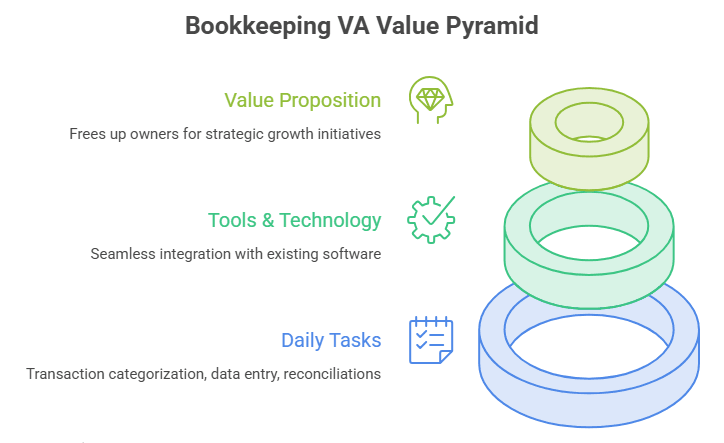
A Bookkeeping VA serves as a remote financial operations specialist who maintains accurate daily records without the overhead of a full-time local hire. These professionals integrate directly into your existing workflows, delivering consistent support that scales with your business needs. By handling routine tasks efficiently, they free up owners and accountants to focus on strategic growth initiatives.
1. Daily Tasks Handled by a Bookkeeping VA
Bookkeeping VAs focus on transactional accuracy and organization. Typical duties include transaction categorization and data entry in tools like QuickBooks Online or Xero. They perform bank and credit card reconciliations while managing invoicing and accounts payable/receivable processes. Additionally, they handle receipt tracking, expense reporting, payroll preparation support, and basic monthly reports such as P&L and balance sheets.
This comprehensive execution keeps your financial data current and reliable. It ensures your accountant receives organized information that reduces their billable time. Ultimately, it creates a strong foundation for informed business decisions throughout the year.
2. Tools and Technology Bookkeeping VAs Use
Modern Bookkeeping VAs work seamlessly in your existing software—no major switches required. Common platforms include QuickBooks, Xero, FreshBooks, or Wave, allowing for quick integration and minimal disruption. They often utilize receipt apps like Dext or Hubdoc to streamline document management and enhance overall efficiency.
This compatibility makes onboarding fast, often completing within the first week of engagement. VAs receive training on your specific setup to maintain consistency and accuracy. As a result, businesses experience smoother financial operations without the learning curve associated with new systems.
3. When a Bookkeeping VA Delivers the Most Value
Hire a Bookkeeping VA when books fall behind, your CPA requests frequent cleanups, or administrative work consumes 5+ weekly hours; 40% of small-business owners spend 80 hours yearly on tax preparation and bookkeeping. This support especially suits businesses processing 50–500 monthly transactions and becomes invaluable when reliable ongoing maintenance matters more than one-off professional advice.
Businesses experiencing rapid growth or inconsistent record-keeping benefit significantly from dedicated VA assistance. Virtual support allows flexibility to adjust hours as needs evolve without long-term commitments. This approach ultimately leads to better financial visibility and reduced stress during tax seasons.
Bookkeeper vs Accountant: Key Differences in Scope
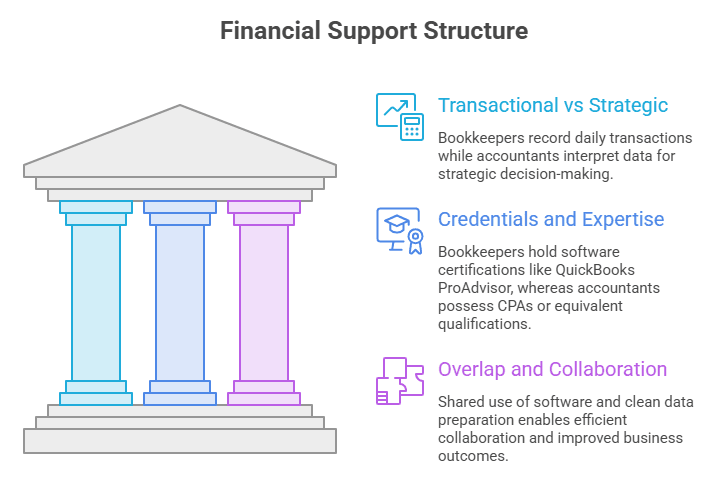
Bookkeepers, including virtual assistants, and accountants play complementary yet distinct roles in your financial ecosystem. Understanding these differences helps business owners allocate resources effectively and avoid paying premium rates for routine tasks. Proper role alignment creates an efficient financial support structure that supports both daily operations and long-term strategy.
1. Transactional vs Strategic Work
Bookkeepers (including VAs) record what happened while accountants interpret data for why it matters and what to do next. This fundamental distinction ensures operational accuracy pairs with insightful analysis for optimal business outcomes.
- Bookkeeping VA scope: Daily/weekly execution, reconciliations, basic reporting.
- Accountant scope: Tax planning, GAAP compliance, financial statements, audits, forecasts, and strategic advice.
- Bookkeeping VA focus: Transaction-level detail and consistency in categorization.
- Accountant focus: High-level interpretation and compliance judgment calls.
2. Credentials and Expertise Levels
- Bookkeeping VAs typically hold software-specific certifications such as QuickBooks ProAdvisor rather than requiring advanced degrees.
- Accountants usually possess CPAs or equivalent qualifications involving 150+ credit hours, rigorous exams, and state licensure.
- The expertise difference allows VAs to excel in execution while accountants provide authoritative guidance on complex matters.
3. Overlap and Collaboration
- Both roles contribute to overall financial health through shared use of accounting software and reporting tools.
- Bookkeepers prepare clean data that enables accountants to work more efficiently on advisory tasks.
- Effective collaboration between the two reduces total costs while improving accuracy and strategic outcomes for the business.
Cost Comparison: Bookkeeping VA vs Hiring an Accountant
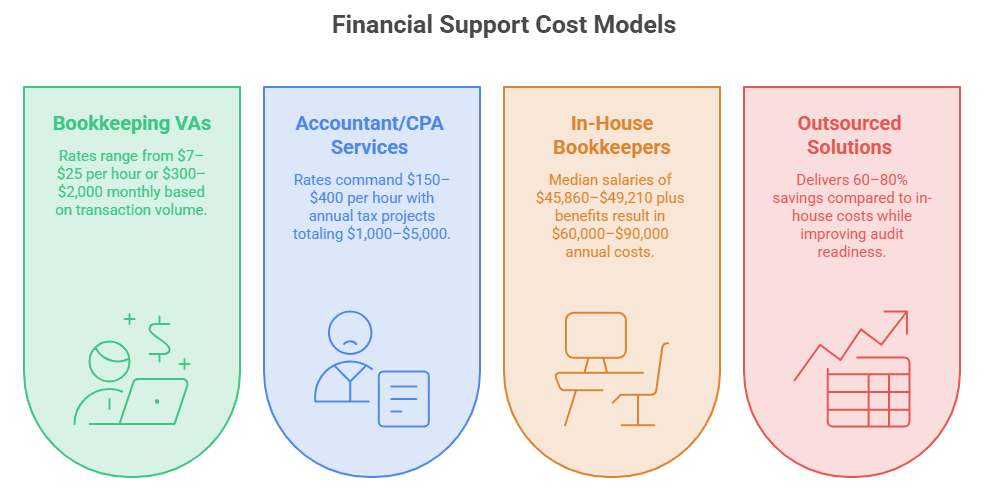
Understanding the true costs of financial support helps small business owners make informed decisions that align with their budgets and operational needs. Bookkeeping VAs generally provide excellent value for routine tasks while accountants command premium rates for specialized expertise. Comparing these options reveals significant opportunities for optimization through strategic outsourcing.
1. Hourly and Monthly Rates Breakdown
Bookkeeping VA costs, especially for offshore or managed services, typically range from $7–$25 per hour, with Philippines or LATAM talent often falling between $8–$15. Monthly expenses usually land between $300–$2,000 depending on transaction volume and scope, making them accessible for most small businesses. This pricing structure offers flexibility without the fixed overhead of traditional employment.
2. Accountant/CPA Costs
Accountant and CPA services generally command $150–$400 or more per hour due to their advanced qualifications and responsibilities. Tax-related projects often total $1,000–$5,000 annually, while monthly retainers for ongoing advisory work range from $500–$2,000 or higher. These rates reflect the strategic value and liability involved in their specialized compliance and planning work.
3. Full-Time In-House vs Virtual/Outsourced Savings
In-house bookkeepers carry median salaries of approximately $45,860–$49,210 plus 30–40% in benefits and overhead, pushing total annual costs to $60,000–$90,000 or more. Virtual and outsourced Bookkeeping VA solutions deliver 60–80% savings compared to these figures while maintaining professional standards. The U.S. payroll and bookkeeping services industry reached about $80.9 billion in 2026, underscoring the widespread adoption of cost-effective models.
4. Hidden Costs and Long-Term ROI
Accountants bill extra cleanup hours when disorganized books increase costs. A dedicated Bookkeeping VA helps prevent this through consistent maintenance and proactive organization. Notably, 37% of small businesses outsource bookkeeping; this support improves audit readiness, reduces avoidable expenses, and strengthens long-term financial stability for sustainable growth.
Scaling with a Bookkeeping VA: Hybrid Models That Work

Hybrid financial support models combining virtual assistants with professional accountants have become increasingly popular among growing small businesses. These arrangements provide both cost efficiency for daily operations and expert guidance for complex decisions. Businesses that adopt this approach often experience improved financial visibility and reduced administrative burden over time.
1. Combining VA Support with Accountant Expertise
Most successful setups pair a Bookkeeping VA for ongoing maintenance with a CPA for taxes and strategy. This combination leverages the cost efficiency of virtual support while ensuring full compliance and expert analysis when needed. The result is a balanced system that optimizes both expenses and financial intelligence for the business.
2. Growth Triggers for Upgrading Support
Hire or expand support when monthly transactions consistently exceed 200–300 or when advanced reporting requirements emerge. Businesses preparing for funding rounds or entering new markets typically need enhanced strategic oversight alongside their VA. Monitoring key indicators like reconciliation delays or frequent accountant cleanup requests helps identify the right timing for adjustments.
Common Myths Debunked

Many business owners hesitate to engage Bookkeeping VAs due to misconceptions about their capabilities and value compared to traditional accountants. Addressing these myths helps clarify the practical benefits and appropriate use cases for virtual support in modern financial management. An accurate understanding leads to better resource allocation and improved financial outcomes.
Myth 1. A Bookkeeping VA Replaces My Accountant
- Bookkeeping VAs handle routine record-keeping but lack the qualifications for tax strategy or official filings that accountants provide.
- Accountants deliver professional judgment, compliance sign-offs, and advisory services that VAs are not positioned to offer.
- Best practice involves using both roles collaboratively, with the VA supporting the accountant through organized data.
Myth 2. Remote Bookkeeping Is Risky
- Controlled access and permission-based systems in modern software make remote work as secure as traditional arrangements.
- Audit trails and regular reviews provide greater visibility and accountability than disorganized in-house processes.
- Professional providers implement NDAs and security protocols that effectively mitigate risks associated with financial data.
Myth 3. It’s Only for Very Small Businesses
- Scaling businesses with moderate to high transaction volumes benefit significantly from flexible VA support.
- Mid-sized operations use VAs to maintain efficiency while reserving accountant time for strategic priorities.
- Industry growth in outsourced services demonstrates broad applicability across various business sizes and sectors.
TaskVirtual: Your Partner in Bookkeeping Virtual Assistant Services

Managing daily financial tasks such as transaction categorization, bank reconciliations, and invoice tracking can quickly become overwhelming for busy small business owners. From keeping up with receipts to ensuring accurate monthly reports, these responsibilities often pull focus away from core growth activities. TaskVirtual provides expert Bookkeeping VA services that simplify your financial operations by handling routine tasks accurately and efficiently while you concentrate on strategic priorities.
1. Expert Bookkeeping Consultation and Review
TaskVirtual’s skilled virtual assistants support essential workflows including transaction categorization in QuickBooks or Xero, bank reconciliations, and AP/AR management. They help organize receipts, prepare basic financial reports, and coordinate with your accountant for seamless handoffs. Their expertise ensures consistent accuracy and helps identify opportunities to streamline your financial processes.
2. Affordable and Flexible Pricing
Hiring a full-time personal assistant can be expensive, but TaskVirtual makes it cost-effective. With pricing plans starting from just $3.12/hour to $14.99/hour, their services are budget-friendly and accessible to individuals, families, and businesses.
3. Comprehensive Bookkeeping Support Solutions
From daily transaction recording and expense tracking to invoice follow-ups and payroll preparation support, TaskVirtual covers it all. Their scalable services adapt whether you need occasional help with reconciliations or consistent support for growing transaction volumes. This comprehensive approach keeps your books clean and audit-ready without the overhead of traditional hires.
4. Ongoing Support and Quality Assurance
TaskVirtual goes beyond basic data entry by providing regular updates on financial status and proactive flagging of discrepancies. Their dedicated support ensures timely month-end closes and reliable reporting that integrates smoothly with your accountant’s work. This continuous assistance minimizes errors and delivers peace of mind throughout the year.
5. Proven Track Record of Excellence
With 364 positive reviews and a 4.7-star rating on trusted VA platforms, TaskVirtual is recognised as a reliable partner worldwide. Clients count on their expertise to simplify bookkeeping tasks and maintain accurate financial records that support business decisions.
FAQ Section
1. What is the main difference between a Bookkeeping VA and an accountant?
A Bookkeeping VA manages daily records and reconciliations. An accountant handles tax strategy, compliance, and analysis.
2. How much does a Bookkeeping VA cost compared to an accountant?
VAs: $300–$2,000/month. Accountants: $150–$400/hour or thousands for projects. Savings often 60–80%.
3. Can a Bookkeeping VA do taxes?
No. They prepare clean data; a CPA files returns and advises.
4. Is hiring a Bookkeeping VA safe for my finances?
Yes, with proper permissions, NDAs, and reviews. Many businesses use them successfully.
5. When should I hire a Bookkeeping VA instead of an in-house bookkeeper?
When seeking flexibility, lower costs, and scalability—especially for part-time or growing needs.
6. How do I find a reliable Bookkeeping VA?
Look for software-specific experience, test with sample tasks, and choose managed providers with guarantees.
Conclusion
A Bookkeeping VA offers an affordable, scalable way to maintain accurate books, freeing you to focus on growth while partnering with an accountant for strategy. This hybrid approach optimizes costs without sacrificing quality—critical in 2026’s competitive landscape.
Choosing between a bookkeeping VA and an accountant requires understanding what each role should handle; this complete bookkeeping VA guide provides additional context on responsibilities, boundaries, and delegation.
Evaluate your transaction volume and pain points today. Start with a Bookkeeping VA trial or consultation to experience the difference. Your future self (and your bottom line) will thank you.
CTA: Ready to streamline your finances? Explore trusted Bookkeeping VA services or book a discovery call with a provider matching your software and needs.
Sources
- My Virtual Mate Blog, Oceans Talent, BookWell.ai, Virtustant, Personiv, FlowFi, Indeed, QuickBooks, NerdWallet, and others (full links in query).
- BLS data, IBISWorld industry reports, Stealth Agents/outsourcing benchmarks.
For more such content, visit our website.
 Siddhartha Basu is a Technical Writer at Task Virtual. He loves online games, e-book reading, and Yoga.