Contents
show
How an Accounting Virtual Assistant Supports Modern Businesses
An accounting virtual assistant is a remote professional who supports financial operations such as bookkeeping, invoicing, reconciliation, and reporting using cloud-based tools. They function as an extension of a company’s finance team without requiring a full-time, in-house hire.
Many small businesses and startups struggle to maintain accurate financial records while focusing on growth. In fact, around 40% of small business owners identify bookkeeping and taxes as one of the most challenging aspects of running a business. Hiring in-house accounting staff can be expensive and inflexible, especially when workloads fluctuate. This is where an accounting virtual assistant becomes operationally valuable—providing structured, process-driven financial support without long-term overhead.
What This Means for Businesses
Using a virtual assistant for accounting allows businesses to standardize financial processes without expanding internal headcount. This approach reduces operational complexity while maintaining consistency and accuracy in financial workflows. It also enables organizations to scale efficiently without incurring additional fixed staffing costs.
For companies in the US and UK, this typically means:
- Delegating repetitive financial tasks to streamline operations, enhance overall efficiency, reduce manual errors, and allow greater focus on strategic decision-making and higher-value activities.
- Maintaining compliance-ready records to ensure regulatory adherence, improve audit preparedness, enhance transparency, and support accurate, timely financial reporting across all operations.
- Improving visibility into cash flow and financial performance to enable informed decision-making, strengthen financial planning, identify potential risks and opportunities, and support sustainable business growth.
Why Companies Outsource This Task
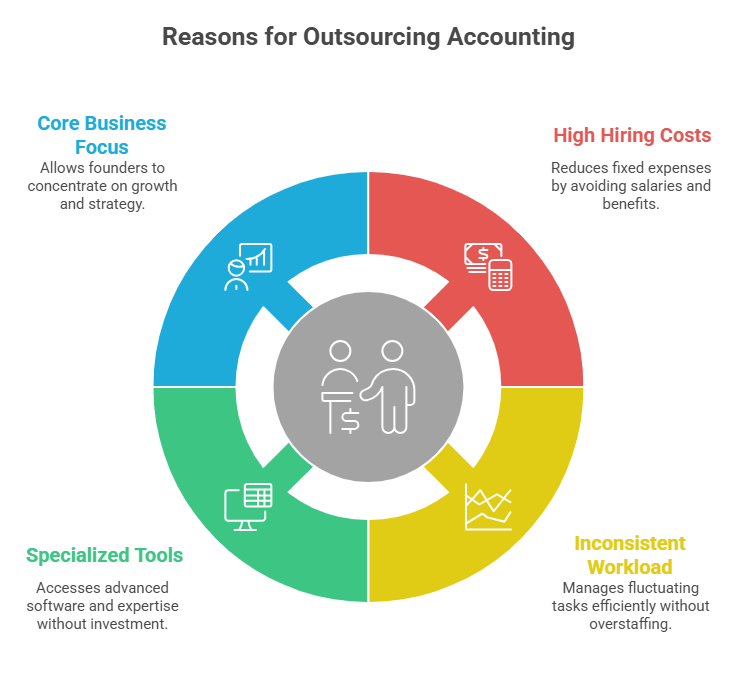
Businesses outsource accounting tasks primarily due to operational inefficiencies and cost constraints that hinder internal performance. These challenges often lead to increased administrative burden, higher expenses, and reduced accuracy in financial management. Outsourcing helps address these issues by improving efficiency, lowering costs, and ensuring more reliable financial operations.
Key drivers include:
- The high cost of in-house hiring, including salaries, benefits, and training, significantly increases fixed operational expenses.
- Accounting workloads are often inconsistent, with tasks fluctuating between routine daily operations and more intensive periods such as month-end processing.
- The need for specialized tools and knowledge, such as platforms like QuickBooks, requires familiarity and consistent usage to ensure accurate and efficient financial management.
- Founders and managers need to focus on core business activities, prioritizing growth and strategic initiatives over time-consuming administrative work.
Tasks Virtual Assistants Perform
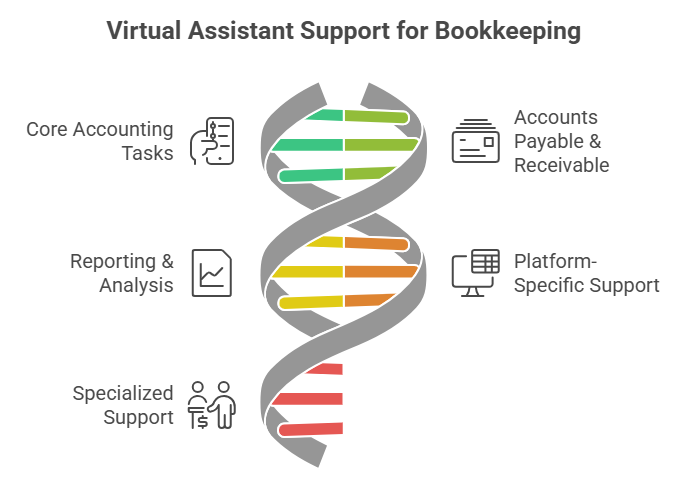
A bookkeeping virtual assistant or virtual assistant for bookkeeping typically handles structured, repeatable financial tasks. Studies indicate that up to 60% of accounting tasks can be automated or delegated, making them highly suitable for virtual support.
1. Core Accounting Tasks
Core accounting tasks include recording daily transactions to ensure all financial activities are accurately documented. This also involves performing bank and credit card reconciliations to maintain consistency between records and actual balances. Additionally, managing general ledgers and handling expense tracking and categorization support organized and reliable financial reporting.
2. Accounts Payable & Receivable
Accounts payable and receivable functions cover invoice creation and timely sending to clients. They also include tracking incoming payments and processing vendor bills to maintain smooth financial operations. Regular follow-ups on overdue payments help ensure steady cash flow and minimize outstanding balances.
3. Reporting & Analysis
Reporting and analysis involve preparing monthly financial reports to provide a clear overview of business performance. This includes generating cash flow summaries and profit and loss statements for better financial insight. Budget tracking is also conducted to monitor spending and ensure alignment with financial goals.
4. Platform-Specific Support
Platform-specific support includes working with tools like QuickBooks to manage accounting processes efficiently. It also involves handling financial operations within platforms such as Xero and FreshBooks. Additionally, payroll data entry support ensures accurate compensation records and compliance.
5. Specialized Support
Specialized support includes providing tailored accounting virtual assistant services for small businesses. It also extends to supporting CPA firms with structured financial processes and documentation. Preparing data for tax filing ensures accuracy, compliance, and readiness for regulatory requirements.
Tools Professional Virtual Assistants Use

An effective outsourced accounting virtual assistant relies on cloud-based systems to maintain accuracy and collaboration across financial operations. These systems enable real-time data access, streamlined workflows, and seamless coordination between stakeholders. As a result, businesses benefit from improved transparency, efficiency, and reliable financial management.
Common Tools
- Accounting software such as QuickBooks and Xero is used for core financial tracking, transaction recording, and generating accurate, real-time reports.
- Expense management tools such as Expensify and Receipt Bank are used to capture, digitize, and categorize receipts and expenses for accurate and efficient financial tracking.
- Payment platforms such as Stripe and PayPal are used to monitor incoming payments and reconcile revenue streams accurately and efficiently.
- Communication tools such as Slack and Zoom enable real-time coordination and seamless communication with clients and teams.
- File management systems such as Google Drive and Dropbox are used to securely store, organize, and manage financial documents for easy access and collaboration.
Step-by-Step Workflow Used by Virtual Assistants
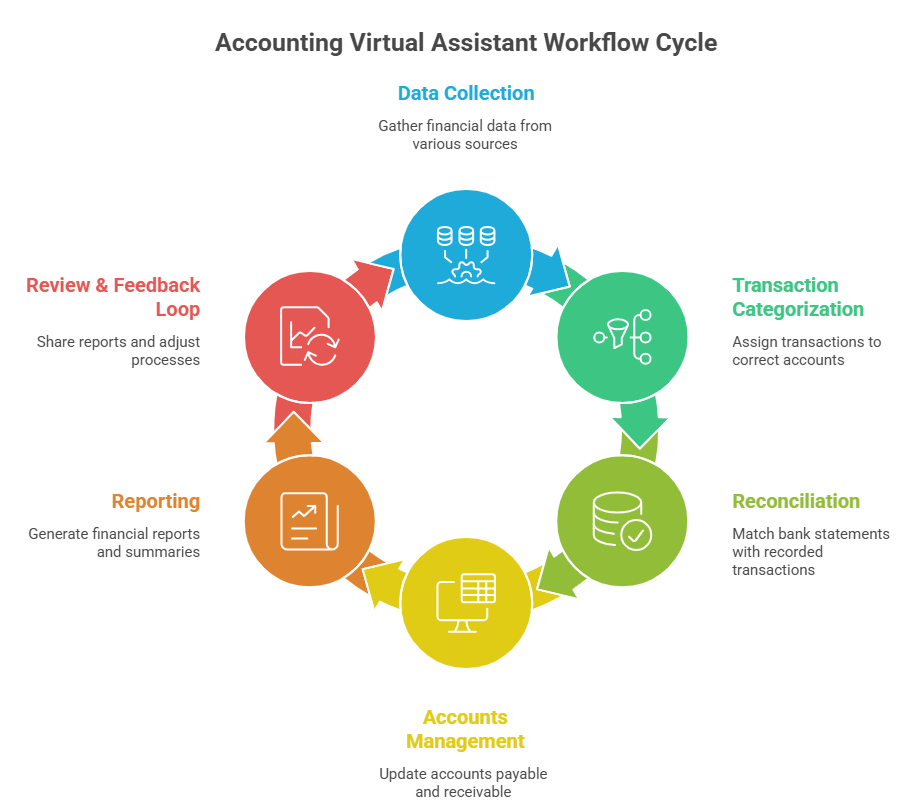
A dedicated accounting virtual assistant follows a structured workflow to ensure consistency and accuracy in financial operations. This approach standardizes processes, reduces the likelihood of errors, and improves overall efficiency. As a result, businesses benefit from reliable financial data and more streamlined accounting practices.
1. Data Collection
Data collection involves accessing bank feeds and relevant financial platforms to gather accurate transaction data. It also includes collecting receipts and invoices to ensure all financial activities are properly documented. Additionally, syncing payment systems helps maintain consistency and real-time updates across financial records.
2. Transaction Categorization
Transaction categorization involves assigning each transaction to the correct accounts for accurate bookkeeping. Consistent accounting rules are applied to maintain uniformity across financial records. Any anomalies or unusual entries are flagged for further review to prevent errors.
3. Reconciliation
Reconciliation involves matching bank statements with recorded transactions to ensure accuracy. This process helps identify any discrepancies between actual and recorded financial data. Resolving mismatches promptly ensures reliable and up-to-date financial records.
4. Accounts Management
Accounts management includes updating accounts payable and receivable to reflect current financial obligations. It also involves tracking due dates to ensure timely payments and collections. Sending reminders helps reduce delays and maintain a healthy cash flow.
5. Reporting
Reporting involves generating monthly financial reports to provide a clear overview of business performance. Financial summaries are prepared to highlight key insights and trends. Key metrics are emphasized to support informed decision-making and strategic planning.
6. Review & Feedback Loop
The review and feedback loop involves sharing reports with the business owner or CPA for evaluation. Feedback is used to refine processes and improve accuracy and efficiency. Continuous adjustments ensure that financial operations remain aligned with business needs and goals.
Common Challenges Businesses Face

Before outsourcing, businesses often encounter several operational and financial challenges that affect efficiency and accuracy. These issues can lead to increased workload, higher risk of errors, and limited financial visibility. As a result, overall performance and decision-making capabilities may be significantly impacted:
- Disorganized financial records can lead to errors, inefficiencies, compliance risks, and reduced visibility into overall financial performance.
- Missed invoices or late payments can disrupt cash flow, strain client relationships, and negatively impact overall financial stability.
- Manual errors in bookkeeping can result in inaccurate financial records, compliance issues, and flawed decision-making due to unreliable data.
- A lack of real-time financial visibility can hinder timely decision-making, obscure cash flow trends, and increase the risk of financial mismanagement.
- Over-reliance on founders for accounting tasks can create operational bottlenecks, divert focus from strategic priorities, and increase the risk of inefficiencies and errors in financial management.
Benefits of Outsourcing to Virtual Assistants
Outsourcing to an affordable accounting virtual assistant delivers measurable operational benefits, with businesses reporting cost savings of up to 78% when outsourcing compared to in-house operations.
| Factor | In-House Accountant | Accounting Virtual Assistant |
|---|---|---|
| Cost | High fixed salary | Flexible, usage-based |
| Scalability | Limited | Easily scalable |
| Availability | Fixed hours | Often extended coverage |
| Tools Expertise | Varies | Typically specialized |
| Setup Time | Long | Faster onboarding |
Key Advantages
- Cost efficiency is improved through lower overhead compared to full-time hires, reducing expenses related to salaries, benefits, and ongoing administrative costs.
- Process consistency ensures that standardized workflows are followed, reducing errors, improving accuracy, and enhancing overall operational efficiency.
- Scalability allows businesses to increase or decrease support as needed, ensuring flexibility in resource allocation while adapting efficiently to changing operational demands.
- Access to expertise provides businesses with experienced professionals who are familiar with accounting tools and best practices, ensuring accurate financial management and informed decision-making.
- Improved financial visibility ensures timely, accurate reporting, enabling better decision-making, stronger financial control, and more effective strategic planning.
How a Virtual Assistant Company Helps Businesses
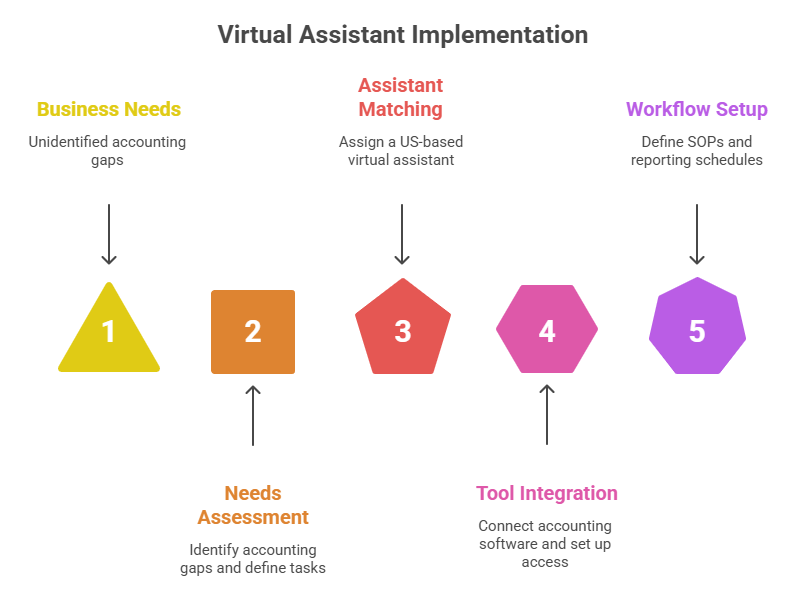
A professional virtual assistant company bridges the gap between business needs and execution by providing structured support and operational efficiency. It ensures that tasks are handled accurately, consistently, and in alignment with business objectives. This enables organizations to focus on strategic growth while maintaining streamlined day-to-day operations.
Implementation Process
- Needs assessment involves identifying accounting gaps and clearly defining the required tasks to ensure accurate, efficient, and well-structured financial operations.
- Assistant matching involves assigning a US-based accounting virtual assistant when necessary to ensure alignment with time zone requirements and familiarity with relevant compliance standards.
- Tool integration involves connecting accounting software systems and setting up secure access protocols to ensure seamless data flow, system compatibility, and protection of sensitive financial information.
- Workflow setup involves defining SOPs (Standard Operating Procedures) and establishing clear reporting schedules to ensure consistency, accountability, and efficient financial operations.
- Ongoing management involves monitoring performance and adjusting the scope of support as the business grows to ensure continued efficiency, alignment with objectives, and scalability of financial operations.
TaskVirtual: Your Partner in Accounting Virtual Assistant Services

Managing bookkeeping, invoices, and financial records alongside core business operations can quickly become overwhelming. Errors, missed deadlines, and a lack of financial visibility often impact decision-making. TaskVirtual provides structured accounting virtual assistant services that help businesses maintain accurate records, streamline workflows, and stay financially organized without the need for in-house staff.
1. Expert Consultation and Financial Process Review
TaskVirtual’s accounting virtual assistants assess your existing financial workflows, identify gaps in bookkeeping or reporting, and help set up efficient systems. They support tools like QuickBooks and Xero, ensuring transactions are categorized correctly and reports are aligned with business needs.
2. Affordable and Flexible Pricing
Hiring full-time accounting staff can significantly increase operational costs. TaskVirtual offers flexible pricing plans starting from $3.12/hour to $14.99/hour, making it easier for startups, agencies, and small businesses to access professional accounting support without long-term commitments.
3. Comprehensive Accounting Support Solutions
From managing accounts payable and receivable to preparing monthly financial reports, TaskVirtual covers essential accounting functions. Their services adapt to different business sizes, whether you need a bookkeeping virtual assistant occasionally or a dedicated accounting virtual assistant for ongoing support.
4. Ongoing Support and Accuracy Assurance
TaskVirtual ensures consistent financial management through regular updates, reconciliations, and reporting. Their assistants follow structured workflows, reducing errors and ensuring your financial data remains audit-ready and up to date.
5. Proven Track Record of Reliability
With 364 positive reviews and a 4.7-star rating on trusted virtual assistant platforms, TaskVirtual is recognized as a dependable partner for outsourced accounting support. Businesses rely on their expertise to maintain financial clarity and operational efficiency.
Conclusion
An accounting virtual assistant provides a practical solution for businesses seeking reliable financial management without the cost and rigidity of in-house hiring.
For a broader look at the tasks, responsibilities, and professional boundaries involved in remote accounting support, see this guide to bookkeeping virtual assistant services.
By combining structured workflows, cloud-based tools, and specialized expertise, virtual assistants enable businesses to maintain accurate records, improve cash flow management, and focus on strategic growth.
Key Takeaways
-
Accounting virtual assistants handle bookkeeping, invoicing, and reporting remotely
-
They follow standardized workflows that improve accuracy and consistency
-
Businesses reduce costs by outsourcing instead of hiring full-time staff
-
Cloud-based tools enable real-time collaboration and transparency
-
Virtual assistant companies provide structured onboarding and ongoing support
FAQ Section
1. What does an accounting virtual assistant do daily?
They manage transactions, reconcile accounts, process invoices, and prepare financial reports using accounting software.
2. Is a virtual assistant suitable for small businesses?
Yes. An accounting virtual assistant for a small business is often more cost-effective than hiring in-house staff.
3. Can a virtual assistant use QuickBooks?
Yes. Many provide virtual assistants for QuickBooks accounting services, including setup and ongoing management.
4. How much does an accounting virtual assistant cost?
Costs vary based on experience and workload, but they are typically more affordable accounting virtual assistant options compared to full-time hires.
5. Do CPA firms use virtual assistants?
Yes. Many firms use an accounting virtual assistant for CPA firms to handle bookkeeping and data preparation tasks.
 Siddhartha Basu is a Technical Writer at Task Virtual. He loves online games, e-book reading, and Yoga.