
Contents
show
Virtual Accounting Assistant Pricing: What to Expect
Hiring help for your books no longer means paying full-time U.S. salaries plus benefits. Virtual accounting assistant pricing has matured into clear ranges that let American small businesses and growing firms get professional day-to-day financial support at a fraction of traditional costs. Whether you need basic transaction coding or full monthly close support, understanding what drives the numbers—and what you actually receive—helps you choose wisely and avoid surprises.
This guide examines current market rates, pricing models, cost comparisons, and decision factors, noting that benefits represent 30.1% of private-industry compensation, so you can budget realistically and maintain clean books without in-house overhead.
What Virtual Accounting Assistants Actually Cost in 2026
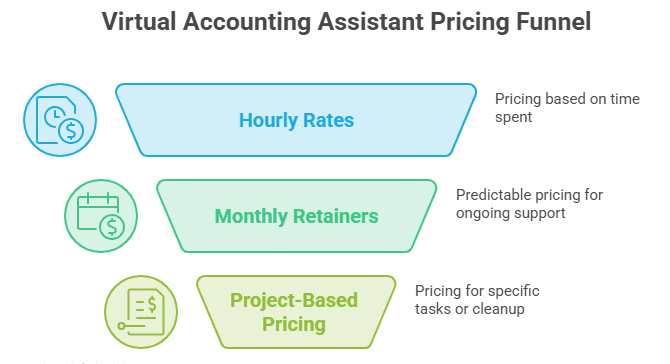
Virtual accounting assistants (often called bookkeeping virtual assistants or virtual bookkeepers) handle recurring financial tasks such as transaction categorization, bank and credit-card reconciliations, accounts payable and receivable, invoice management, receipt organization, and basic monthly reporting. They work inside your existing tools—QuickBooks Online, Xero, or similar—under permissions you control. They do not replace a CPA or provide tax strategy; they keep the records accurate and ready for your accountant.
1. Typical Hourly Rates by Location and Skill Level
Virtual Accounting Assistant Pricing varies significantly by location and expertise. Skilled offshore or nearshore professionals in the Philippines, India, and Latin America earn about $8–$20 per hour, while U.S.-based freelancers and agency assistants often command $25–$50 or more. Specialists with advanced experience may charge higher rates. The U.S. Bureau of Labor Statistics reported a May 2024 median wage of $49,210 annually, equivalent to approximately $23.66 per hour, for bookkeeping, accounting, and auditing clerks.
Specialized skills—multi-entity work, inventory tracking, e-commerce reconciliations, or QuickBooks ProAdvisor-level experience—push rates toward the higher end of each range. Basic data-entry support sits lower. These figures provide a useful benchmark for comparing virtual options against domestic labor costs before benefits and overhead.
2. Monthly Retainers and Package Pricing
Many providers and freelancers offer monthly packages for predictability. Basic support of roughly 10–15 hours often falls in the $500–$1,000 range, while standard ongoing bookkeeping of 20–30 hours commonly runs $1,000–$2,000. More comprehensive or dedicated full-time equivalent support can reach $2,000–$4,000+ per month depending on volume, complexity, and whether the arrangement is managed through an agency.
Agency models often provide vetting, oversight, and replacement guarantees, raising prices; 52% of small businesses use firms or agencies. Freelancers may seem cheaper but transfer recruitment, training, and continuity risks directly to clients.
3. Project-Based and Cleanup Pricing
Catch-up or historical cleanup work is usually priced hourly or as a fixed project fee because the effort is denser and less predictable than steady monthly maintenance. Expect $50–$100+ per hour (or equivalent fixed quotes) for intensive cleanup of lagged books, uncategorized transactions, or multi-year backlogs. Once the records are brought current, most clients shift to a recurring monthly arrangement that costs less per hour overall.
A thorough one-time cleanup reduces ongoing risk of errors and prepares the books for reliable monthly closes. Clients who invest in this step first typically see faster turnaround and higher accuracy from their virtual accounting assistant afterward. Always clarify whether the quote covers only data entry or also includes full reconciliations, documentation, and a clean handoff package for your CPA.
Key Factors That Influence Virtual Accounting Assistant Pricing
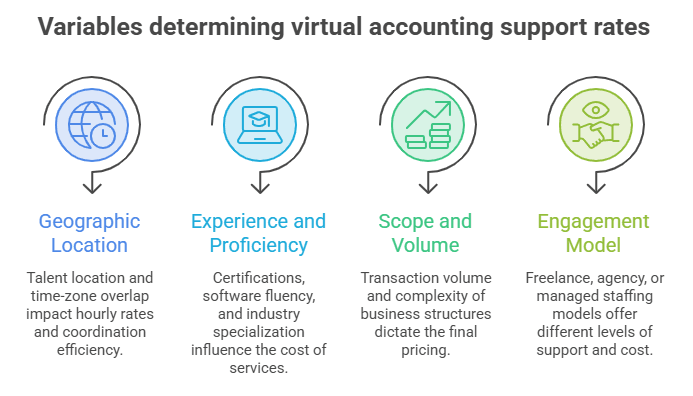
Several variables determine the final rate you pay for virtual accounting support. Understanding these factors helps you compare quotes accurately and select the arrangement that matches both your budget and operational needs.
1. Geographic Location and Time-Zone Overlap
- Talent based in lower-cost regions such as the Philippines or India delivers professional results at lower hourly rates.
- U.S.-based assistants command a premium for native English, cultural alignment, and full business-hour overlap.
- Latin American talent often provides a useful middle ground with competitive rates plus stronger daytime overlap with U.S. time zones.
- Time-zone compatibility reduces delays in clarifications and month-end close coordination.
2. Experience, Certifications, and Software Proficiency
- A certified QuickBooks Online ProAdvisor or multi-year industry specialist costs more than a generalist.
- Proven fluency in your specific software stack shortens onboarding time and lowers error risk.
- Experience with e-commerce platforms, multi-entity structures, or regulated industries justifies higher rates.
- Many owners find the premium worthwhile because it reduces the need for constant oversight.
3. Scope of Work and Transaction Volume
- Simple single-entity books with modest monthly transactions cost less than complex setups.
- Multi-channel e-commerce, multi-state sales tax, inventory tracking, or high AP/AR volume increases the rate.
- Clearly defining the number of bank accounts, reporting frequency, and any payroll-prep support keeps quotes accurate.
- Expanding scope later is easier than underestimating volume at the start and facing unexpected overages.
4. Engagement Model: Freelance, Agency, or Managed
- Freelance platforms offer flexibility and often lower headline rates but require you to handle screening and backups.
- Agencies charge more for pre-vetted talent, performance monitoring, and replacement guarantees.
- Managed staffing providers reduce your administrative burden and continuity risk.
- The total cost of ownership frequently favors the managed option once management time and turnover are considered.
Virtual Accounting Assistant vs. In-House Bookkeeper: True Cost Comparison

A full-time in-house bookkeeper’s base pay sits near the BLS median, yet the true cost rises substantially once benefits, taxes, and overhead are added. Virtual arrangements eliminate most of those extras while delivering comparable day-to-day support. Comparing the two side by side reveals why many American businesses shift recurring bookkeeping work to remote professionals.
| Cost Category | In-House Bookkeeper | Virtual Accounting Assistant |
|---|---|---|
| Base Annual Compensation | ~$49,210 (BLS median) | Equivalent to $12,000–$36,000 depending on hours |
| Benefits, Taxes & PTO | 25–40% additional | None |
| Equipment, Software & Office | $2,000–$5,000+ annually | Minimal or included in rate |
| Management & Training Overhead | Significant ongoing time | Lower after initial onboarding |
| Estimated Fully Loaded Annual Cost | $60,000–$90,000+ | $12,000–$48,000 for comparable hours |
| Flexibility | Fixed full-time commitment | Scale hours up or down as needed |
Businesses commonly report 40–60% savings with virtual support while maintaining or improving accuracy and turnaround. The opportunity cost of owner time previously spent on books further improves the return on investment.
Pricing Models Explained and When Each Makes Sense
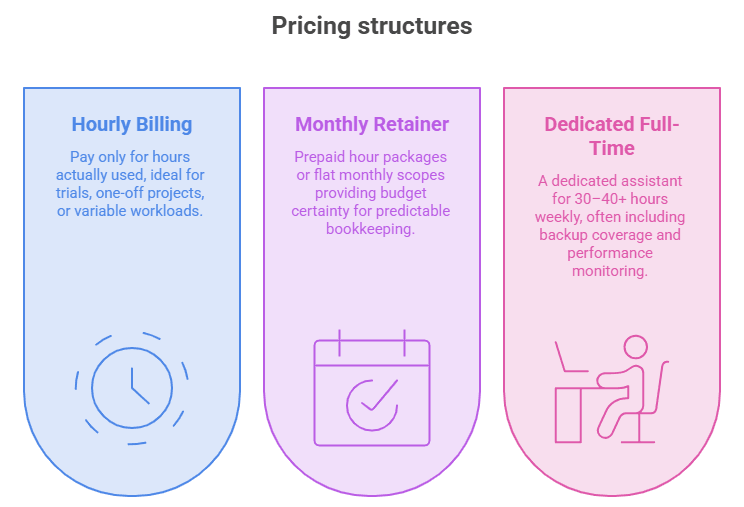
Virtual Accounting Assistant Pricing models fit changing growth stages and workloads; 80% of executives plan to maintain or increase outsourcing investment. The right structure controls costs, supports consistency, and adjusts smoothly as business needs gradually stabilize.
1. Hourly Billing
Hourly billing works best for trials, one-off projects, or highly variable workloads because you pay only for hours actually used. The model offers maximum flexibility when scope is still being defined or when cleanup work is required. Set weekly or monthly caps and track carefully, because the meter can run during clarification or rework if processes are unclear.
2. Monthly Retainer or Hour Packages
Monthly retainers or prepaid hour packages deliver budget certainty for predictable ongoing bookkeeping. Packages of 10, 20, or 40 hours (or flat monthly scopes) suit most small businesses once systems stabilize. Confirm rollover policies for unused hours, and how overages are handled so you avoid surprises at month-end.
3. Dedicated Full-Time or Near Full-Time
When volume justifies 30–40+ hours weekly, a dedicated assistant builds deeper knowledge of your systems and preferences. Agency versions of this model often include backup coverage and performance monitoring. Hybrid approaches—retainer for core monthly work plus occasional project hours—work well for many firms that experience seasonal spikes.
How to Evaluate Quotes and Avoid Common Pitfalls

Choosing the right provider involves more than comparing the lowest advertised rate. Virtual Accounting Assistant Pricing should be evaluated alongside experience, service scope, software proficiency, security practices, communication standards, and replacement support. A structured review of these factors helps businesses protect bookkeeping accuracy, prevent hidden expenses, and secure dependable long-term value.
- Request a written scope that lists included tasks, software platforms, reporting cadence, response times, and explicit exclusions such as tax advice.
- Confirm security practices including role-based access, NDAs, two-factor authentication, and audit trails; never share full banking credentials.
- Test candidates with a small real or sample bank feed and reconciliation exercise rather than relying solely on interviews.
- Start with a limited set of tasks, review thoroughly for the first 30–60 days, then expand autonomy as quality is proven.
- Watch for hidden costs such as platform fees, required software licenses, and your own management time during onboarding.
- Prefer providers who offer replacement guarantees or clear continuity plans so a single departure does not disrupt month-end close.
TaskVirtual: Reliable Virtual Accounting Assistant Support

Keeping accurate financial records while running a business can quickly consume valuable time that should be spent on growth and strategy. From categorizing transactions and reconciling accounts to managing invoices and preparing monthly reports, the administrative load of bookkeeping often falls on owners who already wear multiple hats. TaskVirtual offers specialized virtual accounting assistant services designed to handle these recurring finance tasks efficiently, giving American small businesses and entrepreneurs consistent, professional support without the cost of a full-time hire.
1. Skilled Bookkeeping Guidance and Review
TaskVirtual’s trained virtual accounting assistants help select the right workflows for your software, organize transaction categories, and maintain clean reconciliations. They also assist with reviewing reports, flagging discrepancies, and preparing documentation so your CPA receives organized files ready for tax or advisory work.
2. Affordable and Flexible Pricing
Hiring a full-time in-house bookkeeper can be expensive, but TaskVirtual makes professional support accessible. With pricing plans starting from just $3.12/hour to $14.99/hour, their services remain budget-friendly for solopreneurs, small businesses, and growing firms that need reliable financial recordkeeping.
3. Complete Day-to-Day Accounting Assistance
From daily transaction entry and bank reconciliations to accounts payable and receivable tracking, invoice follow-up, and monthly statement preparation, TaskVirtual covers the core bookkeeping functions most businesses need. Their scalable approach adapts whether you require occasional cleanup support or consistent monthly close assistance.
4. Continuous Oversight and Accuracy Checks
TaskVirtual goes beyond basic data entry by providing regular status updates, exception alerts, and quality reviews. Their proactive approach helps ensure books stay current, errors are caught early, and financial visibility remains strong throughout the month.
5. Established Reputation for Dependable Service
With 364 positive reviews and a 4.7-star rating on trusted VA platforms, TaskVirtual is recognized as a reliable partner for remote financial support. Clients rely on their expertise to simplify bookkeeping processes and maintain accurate records without the overhead of traditional staffing.
FAQ Section
1. How much does a virtual accounting assistant cost per hour?
Offshore or nearshore talent typically runs $8–$20 per hour for competent bookkeeping work. U.S.-based professionals more commonly charge $25–$50+ depending on experience and specialization.
2. Is a virtual bookkeeper cheaper than hiring in-house?
Yes, in most cases. Fully loaded in-house costs often exceed $60,000–$90,000 annually, while capable virtual support can deliver equivalent recurring work for a fraction of that amount with greater flexibility.
3. Do virtual accounting assistants replace my CPA?
No. They maintain accurate day-to-day records and prepare clean files so your CPA can focus on tax strategy, compliance, and advisory work more efficiently.
4. What software do they use?
Most work inside the platforms you already use—QuickBooks Online, Xero, FreshBooks, and supporting tools such as Dext, Hubdoc, or receipt apps—under limited permissions you control.
5. How do I keep my financial data secure with a remote assistant?
Use role-based access, NDAs, two-factor authentication, approval thresholds for payments, and regular review of audit logs. Limit the assistant to data entry and reconciliation; keep final payment authority internal.
6. Should I hire freelance or through an agency?
Freelance can be lower cost for simple needs if you are willing to manage screening and continuity. Agencies cost more but reduce risk through vetting, training, and replacement guarantees—often preferable for finance work.
Conclusion
Virtual accounting assistant pricing in 2026 offers American businesses a practical, scalable way to keep books current without the full burden of an in-house hire. Rates typically range from the low teens per hour offshore to the mid-twenties and higher for U.S. talent, with monthly packages commonly falling between $500 and $3,000+ depending on hours and complexity. Matching scope to real needs, insisting on clear processes and security controls, and comparing total cost of ownership rather than headline rates produces the best results.
If your books are consistently behind, your CPA repeatedly requests cleanup, or you spend valuable hours on transaction coding, obtain a few detailed quotes. Document your tools, approximate monthly volume, and must-have tasks, then choose the arrangement that balances cost, reliability, and fit. Accurate books are infrastructure for better decisions.
Sources
- U.S. Bureau of Labor Statistics, Bookkeeping, Accounting, and Auditing Clerks occupational outlook (median pay data)
- U.S. Bureau of Labor Statistics, Secretaries and Administrative Assistants
- ZipRecruiter Virtual Bookkeeper salary data
- Additional market observations drawn from industry analyses of virtual assistant and bookkeeping service pricing models
For more such content, visit our website.
 Siddhartha Basu is a Technical Writer at Task Virtual. He loves online games, e-book reading, and Yoga.