Contents
show
SEO Virtual Assistant
Search engine optimization is no longer a project a business completes once and forgets. Websites accumulate outdated pages, broken links, indexing problems, weak internal navigation, stale metadata, missed keyword opportunities, and content that no longer satisfies the questions customers ask. Meanwhile, AI Overviews, AI Mode, local results, video, images, products, and traditional blue links have made search visibility more varied and operationally demanding. An SEO virtual assistant helps manage that execution burden.
This remote professional can research keywords, update pages, prepare content briefs, check technical issues, organize link-building outreach, maintain reports, and keep an SEO backlog moving. The assistant does not automatically replace a strategist, developer, subject-matter expert, or digital PR specialist. Instead, the role creates dependable capacity for repeatable work that often remains unfinished inside a small business.
The opportunity is significant for American companies. Pew Research Center reports that 96% of U.S. adults use the internet, while 16% are smartphone-only internet users. A website therefore needs to be discoverable, useful, and usable across devices. This guide explains what SEO virtual assistant services include, which tasks to delegate, how the workflow operates, what results take time, and when a VA, specialist, or agency is the right choice.
What Are SEO Virtual Assistant Services?
SEO virtual assistant services provide remote operational support for improving a website’s organic search visibility. The scope may cover research, content, on-page optimization, technical checks, outreach administration, local SEO, reporting, and project coordination. The exact responsibilities should reflect the site’s condition, the assistant’s skill level, and the business outcomes SEO is expected to support.
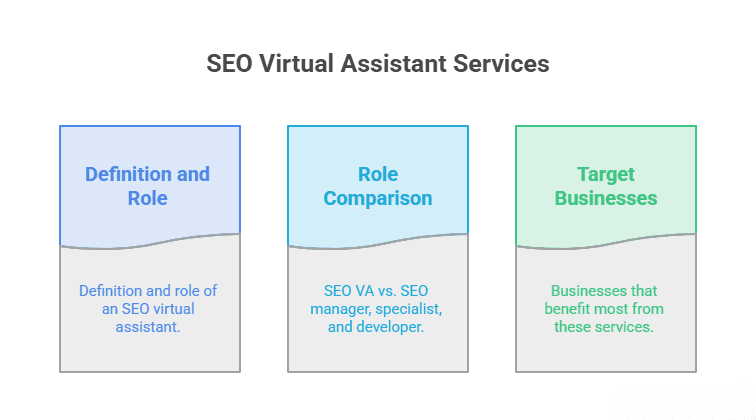
1. Definition and Role of an SEO Virtual Assistant
An SEO virtual assistant is a remote professional who completes defined search optimization tasks under an agreed strategy and quality process. Common responsibilities include collecting search data, mapping keywords to pages, drafting title tags and meta descriptions, building content briefs, updating internal links, checking Search Console, documenting technical errors, monitoring rankings, and preparing reports.
The word “assistant” should not be mistaken for unskilled support. SEO work requires research ability, attention to detail, sound judgment, and familiarity with search tools and content management systems. However, capability varies. One VA may specialize in content operations, while another can run crawls and investigate indexing signals. A business should therefore hire against a written scope rather than assuming every SEO VA provides the same expertise.
2. SEO VA vs. SEO Manager, Specialist, and Developer
An SEO manager typically owns strategy, cross-functional priorities, forecasting, stakeholder communication, and performance interpretation. The specialists may bring deeper expertise in technical SEO, content strategy, local search, ecommerce, or digital PR. A developer changes templates, code, servers, and site architecture. They usually support recurring implementation and coordination across these functions.
The boundaries are not absolute. An experienced VA may conduct audits, plan content, or recommend fixes. Still, businesses should not expect one person to be a senior strategist, copywriter, outreach specialist, analyst, and developer simultaneously. Complex JavaScript rendering, migrations, international architecture, algorithmic penalties, or enterprise crawl management often require senior technical support.
3. Businesses That Benefit Most
Local service companies can delegate location-page updates, review monitoring, citation checks, Google Business Profile support, and reporting while their owners focus on serving customers. Professional service firms can turn attorney, accountant, consultant, or healthcare expertise into accurate briefs, optimized service pages, and useful educational content. Ecommerce businesses can use SEO VA support for category optimization, product metadata, internal linking, image information, discontinued-product workflows, and recurring technical checks.
Content-led brands can organize editorial calendars, refresh aging articles, consolidate overlapping topics, improve internal links, and measure search performance consistently. Digital agencies can expand delivery capacity by assigning defined research, auditing, implementation, reporting, and quality-assurance tasks to trained remote support. Startups and small businesses can build a dependable SEO operating system before they are ready for a full-time hire or broad agency engagement.
Core SEO Tasks You Can Delegate

The safest work to delegate is repeatable, documented, reviewable, and connected to a measurable objective. A VA should know which tasks can be completed independently, which need editorial approval, and which require a strategist or developer. Clear boundaries improve speed without allowing routine optimization to create brand, technical, or compliance risks.
1. Keyword Research and Competitor Analysis
- Collect keyword evidence from Search Console, research platforms, customer questions, sales conversations, competitor pages, and relevant features appearing in Google results.
- Group related terms by topic, audience need, funnel stage, and search intent so informational and commercial opportunities are not treated as interchangeable.
- Map keywords to URLs by assigning viable topics to existing or planned pages while identifying overlap that could create cannibalization or user confusion.
- Analyze competitor coverage to document topic gaps, page structures, content depth, positioning patterns, and legitimate link opportunities without copying another site’s work.
- Prioritize business relevance by weighing intent, conversion potential, competition, authority, and production requirements instead of selecting targets solely by estimated search volume.
- Create decision-ready outputs such as keyword maps, topic groups, page recommendations, and supporting evidence rather than delivering an unfiltered spreadsheet containing thousands of phrases.
2. On-Page SEO Tasks
- Optimize page titles by matching the primary topic and search intent while keeping each title specific, readable, and distinct from other pages.
- Improve meta descriptions with accurate page summaries and useful value propositions rather than stuffing keywords or making claims the page cannot support.
- Structure headings clearly so readers and search systems can identify the main subject, supporting questions, steps, comparisons, and conclusions without unnecessary repetition.
- Strengthen internal links using descriptive anchor text that helps visitors discover related pages and clarifies relationships within the broader topic cluster.
- Improve images and media through descriptive file names, relevant alternative text, sensible dimensions, compression coordination, captions, and placement near supporting content.
- Run a repeatable QA checklist based on a structured on-page SEO service, covering URLs, canonicals, headings, metadata, links, mobile presentation, factual accuracy, calls to action, and approval status before publication.
3. Content Optimization and Publishing Support
- Update existing pages by correcting outdated facts, adding missing subtopics, improving introductions, removing repetition, and aligning the structure more closely with search intent.
- Strengthen page connections by inserting relevant internal links, repairing broken references, clarifying anchor text, and directing readers toward genuinely useful supporting resources.
- Coordinate new production by collecting expert input, building briefs, tracking drafts, organizing reviews, and confirming responsibilities, deadlines, and approval status.
- Prepare publication details such as titles, meta descriptions, headings, image information, citations, calls to action, and CMS formatting before the page goes live.
- Complete prepublication QA by checking factual accuracy, source quality, links, layout, mobile presentation, indexing directives, and whether the approved version was uploaded correctly.
- Protect content quality by following Google’s people-first content guidance and supporting original expertise instead of mass-producing interchangeable pages for additional keywords.
Technical SEO and Website Health
Technical SEO helps search engines access, interpret, and index the correct pages while giving visitors a stable, usable experience. An SEO VA can identify and document many technical problems, implement approved CMS-level fixes, and coordinate developers. The level of independent ownership should depend on the assistant’s technical training and the risk of the change.
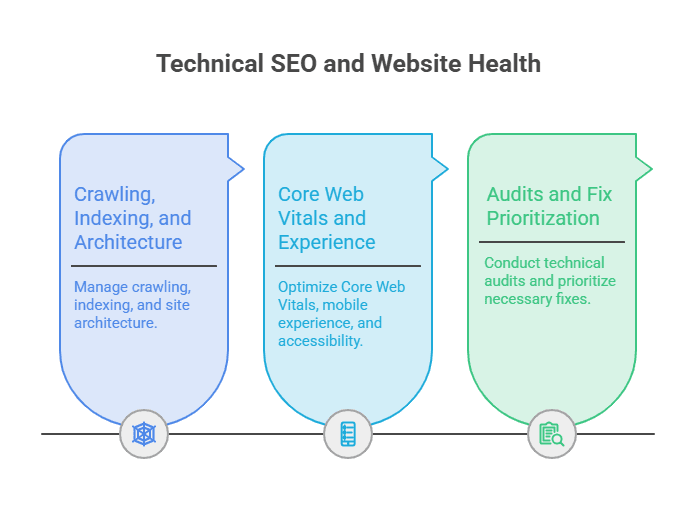
1. Crawling, Indexing, and Site Architecture
An SEO VA can review Google Search Console to identify excluded, redirected, duplicate, blocked, or erroring URLs that warrant investigation. They can check robots directives carefully because robots.txt manages crawler access, while noindex controls whether an accessible page may be indexed. They can also maintain XML sitemaps containing preferred, canonical, indexable URLs while remembering that a sitemap supports discovery but does not guarantee crawling or indexing.
The assistant can inspect canonical signals across tags, redirects, internal links, and sitemaps so conflicting instructions do not select or consolidate the wrong URL. They can find orphan or deeply nested pages and recommend navigation or contextual links that make important content easier to discover. They can also document broken URLs, redirect chains, loops, soft 404s, and misconfigured server responses before the responsible specialist implements and verifies each fix.
2. Core Web Vitals, Mobile Experience, and Accessibility
An SEO VA can use PageSpeed Insights, Search Console, browser testing, and developer tools to collect evidence about performance problems. They can compress or resize images, identify oversized assets, check mobile layouts, document intrusive elements, and route template or code issues to developers. Improvements should be verified after deployment rather than marked complete when a ticket is created.
Google defines good Core Web Vitals targets as Largest Contentful Paint within 2.5 seconds, Interaction to Next Paint below 200 milliseconds, and Cumulative Layout Shift at 0.1 or less. These thresholds measure loading performance, responsiveness, and visual stability, but they are not a guarantee of high rankings. Relevance and content quality still matter.
3. Technical Audits and Fix Prioritization
A technical audit should produce a prioritized action plan rather than an export of every warning found by a crawler. A VA can combine crawl data, Search Console evidence, analytics, templates, page types, and business importance to document each issue’s scope. The backlog should state the affected URLs, likely impact, responsible owner, proposed fix, risk, and verification method.
Professional technical SEO services may be required for complex fixes, while structured SEO audit services help establish the evidence and priorities. The VA can keep both processes organized and verify completion.
SEO Content and Copywriting Operations
Search content must answer real questions, demonstrate useful experience or expertise, and support a business purpose. An SEO VA can manage the workflow surrounding that content, but subject-matter accuracy and distinctive insight should come from knowledgeable contributors. The best system combines research, expert input, editorial quality, optimization, and post-publication learning.
1. Search Intent, Topic Maps, and Content Briefs
- Define the intended reader by documenting who the page serves, what that person wants to accomplish, and which obstacle, question, or decision the content addresses.
- Analyze search intent using current results, related searches, customer language, competing coverage, internal data, and existing site content rather than relying on a keyword label alone.
- Build logical topic maps around services, problems, comparisons, use cases, industries, and customer-journey stages so publishing supports a coherent area of expertise.
- Assign a distinct page purpose to every planned URL, reducing cannibalization and giving navigation and internal linking a clear, maintainable structure.
- Specify evidence and expertise by listing original examples, authoritative sources, first-party information, visuals, proof, and the subject-matter expert responsible for review.
- Evaluate production quality when comparing the best SEO content writing services, including research, sourcing, expert review, editing, and QA—not simply the quoted price per word.
2. SEO Copywriting Without Keyword Stuffing
- Connect discovery with persuasion by writing for the reader’s question and desired next step while making the page’s topic clear to search systems.
- Use the primary phrase naturally in appropriate locations such as the title, main heading, introduction, selected subheadings, and body without forcing repetitive exact matches.
- Expand topical clarity with accurate synonyms, relevant entities, concrete examples, definitions, comparisons, and direct answers that improve understanding rather than inflate length.
- Match the page’s purpose by giving service pages, guides, comparisons, product pages, and category pages the information their specific audiences need to act.
- Balance essential qualities through an SEO copywriting service that respects search intent, brand voice, evidence, readability, accuracy, and conversion goals.
- Apply an approval process to factual claims, testimonials, regulated statements, competitive comparisons, and other language that creates legal, reputational, or customer risk.
3. Content Refreshes, Consolidation, and Internal Links
- Inventory existing URLs before expanding the site so the team can understand what content already exists, how it performs, and where unnecessary bloat has developed.
- Identify maintenance candidates by comparing performance trends, stale facts, overlapping topics, backlinks, conversions, present relevance, and the historical value of each page.
- Recommend the right action for every reviewed asset, whether that means updating, consolidating, redirecting, retaining, repositioning, or carefully removing the page.
- Make refreshes substantive with expert commentary, current examples, stronger explanations, improved media, authoritative sources, clearer formatting, and information readers can use.
- Improve internal linking selectively by repairing broken links, using natural descriptive anchors, supporting important pages, and maintaining logical hub-and-cluster relationships.
- Establish recurring maintenance because a quarterly review of valuable existing content often produces more benefit than continually expanding an unmanaged archive.
Authority Building, Links, and Local Visibility

Authority cannot be manufactured through volume alone. Search visibility is strengthened when a business becomes a credible source, earns relevant references, maintains accurate local information, and demonstrates genuine expertise. An SEO VA can support research and administration, while relationship-building, expert contributions, and brand reputation remain human responsibilities.
1. Ethical Link-Building Support
An SEO VA can research relevant prospects such as industry publications, associations, resource pages, local organizations, suppliers, partners, podcasts, and credible journalists. Each opportunity should be qualified for topical relevance, editorial standards, audience fit, ownership, placement context, and signs of manipulative activity before outreach begins. The assistant can then prepare personalized messages that explain the genuine value of a resource, expert contribution, dataset, tool, case study, or partnership without using deceptive claims.
The VA can maintain outreach records containing contact details, dates, responses, follow-ups, outcomes, target pages, anchor context, and relationship notes. They can also coordinate linkable assets such as original research, calculators, templates, expert commentary, useful guides, visual resources, and case studies worth referencing. Businesses choosing an SEO link-building service should reject purchased networks, automated spam, irrelevant guest posts, hidden placements, and guaranteed link quotas because the method matters more than the raw count.
2. Local SEO and Reputation Support
For location-based businesses, an SEO VA can help maintain consistent names, addresses, phone numbers, hours, services, and categories across important directories. They can prepare Google Business Profile updates, organize photos, monitor questions, flag reviews, track local landing pages, and document inaccurate listings for correction.
Local content should be genuinely useful. A strong location page explains the services available, who provides them, which areas are served, what customers should expect, and what makes the local operation distinct. Thin pages that merely swap city names add little value.
3. Digital PR, Brand Mentions, and Expert Contributions
Digital PR earns attention by offering information worth publishing. A VA can monitor journalist requests, maintain expert biographies, organize approved quotes, research publications, track deadlines, and coordinate supporting assets. Senior experts should provide the actual insight and approve anything attributed to them.
Unlinked brand mentions may create legitimate outreach opportunities when a publication already references the company but has omitted a useful citation. The VA can politely contact the publisher without treating a link as an entitlement. They can also monitor incorrect company information and route reputational issues.
SEO Tools, Measurement, and Reporting
Tools help an SEO VA collect evidence at scale, but they do not replace judgment. Different platforms estimate keywords, links, traffic, and difficulty using different datasets. First-party sources such as Google Search Console, analytics, CRM data, and customer inquiries should anchor reporting, while third-party tools expand research and diagnostic coverage.
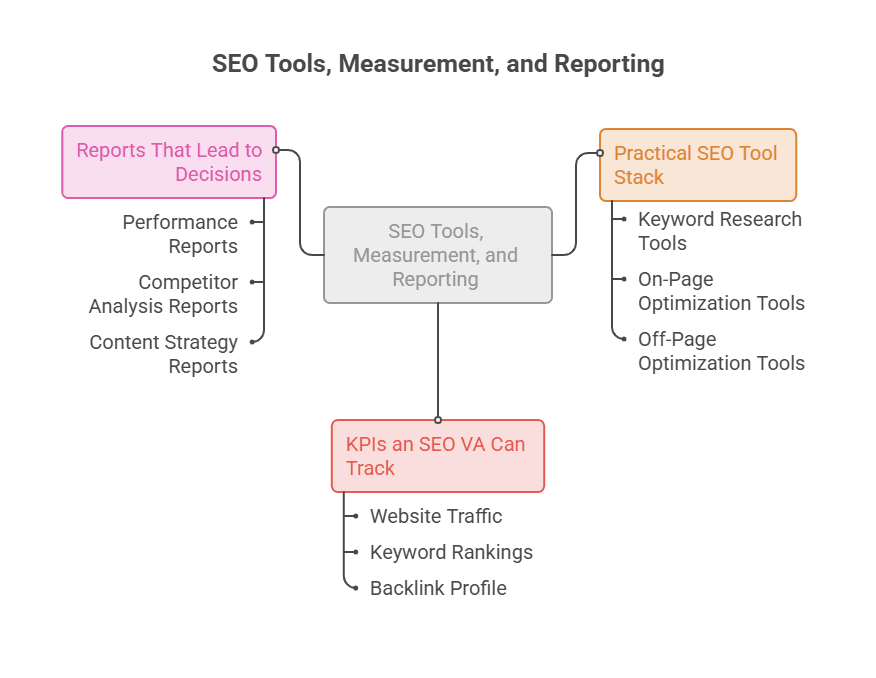
1. A Practical SEO Tool Stack
- Google Search Console provides first-party information about queries, clicks, impressions, position, indexing, enhancements, manual actions, and Core Web Vitals.
- Google Analytics or another analytics platform connects landing pages and traffic sources with engagement, events, conversions, and meaningful on-site behavior.
- A crawler such as Screaming Frog or Sitebulb inventories URLs, metadata, status codes, canonicals, directives, internal links, and template patterns.
- Keyword and backlink platforms support opportunity research, competitor comparisons, rank tracking, link analysis, and content planning, although estimates require interpretation.
- Performance and validation tools such as PageSpeed Insights, Rich Results Test, and schema validators document experience or markup issues.
- Project and documentation systems preserve briefs, approvals, audit findings, change logs, owners, deadlines, and verification evidence, while a practical guide to SEO tools for small businesses in 2026 helps teams choose platforms that match their goals and capacity.
2. KPIs an SEO VA Can Track
- Search visibility metrics include clicks, impressions, position, query coverage, indexed pages, and landing-page performance from Search Console.
- Organic traffic quality includes engaged sessions, key events, conversion rates, assisted conversions, and behavior on important landing pages.
- Business outcomes include qualified leads, consultations, calls, purchases, revenue, applications, sign-ups, or other actions connected to organic discovery.
- Content performance tracks pages published, refreshes completed, topics gaining impressions, internal links, conversions, and assets needing further improvement or expert review.
- Technical health indicators include indexing errors, broken links, redirects, Core Web Vitals groups, sitemap status, and completion of fixes that have been properly validated.
- Authority and local measures include earned links, referral visits, mentions, reviews, local actions, and outreach relationships rather than arbitrary volume; the need for disciplined measurement is also reflected in BLS projections of 7% growth and 87,200 annual openings for market research analysts.
3. Reports That Lead to Decisions
- Begin with the objective so the report evaluates the business outcome SEO is expected to support instead of presenting an unexplained wall of charts.
- Summarize meaningful changes by explaining what moved, why it may matter, which work was completed, what remains uncertain, and what should happen next.
- Use rankings diagnostically without allowing position changes to overshadow qualified traffic, leads, sales, conversions, or content that genuinely supports customers.
- Prepare a concise narrative that connects landing-page, query, technical, content, authority, and conversion evidence with the month’s completed implementation work.
- Compare suitable periods and annotate migrations, promotions, tracking changes, site releases, seasonality, and offline events that may influence the observed performance.
- State limitations clearly by distinguishing evidence from assumptions, separating brand and nonbrand patterns where practical, and identifying questions requiring deeper analysis.
How an SEO VA Workflow Operates
An effective workflow makes every task traceable from evidence to implementation and verification. It prevents SEO from becoming a collection of disconnected recommendations. The exact cadence varies with site size and publishing volume, but most businesses benefit from a baseline, prioritized backlog, weekly execution cycle, and monthly review.
1. Discovery and Baseline Setup
The engagement begins with business goals, target customers, priority services or products, geographic markets, seasonality, competitors, conversion paths, and past SEO work. The VA should also learn brand voice, compliance restrictions, approval owners, and which outcomes matter commercially.
The initial audit turns findings into a prioritized backlog. A documented real SEO VA workflow may begin with technical blockers and important existing pages before expanding into new content. This sequence prevents a team from publishing aggressively on a site that cannot reliably surface or measure the work.
2. Weekly Execution Cycle
At the start of each week, the VA reviews alerts for indexing changes, manual actions, outages, broken pages, unusual traffic movement, publishing errors, and urgent requests. The assistant confirms priorities against the approved backlog, available expert input, developer capacity, campaigns, seasonality, and expected business impact. They then complete defined tasks such as research, briefs, metadata, page updates, internal links, crawl checks, outreach administration, or local profile maintenance.
Before and after publication, the VA runs quality assurance covering factual accuracy, links, metadata, directives, layout, tracking, mobile usability, and approval status. Documentation records completed work, changed URLs, evidence, decisions, blockers, owners, and the method used to verify implementation. Any task requiring strategic judgment, development access, legal review, subject-matter approval, or a risky sitewide change is escalated quickly, giving every action a clear reason, owner, and definition of done.
3. Monthly Review and Next-Step Planning
At month-end, the VA compiles completed work, search trends, landing-page movement, conversions, technical health, content performance, authority activity, and unresolved blockers. The review compares results with the established baseline and business objectives rather than celebrating isolated ranking changes. It also documents seasonality, site releases, tracking changes, campaigns, and other context that may influence the numbers.
The strategist or business owner then decides which hypotheses deserve continued investment and which approaches should change. For example, a page gaining impressions but few clicks may need stronger relevance, while qualified traffic without inquiries may indicate a conversion problem. The next plan assigns owners, dates, dependencies, and success measures, carrying unfinished work forward only when it remains valuable instead of storing every platform suggestion indefinitely.
Benefits, Limitations, and SEO Timelines
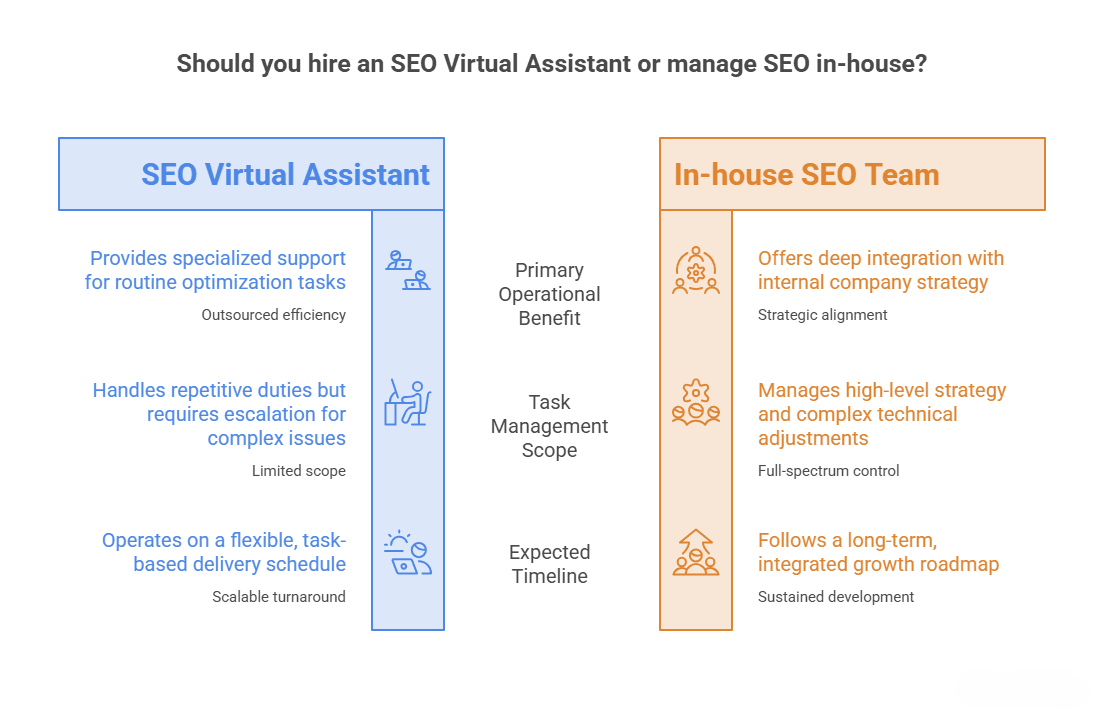
An SEO VA creates leverage through consistent execution, documentation, and measurement. Results still depend on competition, site history, technical condition, authority, content quality, and internal approvals.
1. Benefits of Hiring an SEO Virtual Assistant
- Consistent execution keeps audits, updates, links, reporting, outreach records, and technical follow-ups from disappearing behind urgent operational work.
- Flexible capacity lets a business begin with part-time support and expand when the workflow and return justify additional investment.
- Lower internal workload gives owners, marketers, writers, and developers more time for strategy, expertise, customers, and revenue-generating responsibilities.
- Better documentation preserves keyword maps, change logs, briefs, approvals, reports, and decisions so knowledge is not trapped in one inbox.
- Faster coordination moves work among experts, editors, designers, developers, and approvers without making the strategist administer every detail.
- Improved learning cycles connect implementation with reporting so teams can repeat useful patterns, investigate weak outcomes, and adjust priorities; this need for marketing capacity is reflected in BLS projections of 6% growth and 36,400 annual openings for advertising, promotions, and marketing managers.
2. Limitations and Tasks to Escalate
- Strategy may exceed the role when the business needs forecasting, executive alignment, positioning, complex analysis, or coordination across international websites.
- Development work needs technical ownership for rendering, server configuration, templates, migrations, performance engineering, databases, security, and risky sitewide deployments.
- Expert content needs real experts because a VA cannot invent experience, regulated guidance, proprietary research, or customer evidence.
- Digital PR requires relationships and authority that cannot be reduced to automated emails, purchased placements, or arbitrary backlink quotas.
- Analytics problems may need specialists when tracking is incomplete, attribution is complex, consent applies, or systems cannot connect leads with sources.
- Ranking guarantees are not credible because no provider controls search systems, competitors, indexing decisions, or the timing of changes.
3. How Long Outsourced SEO Takes
- Separate implementation from impact because metadata, links, and technical fixes can be published quickly, while crawling, indexing, reassessment, and conversion learning take longer.
- Expect different timeframes according to the change, crawl activity, site history, competition, demand, authority, and whether the improvement genuinely helps the reader.
- Use Google’s guidance realistically because some effects may appear within days while sitewide quality improvements can take several months to be reflected.
- Establish measurement first so later changes in visibility, qualified traffic, leads, sales, and technical health can be compared with a trustworthy baseline.
- Track meaningful milestones such as fixing blockers, improving priority pages, publishing or refreshing useful content, and developing legitimate authority rather than promising dates.
- Set expectations transparently with a guide to how long SEO takes when outsourced to a VA and evaluate leading and business indicators over suitable periods.
SEO VA Costs and Service Models
SEO VA pricing varies with geography, experience, specialization, tool access, hours, management model, and scope. The cheapest hourly rate may create expensive rework, while a highly skilled specialist may be unnecessary for routine implementation. Businesses should compare the total cost of achieving a defined standard of work.
1. What Affects SEO VA Pricing?
Scope and volume affect pricing because maintaining one local service site differs substantially from managing hundreds of ecommerce, publishing, marketplace, or multilocation pages. Technical depth also raises the required skill level when the work includes advanced crawling, log analysis, structured data, JavaScript diagnosis, migrations, international SEO, or developer coordination. Content responsibility changes the price depending on whether the VA uploads approved copy or also researches, briefs, drafts, edits, sources, optimizes, and performs QA.
Tool requirements influence total cost because premium crawling, keyword, link, reporting, and collaboration platforms may be included by the provider or billed separately. Management and quality assurance add value when the service includes documented processes, review, backup capacity, training, communication standards, and escalation support. Engagement structure further influences rates across hourly, project-based, retainer, part-time, full-time, freelancer, and managed-service arrangements.
2. SEO VA vs. SEO Agency
An SEO VA is often a good fit for businesses with an established direction and a backlog of recurring work. The relationship can be flexible and closely integrated with internal processes. However, the business may need to provide strategy, tools, review, and specialist escalation.
An agency usually provides a broader combination of strategy, account management, technical expertise, content, digital PR, reporting, and production capacity. That range can support complex programs, but it generally costs more and still requires timely access, approvals, and expert input from the client. A detailed SEO VA versus SEO agency comparison should therefore evaluate capability, oversight, risk, speed, and total cost, while a hybrid model can use senior direction with VA-led implementation.
3. What a Managed SEO VA Service May Include
A managed service may bundle candidate vetting, assignment, training, replacement coverage, time tracking, workflow support, quality review, and account coordination. SEO deliverables can include keyword research, on-page updates, content briefs, uploads, internal linking, technical checks, local tasks, outreach administration, and reporting.
Prospective clients reviewing Task Virtual’s SEO VA service inclusions and pricing should match the package to an actual monthly backlog. The best plan is the one that supplies enough qualified capacity to complete priority work without paying for unused hours or assuming capabilities that are not included.
How to Hire and Onboard an SEO VA
Hiring should test whether the candidate can think carefully, follow processes, communicate uncertainty, and produce accurate work. Tool familiarity is useful, but screenshots of rankings or a list of platform logos do not prove judgment. A short paid assignment and structured onboarding reveal more than generic interview answers.
1. Skills and Vetting Questions
- Test diagnostic thinking by asking how the candidate would investigate a page losing organic traffic and which evidence they would examine before recommending changes.
- Check technical understanding by asking the candidate to distinguish crawling from indexing, explain canonical signals, prioritize audit findings, and verify a completed on-page fix.
- Evaluate keyword judgment through a small mapping exercise that requires grouping intent, assigning pages, identifying cannibalization, and explaining why particular opportunities deserve priority.
- Review communication quality by checking whether the VA can summarize findings for nontechnical stakeholders, label assumptions, cite sources, and write implementation instructions others can follow.
- Assess content knowledge by testing understanding of intent, useful structure, originality, fact-checking, internal linking, metadata, expert review, and prepublication quality assurance.
- Use a fair paid task such as auditing one page, interpreting a Search Console sample, finding internal links, or producing a brief, then score accuracy, reasoning, communication, and detail.
2. Access, Governance, and Quality Control
- Use separate accounts and role-based access for the CMS, analytics, Search Console, local profiles, project tools, and file systems whenever each platform supports them.
- Apply least-privilege permissions so the VA can complete assigned work without receiving unnecessary access to billing, user administration, servers, customer records, or sensitive settings.
- Document approval levels for metadata, content, redirects, canonicals, schema, page deletion, outreach, local responses, and any sitewide or customer-facing change.
- Maintain change logs and backups so the team knows what changed, when it changed, who approved it, and how to reverse a harmful implementation.
- Create escalation rules for traffic drops, security concerns, manual actions, legal claims, regulated content, migration problems, outages, and changes affecting many URLs.
- Audit completed work regularly through sample reviews, crawl comparisons, published-page checks, analytics validation, and feedback that improves the operating procedure.
3. A Practical First 30 Days
- Introduce the business during week one by explaining the audience, offers, priority pages, competitors, brand rules, compliance needs, goals, and established SEO direction.
- Configure secure access to the necessary CMS, analytics, Search Console, project-management, crawling, reporting, and shared-file systems using role-based permissions.
- Confirm the measurement baseline by checking tracking, conversions, Search Console ownership, reporting definitions, annotations, and any gaps that could distort future comparisons.
- Begin with low-risk assignments that reveal how the VA researches, documents, communicates uncertainty, asks questions, follows instructions, and completes quality assurance.
- Build the recurring cadence for weekly execution, monthly reporting, approvals, escalations, specialist handoffs, backlog management, and updates to standard operating procedures.
- Review performance by week four using quality, speed, communication, blockers, and operational metrics, expanding autonomy only where work has been consistently accurate.
SEO for Google Search and AI Overviews in 2026
AI-assisted search has changed how people explore complex questions, but it has not eliminated foundational SEO. Google states that the same core practices remain relevant for AI Overviews and AI Mode. Businesses need technically eligible pages, clear information, original value, and evidence that helps readers evaluate the answer.
1. Helpful Content, Experience, and Trust
Content should answer the user’s question directly, then provide the detail needed to act or decide. An SEO VA can help structure pages around real tasks, comparisons, definitions, risks, steps, and evidence. Thin introductions, repetitive summaries, and filler written only to reach a word count should be removed.
Google’s current guidance for generative AI search recommends unique, expert-led, non-commodity content. A VA can coordinate the workflow and improve presentation, but the organization must supply the distinctive knowledge that makes the page worth citing or visiting.
2. Technical Eligibility for AI Features
Google says there are no additional technical requirements for AI Overviews or AI Mode. A supporting page must be indexed, eligible to appear in Search, and able to show a snippet. Special “AI optimization” files or invented markup do not replace standard crawling, indexing, and content practices.
The VA should therefore focus on accessible pages, clear internal links, sensible site architecture, accurate directives, useful text, descriptive media, valid structured data where appropriate, and consistent entity information. Structured data must represent visible page content and follow the requirements for the specific search feature.
3. Common SEO Mistakes to Avoid
Publishing for search engines first creates generic pages that repeat existing information without original expertise, useful examples, or a clear reason to exist. Targeting keywords without understanding intent attracts the wrong audience, encourages cannibalization, and produces pages that do not match the question or commercial objective. Ignoring technical foundations allows blocked pages, incorrect canonicals, broken links, slow templates, poor mobile layouts, and tracking problems to undermine otherwise valuable content.
Buying or automating links prioritizes volume over editorial relevance and can expose the brand to spam, wasted spending, and reputational damage. Reporting vanity metrics alone hides whether organic search contributes qualified visitors, leads, sales, retention, or other meaningful business outcomes, while uncontrolled sitewide changes can cause large-scale problems without backups and verification. A practical review of common SEO mistakes and current website-ranking strategies can help the VA maintain a prevention-focused QA checklist.

FAQ
1. What does an SEO virtual assistant do?
An SEO virtual assistant supports keyword research, on-page updates, content briefs, publishing, internal linking, technical checks, outreach administration, local SEO, reporting, and workflow coordination.
2. Can an SEO VA guarantee first-page rankings?
No. Search rankings depend on many factors outside the VA’s control. A credible provider promises defined work, transparent reporting, responsible methods, and continuous improvement—not a guaranteed position.
3. Can an SEO virtual assistant handle technical SEO?
Many VAs can run crawls, monitor Search Console, document errors, and implement low-risk CMS fixes. Complex rendering, server, migration, or code issues should go to an experienced technical SEO specialist or developer.
4. What should I delegate first?
Begin with measurable, low-risk tasks such as keyword mapping, metadata updates, internal linking, content inventory, Search Console monitoring, publishing QA, and monthly reporting.
5. How much does an SEO virtual assistant cost?
Cost depends on location, experience, specialization, hours, tools, management model, and scope. Compare proposals using specific deliverables, quality controls, and total supervision or rework required.
6. How soon can an SEO VA improve results?
Operational improvements can begin immediately, but search effects may take days or months. Technical condition, competition, authority, content quality, crawl frequency, and internal approval speed all influence the timeline.
Conclusion: Build an SEO System That Keeps Improving
An SEO virtual assistant gives businesses something search programs often lack: consistent execution. The right VA can turn research into briefs, audits into prioritized tasks, approved recommendations into published improvements, and raw data into reports that support decisions. That continuity is valuable for small businesses, agencies, ecommerce brands, local companies, and professional service firms.
Results still depend on the system around the assistant. The business needs clear goals, reliable measurement, expert input, secure access, documented approvals, quality reviews, and specialist support for complex work. SEO should improve discoverability and user value together—not chase rankings through thin content, manipulative links, or uncontrolled technical changes.
CTA: Ready to create a more consistent SEO workflow? Identify the priority pages, recurring tasks, technical blockers, and reporting gaps that slow your team down. Then define which work a trained SEO virtual assistant can own and which responsibilities should remain with your strategist, experts, or developers.
Sources List
- Google Search Central — Optimizing for generative AI features
- Google Search Central — AI features and your website
- Google Search Central — Creating helpful, reliable, people-first content
- Google Search Central — SEO Starter Guide
- Google Search Central — Core Web Vitals
- Google Search Central — Sitemaps overview
- Google Search Central — Core updates and improvement timelines
- Pew Research Center — Internet, Broadband Fact Sheet
- U.S. Bureau of Labor Statistics — Advertising, Promotions, and Marketing Managers
- U.S. Bureau of Labor Statistics — Market Research Analysts
 Siddhartha Basu is a Technical Writer at Task Virtual. He loves online games, e-book reading, and Yoga.