Contents
show
How Bookkeeping VAs Handle Month-End Close
In the fast-paced world of small business finance, the month-end close remains one of the most critical routines. For bookkeeping virtual assistants (bookkeeping VAs)—remote professionals who support accountants, bookkeepers, and owners—the ability to execute a reliable close separates good service from exceptional partnership.
Bookkeeping VAs handle month-end close through structured workflows that include data collection, reconciliation, adjustments, reviews, and reporting. Using tools like QuickBooks Online, Xero, Asana, and automation, they deliver accurate financials by the 5th of the following month. In 2026, AI-assisted continuous close and virtual teams are turning this once-chaotic process into a strategic advantage.
With remote work normalized, bookkeeping VAs have become essential for efficient financial operations. They implement systems that catch errors early, prevent fraud, and provide timely insights. This guide shares real best practices for firm owners, solo practitioners, and businesses seeking scalable support.
Why Month-End Close Matters for Bookkeeping VAs and Their Clients
Bookkeeping VAs understand that a disciplined month-end close is foundational to delivering reliable financial services. It transforms raw transaction data into actionable insights while protecting clients from risks that arise from incomplete or inaccurate records. By prioritizing monthly closes, VAs help businesses maintain strong financial health year-round rather than facing surprises at tax time or during audits.
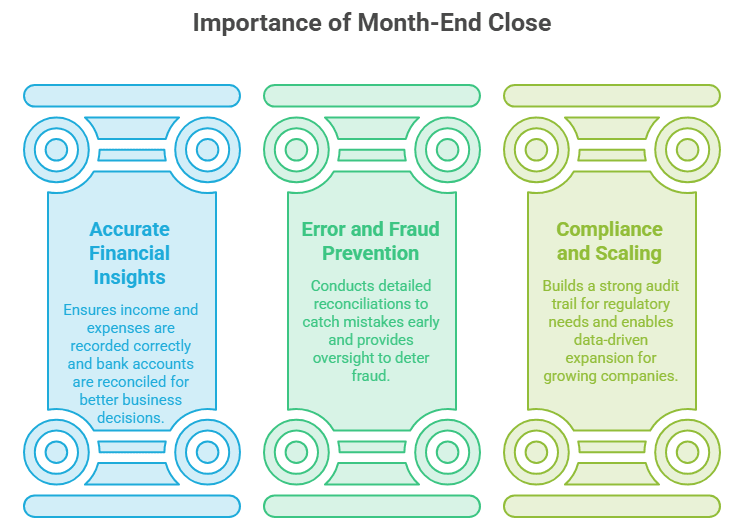
1. Accurate Financial Insights Drive Better Business Decisions
Clients rely on bookkeeping VAs for timely, trustworthy reports that reflect true financial performance. A proper month-end close ensures income and expenses are recorded correctly, bank accounts are reconciled, and key statements like the P&L and balance sheet offer a clear view. This accuracy supports confident decisions on cash flow, investments, hiring, and operations.
When bookkeeping VAs deliver these insights monthly, clients gain a competitive edge. They spot trends early, optimize resources, and forecast effectively, boosting profitability and stability. This reliability positions VAs as strategic partners rather than mere transaction processors.
2. Early Error Detection and Fraud Prevention
Small mistakes in bookkeeping can escalate quickly if left unaddressed. Bookkeeping VAs conduct detailed reconciliations and reviews during the month-end close to catch duplicates, miscategorizations, or unusual activity while details are fresh. This proactive step prevents errors from compounding and lightens future workloads.
Beyond catching errors, regular closes provide key oversight that deters fraud, especially in small businesses with limited controls. VAs systematically review transactions, flag anomalies, and ensure transparency. Clients enjoy greater peace of mind with consistent monthly monitoring of their financial records.
3. Foundation for Compliance, Audits, and Scaling
Consistent month-end processes build a strong audit trail through documented reconciliations, adjustments, and approvals. Bookkeeping VAs keep records ready for regulatory needs, tax filings, and lender reviews, avoiding major year-end scrambles. This preparedness supports long-term compliance for businesses of all sizes.
For growing companies, reliable monthly closes by VAs enable scaling without losing financial visibility. The structured process allows smooth handoffs, accurate investor reporting, and data-driven expansion decisions. It ultimately positions businesses for sustainable growth with trustworthy numbers.
The Real Workflow: How Bookkeeping VAs Execute Month-End Close

Bookkeeping VAs follow a proven, phased workflow tailored to each client’s needs, promoting preparation, accuracy, and timely delivery across clients; 36% of respondents identify manual errors during month-end close as pressing concerns.
1. Pre-Close Preparation: Setting Up for Success
Effective month-end closes begin well before the period ends, with bookkeeping VAs focusing on readiness to avoid bottlenecks. Proactive steps in data gathering and system checks set the stage for a smooth process.
Client Communication and Document Collection
- Bookkeeping VAs establish dedicated client portals such as Hubdoc or Google Drive to streamline requests for invoices, receipts, bank statements, and payroll records well in advance.
- They send automated reminders and set clear deadlines to minimize follow-up chases while maintaining positive client relationships.
- This organized approach ensures complete documentation arrives on time, reducing delays and supporting accurate period cutoffs.
Tool Setup and Automation Configuration
- VAs verify that bank feeds and transaction rules in QuickBooks Online or Xero are functioning properly and updated for the upcoming close.
- They prepare recurring entries for items like depreciation or standard accruals to ensure seamless posting.
- Regular system checks prevent integration issues and maximize automation benefits throughout the workflow.
Cutoff Rules and Team Assignment
- Bookkeeping VAs define clear “no-post after” dates and communicate cutoff policies to all stakeholders for each client.
- Tasks are assigned in project management tools like Asana based on team member expertise and availability.
- This clarity prevents period overlap and ensures accountability across junior and senior roles.
2. Core Reconciliation and Transaction Processing
This phase anchors VA responsibilities, verifying completeness and accuracy against external sources. Thorough reconciliations catch discrepancies early and strengthen final numbers; 68% of finance respondents cite accurate preparation and reconciliation as major challenges.
Bank, Credit Card, and Cash Reconciliations
- VAs match all ledger transactions against independent bank and credit card statements, carefully investigating any outstanding items or timing differences.
- They resolve exceptions such as duplicate feeds or stale checks while documenting findings for the audit trail.
- Clearing undeposited funds and confirming transfers between accounts ensures cash balances are fully accurate and reliable.
Accounts Receivable and Payable Review
- Bookkeeping VAs analyze aging reports to identify stale receivables or unapplied payments, following up as needed with clients or vendors.
- They ensure all incoming invoices are captured, coded correctly, and matched to supporting documentation.
- This review prevents duplicate payments and maintains healthy cash flow visibility for the client.
Payroll and Liability Tie-Outs
- VAs cross-check payroll postings against reports to confirm taxes, benefits, and liabilities are accurately reflected.
- Adjustments are made for any off-cycle payments or corrections identified during the review.
- Reconciliation of related accounts like accrued wages ensures compliance and balance sheet integrity.
3. Adjustments, Reviews, and Reporting
Once reconciled, bookkeeping VAs finalize records through adjustments and analytical reviews, ensuring financials reflect period activity under accrual accounting, as nearly 40% of CFOs lack complete trust in corporate financial data.
Posting Adjusting Journal Entries
- VAs record necessary accruals for expenses incurred but not yet invoiced, along with prepayment amortizations.
- Depreciation, revenue deferrals, and reclassification entries are posted with full documentation of rationale and approvals.
- A detailed adjustment log tracks each entry to support future reviews and audits.
Variance Analysis and Reasonableness Checks
- Bookkeeping VAs compare current period results against prior months, budgets, or forecasts using defined thresholds like 10% and $1,000.
- They investigate and document significant anomalies or negative balances that require explanation.
- This analysis turns raw data into meaningful insights for client discussions.
Financial Statement Preparation and Delivery
- VAs generate core statements including the income statement, balance sheet, and cash flow report for thorough internal review.
- Supporting schedules and notes are compiled into professional packages tailored to client preferences.
- Final delivery occurs through secure portals with clear summaries to facilitate quick client understanding.
Tools and Technology Bookkeeping VAs Rely On
Modern bookkeeping VAs rely on a robust tech stack to deliver fast and accurate month-end closes across multiple clients. Integration reduces effort and silos, improves consistency, and supports higher-value analysis and client service. 77% of respondents report relying substantially on labor-intensive manual processes to collect and use financial data.
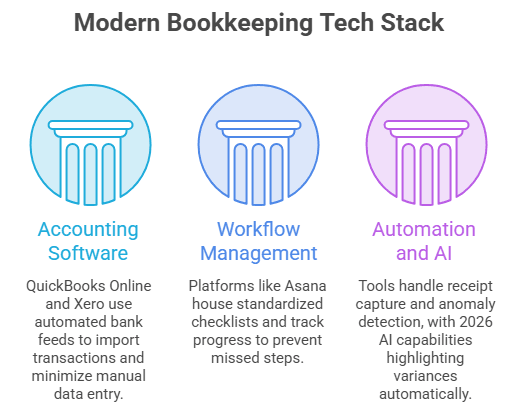
1. Accounting Software and Bank Feeds
Bookkeeping VAs primarily work within QuickBooks Online and Xero, where automated bank feeds import transactions directly and minimize manual data entry. Rules and categorization features handle routine expenses like rent or subscriptions efficiently. Regular maintenance of these connections ensures reliable data flow during the close process.
2. Workflow and Project Management Platforms
Platforms like Asana enable VAs to house standardized checklists, assign tasks with due dates, and track progress in real time for every client. This visibility prevents missed steps and supports collaboration whether working solo or with a team. Custom templates make it easy to replicate successful processes across engagements.
3. Automation and AI Enhancements
Advanced automation tools handle receipt capture, anomaly detection, and continuous reconciliation, flagging issues before they reach the formal close. In 2026, AI capabilities further accelerate reviews by highlighting variances automatically. These technologies help VAs achieve faster turnaround times while maintaining exceptional accuracy.
Delegation, Checklists, and Best Practices for Bookkeeping VAs
Bookkeeping VAs scale their impact by building repeatable systems that go beyond individual effort. These practices ensure quality remains high even as client loads increase. Documentation and clear processes make delegation seamless and support long-term practice growth.
1. Standardized Checklists and SOPs
- Bookkeeping VAs maintain detailed, sequenced checklists that cover every step from data collection through final delivery for consistency.
- SOPs document client-specific nuances, such as report formats or unique transaction handling, for easy reference.
- These resources facilitate training new team members and ensure smooth coverage during absences.
2. Task Assignment and Quality Control
- Tasks are delegated according to skill level, with juniors handling data entry and basic reconciliations while senior post holders focus on reviews.
- Multiple layers of review for key accounts and adjustments maintain high standards and catch potential oversights.
- Project tools provide visibility into assignments and deadlines to prevent work from falling through the cracks.
3. Post-Close Retrospective
- After delivery, VAs conduct quick reviews to identify what went well and any bottlenecks encountered during the process.
- Lessons learned are incorporated into updated checklists and SOPs for the next cycle.
- This continuous improvement approach leads to progressively faster and more efficient closes over time.
Overcoming Common Challenges in Month-End Close
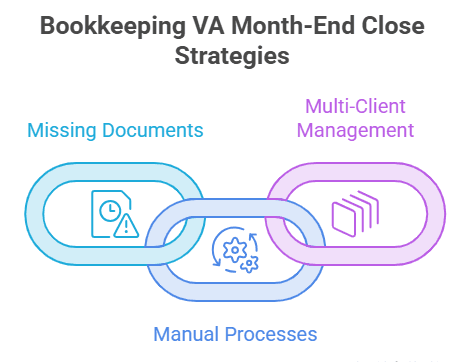
Bookkeeping VAs encounter month-end close hurdles but address them through proactive systems, clear communication, and experience across diverse clients. They anticipate problems, implement solutions, and prioritize prevention to protect timelines and satisfaction. Notably, 59% of accountants still report making several financial errors monthly due to capacity constraints.
1. Missing Documents and Client Delays
Bookkeeping VAs mitigate document delays by implementing user-friendly portals and automated reminder systems well before deadlines. They set realistic buffers in schedules while maintaining professional follow-ups that respect client workloads. This combination significantly reduces last-minute scrambles and ensures the close proceeds smoothly.
2. Manual Processes and Volume
Heavy reliance on manual work is countered with automation for matching and categorization, freeing VAs to focus on exceptions and analysis. Prioritizing critical accounts early in the process maintains momentum even with high transaction volumes. Regular tool optimizations keep efficiency high as client needs evolve.
3. Multi-Client Management
VAs manage multiple clients effectively by using client-specific templates within centralized project platforms for quick navigation. Batch processing of similar tasks across engagements maximizes productivity without sacrificing attention to detail. Standardized yet flexible workflows allow scaling while preserving customization where required.
Benefits of Partnering with Bookkeeping VAs for Month-End Close

Engaging skilled bookkeeping VAs delivers transformative advantages for businesses seeking reliable financial support. Their specialized workflows and tools create efficiency that internal teams or generalists often struggle to match. This partnership model supports both immediate needs and long-term growth objectives.
1. Time Savings and Focus on High-Value Work
- Bookkeeping VAs handle the full month-end close, freeing business owners and CPAs from routine tasks to concentrate on advisory services and strategy.
- Consistent early completion of closes provides extra days each month for business development and client relationship building.
- Reduced administrative burden leads to lower stress and higher overall productivity for leadership teams.
2. Enhanced Accuracy, Compliance, and Scalability
- Professional systems and reviews from VAs result in fewer errors and stronger audit readiness across periods.
- Reliable monthly financials support better compliance with regulations and easier access to financing or investment opportunities.
- The scalable nature of VA support allows businesses to grow without proportional increases in overhead or internal headcount.
3. Cost Efficiency and Flexibility
- Flexible engagement models provide expert bookkeeping without the full cost of in-house hires or benefits.
- VAs adapt quickly to changing volumes or seasonal demands through month-to-month arrangements.
- Overall, businesses achieve professional results at predictable costs while maintaining control over their financial operations.
TaskVirtual: Your Partner in Bookkeeping Virtual Assistant Services

Managing month-end close responsibilities alongside daily operations can be overwhelming for accountants, bookkeepers, and business owners. From chasing client documents and reconciling accounts to preparing accurate reports under tight deadlines, the process demands precision and consistency. TaskVirtual connects you with an expert bookkeeping virtual assistant service that handles the entire month-end close workflow efficiently, allowing you to focus on strategic growth and client advisory work.
1. Expert Month-End Close Support
TaskVirtual’s skilled bookkeeping VAs manage full reconciliation cycles, post adjusting entries, conduct variance analysis, and deliver professional financial statements using proven checklists and tools like QuickBooks and Xero. They ensure timely completion with proactive client communication and thorough quality reviews every month.
2. Affordable and Flexible Pricing
Hiring a full-time personal assistant can be expensive, but TaskVirtual makes it cost-effective. With pricing plans starting from just $3.12/hour to $14.99/hour, their services are budget-friendly and accessible to individuals, families, and businesses.
3. Comprehensive Bookkeeping Close Solutions
From pre-close document collection and automation setup to multi-client reconciliation management and post-close retrospectives, TaskVirtual covers the complete workflow. Their scalable services adapt whether you need occasional support or consistent month-end close handling across multiple clients.
4. Ongoing Support and Quality Assurance
TaskVirtual provides continuous updates, anomaly flagging, and process improvements throughout each close cycle. Their proactive approach ensures accurate, audit-ready financials delivered on time without unnecessary stress.
5. Proven Track Record of Excellence
With 364 positive reviews and a 4.7-star rating on trusted VA platforms, TaskVirtual is recognised as a reliable partner worldwide. Clients count on their expertise to simplify month-end close processes and streamline financial operations.
FAQ Section
1. What does a bookkeeping VA do during month-end close?
They collect documents, reconcile accounts, post adjustments, review variances, prepare statements, and deliver reports—following standardized workflows for accuracy.
2. How long should a bookkeeping VA take for month-end close?
Efficient VAs aim for 3-7 business days, often completing by the 5th, using automation and checklists.
3. Do bookkeeping VAs use specific software?
Yes—QuickBooks, Xero, Asana, bank feeds, and automation tools for reconciliations and reporting.
4. How do bookkeeping VAs handle client document delays?
Through dedicated portals, reminders, and buffers in schedules to maintain timelines.
5. Can bookkeeping VAs help with fraud prevention?
Absolutely—regular reconciliations, reviews, and oversight add critical controls.
6. Is hiring a bookkeeping VA cost-effective?
Yes, providing expertise, time savings, and scalability at lower cost than full-time hires.
Conclusion
Bookkeeping VAs transform the month-end close from a dreaded chore into a streamlined, value-adding process through preparation, rigorous reconciliation, smart adjustments, thorough reviews, and reliable delivery. By leveraging tools, checklists, delegation, and best practices, they deliver accurate financials that empower better decisions, reduce risks, and support business growth.
For accountants, firm owners, or businesses overwhelmed by bookkeeping, partnering with skilled VAs offers a practical path to efficiency in 2026 and beyond. Implement these workflows, invest in systems, and watch your financial operations—and peace of mind—improve dramatically.
Sources
- Aero Workflow: Mastering the Monthly Close
- Workflow Queen: Month-End Close Preparation
- HighRadius: Month-End Close Process
- Rippling: Month-End Close Checklist
- Xenett: Month-End Close Guide and Flowchart
- GetMagic: Bookkeeping VA Services
- Additional benchmarks from Ventana Research, APQC, and industry reports via authoritative channels.
For more such content, visit our website.
 Siddhartha Basu is a Technical Writer at Task Virtual. He loves online games, e-book reading, and Yoga.