Contents
show

Virtual Assistants for Lawyers
Legal work depends on judgment, precision, deadlines, and trust, yet attorneys spend substantial time on scheduling, intake, document handling, billing, follow-up, file organization, and marketing administration. Virtual assistants for lawyers can help manage these responsibilities, which matter but can fragment an attorney’s day and slow the work that requires a law license. In 2026, the pressure is greater because clients expect quick communication while courts, vendors, and firms increasingly operate through digital systems.
A legal virtual assistant gives a law firm remote capacity for defined administrative and supervised legal-support tasks. The assistant may coordinate calendars, prepare intake packets, format documents, maintain case-management records, organize transcripts, update billing data, support marketing, and route information to the right person. The attorney remains responsible for legal judgment, client advice, supervision, confidentiality, and compliance with the rules of the governing jurisdiction.
The need for efficient legal delivery is significant. The Legal Services Corporation reports that low-income Americans received inadequate or no help for 92% of their civil legal problems, while 74% of low-income households experienced at least one civil legal problem in the prior year. A legal VA cannot solve the justice gap alone, but better operations can help firms use licensed-professional time more deliberately, improve responsiveness, and serve matters with a consistent process.
What Are Legal Virtual Assistant Services?
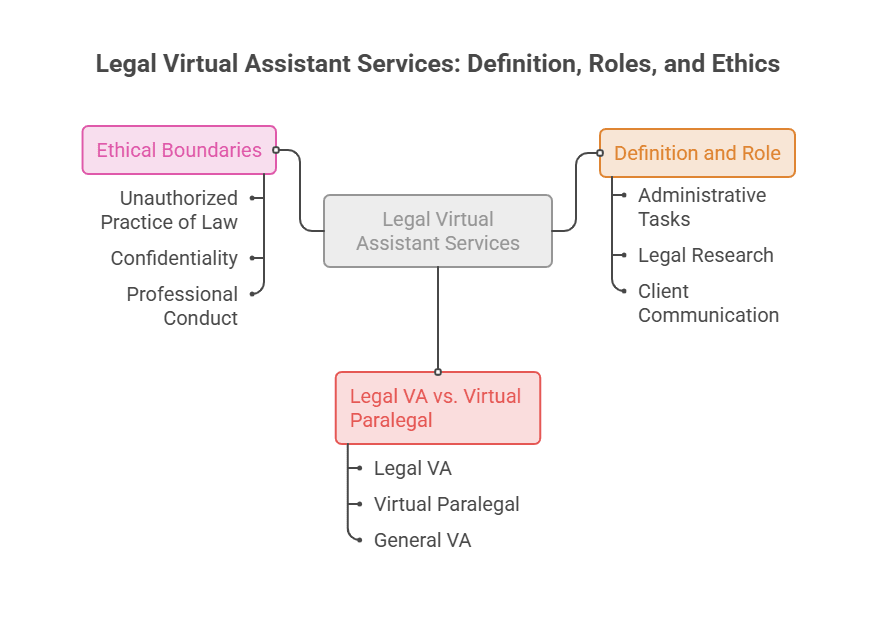
Legal virtual assistant services provide remote administrative, operational, marketing, and supervised legal-support capacity to attorneys, law firms, corporate legal departments, and legal-service providers. Scope varies by practice area, jurisdiction, training, and firm policy. The safest model defines permitted tasks, attorney-review points, access rights, and escalation rules before work begins.
1. Definition and Role of a Legal Virtual Assistant
A legal virtual assistant is a remote worker who supports a legal practice without independently practicing law. Titles may include law firm virtual assistant, legal administrative VA, remote legal assistant, or virtual paralegal, but the label does not determine what the person may legally do. Education, certification, supervision, state rules, and the actual task all matter when selecting a virtual legal assistant service.
Common work includes appointment scheduling, prospective-client intake, document formatting, deadline entry, file naming, billing administration, database updates, transcription coordination, marketing support, and attorney-directed research assistance. A trained assistant may perform more complex tasks under supervision, while a general administrative VA should receive a narrower scope.
2. Legal VA vs. Virtual Paralegal and General VA
A general VA handles broad business administration and may lack legal terminology, court-process knowledge, or experience with legal software. A legal VA has law-firm-specific training or experience but may still focus mainly on administrative coordination. A virtual paralegal typically performs substantive legal support under attorney supervision, such as organizing discovery, summarizing records, drafting from approved templates, or conducting preliminary research.
These categories overlap, and paralegal regulation differs across states. Firms should not rely on a job title when assigning work. They should review credentials, prior duties, writing and research ability, technology skills, and familiarity with the applicable practice area.
The attorney should also decide whether work is clerical, administrative, or substantive. A VA can transmit approved information, but should not interpret legal consequences for a client. A paralegal may prepare a draft under supervision, but the lawyer must review it and remain accountable for the representation.
A legal VA must not give independent legal advice, recommend strategy, predict outcomes, negotiate rights, appear as counsel, or create an attorney-client relationship. Client communications should stay within attorney-approved intake questions, scheduling, document requests, and status updates, with uncertainty escalated to supervising counsel. The assistant may prepare permitted templates and drafts, but qualified personnel must review legal substance, citations, filing requirements, and final versions.
Because rules on paralegals, outsourcing, fee sharing, advertising, supervision, and unauthorized practice vary, firms must check the governing jurisdiction rather than rely on job titles. The attorney remains responsible for supervision under applicable duties, including the principles reflected in ABA Model Rule 5.3. This article offers general operational information, not legal or ethics advice; firms should review binding conduct rules, court requirements, client agreements, and qualified counsel before outsourcing.
Core Legal VA Tasks Lawyers Can Outsource

Delegation should begin with repetitive, documentable work that can be checked objectively. The firm should identify the source of truth, required turnaround, approval owner, confidentiality level, and definition of done for every task. This reduces rework and prevents routine support from crossing into legal judgment.
1. Scheduling, Deadlines, and Administrative Coordination
- Maintain attorney calendars by scheduling consultations, depositions, meetings, hearings, internal reviews, and protected preparation time according to firm rules.
- Record deadlines carefully from attorney-approved sources, using double-check procedures, attorney-controlled calendaring policies, backup reviewers, and redundant reminders rather than asking the VA to interpret procedural law.
- Coordinate participants by confirming dates, time zones, locations, videoconference details, accessibility needs, and approved documents with clients, counsel, witnesses, and vendors.
- Prepare routine packets containing approved agendas, directions, meeting links, forms, checklists, and background materials without making substantive legal selections independently.
- Track follow-up work through task systems that show the owner, due date, dependency, status, and escalation path for incomplete or blocked items.
- Document every change so rescheduled events, missed responses, conflicting dates, and attorney instructions remain visible and auditable, while ensuring one remote assistant is never solely responsible for calculating or verifying legal deadlines.
2. Client Intake and Communication Support
- Manage inquiries by routing calls, responding to web submissions, sending approved intake forms, scheduling consultations, confirming documents, and updating contact records.
- Collect facts consistently through attorney-designed questionnaires, recording statements without interpretation and flagging possible conflicts for review.
- Respect firm boundaries by never promising representation, quoting unapproved fees, evaluating merits, or suggesting legal action.
- Triage urgency using written definitions for limitation concerns, court deadlines, threats, safety issues, detention, adverse-party contact, complaints, and other escalation events.
- Use approved scripts that explain the assistant’s role, request necessary information, protect sensitive details, and clarify that intake alone does not create an attorney-client relationship.
- Maintain an auditable handoff by recording messages, owners, deadlines, follow-ups, consultations, and unresolved questions while routing legal explanations and unusual circumstances to the attorney.
3. Documents, Transcription, and File Organization
- Format attorney-approved documents using firm templates, styles, captions, tables, numbering, signature blocks, and naming conventions without changing substantive legal positions.
- Proofread for presentation by checking spelling, dates, defined terms, cross-references, page numbers, exhibits, and obvious inconsistencies while escalating anything that may affect meaning.
- Organize matter files according to retention, version-control, access, and folder standards so the team can locate the current document and its supporting materials.
- Coordinate signatures and filing logistics through approved tools and checklists, leaving legal sufficiency, final filing authorization, and jurisdictional interpretation to qualified personnel.
- Manage recordings securely by verifying authorization, transfer method, speakers, turnaround, formatting, confidentiality requirements, review stages, and approved retention or deletion.
- Distinguish working transcripts from official records: A legal transcription service can create useful text, but it should not be represented as a certified court transcript unless produced by an authorized professional under applicable rules; the supervising lawyer should set the accuracy and review standard according to whether the output is a searchable interview, deposition summary, evidentiary exhibit, or filing.
Legal VA Tasks by Practice Area
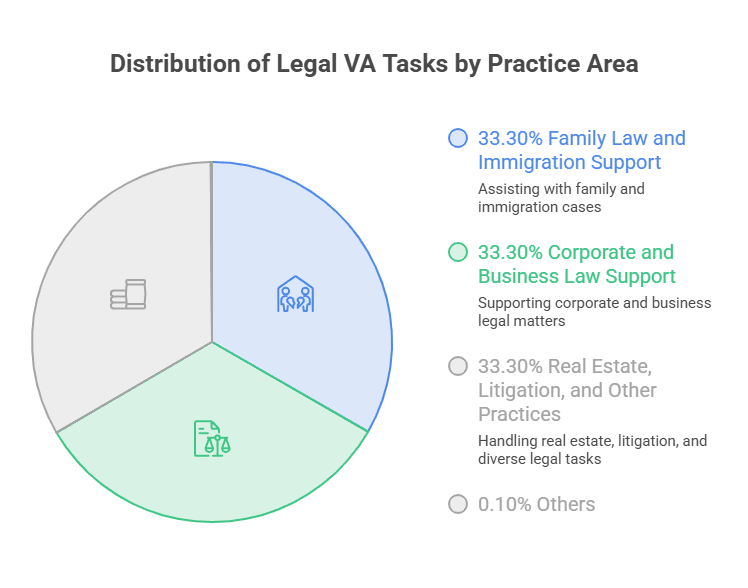
The same administrative task can carry different risks across practice areas. Family law involves emotional client contact and sensitive personal records; corporate work depends on versions, entities, and approvals; real estate matters revolve around dates, parties, and transaction documents. A practice-specific task map helps the VA understand context without asking them to make legal decisions.
1. Family Law and Immigration Support
Family law VAs can distribute intake questionnaires, request attorney-approved financial and parenting documents, schedule consultations, organize exhibits, maintain contact lists, and track client-provided information. They may prepare status summaries from the case-management record, but should not advise clients about custody, support, divorce strategy, or protective relief.
Immigration support may include assembling client-supplied identity records, organizing translations, tracking attorney-established checklists, scheduling appointments, and maintaining correspondence. The attorney must determine eligibility, choose forms, interpret requirements, and approve submissions. Because deadlines and status issues can be consequential, escalation rules should be explicit.
Both practices require trauma-aware communication and careful privacy controls. The VA should know how to route threats, domestic violence concerns, detention, expiring status, missing children, or urgent court dates. Marketing teams can also coordinate SEO for a family law attorney without using guarantees, sensational claims, or confidential client details.
2. Corporate and Business Law Support
Corporate legal VAs can maintain entity lists, closing checklists, due-diligence folders, signature status, board calendars, approved templates, and contact databases. They can compare documents mechanically, label versions, populate attorney-approved fields, and prepare tables that help counsel see missing information. The attorney decides legal sufficiency and resolves discrepancies.
Contract administration may include intake, routing, naming, renewal reminders, obligation tracking, and execution records. The VA should not negotiate terms or interpret contractual rights unless the person is legally permitted and expressly supervised to perform that work. Escalation is required when a counterparty changes language, an approval is missing, or a deadline conflicts with policy.
3. Real Estate, Litigation, and Other Practices
Real estate practices can delegate document collection, party lists, checklists, signature tracking, closing calendars, and approved updates while attorneys retain legal analysis. Litigation teams can assign exhibit indexes, chronologies, discovery organization, deposition logistics, transcript management, and attorney-directed research collection. Estate-planning VAs can coordinate questionnaires, asset requests, signing appointments, beneficiary updates, and secure delivery under the lawyer’s workflow.
Personal injury practices can delegate records, provider lists, expense documents, correspondence, and follow-up without asking the VA to value claims or advise clients. Criminal-defense firms may assign scheduling, record requests, discovery organization, and approved communications under heightened rules for urgency and restricted information. Every firm should use a documented legal VA task list by practice area rather than assume one checklist fits every matter.
Legal Process Outsourcing and Case Operations
Legal process outsourcing can range from administrative support to specialized document review, research, litigation support, and contract operations. A VA may coordinate portions of that system, but the firm needs clear vendor due diligence, instructions, supervision, quality standards, and client-consent analysis where applicable.
1. How VAs Support Legal Process Outsourcing
- Receive controlled assignments by confirming scope, matter identifier, confidentiality level, source materials, deadline, output, and supervising attorney before work begins.
- Track source files through authorized systems, maintaining version history, access restrictions, delivery receipts, and a record of what each provider received.
- Coordinate participants through status dashboards across vendors, attorneys, paralegals, translators, transcriptionists, and technology providers so work remains visible.
- Route questions and exceptions to the decision-maker instead of allowing unapproved changes to scope, methods, deadlines, or substantive assumptions.
- Administer quality controls such as sample review, exception tracking, corrections, documented acceptance, and reviewer assignment while lawyers determine substantive suitability.
- Preserve professional responsibility by documenting who supervises and authorizes each task; a detailed guide to how virtual assistants support legal process outsourcing reinforces that outsourcing transfers work, not the lawyer’s duty to protect the client and provide competent representation.
2. Attorney-Directed Research and Case Preparation
- Frame assignments precisely with the jurisdiction, date range, sources, legal question, matter context, output format, and attorney responsible for review.
- Collect primary materials such as statutes, regulations, rules, opinions, dockets, and agency guidance from approved databases without treating retrieval as final analysis.
- Organize results transparently with citations, links, dates, quoted language, search terms, and explicit notes about missing, conflicting, or uncertain information.
- Support factual chronologies by arranging record events, communications, transactions, and participants while preserving links to the source documents.
- Prepare working summaries of transcripts, discovery, contracts, or records under instructions, clearly labeling them as drafts that require qualified review.
- Escalate interpretation whenever the task asks what law applies, which position the client should take, whether authority remains valid, or how evidence affects strategy.
3. Billing, Timekeeping, and Matter Reporting
- Review time entries by checking required fields, matter numbers, dates, billing codes, and gaps without changing substantive narratives or inventing descriptions.
- Prepare draft invoices and expenses in authorized systems, following client guidelines and routing discounts, write-offs, rate questions, and disputed terms for approval.
- Follow approved billing and collections sequences while documenting delivery, responses, commitments, and exceptions without altering client terms.
- Separate trust-account work because deposits, disbursements, reconciliations, and related communications require distinct controls and qualified personnel.
- Maintain matter dashboards covering intake, upcoming events, open tasks, documents awaiting review, invoices, and bottlenecks without reducing legal risk to a simplistic score.
- Report process health through intake response time, task aging, document turnaround, billing completeness, unreturned messages, and exceptions while attorneys retain context and priority decisions.
Confidentiality, Security, and Compliance
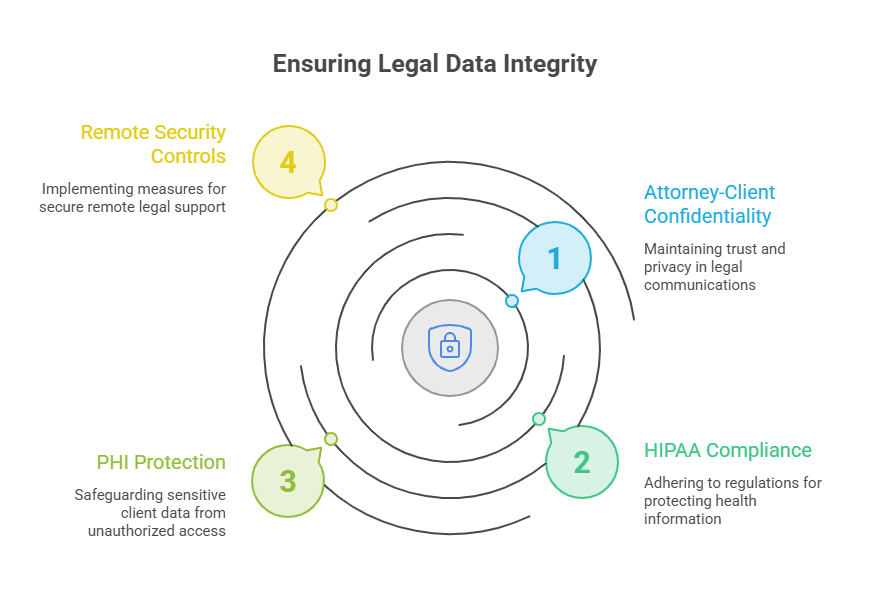
Remote support is not inherently insecure, but informal access is. Legal VAs may encounter identity records, privileged communications, health information, financial data, trade secrets, litigation strategy, and court-protected materials. Firms should design controls around data sensitivity and professional duties rather than relying on a nondisclosure agreement alone.
1. Attorney-Client Confidentiality and Supervision
The lawyer should assess the provider, location, personnel, technology, subcontractors, training, incident history, and ability to follow firm policies. Client agreements and jurisdictional rules may require notice or consent for some outsourcing. Conflict-check procedures should also address whether the VA or provider serves adverse or competing parties.
Access should be matter-specific and time-limited. The VA needs instructions on copying, downloading, printing, discussing, transmitting, retaining, and deleting information. Personal devices, consumer file-sharing tools, shared accounts, and unapproved AI systems should be prohibited unless the firm has assessed and authorized them.
Supervision includes more than assigning tasks. Lawyers should review work, monitor compliance, correct errors, and ensure nonlawyer conduct is compatible with professional obligations. Written procedures provide evidence and consistency, but managers must verify that people actually follow them.
2. HIPAA, PHI, and Sensitive Client Data
HIPAA does not automatically apply to every law firm or every legal matter. A lawyer or provider may become a business associate when providing services to a covered entity that involve protected health information, depending on the relationship and functions performed. The firm should obtain advice on its status rather than treating “HIPAA compliant” as a generic marketing label.
HHS explains that a covered entity may disclose PHI to a business associate when it receives appropriate written assurances, generally through a business associate agreement. Business associates can also be directly liable for certain HIPAA obligations. Contracts, minimum-necessary access, permitted uses, subcontractors, safeguards, breach procedures, and termination duties must align with the actual arrangement.
A guide to HIPAA and confidentiality for legal VAs should distinguish HIPAA from broader duties involving privilege, state privacy laws, professional conduct, court orders, and client contracts. Meeting one framework does not satisfy every confidentiality obligation.
3. Practical Security Controls for Remote Legal Support
Firms should issue unique accounts with multifactor authentication and least-privilege access across legal and collaboration systems. Approved devices and connections should use encryption, patching, endpoint protection, screen locks, remote-wipe capability, and controlled networks. Data rules should restrict local downloads, personal email, removable media, printing, screenshots, unsanctioned messaging, and transfers into unapproved AI tools.
Incident procedures should explain when to stop work, preserve evidence, notify the firm, and prevent further disclosure. Firms should audit providers through due diligence, training records, permission reports, access logs, sample checks, offboarding, and documented remediation. These controls are urgent because approximately 75% of attorneys used cloud computing for work, while only 60% of firms had formal cybersecurity policies, according to ABA reporting.
AI, Automation, and Human Review in Legal VA Work
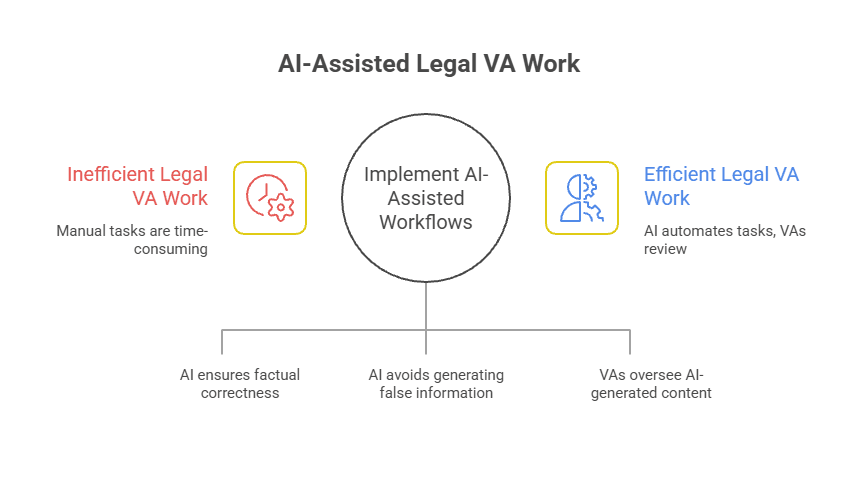
AI can accelerate transcription drafts, document classification, summarization, search, template completion, and administrative writing. It can also fabricate authority, omit context, expose confidential information, or produce persuasive but wrong language. A legal VA should use AI only within attorney-approved policies, tools, and review procedures.
1. Appropriate Uses of AI-Assisted Workflows
- Create low-risk first drafts such as meeting summaries, nonlegal emails, administrative checklists, or standardized internal notes, provided a human compares the result with the source and approves its use.
- Classify and extract information from authorized documents by identifying dates, names, categories, or fields, while preserving links to originals so every extracted item can be checked.
- Normalize routine data across approved spreadsheets or case systems when validation rules, exception reports, access controls, and a reversible correction process are in place.
- Assign review according to risk because nonconfidential administrative text may need modest checking, whereas legal research, filings, contracts, evidence, privilege logs, and sensitive-data processing demand stronger controls or may be prohibited.
- Define the governance before use by naming approved tools, permitted data, retention settings, disclosure requirements, review standards, and the people authorized to approve exceptions.
- Keep accountable humans in control of every workflow; with 30.2% of surveyed attorneys reporting that their offices used AI-based technology, practical supervision matters more than assuming the tool is safe because it is common.
2. Accuracy, Hallucinations, and Verification
- Treat AI output as unverified: Fluency is not evidence, and a confident answer may contain fabricated cases, wrong quotations, outdated law, or missing exceptions.
- Verify legal authorities independently against approved primary sources, checking jurisdiction, date, subsequent history, quotations, pinpoints, and whether the proposition is actually supported.
- Compare summaries with originals so omitted qualifications, dates, parties, defined terms, exhibits, and contradictory passages are identified before reliance.
- Use source-linked workflows that preserve the document, prompt or instruction, output, reviewer, corrections, and final approval appropriate to the task’s risk.
- Protect confidential data by prohibiting client information in public or unapproved systems and reviewing provider terms, training use, retention, access, and security.
- Escalate uncertainty to a lawyer rather than prompting until the model produces a convenient answer; understanding how accurate AI is for legal work requires testing the specific tool, task, data, and review process because no general accuracy percentage makes an output safe for a client matter.
3. Will AI Replace Lawyers or Legal VAs?
- Expect task redesign rather than wholesale replacement because AI can speed narrow steps but does not assume a lawyer’s duties, accountability, or client relationship.
- Preserve licensed legal judgment for client advice, strategy, advocacy, negotiation, interpretation, and decisions affecting rights or obligations.
- Retain human operational ownership because legal VAs provide contextual coordination, communication, exception handling, and quality control that automation cannot reliably manage alone.
- Automate suitable routine work while recognizing BLS guidance that AI may improve efficiency even as firms continue to need people who prepare and organize legal documents.
- Combine technology with trained reviewers so each high-impact output has an accountable owner, verification method, and attorney-supervised escalation path.
- Ask the practical staffing question: Rather than focus only on whether AI will replace lawyers, identify which tasks are safe to automate, which require professional judgment, and who will supervise the technology.
Legal Marketing, Content, and Search Support
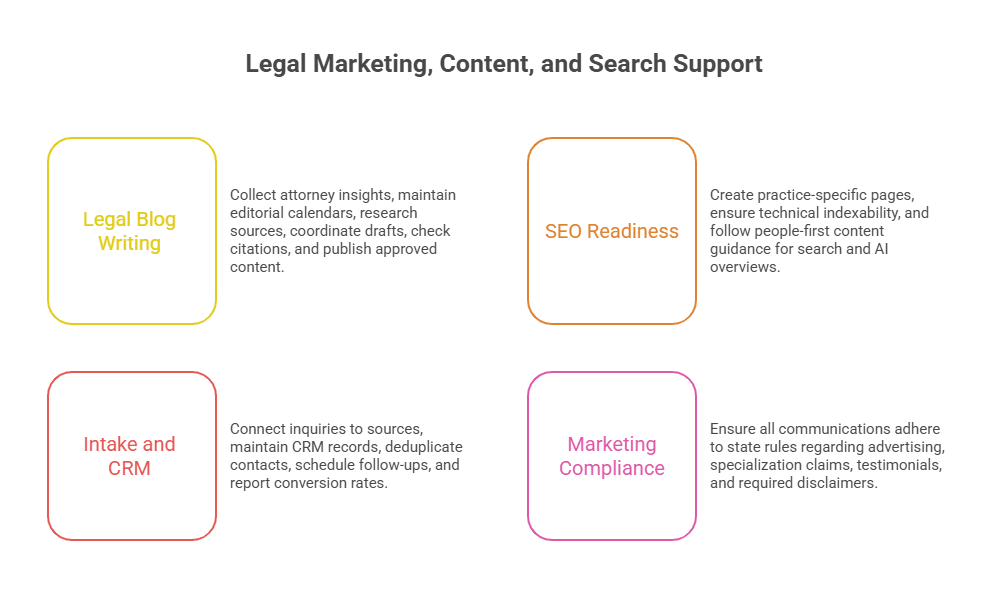
A legal VA can support marketing operations without making unapproved claims or creating an attorney-client relationship. Every state has rules governing lawyer communications, advertising, solicitation, specialization claims, testimonials, and required disclaimers. Content should be accurate, useful, reviewed, and consistent with the firm’s approved positioning.
1. Legal Blog Writing and Content Operations
A VA can collect attorney insights, maintain an editorial calendar, build briefs, research authoritative public sources, coordinate drafts, check citations, format articles, prepare metadata, and publish approved content. The attorney or qualified reviewer should verify legal accuracy and confirm that examples do not disclose client information.
A credible legal article answers a real question, states jurisdictional limits, explains uncertainty, and avoids implying that general information is personalized advice. Firsthand attorney experience, named review, primary sources, current dates, and transparent authorship support trust. Generic text that merely repeats other law-firm pages adds little value.
A professional legal blog writing service should therefore include expert intake, fact-checking, editorial review, compliance checks, and version control. Publishing volume alone is not a meaningful quality measure.
2. SEO and AI Overview Readiness for Law Firms
Law firms should create practice-specific pages that explain services, jurisdictions, processes, permitted fee information, common questions, risks, and realistic next steps. Local visibility should rest on accurate office, attorney, service-area, directory, review, and Google Business Profile information instead of mass-produced city-name pages. Primary legal sources, clear authorship, qualified review, and visible update dates help readers evaluate the content’s authority, currency, and jurisdictional fit.
Technical readiness requires indexable pages, logical internal links, secure delivery, mobile usability, accurate structured data, accessible design, and monitored performance. Direct answers remain valuable because Google says foundational SEO still applies to AI Overviews and AI Mode and no special markup is required for consideration. Firms should follow Google’s people-first content guidance, contribute genuine legal expertise, and avoid scaled, thin production designed primarily for search systems.
3. Intake, CRM, and Marketing Compliance
Marketing support should connect each inquiry to its source, practice area, location, response status, consultation, and approved outcome. A VA can maintain the CRM, deduplicate contacts, schedule follow-ups, and report operational conversion rates. Access should be limited because prospect information may be sensitive even before representation begins.
The firm should approve every script, form, email sequence, testimonial, biography, award reference, and service description. The VA should escalate requests involving guarantees, comparisons, past results, specialization, urgency, or contact with represented persons. Consent and communication-preference rules also affect email, text, and call workflows.
Benefits and Limitations of Legal VA Services
The strongest benefit is not simply lower labor cost. A legal VA creates dependable capacity for recurring work, which can improve responsiveness, organization, and attorney focus. Results depend on task design, supervision, provider quality, technology, and the firm’s willingness to maintain clear procedures.
1. Operational and Client-Service Benefits
- More focused attorney time becomes available when scheduling, records, intake administration, billing preparation, and routine coordination have a reliable owner.
- More consistent client communication results from approved response standards, documented follow-ups, organized contact data, and clear escalation to licensed professionals.
- Lower fixed overhead may be possible when remote support reduces the need for additional office space, equipment, and full-time capacity during uneven workloads.
- Scalable coverage allows the firm to add support for intake surges, document projects, extended hours, or new practice areas without rushing a permanent hire.
- Better process visibility comes from dashboards, task ownership, documented exceptions, change logs, and files stored in authorized systems instead of personal inboxes.
- Improved continuity and capacity are possible when documented procedures and cross-training prevent one absence from stopping operations and help reserve attorney time for licensed work; this matters as BLS projects lawyer employment to grow 4% from 2024 to 2034, with about 31,500 openings each year.
2. Limitations and Tasks That Require Escalation
- Unclear processes remain unclear after delegation: Outdated templates, conflicting responsibilities, disorganized files, and delayed attorney review should be corrected before a firm grants broad remote autonomy.
- Substantive legal judgment stays with qualified professionals, including advice, strategy, interpretation, negotiation, legal conclusions, and decisions that affect a client’s rights or obligations.
- Specialized work may require specialized personnel because complex research, filings, trust accounting, discovery, contracts, health records, and court communications can demand credentials, local knowledge, dedicated tools, or direct attorney involvement.
- Provider capability varies materially across practice areas, jurisdictions, languages, terminology, platforms, and document types, so firms should match demonstrated experience to the actual assignment.
- Sensitive events require immediate escalation, including urgent legal issues, advice requests, ethical concerns, suspected breaches, complaints, conflicts, adverse communications, and facts that fall outside the approved procedure.
- Responsible hesitation is a performance strength: The VA should be evaluated on recognizing when not to proceed, documenting uncertainty, and requesting guidance instead of improvising with confidence.
3. Measuring Legal VA Performance Responsibly
- Measure controllable work rather than holding the VA responsible for case outcomes, court schedules, client decisions, or strategic results outside the assigned role.
- Track service reliability through intake response time, scheduling accuracy, task completion, turnaround, follow-up status, and the age of unresolved items.
- Evaluate work quality using document error rates, billing-entry completeness, file organization, correction frequency, and compliance with approved procedures.
- Assess judgment and risk behavior through escalation speed, confidentiality practices, security adherence, exception documentation, and willingness to pause when instructions are unclear.
- Separate speed from accuracy so higher output does not conceal costly errors, missed review points, weak documentation, or safeguards bypassed to meet a volume target.
- Review business impact monthly by asking whether delegation saved attorney time, reduced backlogs, improved responsiveness, and maintained confidentiality, then adjusting scope, training, permissions, or staffing from evidence.
Legal VA Pricing and Staffing Models
Pricing depends on experience, location, practice-area knowledge, schedule, task risk, technology, management, and volume. An hourly rate does not show the full cost of supervision, rework, tools, security, or unused capacity. Firms should compare services against a written workload and quality standard.
1. What Affects Legal VA Pricing?
Task complexity and required credentials are major price drivers because calendar entry and data cleanup generally demand less specialization than discovery support, contract operations, transcription, or attorney-directed research. Paralegal education, certifications, practice-area familiarity, legal writing, bilingual ability, platform expertise, location, time-zone coverage, and jurisdictional familiarity can all affect rates. Security expectations—including managed devices, background checks, dedicated workspaces, restricted access, audits, cyber insurance, and contractual controls—also add legitimate operating cost.
The management model matters because a freelancer may need more direct supervision, while a managed provider may include vetting, training, review, replacement coverage, and account support. Project, hourly, part-time, full-time, after-hours, rush, and retainer arrangements price availability and volume differently, so the lowest hourly quote may not produce the lowest total cost. A current legal VA pricing guide can frame the comparison, but firms should request a tailored scope covering deliverables, exclusions, tools, hours, review, security, and termination terms.
2. Virtual Paralegal vs. In-House Paralegal
An in-house paralegal offers direct integration, immediate office presence, institutional knowledge, and potentially broad matter ownership. The total employment cost includes salary, payroll taxes, benefits, equipment, workspace, recruiting, training, and capacity that may not match fluctuating demand. In-person access can still be essential for some firms and matters.
A virtual paralegal can provide flexible hours, specialized project capacity, or coverage outside the firm’s local hiring market. The firm must manage remote communication, supervision, security, availability, and continuity. Some providers supply backup staff, while an independent professional may not.
BLS reports that paralegals and legal assistants earned a median annual wage of $61,010 in May 2024 and projects about 39,300 openings annually through 2034. A virtual-versus-in-house paralegal cost comparison should add supervision, risk, benefits, tools, utilization, and quality—not compare salary with an hourly invoice alone.
3. Choosing a Freelancer, Managed Service, or Hybrid Team
A freelancer can be a good fit when the firm has a clear scope, strong management, and a trusted individual with the right skills. A managed service may provide sourcing, vetting, account oversight, replacement coverage, standardized security, and broader capacity. The firm should verify claims rather than assume the provider’s label guarantees quality.
A hybrid team can assign reception and administration to a VA, substantive support to a paralegal, complex technology to specialists, and legal decisions to attorneys. This model keeps each task at the appropriate level. It also requires a responsibility matrix so work is not duplicated or lost between roles.
How to Hire, Onboard, and Manage a Legal VA

Good hiring begins with the work, not a generic job description. The firm should inventory tasks, classify risk, estimate volume, identify required systems, and mark attorney-review points. Candidates can then be assessed against real responsibilities instead of broad claims about legal experience.
1. Skills, Vetting, and Paid Test Tasks
- Verify relevant experience by asking which practice areas, matter types, jurisdictions, documents, and legal platforms the candidate has supported and in what capacity.
- Test boundary judgment with scenarios involving advice requests, urgent deadlines, adverse parties, confidential attachments, suspicious links, and unclear attorney instructions.
- Review written communication for tone, grammar, precision, discretion, escalation, and the ability to distinguish a factual update from a legal explanation.
- Assess organization through a limited file, calendar, intake, or checklist task that reveals naming, version control, completeness, and attention to instructions.
- Evaluate security behavior by asking how the candidate handles passwords, devices, downloads, public networks, phishing, AI tools, incidents, and offboarding.
- Use a paid, realistic test with fictional or sanitized information, the same instructions for finalists, a defined time limit, and scoring for accuracy, reasoning, and communication.
2. The First 30 Days of Onboarding
- Establish role context in week one by explaining the firm’s structure, practice areas, client experience, ethical boundaries, confidentiality duties, communication norms, and escalation chain.
- Configure secure access before live work with separate accounts, multifactor authentication, approved devices, least-privilege permissions, and verified access to only the required matters and systems.
- Begin with low-risk assignments such as sanitized exercises, approved scheduling, file checks, or draft administrative work, using sample review to confirm that instructions are understood.
- Transfer defined recurring work in weeks two and three across scheduling, intake administration, billing preparation, file maintenance, or approved marketing coordination as demonstrated accuracy permits.
- Review performance and repair procedures continuously by examining accuracy, timeliness, documentation, questions, escalation behavior, and security compliance whenever an instruction proves incomplete or ambiguous.
- Complete a week-four readiness review of quality, workload, availability, attorney time saved, and control compliance, expanding access or complexity only where evidence supports it rather than granting instant unsupervised autonomy.
3. Standard Operating Procedures and Quality Assurance
- Document every recurring task with its purpose, trigger, inputs, steps, system of record, confidentiality level, approval owner, deadline, definition of done, and escalation path.
- Explain judgment boundaries clearly through examples, screenshots, permitted actions, prohibited actions, and decision points so an SOP supports careful work instead of blind clicking.
- Control procedure versions by assigning an owner, effective date, review date, revision history, and prompt updates whenever a platform, rule, template, or responsibility changes.
- Match quality assurance to risk through dual calendar review, document checklists, source comparison, sample audits, lawful call review, permission reports, and post-publication verification.
- Learn from errors transparently by recording the issue, impact, root cause, correction, responsible owner, and prevention step without creating incentives for workers to hide mistakes.
- Include complete offboarding controls to disable accounts, recover equipment, rotate shared secrets, transfer open tasks, preserve required records, confirm deletion duties, and restate continuing confidentiality when the relationship ends.

FAQ
1. What does a legal virtual assistant do?
A legal VA supports scheduling, intake, files, document formatting, billing administration, transcription coordination, marketing, and other approved tasks under the firm’s procedures and supervision.
2. Can a legal VA give legal advice?
No. A nonlawyer VA should not independently advise clients, select legal strategy, represent a client, or perform work constituting unauthorized practice under applicable law.
3. Is a legal virtual assistant the same as a paralegal?
Not necessarily. Some legal VAs are qualified paralegals, while others specialize in administration. Firms should evaluate credentials, jurisdictional rules, supervision, and the actual task.
4. Are legal virtual assistant services confidential?
They can be managed securely, but confidentiality requires due diligence, contracts, training, approved technology, limited access, supervision, monitoring, and incident procedures.
5. How much does a legal virtual assistant cost?
Cost varies by experience, location, hours, practice-area knowledge, credentials, task complexity, security, tools, and whether the provider is independent or managed.
6. What should a law firm outsource first?
Start with repeatable, low-risk tasks such as scheduling, intake administration, file organization, billing preparation, approved document formatting, and CRM updates.
Conclusion: Build a Secure Legal Support System
Legal virtual assistant services can give law firms reliable capacity for the work that surrounds legal judgment. Scheduling, intake, documents, transcription, billing, file organization, marketing, and workflow coordination all become easier to manage when responsibilities are documented and assigned to trained support.
The model succeeds only when attorneys preserve professional control. Firms need jurisdiction-specific boundaries, qualified supervision, secure systems, limited access, quality review, AI governance, and clear escalation. A remote assistant should extend the firm’s standards, not operate outside them.
CTA: Ready to improve your legal operations? List the repetitive tasks creating backlogs, classify their risk, identify attorney-review points, and decide which work a trained legal virtual assistant can handle within a secure, supervised workflow.
Sources List
- American Bar Association — Model Rules of Professional Conduct
- American Bar Association — 2024 Artificial Intelligence TechReport
- American Bar Association — 2024 Cloud Computing TechReport
- American Bar Association — Formal Opinion 512 overview
- U.S. Bureau of Labor Statistics — Lawyers
- U.S. Bureau of Labor Statistics — Paralegals and Legal Assistants
- U.S. Department of Health and Human Services — Business Associates
- Legal Services Corporation — Justice Gap Research
- Google Search Central — AI Features and Your Website
- Google Search Central — Helpful, Reliable, People-First Content
 Siddhartha Basu is a Technical Writer at Task Virtual. He loves online games, e-book reading, and Yoga.