

Contents
show
Legal VA Tasks by Practice Area: Family Law, Corporate, Real Estate Law
In today’s fast-paced legal landscape, attorneys face mounting administrative burdens that eat into billable hours and delay client service. Legal VA tasks—specialized support from remote virtual assistants trained in legal workflows—have emerged as a game-changer, especially amid rising caseloads and the push for remote work post-pandemic.
Legal virtual assistants (VAs) handle non-licensed administrative, organizational, and support duties under attorney supervision, allowing firms to scale without the overhead of full-time hires. Whether managing sensitive family law matters, complex corporate transactions, or high-volume real estate closings, these professionals deliver precision, confidentiality, and efficiency.
This guide dives deep into legal VA tasks tailored to three key practice areas: family law, corporate law, and real estate law. Drawing from industry insights, you’ll learn actionable ways VAs reduce overhead, improve client experiences, and drive firm growth—optimized for the demands of 2026 legal practices.
Why Legal VAs Are Essential for Modern Law Firms

With 74% of hourly billable work potentially automatable, legal professionals spend significant time on non-billable work, limiting their capacity to serve clients effectively and grow their practices. Legal VAs address this challenge by handling repetitive administrative duties, enabling attorneys to reclaim hours for legal work and strategic client engagement. As firms navigate complexity and competition, partnering with virtual assistants has become a strategic necessity for success and improved profitability.
1. The Growing Demand for Specialized Support
The demand for legal support roles continues to rise as firms seek efficient ways to manage growing caseloads without expanding physical office space. According to the U.S. Bureau of Labor Statistics, the field supports hundreds of thousands of positions, with virtual solutions offering flexible, cost-effective alternatives that align with modern remote work trends.
Virtual assistants provide specialized expertise tailored to specific practice areas, delivering consistent results that in-house hires often struggle to match at scale. This trend reflects broader industry shifts toward technology-enabled operations that prioritize efficiency and work-life balance for legal teams.
2. Benefits Across Practice Areas
Legal VAs deliver measurable advantages by handling standardized tasks that appear consistently across family, corporate, and real estate practices. Their support leads to faster client onboarding, fewer missed deadlines, and higher overall firm productivity while reducing operational costs significantly.
By integrating seamlessly with existing tools and workflows, VAs allow attorneys to focus on high-value activities that drive revenue and client satisfaction. This adaptability makes them ideal for firms of all sizes seeking scalable solutions in a dynamic legal environment.
3. Confidentiality and Ethical Compliance
Maintaining client confidentiality remains paramount in legal practice, and professional VAs uphold the highest standards through comprehensive NDAs and secure protocols. They undergo conflict checks and operate within clearly defined access limits to align with bar regulations and firm policies.
With over 40% of British businesses reporting security incidents, attorneys retain supervisory responsibility, ensuring delegated work complies with ethical guidelines. This oversight enables the use of remote talent, builds trust, and protects sensitive information.
Legal VA Tasks in Family Law
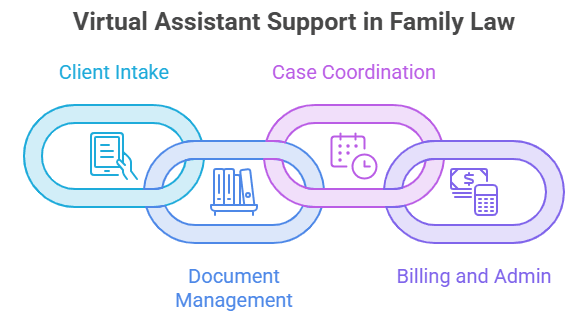
Family law involves emotionally charged cases like divorce, custody, child support, and adoption, where attorneys must balance legal strategy with sensitive client interactions. VAs provide compassionate, organized support that keeps operations smooth while maintaining strict confidentiality throughout the process. Their assistance helps firms manage high client volumes efficiently and ensures the timely handling of time-sensitive family matters.
1. Client Intake and Onboarding
VAs manage initial inquiries by gathering case details through secure forms and conducting basic conflict checks to ensure compliance from the very beginning. They prepare engagement letters, send retainers for electronic signature, and enter new client data accurately into case management systems. Follow-up communications help convert leads quickly and create positive first impressions during stressful family law situations.
2. Document Preparation and Management
VAs draft petitions, motions, and settlement agreements using approved templates while carefully organizing financial disclosures for accuracy and completeness. They proofread all materials thoroughly, maintain proper version control, and assemble necessary exhibits for court submissions or mediations. Secure e-filing combined with systematic file organization ensures quick retrieval and significantly reduces the risk of errors in high-stakes cases.
3. Case Coordination and Communication
VAs schedule hearings, mediations, and client appointments while diligently tracking critical deadlines to prevent compliance issues. They coordinate effectively with opposing counsel and send regular status updates that keep clients informed without requiring constant attorney involvement. Discovery support includes organizing records and preparing materials that streamline trial preparation and overall case progress.
4. Billing and Administrative Support
VAs compile attorney time entries accurately and prepare client invoices on schedule to maintain healthy cash flow for the firm. They follow up professionally on outstanding payments and manage routine correspondence that supports daily operations. This reliable assistance allows attorneys to focus more on substantive legal work and client advocacy.
Legal VA Tasks in Corporate Law
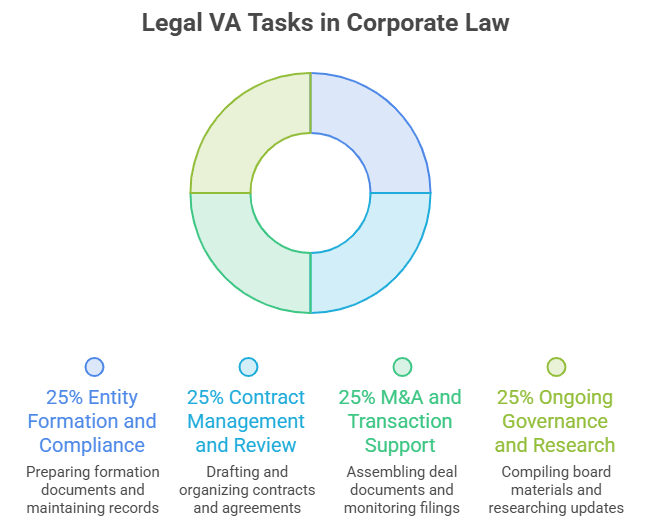
Corporate practice focuses on business formations, contracts, compliance, mergers and acquisitions, and governance, where attention to detail and timely execution are critical for client success. Legal VAs excel in these areas by managing repetitive yet essential processes that allow corporate attorneys to concentrate on strategic negotiations and advisory work. Their support helps firms handle increasing regulatory demands and complex transactions more efficiently in a competitive business environment.
1. Entity Formation and Compliance
Legal VAs prepare formation documents, including articles of incorporation and operating agreements, while ensuring filings meet standards. They maintain corporate records and track annual reports to avoid penalties. This proactive support strengthens business operations and gives attorneys confidence in administrative foundations.
2. Contract Management and Review
VAs draft contracts, NDAs, and agreements using templates while coordinating revisions. They organize due diligence files and track document versions for accuracy. This detailed assistance speeds up transactions and lightens the load on corporate teams.
3. M&A and Transaction Support
VAs assemble deal documents and schedule board meetings for smooth progress. They prepare minutes and monitor regulatory filings tied to M&A activity. With ongoing market resilience, this helps manage high-volume demands effectively.
4. Ongoing Governance and Research
VAs compile board materials and research business structures or updates. They manage vendor communications and keep governance records current. This consistent support builds client relationships and aids compliance.
Legal VA Tasks in Real Estate Law
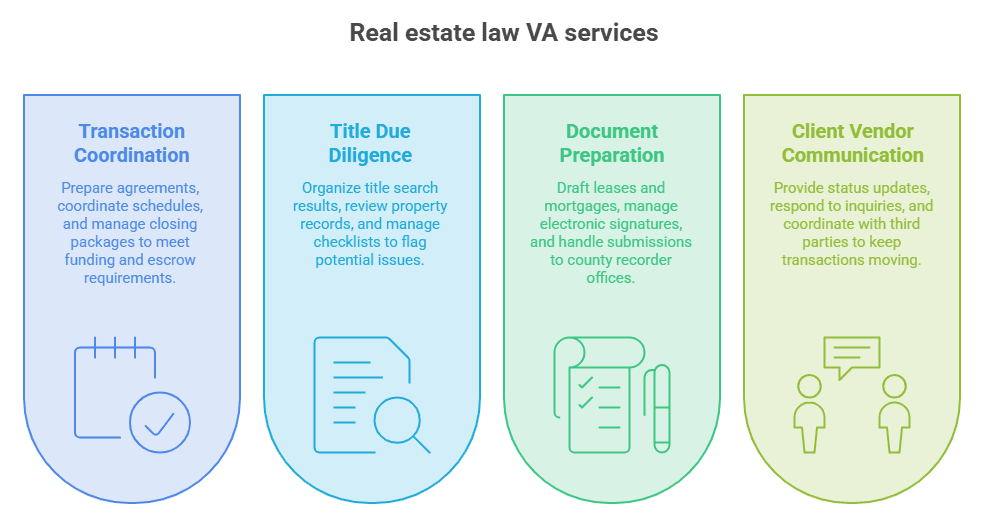
Real estate law features fast-paced transactional workflows involving tight deadlines, multiple parties, and extensive documentation for purchases, sales, leases, and closings. VAs deliver precise coordination and administrative support that helps ensure smooth transactions and compliance with local regulations. Their involvement reduces bottlenecks and allows attorneys to concentrate on complex negotiations and legal strategy.
1. Transaction Coordination and Closings
VAs prepare purchase agreements, deeds, and related disclosures while coordinating schedules efficiently with title companies, lenders, and real estate agents. They assemble complete closing packages and manage timelines to ensure all parties meet funding and escrow requirements on time. Post-closing follow-up includes confirming recordings and handling any necessary adjustments for successful transaction completion.
2. Title and Due Diligence Support
VAs organize title search results and review property records thoroughly to identify potential liens, encumbrances, or other issues that could affect the deal. They facilitate due diligence by managing detailed checklists and promptly flagging concerns that require attorney attention. Systematic documentation ensures all involved parties receive clear and accurate information throughout the transaction process.
3. Document Preparation and Filing
VAs draft leases, mortgages, and settlement statements using templates while performing careful proofreading to maintain legal accuracy and consistency. They manage electronic signatures through reliable platforms and prepare materials for submission to county recorder offices. Strong version control and organized filing systems support efficient retrieval and minimize risks during fast-paced closings.
4. Client and Vendor Communication
VAs serve as the primary point of contact by providing regular status updates and responding professionally to client or vendor inquiries. They collect required client documents and coordinate effectively with inspectors, appraisers, or other third parties as needed. Clear and consistent communication helps maintain positive relationships and keeps transactions moving forward on schedule.
Implementing Legal VA Support: Best Practices

Hiring and integrating legal virtual assistants requires planning, particularly as 55% of remote-capable employees work hybrid schedules. Successful implementations prioritize clear roles and ongoing collaboration, aligning remote support seamlessly with in-house workflows and operations.
1. Choosing the Right VA Partner
- Evaluate candidates for relevant practice-area experience and strong proficiency with your firm’s specific software tools.
- Prioritize alignment with U.S. business hours to enable real-time collaboration and effective communication.
- Require comprehensive confidentiality protocols, including NDAs and secure data handling practices.
- Choose providers that offer trial periods or structured onboarding processes for proper assessment of fit.
2. Integration and Scaling
- Begin with detailed task documentation and focused training on your unique processes and preferences.
- Allow VAs to scale hours flexibly according to caseload fluctuations in different practice areas.
- Use regular check-ins and shared reporting tools to maintain strong alignment over time.
- Make quick adjustments as the firm’s needs evolve to ensure continued effectiveness.
3. Measuring ROI
- Track recovered billable hours and reductions in client response turnaround times.
- Monitor decreases in administrative errors following VA implementation.
- Calculate cost savings compared to traditional hiring methods.
- Assess improvements in realization rates and client satisfaction scores.
TaskVirtual: Your Partner in Legal Support Services

Busy law firms often struggle to balance high caseloads with essential administrative demands across family law, corporate matters, and real estate transactions. From client intake and document management to deadline tracking and compliance coordination, these tasks consume valuable time that could be spent on billable work and client advocacy. TaskVirtual VA provides expert legal virtual assistant services that simplify legal operations by handling routine yet critical tasks with precision and confidentiality.
1. Expert Legal Support and Review
TaskVirtual VA’s skilled virtual assistants support attorneys by managing practice-specific tasks such as drafting documents from templates, organizing case files, and coordinating client communications across family, corporate, and real estate matters. They ensure seamless integration with your tools and workflows while maintaining strict attention to deadlines and ethical standards.
2. Affordable and Flexible Pricing
Hiring a full-time personal assistant can be expensive, but TaskVirtual VA makes it cost-effective. With pricing plans starting from just $3.12/hour to $14.99/hour, their services are budget-friendly and accessible to individuals, families, and businesses.
3. Comprehensive Legal Practice Support Solutions
From client onboarding and billing follow-ups to transaction coordination and compliance tracking, TaskVirtual VA covers essential administrative needs in key practice areas. Their scalable services adapt whether you need occasional help or consistent support for growing caseloads.
4. Ongoing Support and Quality Assurance
TaskVirtual VA goes beyond basic task delegation by offering proactive updates, deadline reminders, and performance monitoring. Their dedicated approach ensures reliable execution that reduces attorney workload and enhances overall firm efficiency without compromising quality.
5. Proven Track Record of Excellence
With 364 positive reviews and a 4.7-star rating on trusted VA platforms, TaskVirtual VA is recognised as a reliable partner worldwide. Clients count on their expertise to simplify legal operations and streamline practice management.
FAQ Section
1. What are the most common legal VA tasks?
Common tasks include client intake, document preparation from templates, calendar/deadline management, billing support, and case file organization across practice areas.
2. How do legal VAs differ from paralegals?
VAs focus on administrative and operational support; paralegals often handle more substantive work like detailed research or drafting under supervision. Both work under attorney oversight.
3. Are legal VAs suitable for small firms?
Yes—solo and small practices benefit greatly from scalable, cost-effective support without full-time overhead.
4. What security measures protect client data?
NDAs, role-based access in software, secure channels, and conflict checks ensure compliance.
5. How much do legal VA services typically cost?
Rates often start around $13–$15/hour or flat monthly for full-time equivalents, significantly lower than in-house staff.
6. Can VAs handle practice-specific tasks like real estate closings?
Yes, experienced VAs are trained in area-specific workflows, tools (e.g., Qualia, Dotloop), and coordination.
Conclusion
Legal VA tasks in family law, corporate, and real estate practices empower attorneys to reclaim time, enhance service quality, and grow sustainably. By delegating repetitive yet critical work, firms achieve better work-life balance, higher profitability, and a competitive edge in client responsiveness.
Legal support requirements vary considerably between family law, corporate matters, real estate transactions, and other practice areas. A virtual assistant for lawyers can be assigned practice-specific administrative and support tasks when the firm’s procedures clearly define responsibilities and attorney-review points.
Ready to transform your practice? Explore partnering with a reputable legal VA provider today and start delegating with confidence.
CTA: Schedule a consultation with a legal VA service to audit your admin bottlenecks and customize support for your firm.
Sources
- Elite Resource Services (Legal VA Services)
- American Military University (Paralegal Roles)
- Virtual Staffing Careers (Practice Areas for VAs)
- Equivity VA (Virtual Paralegals)
- VA Masters (Law Firm VA)
- Virtual Staffing (Real Estate Legal Assistant)
- LegalSoft (Real Estate & Estate Planning)
For more such content, visit our website.
 Siddhartha Basu is a Technical Writer at Task Virtual. He loves online games, e-book reading, and Yoga.