

Contents
show
Virtual Paralegal vs In-House Paralegal: Cost Comparison
Law firms face rising operational pressures in 2026, with client demands growing and margins tightening. Many attorneys spend too much time on non-billable tasks instead of high-value legal work. A key decision is whether to hire an in-house paralegal or opt for a virtual paralegal.
Virtual paralegals (also called paralegal virtual assistants or virtual legal assistants) provide remote support for tasks like case management, document drafting, legal research, and discovery. They deliver professional expertise without the fixed costs of traditional hiring. This blog delivers a detailed virtual paralegal vs in-house paralegal cost comparison, drawing from industry sources and real-world data to help US law firms—especially solos and small practices—make informed choices.
We’ll examine total costs, flexibility, and productivity—including a Stanford-documented 13% remote-work performance increase—and when each model fits best, with insights on virtual paralegal services, hiring, pricing, and strategies.
The True Cost of an In-House Paralegal
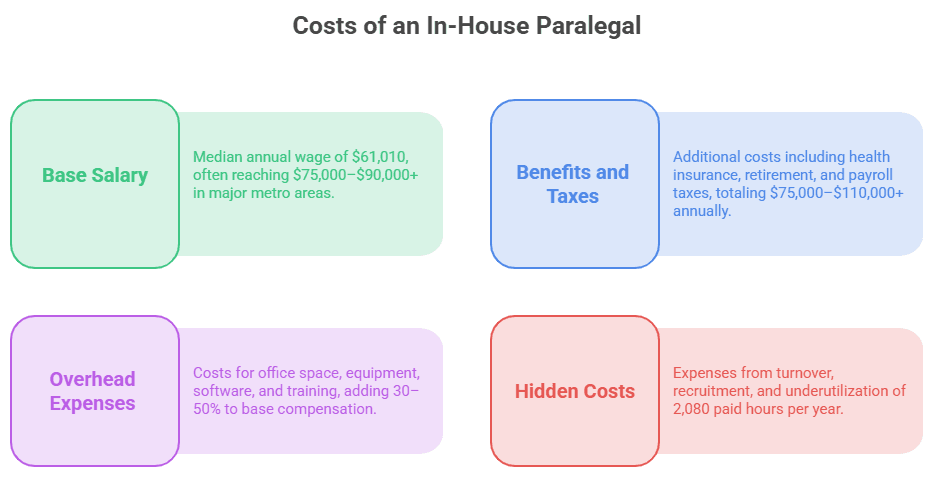
Hiring an in-house paralegal involves more than salary alone, as law firms must account for full costs; benefits represent 29.9% of private-industry compensation costs when evaluating staffing expenses. These costs accumulate through multiple layers, including compensation packages, operational requirements, and indirect burdens that impact overall firm profitability. Understanding this full scope helps attorneys and practice managers compare options objectively against more flexible alternatives like virtual support.
1. Base Salary and Median Wages
According to the U.S. Bureau of Labor Statistics (BLS), the median annual wage for paralegals and legal assistants was $61,010 in May 2024 (approximately $29.33 per hour). In major metro areas or for specialized roles, salaries often reach $75,000–$90,000+.
This base figure represents only the starting point for budgeting purposes in most law firms. Actual offers frequently adjust upward based on experience, certifications, practice area demands, and local cost of living variations across different regions.
2. Benefits, Payroll Taxes, and Employer Costs
Employers add substantial costs beyond salary. BLS data shows that benefit costs average about 30.1% of total compensation for private industry workers. For law firms, this often includes health insurance, retirement contributions, payroll taxes (Social Security, Medicare, and unemployment), and paid time off.
Industry estimates place the fully loaded cost of an in-house paralegal at $75,000–$110,000+ annually when including these factors. These mandatory and elective benefits create ongoing financial commitments that continue regardless of actual case volume or firm performance fluctuations.
3. Overhead Expenses: Office Space, Equipment, and More
In-house staff requires physical workspace, utilities, computers, software licenses (e.g., case management tools), furniture, and supplies. Additional costs include onboarding, training, supervision time, and administrative HR support.
These overhead elements can add 30–50% or more to base compensation. One detailed comparison shows a full-time employee at an effective rate leading to nearly $77,000 annually for 2,080 hours (including benefits at 35% and overhead at 50%), versus far lower variable costs for virtual support.
4. Hidden Costs: Turnover and Underutilization
Employee turnover is expensive. Replacing a staff member can cost 50–200% of their annual salary due to recruitment, lost productivity, and training. Paralegal roles often see higher churn in competitive markets.
Firms also pay for 2,080 hours per year (40 hours/week × 52), but actual productive time is lower due to PTO, holidays, breaks, training, and downtime during slow periods. Attorneys may lose billable time covering gaps, further compounding the total economic impact on the practice.
Virtual Paralegal Pricing and Cost Structure
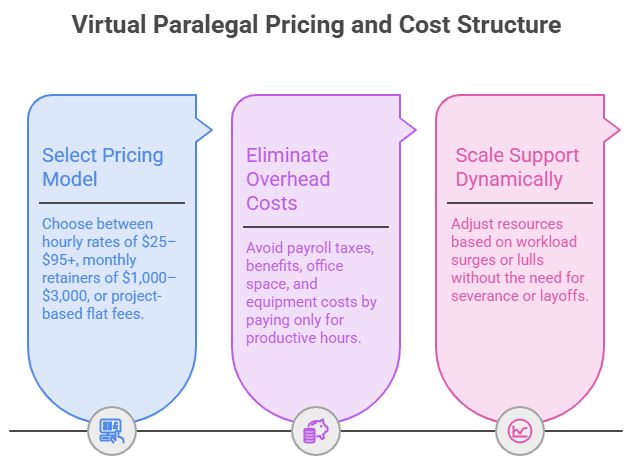
Virtual paralegal arrangements offer a modern alternative that aligns expenses directly with actual needs rather than fixed commitments typical of traditional employment. This model has gained traction among law firms seeking greater control over operational budgets while maintaining high-quality legal support. Providers deliver experienced professionals through flexible engagement structures tailored to varying practice demands.
1. Hourly Rates and Retainer Models
Virtual paralegal services typically range from $25–$75 per hour, with specialized or experienced providers at $45–$95+. Rates vary by expertise, practice area (e.g., litigation is higher than general admin), and location of the provider.
Many firms use monthly retainers of $1,000–$3,000 for a set number of hours, or project-based pricing (e.g., flat fees for motions or discovery organization). This pay-as-you-go model eliminates fixed commitments and provides predictable budgeting for both short-term projects and ongoing assistance.
2. No Benefits, Overhead, or Idle Time Costs
Virtual paralegals work as contractors or through services, so firms avoid payroll taxes, benefits, office space, equipment, and most HR burdens. You pay only for productive hours—often 480 hours/year in example comparisons versus 2,080 for full-time staff.
This yields significant savings. One analysis highlights an over $60,000 annual difference per position when comparing equivalent support levels across different engagement models.
3. Scalability and Variable Costs
Hire virtual paralegal support that scales with workload. Ramp up during trials or discovery surges; scale down during lulls without severance or layoffs.
This flexibility improves cash flow and protects margins during unpredictable periods common in legal practice. Firms gain the ability to adjust resources dynamically while preserving operational stability and client service standards.
Side-by-Side Cost Comparison
| Cost Category | In-House Paralegal | Virtual Paralegal |
|---|---|---|
| Annual Base/Effective Cost | $61k–$90k+ salary + loaded | $16k–$50k+ (usage-based) |
| Benefits & Taxes | 20–40%+ added | None (provider-handled) |
| Office/Equipment/Overhead | $10k–$30k+ annually | Minimal/None |
| Productive Hours Paid | ~1,500–1,800 (after PTO/downtime) | Only hours worked |
| Total Annual Estimate | $75k–$110k+ | $16k–$40k+ (scalable) |
| Scalability | Fixed commitment | Highly flexible |
Virtual paralegal pricing consistently delivers 20–60%+ lower total costs for equivalent output in many scenarios, especially for document-heavy or fluctuating workloads. The table illustrates how variable expenses replace rigid fixed obligations, allowing practices to allocate resources more strategically toward growth initiatives and client-focused activities.
Firms benefit from reduced financial risk and improved adaptability when caseloads shift, which represents a key advantage in today’s dynamic legal market environment.
Productivity, Quality, and ROI Beyond Raw Costs
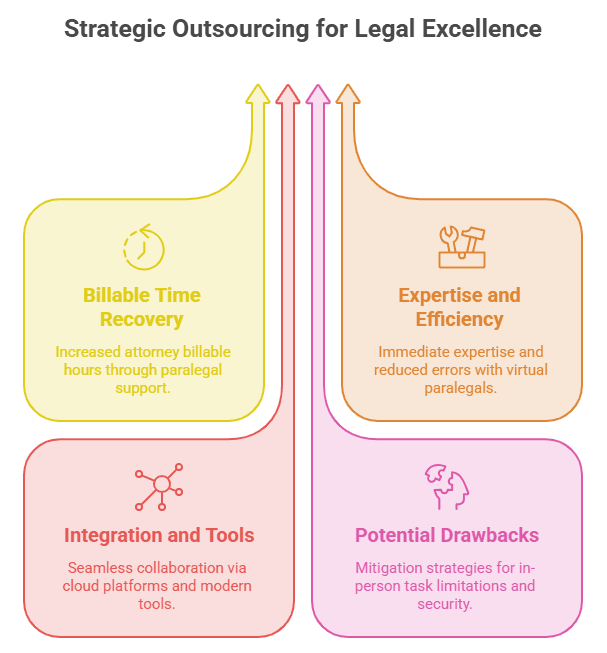
Evaluating paralegal support extends well beyond direct expense comparisons to encompass overall contributions to firm efficiency, output quality, and long-term financial returns. Virtual models often enhance these areas by providing specialized skills on demand and minimizing non-productive overhead. This broader perspective reveals why many practices achieve superior results through strategic outsourcing of legal support functions.
1. Billable Time Recovery
Attorneys average only 2–3 billable hours per day in many firms, with much time lost to admin tasks. A virtual paralegal handling case management or research frees attorneys for higher-value work, often generating $250–$350+/hour in recovered billables.
This time, reclamation directly boosts revenue potential without corresponding increases in fixed staffing costs. The resulting productivity gains compound over time as attorneys focus more consistently on client matters and strategic case development.
2. Expertise and Efficiency
Virtual providers often supply experienced professionals (sometimes former in-house staff or specialists) who hit the ground running with minimal training. They bring the best practices from diverse firms.
This immediate expertise accelerates project completion and reduces error rates commonly associated with ramp-up periods for new employees. Firms access targeted skills precisely when needed rather than maintaining broad generalist capabilities year-round.
3. Integration and Tools in 2026
Cloud platforms (Clio, MyCase, etc.) enable seamless collaboration via shared access, Slack/Zoom, and secure portals. Quality matches or exceeds in-house when processes are documented.
Modern technology has largely eliminated traditional barriers to remote work effectiveness in legal environments. Practices leveraging these tools report smooth workflows that rival or surpass conventional office-based arrangements.
4. Potential Drawbacks and Mitigation
Virtual models limit in-person tasks (e.g., physical filings, some client meetings). Hybrid approaches—core in-house plus virtual support—address this effectively for many firms.
Security is managed via NDAs, role-based access, and compliant tools that maintain strict confidentiality standards. Clear communication protocols and documented processes further minimize any potential coordination challenges.
When to Choose Virtual Paralegal Services vs. In-House

Selecting between virtual and in-house paralegal support requires careful assessment of firm-specific needs, workflow patterns, and long-term objectives. Both models deliver valuable contributions when aligned properly with operational realities and growth strategies. The optimal choice often depends on balancing cost efficiency with practical requirements for collaboration and presence.
1. Ideal for Virtual Paralegal
- Fluctuating or project-based workloads where flexible scaling prevents overstaffing during slower periods.
- Solo/small firms seeking virtual paralegal pricing advantages to maintain lean operations while expanding capacity.
- Document review, research, drafting, and case management virtual paralegal needs that suit remote execution effectively.
- Scaling without overhead or testing new practice areas before committing to permanent hires.
2. Ideal for In-House
- High-volume, consistent daily needs with heavy in-person requirements for seamless team integration.
- Firms with strong internal management capacity and stable revenue supporting full-time commitments.
- Culture/integration priorities where physical presence adds value to daily interactions and firm cohesion.
Additional Benefits of Hiring a Virtual Paralegal
Virtual paralegal services offer access to a broader talent pool, faster onboarding (days vs. weeks/months), reduced administrative burden, and improved work-life balance for attorneys. They support case management and virtual paralegal tasks efficiently across time zones.
Firms report higher ROI through flexibility and focus on growth rather than fixed staffing liabilities. This approach enables practices to adapt quickly to market changes while preserving resources for strategic priorities and client service excellence.
How Virtual Assistants Help With Paralegal Services

Virtual assistants specializing in paralegal services bring remote expertise that integrates seamlessly into law firm workflows, helping manage growing caseloads without the overhead of traditional hires. They handle critical support functions efficiently while allowing attorneys to concentrate on core legal responsibilities and client relationships. This approach enhances productivity and provides scalable solutions tailored to individual practice needs.
- Legal Research and Analysis: Virtual assistants conduct thorough case law research, summarize findings, and prepare memos that support stronger legal strategies and faster decision-making.
- Document Drafting and Management: They draft pleadings, contracts, discovery requests, and correspondence while organizing files for easy access and compliance.
- Case Management Support: Assistants track deadlines, update case statuses, coordinate with clients, and maintain accurate records across cloud-based platforms.
- Discovery and Evidence Handling: They assist with document review, indexing, and preparation of trial binders to streamline complex litigation processes.
- Administrative Efficiency: Virtual support includes scheduling, billing assistance, client intake coordination, and general office tasks that reduce attorney workload.
TaskVirtual: Your Partner in Virtual Paralegal Services

Managing complex legal workloads, tight deadlines, and routine administrative tasks can overwhelm law firms and divert focus from high-value client work and strategic advocacy. From case file organization and document drafting to legal research and discovery coordination, these responsibilities demand reliable support without the burden of full-time overhead. TaskVirtual provides expert virtual paralegal services that simplify operations by delivering professional remote assistance tailored to your firm’s caseload and practice areas.
1. Expert Consultation and Review
TaskVirtual’s skilled virtual paralegals assist in selecting optimal support strategies, organizing case workflows, and ensuring precise execution of legal tasks. They also help refine processes for research, drafting, and case management to align with your firm’s procedures and compliance requirements.
2. Affordable and Flexible Pricing
Hiring a full-time personal assistant can be expensive, but TaskVirtual makes it cost-effective. With pricing plans starting from just $3.12/hour to $14.99/hour, their services are budget-friendly and accessible to individuals, families, and businesses.
3. Comprehensive Legal Support Solutions
From drafting documents and organizing discovery materials to conducting legal research and managing case timelines, TaskVirtual covers it all. Their scalable services adapt whether you need occasional project help or consistent ongoing paralegal support for your growing practice.
4. Ongoing Support and Quality Assurance
TaskVirtual goes beyond initial task assignment by offering continuous updates, progress tracking, and deadline reminders. Their proactive support ensures deliverables meet quality standards and integrate seamlessly with your firm’s operations without added stress.
5. Proven Track Record of Excellence
With 364 positive reviews and a 4.7-star rating on trusted VA platforms, TaskVirtual is recognised as a reliable partner worldwide. Clients count on their expertise to simplify legal operations and streamline everyday practice management.
FAQ Section
1. How much does a virtual paralegal cost compared to an in-house one?
Virtual options often total $16k–$50k annually (variable), versus $75k–$110k+ for in-house, delivering substantial savings on benefits and overhead.
2. What tasks can a virtual paralegal handle?
Legal research, document drafting, discovery, case management, client communication support, deposition summaries, and more—nearly anything non-physical.
3. Are virtual paralegals as reliable as in-house staff?
Yes, when vetted properly. Many are highly experienced professionals using secure tools; clear processes ensure quality.
4. What is typical virtual paralegal pricing?
$25–$75/hour, or $1k–$3k/month retainers. Offshore/hybrid models can be lower while maintaining standards.
5. Can small firms benefit from virtual paralegal services?
Absolutely—many solos and small practices use them to scale affordably without full-time commitments.
6. How do I hire a virtual paralegal?
Research providers, review references/samples, start with a trial project or retainer, and define clear SOPs for integration.
Conclusion
The virtual paralegal vs in-house paralegal cost comparison clearly favors virtual options for most modern law firms seeking efficiency, scalability, and profitability in 2026. By reducing fixed costs, eliminating overhead, and enabling flexible virtual paralegal services, firms reclaim attorney time for billable work while controlling expenses. Whether through full outsourcing, hybrid models, or targeted hire virtual paralegal support for case management and virtual paralegal needs, the strategic shift delivers measurable ROI.
Choosing between virtual and in-house support involves more than comparing hourly rates with salaries; firms should also consider supervision, technology, utilization, security, and workload flexibility. These factors are central when evaluating virtual assistant support for lawyers as part of a firm’s staffing model.
Evaluate your firm’s workload, budget, and growth goals. Many are transitioning successfully and seeing transformed operations.
Ready to explore savings? Contact a reputable virtual paralegal provider today for a consultation or cost analysis tailored to your practice. Optimize with virtual paralegal pricing that fits your needs and propel your firm forward.
Sources
- U.S. Bureau of Labor Statistics (BLS) Occupational Outlook Handbook
- Industry analyses from ParalegalAssistants.com, TheVirtualParalegal.com, RegentsRS.com, and others are referenced
- Additional data from Clio Legal Trends and related reports
For more such content, visit our website.
 Siddhartha Basu is a Technical Writer at Task Virtual. He loves online games, e-book reading, and Yoga.