

Contents
show
What Is a Virtual Support Assistant and What Do They Do?
American companies continue to balance rising customer expectations with the need for efficient, flexible support operations. A virtual support assistant has become a practical solution for many U.S. businesses seeking remote professionals who handle customer inquiries, resolve issues, and manage related administrative work without the full overhead of traditional in-house staffing.
In 2026, these roles sit between pure AI automation and full-time office teams. According to the U.S. Bureau of Labor Statistics, customer service representatives held about 2.8 million jobs in 2024 with a median annual wage of $42,830, yet the occupation faces a projected 5% decline through 2034 as automation and remote models reshape the field. At the same time, the global virtual assistant services market reached roughly $19.5 billion in 2025 and is forecast to grow to $55.4 billion by 2035 at an 11% CAGR. Understanding what a virtual support assistant does helps business owners decide whether this model fits their support needs.
What Is a Virtual Support Assistant?
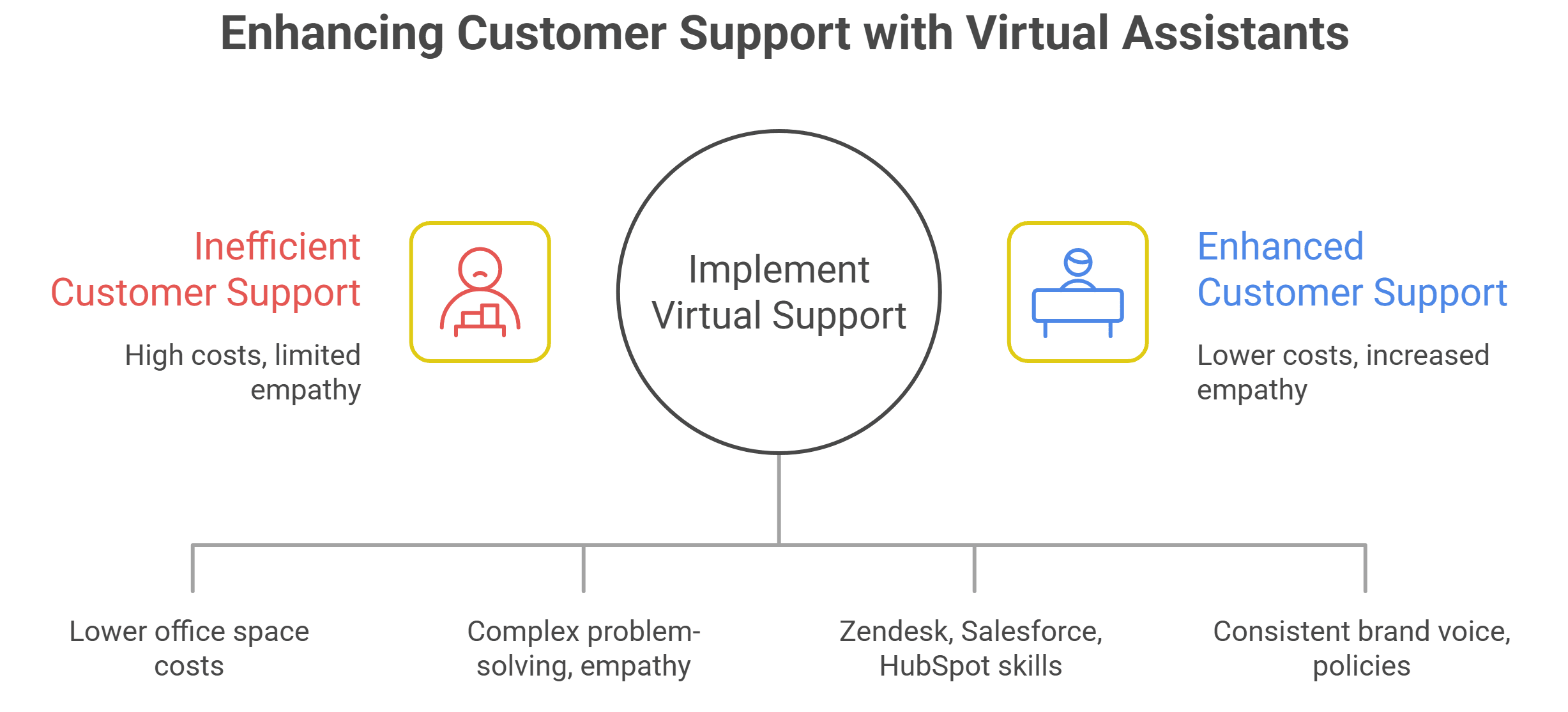
A virtual support assistant is a remote professional who delivers customer-facing and operational support through digital channels such as email, live chat, VoIP phone, CRM systems, and collaboration tools. These assistants work from home offices or remote locations, focusing on resolving inquiries, managing tickets, updating customer records, and handling related administrative tasks while representing the company’s brand voice and policies.
1. Key Distinctions from Related Roles
Virtual support assistants differ from in-house customer service representatives mainly by working remotely and often as contractors, which lowers costs related to office space and benefits. They stand apart from AI chatbots by providing human judgment, empathy, and complex problem-solving that software cannot fully replicate—Gartner research notes that 87% of customers expect access to a human agent even when generative AI is used. Compared with general virtual assistants, their primary strategy for customer support differs from pure administrative or executive tasks, and they typically offer stronger cultural alignment for U.S. audiences than many offshore call-center options.
2. Core Skills and Qualifications
Effective virtual support assistants combine clear written and verbal communication with solid technical proficiency in common platforms such as Zendesk, Salesforce, HubSpot, and Microsoft Teams. They need strong multitasking ability, emotional intelligence for de-escalating frustrated customers, attention to detail when documenting interactions, and the capacity to follow brand guidelines consistently. The World Economic Forum reports that 44% of workers’ core skills will be disrupted by 2027, highlighting the need for adaptable digital and human-centered capabilities. Most hold at least a high school diploma, while many bring specialized industry experience in retail, healthcare, technology, or professional services.
Primary Duties and Responsibilities of a Virtual Support Assistant
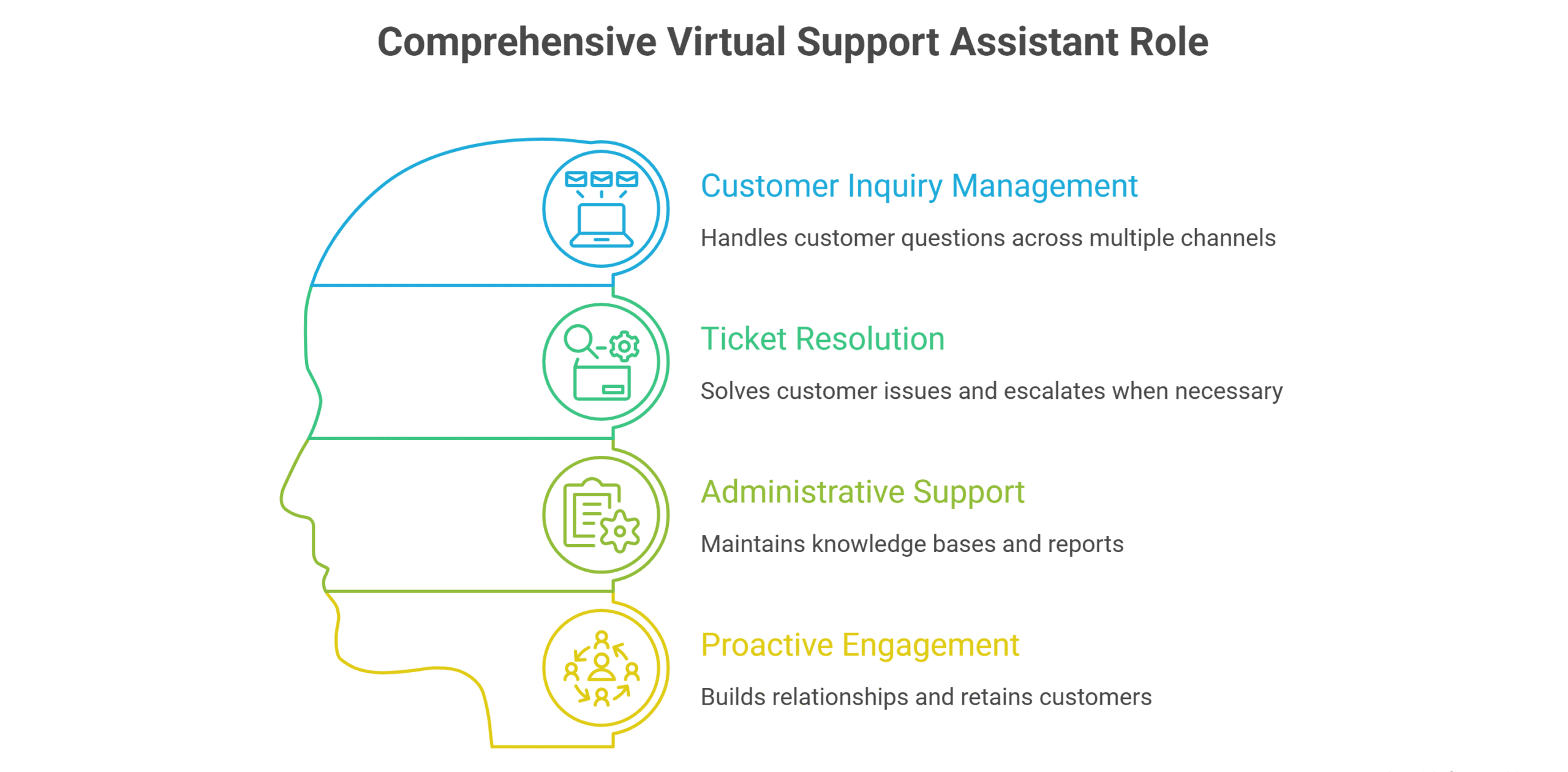
Virtual support assistants spend their days solving real customer problems and keeping internal processes running smoothly. Their responsibilities adapt to the client’s industry, volume, and preferred channels, yet several core functions appear consistently. Clear documentation and adherence to company policies remain essential across every task.
1. Customer Inquiry Management Across Channels
Virtual support assistants respond to customer questions that arrive by email, live chat, social media messages, and phone. They triage incoming tickets, supply accurate product or service information, process returns or refunds according to policy, update order statuses, and record every interaction in the CRM so the full history stays available. Consistency of tone and brand voice matters because each reply shapes the customer’s perception of the company.
In e-commerce or subscription environments, the volume can be high, requiring the assistant to coordinate with warehouses, shipping partners, or billing systems while maintaining response-time targets. They also handle routine account updates and status checks, freeing specialized staff for more complex work and ensuring customers receive timely answers across the channels they prefer.
2. Ticket Resolution and Escalation Handling
When a customer issue exceeds standard scripts—technical troubleshooting, billing disputes outside policy, or emotionally charged complaints – the virtual support assistant gathers complete details, attempts resolution within their authority, and prepares a clean handoff if escalation is required. They document the steps already taken so the next team member does not force the customer to repeat information.
Follow-up remains part of the process. Assistants check that escalated cases reach final resolution and that the customer receives confirmation. This disciplined approach reduces repeat contacts, improves first-contact resolution rates, and protects overall satisfaction scores.
3. Administrative and Backend Support Tasks
Beyond direct customer contact, many virtual support assistants maintain knowledge bases, prepare daily or weekly support metrics reports, schedule follow-up calls, correct simple data-entry errors in order records, and keep digital files organized. These backend activities create the accurate information foundation that both human agents and AI tools rely on.
By handling these supporting duties, the assistant prevents small administrative gaps from becoming larger service failures. Regular updates to internal documentation also help new team members or automated systems deliver consistent answers over time.
4. Proactive Customer Engagement and Retention Efforts
Some virtual support assistants move beyond reactive tickets to outbound check-ins after purchases, invitations to complete feedback surveys, or outreach about loyalty programs. They watch interaction patterns for early signs of dissatisfaction and flag at-risk accounts for retention efforts.
This proactive layer turns routine support into a relationship-building function. When executed carefully, it contributes to higher repeat-purchase rates and stronger long-term customer loyalty without requiring additional full-time headcount.
Benefits of Hiring a Virtual Support Assistant for US Businesses

U.S. companies face persistent pressure to control support costs while meeting rising customer expectations for speed and personalization. Virtual support assistants address both challenges by combining remote flexibility with human judgment. The model has matured alongside remote-work norms and AI adoption, giving businesses a practical middle path between full in-house teams and pure automation.
1. Significant Cost Savings Without Sacrificing Quality
- Eliminates expenses for office space, equipment, and many traditional benefits packages associated with full-time employees.
- Reduces overall labor costs compared with equivalent in-house customer service roles while still delivering professional service.
- Allows companies to pay only for needed hours or projects rather than carrying fixed full-time overhead year-round.
- Frees budget that can be redirected toward product development, marketing, or higher-value internal roles.
- Maintains service quality through clear key performance metrics and documented processes rather than relying solely on physical presence.
2. Scalability and Flexibility for Fluctuating Demand
- Supports rapid increases in coverage during seasonal peaks, product launches, or promotional campaigns.
- Enables quick reduction of hours when volume drops, avoiding the cost of idle full-time staff.
- Allows businesses to test new channels or extended hours without long-term hiring commitments.
- Provides coverage across multiple time zones more easily than a single local office team.
- Adapts to sudden changes in demand caused by market shifts or unexpected events.
3. Access to Broader Talent Pools and Specialized Expertise
- Opens hiring to skilled professionals across the United States and compatible time zones who prefer remote work.
- Makes specialized knowledge in healthcare, technology, retail, or regulated industries available without relocation.
- Leverages the large pool of experienced remote workers already comfortable with digital collaboration tools.
- Supports a diversity of backgrounds and perspectives that can improve problem-solving for varied customer bases.
- Reduces geographic constraints that traditionally limited the available talent for support roles.
4. Improved Focus for Core Teams
- Shifts routine ticket handling and administrative load away from higher-paid specialists and managers.
- Allows internal staff to concentrate on complex technical issues, strategic accounts, and product improvement.
- Reduces the daily interruption volume that fragments in-house employees’ focus.
- Creates clearer role boundaries that improve overall team productivity and job satisfaction.
- Supports better prioritization of work that directly drives revenue or innovation.
5. Enhanced Customer Experience Through Consistent Coverage
- Delivers faster average response times through dedicated remote capacity that can span extended hours.
- Maintains reliable follow-through on tickets even when internal teams face competing priorities.
- Provides consistent brand voice and policy application across every customer interaction.
- Improves satisfaction metrics that influence online reviews, repeat purchases, and referrals.
- Combines human empathy with structured processes to resolve issues that pure automation cannot handle alone.
How Virtual Support Assistants Integrate with AI and Technology
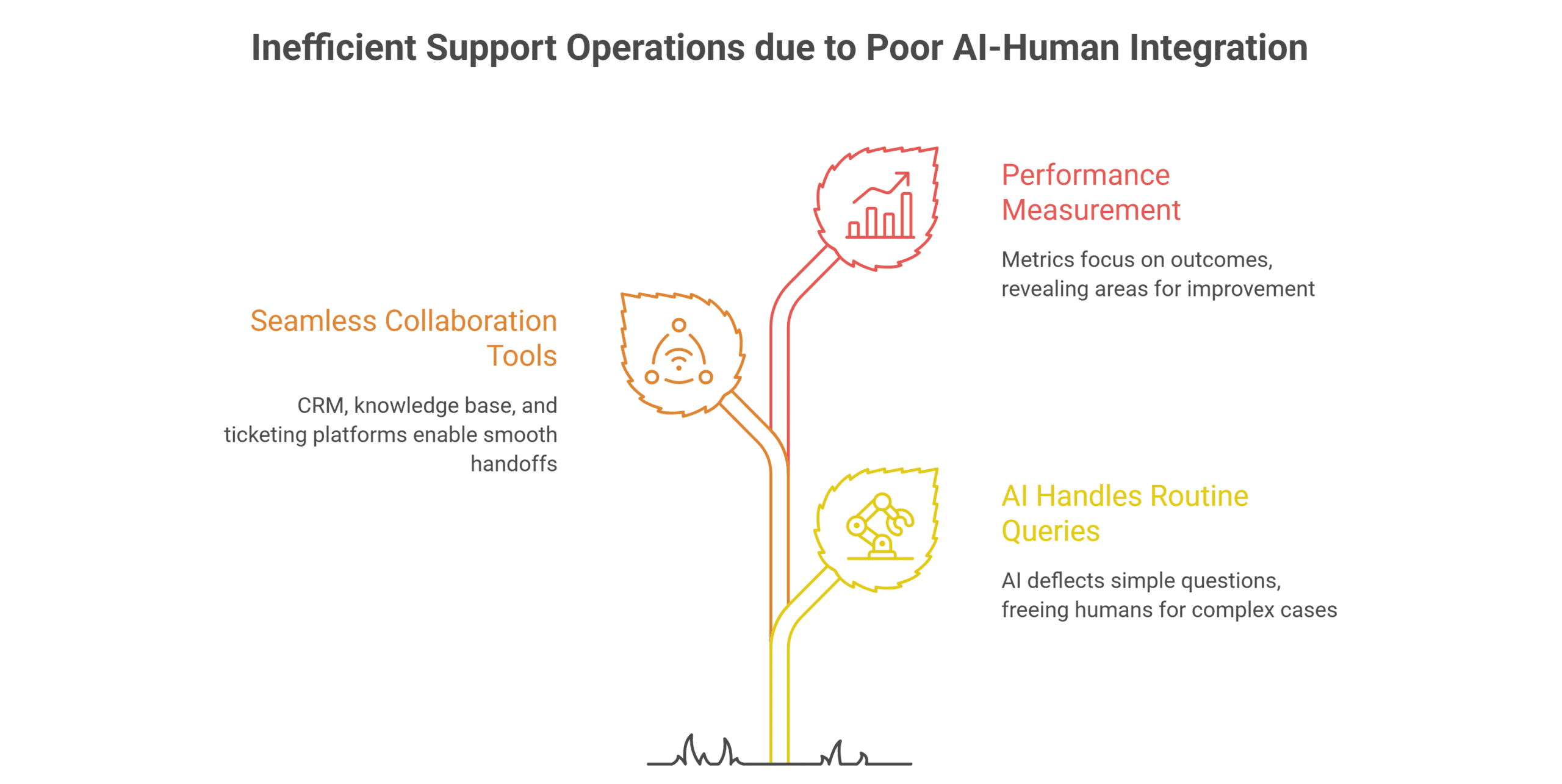
Modern support operations rarely rely on either humans or AI alone. The strongest results come from a deliberate combination of both. Virtual support assistants handle the judgment-intensive cases that technology routes to them, while AI systems manage high-volume routine questions. This hybrid approach has become the practical standard for many U.S. businesses in 2026.
1. AI Handles Routine Queries; Humans Manage Complexity
Intelligent virtual assistants and generative AI tools deflect simple, repetitive questions—order tracking, password resets, basic product FAQs—around the clock and without fatigue. McKinsey research indicates that 88% of organizations now use AI in at least one business function, and customer service ranks among the most common applications. When a query requires empathy, multi-step reasoning, or policy exceptions, the system hands the conversation to a virtual support assistant who already possesses the interaction history.
This division of labor improves both speed and quality. Customers receive immediate answers for straightforward needs and skilled human attention for more difficult situations. The virtual support assistant spends less time on repetitive work and more time on cases that benefit from real judgment and relationship skills.
2. Tools and Platforms That Enable Seamless Collaboration
Virtual support assistants work inside the same CRM, knowledge base, and ticketing platforms used by internal teams. These systems often surface AI-generated suggestions, AI workflow automation, and real-time coaching that help the human agent respond faster and more accurately. Secure remote access, VPN connections, and compliance tools protect sensitive customer data while enabling work from any location.
Shared dashboards and collaboration software keep everyone aligned on priorities, open tickets, and performance trends. When the technology stack is well configured, handoffs between AI and humans feel continuous rather than fragmented to the customer.
3. Measuring Performance in a Hybrid Model
Success metrics focus on outcomes that matter to customers and the business: first-response time, resolution rate, customer satisfaction scores, and escalation volume. Virtual support assistants are evaluated on the quality of the cases they handle rather than raw ticket count alone. Regular reviews of AI containment rates alongside human performance data reveal where processes or training need adjustment.
Transparent measurement builds accountability and continuous improvement. Teams that track both automation efficiency and human contribution gain a clearer picture of overall support health and can refine the balance over time.
Hiring and Managing a Virtual Support Assistant Successfully

Bringing a virtual support assistant on board works best when expectations, processes, and communication are defined early. Many companies achieve strong results by treating the role as an integrated extension of the team rather than a pure vendor relationship. Careful selection and structured management reduce the risk of misalignment.
1. Defining Scope and Success Metrics Up Front
- Document exact responsibilities, preferred channels, and the types of issues the assistant will own.
- Set clear authority limits for refunds, credits, or policy exceptions so decisions stay consistent.
- Establish measurable targets for response time, resolution rate, and customer satisfaction.
- Clarify reporting cadence and the tools that will be used to track performance.
2. Sourcing Channels and Vetting Practices
- Evaluate specialized virtual assistant agencies that pre-screen candidates for remote experience and communication skills.
- Use freelance platforms with robust review systems and skills testing features when seeking independent talent.
- Request sample ticket responses or conduct role-play scenarios to assess real-world capability.
- Check references focused on reliability, remote collaboration, and industry-relevant experience.
3. Onboarding, Training, and Communication Rhythms
- Provide immediate access to brand guidelines, product knowledge, CRM campaign management, and escalation protocols.
- Schedule frequent early check-ins that gradually shift to a sustainable weekly or bi-weekly rhythm.
- Use shared dashboards so both parties can see volume, quality metrics, and open items in real time.
- Encourage questions and feedback during the first weeks to surface gaps before they affect customers.
4. Common Pitfalls to Avoid
- Launching the relationship with vague role descriptions that lead to mismatched expectations.
- Delaying system access or incomplete knowledge-base materials that slow early performance.
- Treating the assistant as a pure transactional vendor instead of a collaborative team member.
- Skipping regular performance conversations that allow small issues to grow into larger problems.
The Future of Virtual Support Assistants in 2026 and Beyond
Several forces will shape the role over the coming years. AI will continue absorbing the simplest tasks, pushing virtual support assistants toward higher-complexity work that demands emotional intelligence and cross-functional knowledge. Demand for specialized support—medical billing coordination, technical product support, or regulated-industry compliance – will grow. McKinsey reports that 88% of organizations now use AI in at least one business function, accelerating the shift toward human-AI collaboration models.
Remote and hybrid work preferences remain strong among U.S. workers. Businesses that master the human-plus-AI model will gain competitive advantages in both cost structure and customer loyalty. Regulatory attention to data privacy and AI transparency may increase documentation requirements, making organized virtual support assistants even more valuable.
Companies that invest early in well-trained virtual support talent, robust processes, and thoughtful AI integration will be best positioned to deliver the responsive, human-centered experiences American consumers continue to expect.
TaskVirtual: Your Partner in Virtual Support Assistance

Managing customer inquiries, ticket resolution, and daily support operations can quickly become overwhelming for growing U.S. businesses. From monitoring multiple channels to ensuring timely responses and consistent brand representation, these responsibilities often pull focus from core strategic work. TaskVirtual delivers specialized virtual support assistant services that streamline customer interactions, handle escalations, and keep your support processes running smoothly so your team can concentrate on higher-value priorities.
1. Expert Support Consultation and Review
TaskVirtual’s experienced virtual support assistants help evaluate your current ticket flow, recommend the most effective channels and CRM setups, and refine response protocols. They assist with organizing knowledge bases, establishing clear escalation paths, and aligning every interaction with your brand voice so customers receive accurate, empathetic help every time.
2. Affordable and Flexible Pricing
Hiring a full-time in-house support specialist can be costly, but TaskVirtual keeps the solution accessible. With pricing plans starting from just $3.12/hour to $14.99/hour, their virtual support assistant services remain budget-friendly and scalable for startups, small businesses, and larger teams alike.
3. Comprehensive Virtual Support Solutions
From managing multi-channel inquiries and resolving complex tickets to handling administrative backend tasks and proactive customer outreach, TaskVirtual covers the full spectrum of support needs. Their services scale easily whether you require part-time coverage during peak periods or consistent daily assistance across email, chat, and phone.
4. Ongoing Support and Quality Assurance
TaskVirtual goes beyond initial ticket handling by providing regular performance updates, response-time monitoring, and continuous process improvements. Their proactive approach ensures issues are resolved efficiently, follow-ups are completed, and your customer satisfaction metrics stay strong without added internal strain.
5. Proven Track Record of Excellence
With 364 positive reviews and a 4.7-star rating on trusted VA platforms, TaskVirtual is recognized as a reliable partner worldwide. Clients rely on their expertise to strengthen customer support operations and deliver consistent, high-quality service at a fraction of traditional staffing costs.
FAQ:
1. What is the difference between a virtual support assistant and a regular virtual assistant?
A virtual support assistant focuses primarily on customer-facing tasks such as inquiry resolution, ticket management, and service recovery. A general virtual assistant often handles broader administrative duties like scheduling, email management, or research that may not involve direct customer contact.
2. How much does a virtual support assistant typically cost for a US company?
Costs vary by experience, location, and engagement model (freelancer vs. agency). Many businesses achieve substantial savings compared with full-time in-house salaries plus benefits, though exact rates depend on specialization and hours required.
3. Can a virtual support assistant replace an entire customer service team?
For small businesses with moderate volume, one or more virtual support assistants can cover core needs. Larger organizations usually combine them with AI tools and a smaller in-house specialist team for complex or high-stakes issues.
4. What industries benefit most from virtual support assistants?
E-commerce, SaaS, professional services, healthcare administration, real estate, and subscription businesses see strong returns because of high inquiry volumes and the need for flexible coverage.
5. Do virtual support assistants work only during standard business hours?
Many arrangements offer extended or staggered coverage to match customer time zones or peak demand periods. Availability is negotiated based on the client’s requirements.
6. How do I measure the success of a virtual support assistant?
Track response times, resolution rates, CSAT or NPS scores, escalation frequency, and qualitative feedback from both customers and internal stakeholders. Regular performance reviews keep the partnership aligned.
Conclusion + CTA
A virtual support assistant offers U.S. businesses a flexible way to deliver responsive customer support while controlling costs and complementing AI tools. By handling complex inquiries, administrative work, and proactive engagement, these remote professionals free internal teams for higher-value activities and help maintain the human touch customers still value.
Evaluate your current support volume and identify processes that could shift to a skilled virtual support assistant. Clear scope, strong onboarding, and regular measurement usually produce visible improvements within the first weeks. Start the conversation with reputable providers or platforms that understand your industry, and build the hybrid support model that fits your goals.
Sources
- U.S. Bureau of Labor Statistics, Customer Service Representatives Occupational Outlook: https://www.bls.gov/ooh/office-and-administrative-support/customer-service-representatives.htm
- U.S. Bureau of Labor Statistics, Secretaries and Administrative Assistants Occupational Outlook: https://www.bls.gov/ooh/office-and-administrative-support/secretaries-and-administrative-assistants.htm
- Future Market Insights, Virtual Assistant Services Market: https://www.futuremarketinsights.com/reports/virtual-assistant-services-market
- Pew Research Center, Remote workers’ views of returning to office (2025): https://www.pewresearch.org/short-reads/2025/01/13/many-remote-workers-say-theyd-be-likely-to-leave-their-job-if-they-could-no-longer-work-from-home/
- Gartner, Survey on GenAI and human agent access in customer service (2026): https://www.gartner.com/en/newsroom/press-releases/2026-08-04-gartner-survey-finds-87-percent-of-customers-say-companies-using-genai-for-customer-service-must-provide-access-to-a-human-agent0
- McKinsey & Company, The State of AI (2025): https://www.mckinsey.com/capabilities/quantumblack/our-insights/the-state-of-ai
For more such content, visit our website.
 Siddhartha Basu is a Technical Writer at Task Virtual. He loves online games, e-book reading, and Yoga.