Contents
show
How to Scale Operations Without Hiring a Full-Time Team
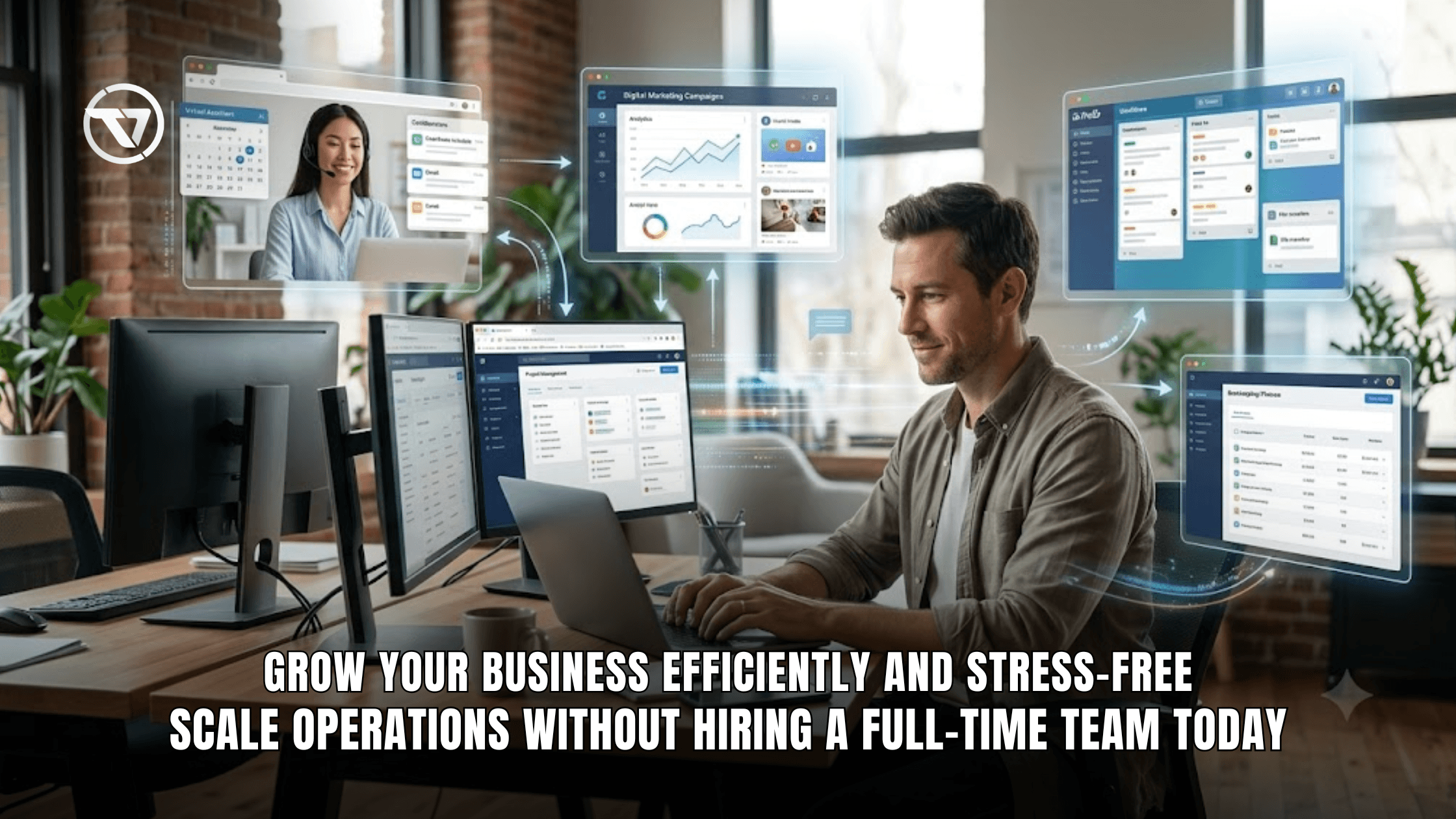
Growth feels exciting until the operational drag sets in. Orders pile up, customer requests multiply, and specialized tasks overwhelm the core team. Yet the traditional response—hiring full-time employees—often creates more problems than it solves: high fixed costs, lengthy recruitment cycles, and rigid headcount that cannot flex with demand. In 2026, American founders and operators increasingly choose a different path: building scalable operations through flexible talent, contractors, and systems that expand capacity without permanent payroll commitments. This approach lets businesses scale operations without hiring a full-time team while maintaining quality, controlling costs, and preserving agility. Adding targeted support, such as a Virtual Assistant for routine coordination, can free founders to focus on strategy rather than daily triage.
The following guide addresses the commercial investigation intent of decision-makers evaluating how to grow efficiently, with particular attention to capacity planning across fluctuating demand and multiple specialisms—the gap most competitor content overlooks. As flexible workforce models become increasingly integrated into modern business operations, more than one in four (28%) U.S. knowledge workers now freelance or work independently, reflecting the growing adoption of external expertise to support changing business needs. By blending core staff with external expertise in areas like Digital Marketing and beyond, companies achieve resilient growth that adapts to real-world volatility without the burden of permanent headcount expansion.
Growth Creates Operational Drag
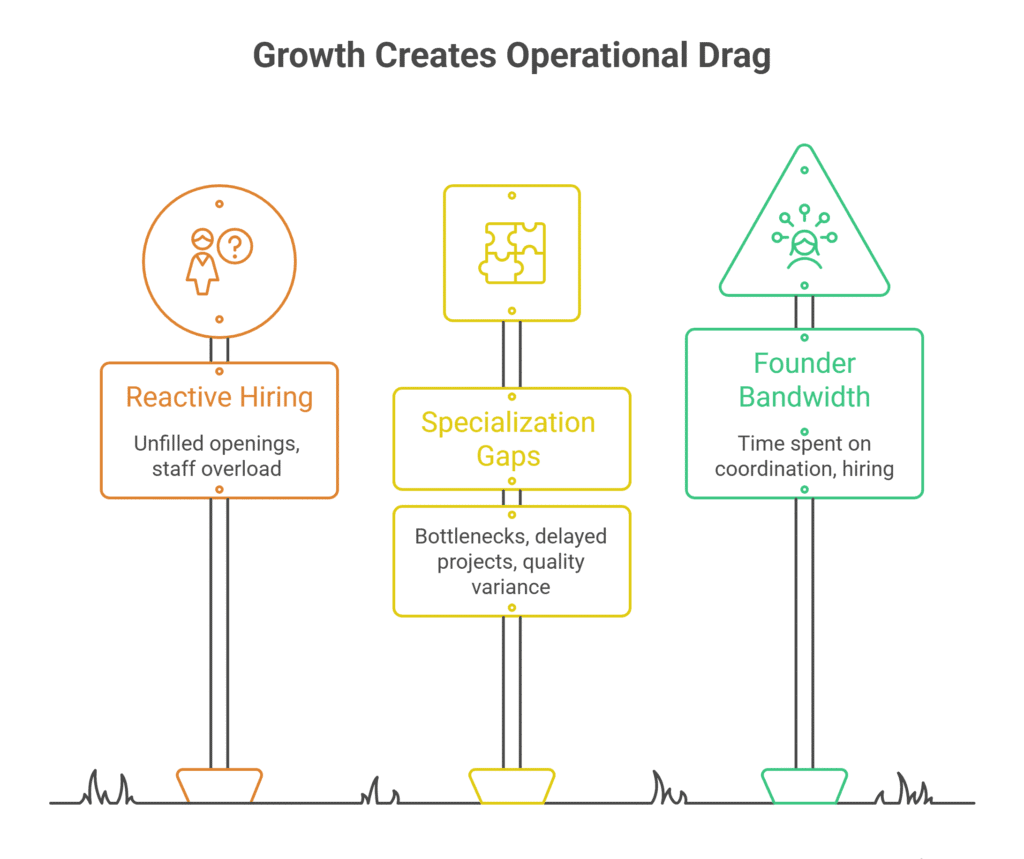
Rapid revenue growth rarely translates into smooth operations. Instead, it generates friction that slows delivery, erodes margins, and burns out founders and early employees. Small businesses account for nearly half of U.S. private-sector employment and most net new jobs, yet many struggle to turn top-line gains into sustainable capacity.
1. The Hidden Cost of Reactive Hiring
When demand spikes, the instinct is to post job openings. National Federation of Independent Business data consistently shows that roughly 30 percent of small business owners report unfilled openings in any given month, with a large share of those attempting to hire finding few or no qualified applicants. The average time-to-fill stretches weeks or months, during which existing staff absorb extra work.
Direct recruiting costs alone average several thousand dollars per hire according to industry benchmarking, while the fully loaded first-year cost of a mid-level employee – including payroll taxes, benefits, equipment, and productivity ramp-up – frequently exceeds 1.3–1.5 times base salary. Bureau of Labor Statistics figures put total employer compensation costs for private-industry workers near $46–48 per hour worked, with benefits comprising about 30 percent of that total. These fixed obligations lock capital into roles that may become underutilized when demand softens. A Personal Assistant engaged on a flexible basis can handle scheduling and administrative overflow during these transitions, preventing the cascade of delays that reactive full-time hiring often fails to solve quickly.
2. Specialization Gaps Amplify Drag
Growth rarely arrives as uniform volume. A product company may need temporary surge capacity in fulfillment, customer support, content, and data analysis simultaneously. Full-time hires optimized for one specialism leave other areas uncovered. The result is bottlenecks, delayed projects, and quality variance. Many growing firms report that reaching customers and managing rising costs remain top operational challenges even as hiring difficulties persist, according to Federal Reserve Small Business Credit Survey findings. Facebook Marketing & Ads expertise brought in on a project basis often closes these gaps faster than waiting for a permanent marketer who may lack depth in every required channel.
When multiple specialisms collide under growth pressure, the absence of elastic support compounds the problem. Teams stretched across unrelated domains experience higher error rates and slower iteration cycles. Instagram Marketing & Ads specialists available as needed allow operators to test and refine campaigns without committing to year-round payroll, preserving both quality and cash runway while the core team stays focused on product and customer relationships.
3. Founder Bandwidth Becomes the Limiting Factor
In early-stage and mid-market companies, founders and senior operators spend disproportionate time on coordination, hiring, and firefighting. This opportunity cost compounds: every hour spent managing recruitment or onboarding is an hour not spent on product, sales, or strategy. Operational drag is therefore not merely a staffing shortage—it is a structural mismatch between fixed capacity and variable, multi-specialism demand. LinkedIn Marketing & Ads support contracted for targeted campaigns can reclaim founder hours that would otherwise disappear into platform management and content calendars.
Without deliberate capacity design, founders become the bottleneck themselves. Delegating discrete high-value tasks such as Video Editing Services to external specialists restores bandwidth for leadership decisions that actually drive the next stage of growth. The alternative—absorbing every new requirement internally—accelerates burnout and slows the very expansion the business is pursuing.
Capacity Triggers

Clear signals tell operators when additional capacity is required and in what form. Relying solely on gut feel leads to either chronic under-resourcing or premature fixed hiring. Establishing explicit triggers creates a repeatable decision framework that matches resources to actual need.
1. Demand Volatility Signals
- Track order velocity and support ticket volume as leading indicators of rising workload.
- Monitor project pipeline conversion rates for early signs of sustained demand increases.
- Watch seasonal patterns and backlog growth over four-to-six-week windows.
- Treat a consistent 20–30 percent workload rise paired with declining response times as a firm capacity trigger, often best met through online Marketing Services rather than permanent roles.
2. Skill and Specialism Bottlenecks
- Map current team capabilities against the pipeline of upcoming work.
- Identify when a single critical skill becomes the constraint across multiple projects.
- Prioritize external capacity for specialized domains that appear repeatedly but not continuously.
- Engage Social Media Marketing expertise on demand when content and engagement volume exceeds internal bandwidth, avoiding the lag of full-time recruitment.
3. Financial and Risk Thresholds
- Define maximum acceptable cost-per-unit of output before adding fixed payroll.
- Calculate the cash-runway impact of each potential full-time hire.
- Set quality and delivery-risk tolerance levels that trigger flexible alternatives.
- Prefer variable arrangements when work is project-based, converting labor-cost risk into controllable expense through targeted SEO Services or similar specialized support.
Variable-Capacity Model
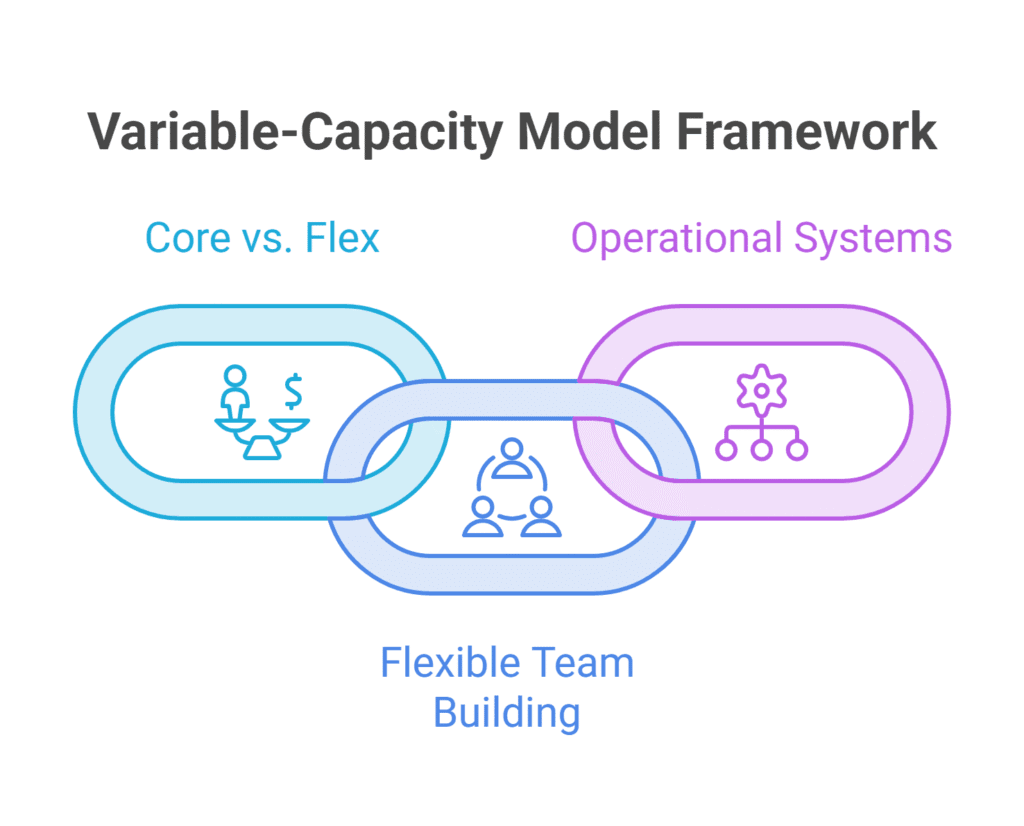
The variable-capacity model treats labor as an elastic resource rather than a fixed asset. It combines core full-time talent for mission-critical, high-context work with flexible specialists, contractors, and fractional operators for everything else. This structure is central to scalable operations and allows companies to scale business without employees in the traditional sense for large portions of their activity.
1. Core vs. Flex Distinction
Identify roles that require deep institutional knowledge, long-term relationship ownership, or continuous decision-making authority—these stay full-time. Everything that is project-based, specialized, seasonal, or capable of clear deliverables can move to flexible arrangements. Many post-2020 small businesses already operate with higher contractor-to-employee ratios than earlier cohorts, reflecting this deliberate design. Website Design Services engaged for specific launches or redesigns exemplify the flex side of the model, delivering high-impact output without permanent overhead.
2. Building a Flexible Team for Growing Business
A practical flexible team includes on-demand specialists accessed through platforms or trusted networks for discrete projects, fractional executives or operators who provide senior expertise part-time, retainer-based contractors for recurring but variable workloads such as support, content, bookkeeping, and design, and temporary or project teams for surges. This model is increasingly adopted by businesses seeking specialized capabilities, with 85% of companies that hire freelancers reporting that independent professionals help them access specialized skills or expertise. Companies that treat contractors as core contributors rather than temporary stopgaps can scale teams up or down more efficiently while integrating expertise such as Website Development exactly when product or client needs demand it.
3. Systems That Make Variable Capacity Work
Success depends less on finding talent than on operating systems: clear scopes of work, standardized onboarding checklists, shared communication channels, documented processes, and performance dashboards. Without these, flexible talent creates coordination overhead that offsets cost savings. Technology – project management tools, knowledge bases, and lightweight automation—reduces that friction and supports operations for startups at scale, while structured Data Handling protocols ensure external contributors can access and update information securely and efficiently without disrupting internal workflows.
Three Growth Scenarios
Different growth patterns require different capacity responses. Applying a one-size-fits-all hiring strategy fails when demand is lumpy or multi-specialist. Matching the model to the specific shape of growth prevents both wasted cost and missed opportunity.
1. Steady Linear Growth
- Gradually expand the core team while layering flexible capacity for specialized or overflow work.
- Maintain a target ratio such as 60–70 percent full-time core and 30–40 percent flexible, reviewing quarterly.
- Keep institutional knowledge growing without locking in excess fixed cost by using Virtual Receptionist support for rising inquiry volumes.
2. Spiky or Seasonal Demand
- Pre-vet contractor pools or temporary teams that can absorb peaks and release capacity afterward.
- Avoid staffing for peak with full-time employees, which produces idle cost in troughs.
- Still meet peak requirements through elastic arrangements, including IT Support Services during high-volume technology or systems periods.
3. Multi-Specialism Expansion
- Engage multiple specialists in parallel through a flexible network when growth requires simultaneous expertise across domains.
- Compress timelines and test new capabilities before committing to permanent roles.
- Address the capacity-planning gap most conventional advice overlooks by adding Bookkeeping Services on a scalable basis as financial complexity increases alongside operational expansion.
Technology and Process Enablers for Scalable Operations
Variable capacity only delivers results when supported by modern tools and disciplined processes. Small businesses that fully embrace technology platforms report stronger performance and greater optimism about growth. Adoption of generative AI and other digital tools has risen sharply, helping reduce administrative burden and improve coordination across both internal and external contributors.
Workflow and knowledge systems such as centralized project management, shared documentation, and standardized operating procedures allow external contributors to ramp quickly and maintain consistency, while measurement and feedback loops that track output quality, cycle time, cost per deliverable, and contributor reliability turn flexible relationships into reliable capacity rather than opportunistic transactions.
90-Day Plan + KPIs
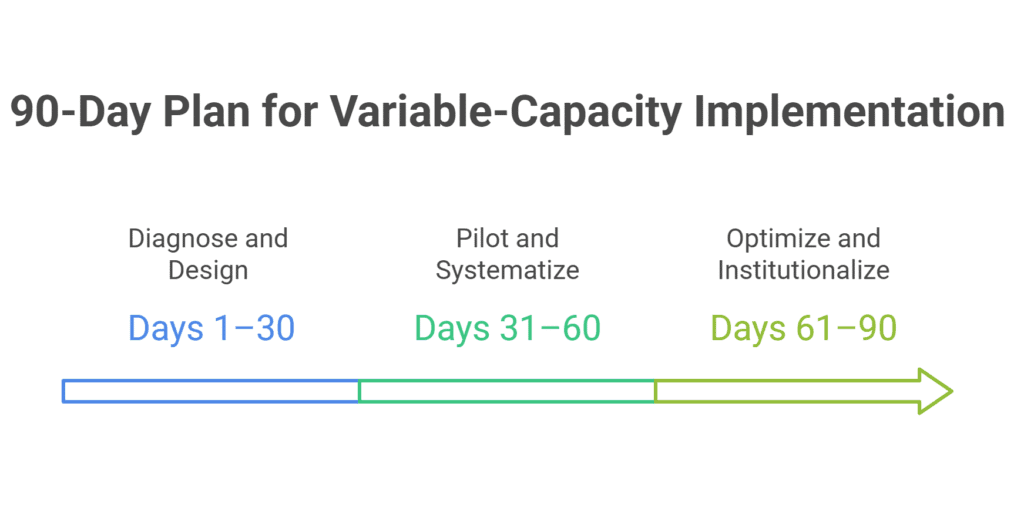
Implementation succeeds when it is staged, measured, and adjusted. The following 90-day sequence converts the variable-capacity concept into operating reality.
Days 1–30: Diagnose and Design
Map current capacity against demand forecasts and skill requirements. Identify the three highest-friction specialisms or volume spikes. Define clear scopes for flexible roles, establish success metrics, and select sourcing channels (platforms, agencies, personal networks, fractional marketplaces). Set baseline KPIs: current cycle times, cost per unit of output, backlog levels, and founder time spent on operational coordination.
Days 31–60: Pilot and Systematize
Engage initial flexible capacity against the highest-priority gaps. Implement onboarding checklists, communication norms, and weekly review cadences. Document what works and what creates friction. Begin building a preferred-contributor roster so future needs can be filled faster.
Days 61–90: Optimize and Institutionalize
Expand successful pilots, retire underperforming arrangements, and formalize the core-versus-flex operating model. Establish quarterly capacity-planning reviews that incorporate demand forecasts and specialism needs. Refine KPIs to include flexible-capacity utilization rate, quality scores relative to internal baselines, total labor cost as a percentage of revenue, and time-to-capacity (days from identified need to productive contributor).
Key ongoing KPIs include:
- Labor cost flexibility ratio (variable spend / total labor spend)
- Delivery cycle time and on-time rate
- Quality defect or revision rate
- Cash-runway impact of capacity decisions
- Founder/operator hours redirected from coordination to growth activities
Regular review against these metrics prevents the model from drifting into unmanaged contractor sprawl or quality erosion.
Risks, Compliance, and Mitigation
Flexible models introduce different risks than traditional employment. Misclassification of workers remains a compliance concern; clear contracts, documented independence, and adherence to IRS and state guidelines are essential. Quality and knowledge continuity can suffer without strong process discipline. Concentration risk arises if too much capacity depends on a small number of external providers. Mitigation includes diversified sourcing, clear SLAs, intellectual-property protections, and periodic internal capability audits to ensure the core team retains critical knowledge.
TaskVirtual: Your Partner in Flexible Operations Capacity

Scaling a business without adding permanent headcount requires reliable external support that expands and contracts with real demand. TaskVirtual delivers outsourced business operations, helping founders and operators offload coordination, specialized tasks, and administrative load so core teams stay focused on growth. Their model aligns directly with variable-capacity strategies by providing skilled remote professionals who integrate into existing workflows without the fixed costs or lengthy onboarding of full-time hires.
1. Expert Capacity Matching and Guidance
TaskVirtual’s experienced professionals help identify where flexible support will produce the greatest impact—whether filling temporary specialism gaps, absorbing volume spikes, or systematizing recurring processes. They assist in scoping clear deliverables, aligning on communication rhythms, and ensuring external contributors ramp quickly into productive roles that protect founder bandwidth.
2. Affordable and Flexible Pricing
Hiring a full-time personal assistant can be expensive, but TaskVirtual makes it cost-effective. With pricing plans starting from just $3.12/hour to $14.99/hour, their services are budget-friendly and accessible to individuals, families, and businesses.
3. End-to-End Operational Support Solutions
From managing project coordination and documentation to supporting multi-channel execution and process standardization, TaskVirtual covers the range of needs that arise during growth. Their scalable engagements adapt whether a company requires short-term surge capacity or ongoing fractional coverage across multiple operational areas.
4. Continuous Alignment and Performance Oversight
TaskVirtual maintains regular check-ins, progress visibility, and proactive adjustments so support stays synchronized with changing priorities. This ongoing quality focus reduces the coordination overhead that often undermines flexible models and keeps delivery standards consistent with internal expectations.
5. Proven Track Record of Excellence
With 364 positive reviews and a 4.7-star rating on trusted VA platforms, TaskVirtual is recognised as a reliable partner worldwide. Clients count on their expertise to simplify complex operational loads and maintain momentum while scaling without permanent headcount expansion.
FAQ
1. How does scaling operations without hiring full-time staff affect company culture?
A well-managed flexible model preserves culture by protecting the core team from overload and burnout while bringing specialized expertise that accelerates results. Clear communication norms and shared tools keep external contributors aligned with values and standards.
2. What is the typical cost savings of a variable-capacity approach?
Savings vary by role and market, but eliminating benefits, payroll taxes, recruiting fees, and idle-time costs often produces 30–50 percent lower fully loaded expense for equivalent output on project or surge work. Exact figures depend on the specific roles and utilization rates.
3. How do I maintain quality with a flexible team?
Define deliverables and acceptance criteria in advance, use short feedback cycles, maintain preferred-contributor lists based on past performance, and invest in process documentation so quality does not rely solely on individual knowledge.
4. When should I convert a flexible role to full-time?
Convert when the work becomes continuous, high-context, and central to competitive advantage, and when the fully loaded cost of a permanent hire is justified by sustained utilization and strategic importance.
5. Are there industries where this model works better?
It is especially effective in professional services, software, digital marketing, e-commerce operations, and any business with project-based or seasonal demand. Capital-intensive or highly regulated continuous operations may require larger core teams.
6. How do I start if my current team is already stretched?
Begin with a single high-friction specialism or a discrete project. Use the first engagement both to deliver immediate relief and to test systems for broader application. Avoid trying to flex everything at once.
Conclusion + CTA
Scaling operations without hiring a full-time team is no longer a stopgap—it is a deliberate operating model that matches capacity to real demand across volume and specialisms. By recognizing operational drag, installing clear capacity triggers, adopting a variable-capacity structure, preparing for different growth scenarios, and executing a disciplined 90-day plan with measurable KPIs, American startups and growing businesses can expand faster, control costs, and protect focus. The companies that treat flexible talent as a strategic system rather than an emergency measure build durable, scalable operations that adapt as markets shift.
Audit your current capacity bottlenecks this week. Identify one specialism or volume spike that could be addressed with flexible support, define the success criteria, and engage the first contributor. The path to scalable growth begins with that deliberate first step.
Sources
- Federal Reserve Banks, 2025 Report on Employer Firms (Small Business Credit Survey)
- National Federation of Independent Business (NFIB) Jobs Reports and Small Business Optimism surveys
- U.S. Bureau of Labor Statistics, Employer Costs for Employee Compensation
- U.S. Small Business Administration, Small Business Profiles and FAQs
- SHRM recruiting benchmarking data
- Statista / related independent workforce estimates
- U.S. Chamber of Commerce technology and small business reports
- Gusto research on contractor usage among small businesses
For more such content, visit our website.
 Siddhartha Basu is a Technical Writer at Task Virtual. He loves online games, e-book reading, and Yoga.