Contents
show
How to Build a Remote Operations Team: Roles, Workflows, and Management Rhythm
Remote work is no longer an experiment. In 2025, nearly 22% of U.S. workers worked from home at least some of the time, according to data analysed by the Federal Reserve Bank of Minneapolis. Gallup’s May 2026 data show that among U.S. employees with remote-capable jobs, 52% work in hybrid arrangements, 26% work exclusively remotely, and 22% work on-site.
Most remote-team advice stays stuck in HR language—culture, engagement, and belonging. Useful, but incomplete for operations. Operations teams need role design, intake rules, routing logic, and a management cadence that surfaces problems early. This guide fills that gap by showing how to map work first, build compact role pods, run manager-led intake, install a weekly operating rhythm, and track the right metrics so a virtual operations team scales without chaos, even when supporting functions such as a Personal Assistant role for executive coverage.
Map Work Before Roles
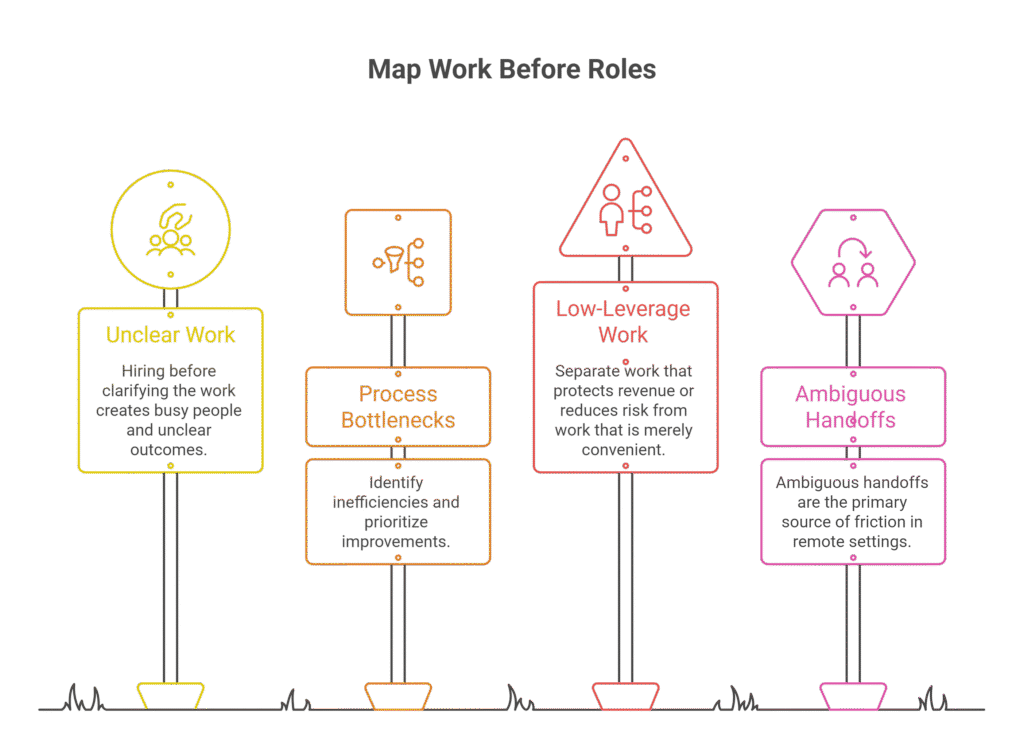
Hiring before clarifying the work creates busy people and unclear outcomes. Many companies jump straight to recruiting and later discover that the new hires are solving the wrong problems or competing for the same unclear tasks. A deliberate mapping exercise prevents that waste. It forces leadership to see the real flow of operational support, the hidden bottlenecks, and the difference between work that protects revenue and work that simply fills time. Once that picture is visible, every subsequent decision about roles, routing, and cadence becomes sharper and more defensible.
1. Inventory current processes and pain points
List the recurring tasks that consume time for founders, department heads, and overloaded generalists, including vendor coordination, invoice processing, customer escalations, project tracking, reporting, compliance checks, and tool administration. Record each task’s volume, frequency, average completion time, owner, and potential cost of delays to identify inefficiencies and prioritize improvements. Process mapping helps businesses visualize workflows, identify bottlenecks, and clarify responsibilities before deciding which tasks to automate, streamline, or delegate. This assessment reveals where a remote operations team or outsourced business operations support can deliver the greatest value, including managing the backend coordination required to keep Digital Marketing campaigns running efficiently.
2. Prioritize high-leverage versus low-leverage work
Separate work that protects revenue or reduces risk from work that is merely convenient. High-leverage items usually include order-to-cash support, customer onboarding handoffs, data hygiene for reporting, and cross-team project coordination. Low-leverage items can often be automated, batched, or eliminated. Focus the first hires on the high-leverage set. Gallup research consistently shows that managers account for 70% of the variance in team engagement; giving them clean processes multiplies their impact when the team also handles execution support for Facebook Marketing & Ads.
3. Document decision rights and handoff points
Write short decision matrices: who can approve spending under a threshold, who owns customer escalations after a certain severity, and who updates the shared dashboard. Ambiguous handoffs are the primary source of friction in remote settings. Clear rights reduce the need for constant Slack check-ins and protect the outsourced operations manager or internal lead from becoming a bottleneck.
Core Role Pods for Growth

A remote operations team succeeds when structure stays compact and intentional. Most growth-stage companies perform best with a small number of focused pods rather than a long list of narrow titles. The design begins with one accountable hub and expands only when measured demand justifies additional capacity.
1. The operations manager as the central hub
- Owns the full intake-to-completion pipeline and sets weekly priorities based on real volume rather than requests that arrive through informal channels.
- Maintains written decision rights so specialists can act without repeated clarification from leadership.
- Protects deep-work blocks for the rest of the team by absorbing most cross-functional coordination and escalation triage.
2. Building the first specialist pods
- Launch with administrative and finance support focused on invoices, vendor follow-ups, and routine compliance tasks.
- Add project and process coordination to track timelines, surface blockers, and keep internal customers informed.
- Include light data and reporting capacity so dashboards stay current and leadership receives reliable numbers without manual chasing.
3. Expanding capacity without adding layers
- Increase hours or headcount inside an existing pod only after cycle times and queue size show sustained pressure.
- Prefer generalists who can later specialize over hiring narrow experts too early.
- Re-evaluate pod boundaries every two quarters so the structure continues to match actual workload patterns.
Manager-Led Intake and Routing
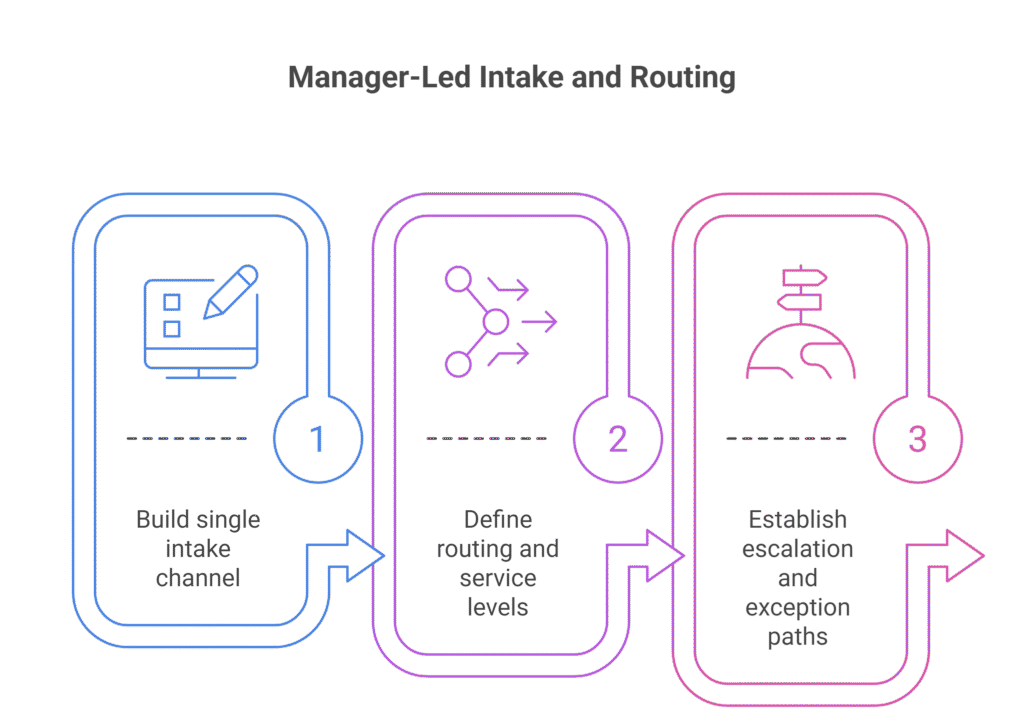
Without a single front door, requests arrive through email, Slack, and hallway or Zoom conversations. Volume rises, priorities blur, and the remote team burns cycles on low-value work. A disciplined intake process turns that chaos into predictable flow and protects specialists from constant context switching.
1. Build a single intake channel
Require every request to enter through a form, shared inbox, or lightweight ticket system that captures requester, urgency, due date, context, and desired outcome. The operations manager reviews the queue daily so nothing falls through informal channels.
2. Define routing rules and service levels
Apply transparent routing rules so routine administrative items reach the admin pod within 24 hours, cross-functional projects reach the coordination pod with a kickoff within 48 hours, and high-severity issues escalate immediately. Publish the service levels so internal customers know what to expect and the system stays consistent while supporting Social Media Marketing coordination needs.
3. Establish escalation and exception paths
Define clear exception paths for requests that fall outside the rules. This keeps the system flexible, ensures the operations manager can pull in founders or department leads only when truly needed, and prevents the team from becoming a bottleneck on edge cases.
Controls and Approval Paths

Effective controls give a remote operations team speed and safety at the same time. When approval paths are vague, either every decision waits for a senior person or important commitments slip through without review. Clear, written rules remove both problems.
1. Spending and commitment thresholds
- Set explicit dollar or risk limits that determine who can approve purchases, contracts, or vendor changes.
- Publish the limits in a single shared document so every team member can check them without asking.
- Review the thresholds quarterly, so they stay realistic as the company grows.
2. Escalation ownership by severity
- Assign named owners for customer or operational issues according to impact level.
- Require a short written brief when an issue moves to the next tier so context is never lost.
- Track how often escalations occur so recurring problems can be fixed at the process level.
3. System and documentation update rights
- Limit who can change shared dashboards, process documents, or core tools.
- Require a brief change log so the team can see what was altered and why.
- Schedule a monthly review of access rights to remove outdated permissions.
Weekly Operating Rhythm
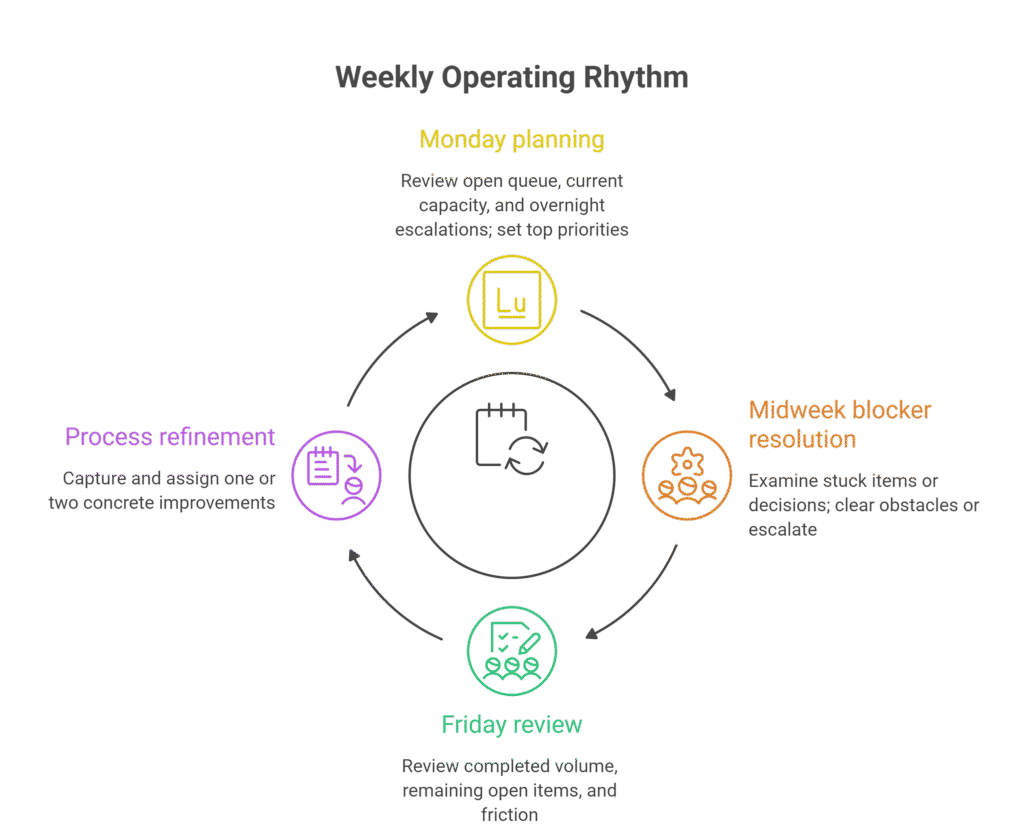
A consistent weekly cadence turns a group of remote contributors into a coordinated operations unit. Without it, priorities drift and small problems compound. The rhythm described below balances planning, execution support, and continuous improvement while remaining light enough to sustain.
1. Monday planning and capacity alignment
The week opens with a short review of the open queue, current capacity across pods, and any overnight escalations. The operations manager issues a brief written summary or holds a twenty-minute call that sets the top priorities. This step prevents the team from starting the week reacting to the loudest request instead of the highest-value work.
2. Midweek blocker resolution
A focused midweek checkpoint examines only items that are stuck or require a decision. Specialists surface obstacles, the manager clears them or escalates, and everyone returns to focused work. Keeping the meeting short protects the deep-work time that remote teams need to deliver consistent throughput.
3. Friday review and process refinement
The week closes with a concise look at completed volume, remaining open items, and any friction that appeared. One or two concrete improvements are captured and assigned. Over successive weeks, this practice steadily removes waste and raises the baseline performance of the entire remote operations function.
Dashboard and Metric Examples
Measurement keeps a remote operations team honest and visible. The goal is a short set of indicators that reveal flow, quality, and capacity without creating surveillance or vanity reporting. Leaders and specialists should look at the same numbers.
1. Throughput and cycle-time indicators
- Track average time from intake to completion for each major request type.
- Monitor total volume closed per pod each week against the published service levels.
- Watch for rising cycle times even when volume is flat, because that signal often points to process friction.
2. Quality and internal customer impact
- Record the rate of rework or corrections required after delivery.
- Collect simple satisfaction scores from internal requestors on closed tickets.
- Count escalations that reach leadership, so systemic issues become visible quickly.
3. Capacity and team health signals
- Maintain a running view of open queue size relative to available hours.
- Note response latency on internal channels as an early indicator of overload.
- Combine quantitative capacity data with occasional qualitative check-ins so burnout risk is caught before performance drops.
Building Trust and Accountability Without Proximity
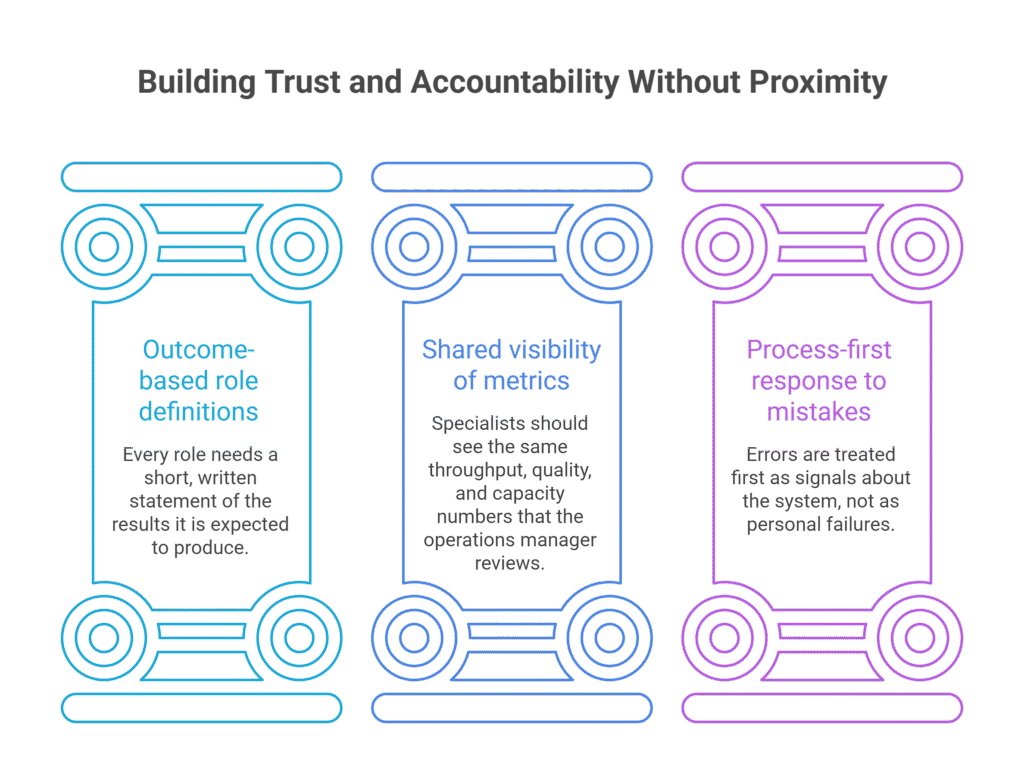
Trust in a remote operations team is built through design, not proximity. Clear outcomes, shared numbers, and consistent follow-through create accountability without surveillance.
1. Outcome-based role definitions
Every role needs a short, written statement of the results it is expected to produce. These outcomes become the reference point for weekly reviews and quarterly conversations. When specialists know exactly what success looks like, they can organize their own time and raise flags early instead of waiting for direction. Managers, in turn, evaluate contribution against the same criteria rather than relying on visible activity or informal impressions. Over time, this clarity reduces both micromanagement and the quiet frustration that appears when expectations stay unspoken.
Specialists should see the same throughput, quality, and capacity numbers that the operations manager reviews. A simple shared dashboard or weekly summary removes the information asymmetry that often undermines remote trust. When the data is open, individuals can spot emerging problems in their own work and correct them before they escalate. It also makes capacity conversations factual rather than emotional, so requests for additional help or scope adjustments rest on evidence instead of perception.
3. Process-first response to mistakes
Errors are treated first as signals about the system, not as personal failures. The initial question is always whether a missing step, unclear handoff, or inadequate tool contributed to the outcome. Only after the process has been examined does the conversation move to individual performance. This sequence protects psychological safety, encourages early reporting of problems, and steadily improves the operating system itself. Teams that adopt it recover faster from setbacks and maintain higher engagement because people know honest mistakes will not be punished before the system is fixed.
Scaling the Team Without Chaos
Growth exposes every weakness in an operating system. Adding people without updating structure, routing, or cadence usually creates more coordination cost than capacity. The practices below keep expansion controlled and reversible.
1. Split pods only when specialization is proven
- Wait for sustained volume data before carving a new specialist seat out of an existing pod.
- Confirm that intake rules can route the new workload cleanly before the split occurs.
- Keep the original pod intact until the new one demonstrates stable throughput.
2. Revisit the work map on a fixed schedule
- Return to the original process inventory every two quarters.
- Remove or automate tasks that no longer justify human effort.
- Adjust pod boundaries so the structure continues to match real demand rather than historical habit.
3. Protect the operating rhythm during expansion
- Keep the Monday–midweek–Friday cadence unchanged even as headcount rises.
- Resist the temptation to add extra status meetings that dilute focus.
- Use the existing review cycle to surface capacity strain early so hiring decisions remain data-driven.
TaskVirtual: Reliable Support for Remote Operations Teams

Building a remote operations team requires more than structure and cadence-it also requires flexible capacity to manage administrative workloads, coordinate cross-functional tasks, and maintain efficient processes without adding full-time headcount too early. Outsourced business operations can help businesses scale efficiently by providing access to trained remote professionals who integrate into existing workflows, manage routine coordination, support specialized execution, and streamline day-to-day operations. TaskVirtual delivers flexible remote talent that helps businesses maintain operational efficiency while allowing internal managers to focus on strategic priorities and higher-value decisions.
1. Skilled remote operations assistance
TaskVirtual professionals step into defined pods and follow existing routing rules, decision matrices, and weekly rhythms. They manage queue intake, track open items, prepare status updates, and execute recurring operational tasks so the core team maintains throughput without constant context switching.
2. Cost-effective capacity that scales with demand
Full-time hires carry fixed overhead that many growth-stage companies prefer to avoid until volume is proven. TaskVirtual offers flexible pricing that begins at $3.12/hour and reaches $14.99/hour, allowing leaders to add or reduce support hours in line with actual queue size and cycle-time data.
3. End-to-end operational task coverage
From maintaining shared dashboards and documenting process changes to coordinating vendor follow-ups and preparing weekly capacity summaries, the service covers the practical work that keeps a remote operations function running. Engagements can start narrow and expand as new pods or higher volume appear.
4. Continuous oversight and process alignment
TaskVirtual teams operate inside the same visibility standards the blog recommends. Regular updates, documented handoffs, and adherence to published service levels ensure that outsourced capacity strengthens rather than fragments the operating system.
5. Established credibility with remote teams
With 364 positive reviews and a 4.7-star rating on trusted virtual-assistant platforms, TaskVirtual has demonstrated consistent performance for organizations that rely on distributed operational support. Clients use the service to stabilize intake, protect manager focus time, and scale capacity without disrupting the weekly rhythm.
FAQ
1. How many people does a remote operations team need to start?
A. Most growth-stage companies begin effectively with one strong operations manager (internal or outsourced) plus one or two specialists. Scale from there based on measured volume, not headcount targets.
2. Should I hire full-time or use an outsourced operations manager?
A. Start with an outsourced or fractional lead if you need speed and proven process templates. Convert or add full-time seats once volume is predictable and company-specific knowledge becomes critical.
3. What tools are essential for a virtual operations team?
A. A shared intake/ticket system, a lightweight project or task board, a simple dashboard (even a well-structured spreadsheet at first), and reliable video plus asynchronous documentation. Tool sprawl is more dangerous than tool scarcity.
4. How do I prevent the operations manager from becoming a bottleneck?
A. Give them clear decision rights, published routing rules, and the authority to push work back when requests lack context. Protect their deep-work blocks so they can design systems rather than only fight fires.
5. How often should the weekly rhythm be adjusted?
A. Review the cadence itself quarterly. Keep the Monday–midweek–Friday skeleton stable; only change meeting length or format when data shows the current version is no longer serving the team.
6. What is the biggest early mistake companies make?
A. Hiring people before mapping the work and defining intake rules. The result is a busy team that still leaves founders and department heads buried in operational detail.
Conclusion and Call to Action
Building a remote operations team is less about finding perfect remote workers and more about designing a lean operating system: map the work, install compact role pods, run manager-led intake, protect a weekly rhythm, and measure the few metrics that matter. When these elements are in place, a virtual operations team becomes a genuine force multiplier for growth rather than another source of coordination overhead.
If your current operational load is still sitting on founders or stretched generalists, start with the work map this week. Clarify the highest-leverage processes, define a single intake path, and decide whether an internal or outsourced operations manager is the right first seat. The companies that treat remote operations as a designed system rather than a collection of remote employees will move faster and with less drama in the years ahead.
Ready to design yours? Map your top ten recurring operational tasks today and identify the single biggest bottleneck. That clarity is the first step toward a high-functioning remote operations team.
Sources
- U.S. Bureau of Labor Statistics, Telework or work at home for pay data and related tables (bls.gov/cps/telework.htm and related Economics Daily releases)
- Gallup Hybrid Work Indicator and workplace research on engagement variance and hybrid arrangements (gallup.com)
- Pew Research Centre analyses of teleworkable jobs and remote work arrangements
- Microsoft Work Trend Index findings on productivity perceptions
- Global Workplace Analytics estimates on employer savings from remote arrangements (widely cited in remote-work research summaries)
- Stanford/WFH Research Survey of Working Arrangements and Attitudes on work-from-home days and hybrid effects
- Bloom et al. hybrid work experiments showing retention benefits without performance loss
For more such content, visit our website.
 Siddhartha Basu is a Technical Writer at Task Virtual. He loves online games, e-book reading, and Yoga.