
Contents
show
How a Virtual Store Management Assistant Simplifies E-commerce
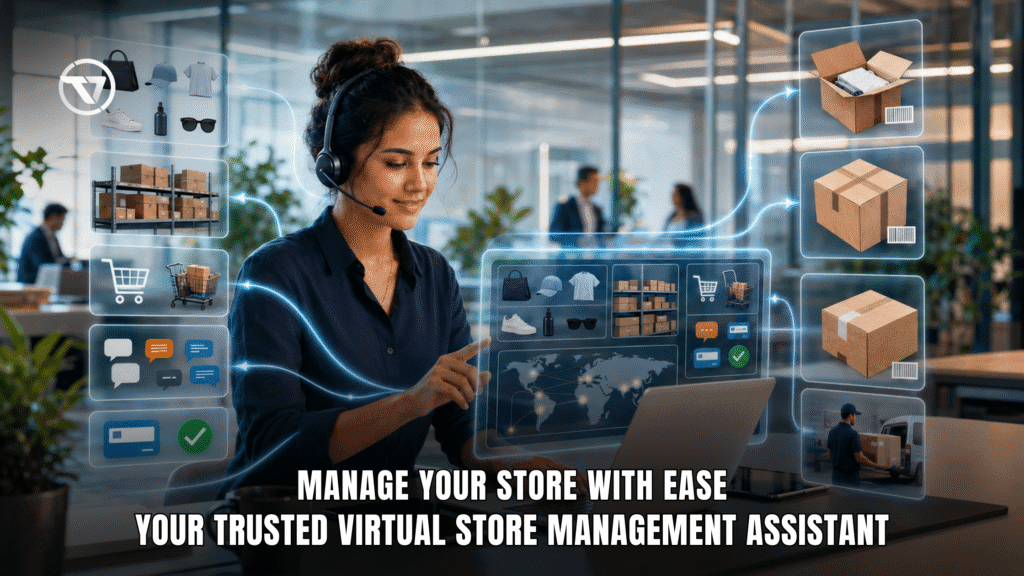
A virtual store management assistant powered by AI steps in as the practical solution that monitors stock levels in real time, synchronizes listings, handles routine customer queries, and surfaces actionable insights. With U.S. e-commerce sales accounting for 16.9% of total retail sales in the first quarter of 2026, according to the U.S. Census Bureau, the pressure to operate efficiently across sales channels while meeting rising customer service expectations has never been higher.
Understanding the Virtual Store Management Assistant
A virtual store management assistant serves as an intelligent operations partner for multichannel sellers. It unifies data and tasks that previously required constant switching between platforms. These systems deliver the consistency and speed American retailers need to stay competitive in a crowded digital marketplace.
1. Defining the Technology and Its Core Role
A virtual store management assistant is an AI-driven software system that oversees day-to-day e-commerce operations across multiple sales channels. It uses machine learning, natural language processing, and predictive analytics to interpret data, recommend actions, and execute routine tasks with minimal human intervention.
These assistants connect to platforms such as Amazon Seller Central, Shopify, Walmart Marketplace, and eBay through APIs to create a unified view of inventory, orders, customer interactions, and performance metrics. For American merchants, this single interface reduces the need to log into separate seller portals repeatedly while flagging issues before they impact sales.
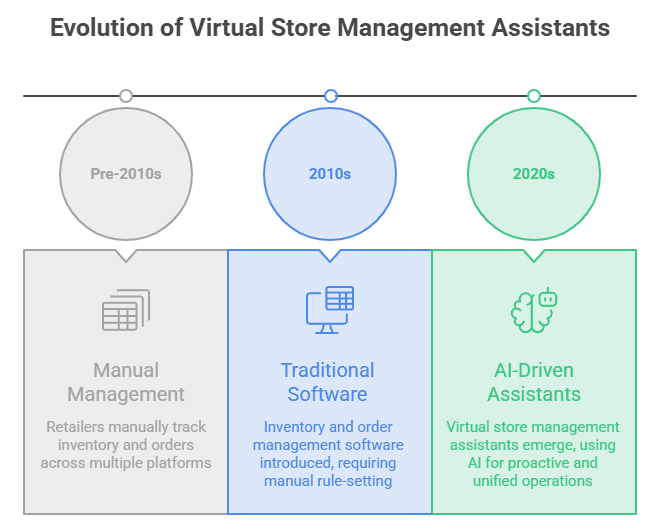
2. How It Differs from Traditional Store Management Tools
Traditional inventory or order management software typically requires users to set fixed rules and review reports manually. A virtual store management assistant continuously learns from historical sales patterns, seasonal trends, and external signals such as shipping delays or promotional calendars.
It moves beyond static alerts to proactive suggestions, such as recommending a reorder quantity that accounts for supplier lead times and expected promotional spikes. This shift from reactive to anticipatory management proves especially valuable for multichannel sellers who must keep listings consistent and stock accurate across platforms with different fulfillment requirements.
3. Integration with Existing E-commerce Ecosystems
Modern assistants integrate with popular U.S. tools including QuickBooks or Xero for accounting, ShipStation or Pirate Ship for shipping labels, and customer service platforms like Zendesk or Gorgias. They pull real-time data so that a sale on one marketplace immediately updates available quantity on others, preventing overselling.
Security features such as role-based access and audit logs help merchants meet compliance expectations common among American payment processors and marketplace partners. This seamless connectivity ensures the assistant enhances rather than disrupts established workflows.
Why Multichannel E-commerce Demands AI Assistance Today
Multichannel selling expands reach but multiplies daily operational demands for U.S. retailers. A virtual store management assistant addresses these pressures by providing coordinated intelligence across every sales channel.
1. The Growth of Multichannel Selling in the United States
- U.S. consumers routinely research products on one channel and complete purchases on another, making single-channel strategies increasingly limiting.
- Multichannel approaches allow brands to meet buyers on Amazon, Shopify, eBay, social platforms, and brand sites while reducing reliance on any single marketplace.
- Each additional channel introduces separate inventory pools, differing return policies, unique fee structures, and distinct customer communication norms.
- Without intelligent coordination, stockouts on high-visibility platforms or mismatched pricing quickly erode margins and seller ratings.
2. Rising Operational Complexity and Labor Costs
- Labor shortages and wage pressures in logistics and customer support have made purely manual multichannel management expensive for American businesses.
- AI assistants reduce the volume of repetitive tasks so existing staff can focus on strategy, supplier relationships, and high-value customer interactions.
- According to McKinsey’s 2025 State of AI survey, 88 percent of organizations now use AI in at least one business function, up from previous years.
- This broad adoption reflects recognition that automation is no longer optional for maintaining competitiveness in e-commerce.
3. Competitive Pressure from AI-Native Retailers
- Large marketplaces and digitally native brands already deploy sophisticated AI for demand forecasting and personalization.
- Smaller and mid-sized U.S. sellers that adopt virtual store management assistants can narrow that competitive gap without building proprietary systems from scratch.
- NVIDIA research has shown that roughly 89 percent of retailers are either using or actively piloting AI solutions.
- Many early adopters report revenue gains and cost reductions that compound over time as operations become more precise.
Core Features of Effective AI-Powered Assistants
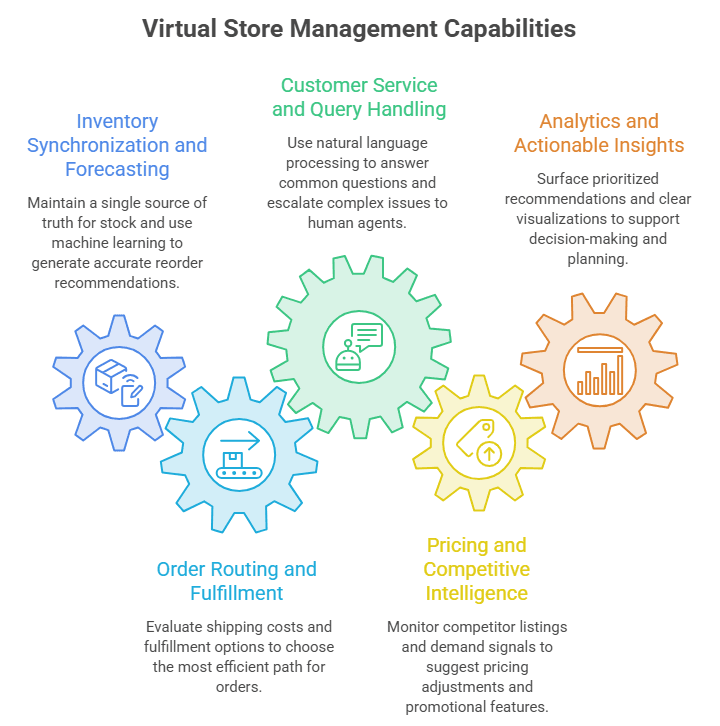
Effective virtual store management assistants combine multiple capabilities into one cohesive system. These features work together to reduce manual effort while improving accuracy across inventory, orders, service, and strategy. Understanding each capability helps merchants evaluate which solution best matches their operational needs.
1. Real-Time Inventory Synchronization and Demand Forecasting
The strongest virtual store management assistants maintain a single source of truth for stock across all channels. Machine learning models analyze past sales velocity, seasonality, promotional calendars, and external factors such as weather or local events to generate accurate reorder recommendations. This capability helps prevent both stockouts that frustrate customers and excess inventory that ties up capital.
2. Automated Order Routing and Fulfillment Optimization
When an order arrives, the assistant evaluates shipping costs, warehouse locations, and marketplace fulfillment options such as Amazon FBA versus merchant-fulfilled to choose the most efficient path. It can also batch similar orders, generate packing slips, and update tracking information across platforms. For U.S. sellers shipping domestically, this reduces the risk of late deliveries that harm seller metrics.
3. Intelligent Customer Service and Query Handling
Natural language processing allows the assistant to answer common questions about order status, return windows, product specifications, and shipping estimates around the clock. Complex or emotionally charged issues escalate to human agents with full context attached. This combination improves response times while preserving the personal touch American shoppers still value for higher-stakes purchases.
4. Pricing, Promotion, and Competitive Intelligence
Dynamic pricing engines monitor competitor listings and demand signals, then suggest or automatically apply adjustments within merchant-defined guardrails. The assistant can also recommend which products to feature in promotions based on margin contribution and inventory age, helping clear slow movers without deep blanket discounts.
5. Analytics Dashboards and Actionable Insights
Beyond raw data, effective systems surface prioritized recommendations: “Increase stock of SKU-123 before the upcoming holiday weekend” or “Customer satisfaction scores dropped on Channel X after a recent policy change.” Clear visualizations and exportable reports support both daily decision-making and longer-term planning.
Tangible Benefits for American E-commerce Businesses

A virtual store management assistant improves profitability; IBM says mature AI adopters report 17% higher customer satisfaction. Benefits compound as operational learning enables the system to provide increasingly precise guidance.
1. Reduced Stockouts and Overstock Costs
- Accurate forecasting and synchronized inventory cut the twin problems of lost sales and excess carrying costs.
- Merchants commonly report fewer emergency restocks once AI-driven recommendations replace gut-feel ordering.
- Lower write-downs on aged inventory free up working capital for growth initiatives.
2. Higher Operational Efficiency and Staff Productivity
- Automating routine monitoring and responses frees team members for higher-leverage work such as product development and supplier negotiation.
- Existing staff can focus on creative marketing and strategic decisions rather than repetitive data checks.
- This productivity gain is particularly valuable for small and medium-sized U.S. businesses that cannot scale headcount as quickly as sales volume.
3. Improved Customer Experience and Retention
- Consistent product availability, accurate order status communication, and faster query resolution translate into better reviews.
- Positive experiences support higher rates of repeat purchases in a competitive market.
- In a landscape where e-commerce already represents nearly 17 percent of total U.S. retail sales, service quality becomes a key differentiator.
4. Better Margin Protection Through Smart Pricing and Channel Mix
- Data-driven pricing helps merchants avoid race-to-the-bottom discounting on competitive listings.
- Channel-performance analysis identifies which platforms deliver the healthiest contribution margins after fees and fulfillment costs.
- Targeted promotions based on inventory age and margin contribution protect overall profitability.
5. Scalability Without Proportional Complexity
- As a business adds channels or SKUs, the assistant absorbs much of the additional coordination burden.
- Growth plans become more achievable without forcing a complete overhaul of internal processes.
- Operational complexity remains manageable even as sales volume and product assortment expand.
Selecting and Implementing the Right Solution
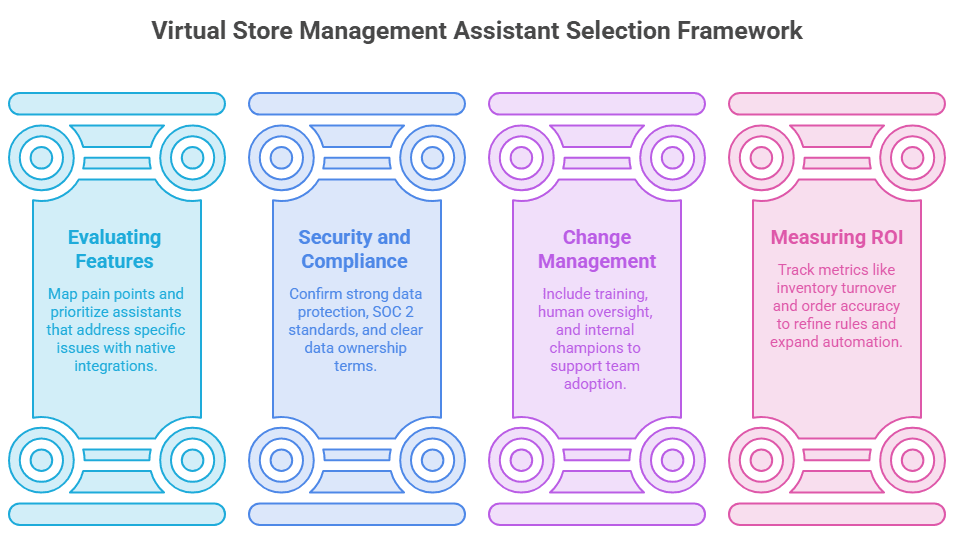
Choosing the right virtual store management assistant requires evaluating features, security, and organizational readiness. This matters because 74% of companies struggle to achieve and scale AI value, according to BCG. Merchants planning carefully achieve faster adoption, measurable returns, and sustainable results.
1. Evaluating Features Against Business Needs
Start by mapping current pain points—frequent overselling, slow customer response times, or opaque profitability by channel. Prioritize assistants that address those specific issues and offer native integrations with the platforms you already use. Request demonstrations that use your actual product catalog and historical data when possible.
2. Data Security, Compliance, and Vendor Reliability
Confirm that the provider follows strong data protection practices, supports SOC 2 or equivalent standards, and maintains clear data ownership terms. U.S. merchants should also verify how the system handles marketplace terms of service and any required tax or reporting features.
3. Change Management and Team Adoption
Successful rollouts include training sessions, clear ownership of AI recommendations, and a period of human oversight before full automation. Designate internal champions who understand both the technology and the business processes it supports.
4. Measuring ROI and Continuous Improvement
Track metrics such as inventory turnover, order accuracy, average response time, and contribution margin before and after implementation. Most platforms provide built-in reporting that makes these comparisons straightforward. Use the insights to refine rules and expand automation over time.
Emerging Trends Shaping Virtual Store Management in 2026 and Beyond

Virtual store management technology evolves as AI expands; Salesforce expects AI to resolve 50% of service cases by 2027. Tracking developments helps U.S. merchants pursue efficiency and meet evolving customer expectations.
1. Rise of Agentic AI Capabilities
- Next-generation assistants are moving from recommendation engines toward more autonomous “agentic” behavior.
- These systems execute approved actions across platforms with appropriate guardrails in place.
- The shift reduces the need for constant human approval on routine decisions while keeping strategic control with the merchant.
2. Deeper Multichannel and Omnichannel Convergence
- Expect tighter links between online marketplaces, brand sites, social commerce, and physical retail locations.
- Assistants will increasingly support buy-online-pickup-in-store workflows.
- Unified customer profiles across touchpoints will become standard for seamless experiences.
3. Greater Emphasis on Sustainability and Ethical Sourcing Signals
- Some systems now incorporate carbon or ethical-sourcing data into inventory and supplier recommendations.
- This responds to growing American consumer interest in responsible purchasing.
- Merchants can align operational decisions with both efficiency and values-based goals.
4. Personalization at Scale Across Channels
- AI will refine product recommendations and messaging for individual shoppers.
- Systems maintain consistent brand voice while adapting content to each channel.
- This further blurs the line between marketing and operations tools for more cohesive customer journeys.
TaskVirtual: Your Partner in Multichannel Store Management Support

Running a multichannel e-commerce operation involves constant monitoring of inventory levels, order fulfillment, pricing adjustments, and customer inquiries across Amazon, Shopify, eBay, and other platforms. These daily responsibilities can quickly overwhelm even experienced sellers and pull focus away from growth strategies. TaskVirtual’s specialized e-commerce virtual assistance service that complements AI-powered virtual store management assistants by handling the human coordination, oversight, and detailed execution needed to keep multichannel stores running smoothly.
1. Expert Multichannel Operations Guidance
TaskVirtual’s trained virtual assistants help sellers configure and monitor virtual store management tools, review inventory forecasts, and coordinate listing updates across marketplaces. They assist with validating AI recommendations, managing exceptions, and ensuring that stock levels and order statuses remain accurate in real time.
2. Cost-Effective Pricing for Growing Sellers
Hiring dedicated full-time staff for multichannel oversight can strain budgets, but TaskVirtual offers flexible plans starting from just $3.12/hour to $14.99/hour. This structure makes professional support accessible to independent sellers, small brands, and expanding e-commerce businesses alike.
3. Full-Spectrum Store Management Assistance
From synchronizing inventory data and optimizing order routing to supporting customer service escalations and analyzing channel performance, TaskVirtual covers the operational details that keep AI systems effective. Services scale to match whether a seller needs occasional help or ongoing daily management of multichannel activities.
4. Continuous Monitoring and Reliable Follow-Through
TaskVirtual provides regular status updates, proactive alerts on potential stock issues, and quality checks on order processing. This ongoing support ensures that virtual store management systems deliver consistent results without requiring constant merchant involvement.
5. Established Reputation for Reliable Results
With 364 positive reviews and a 4.7-star rating on trusted VA platforms, TaskVirtual is recognized as a dependable partner for e-commerce operations. Clients rely on their expertise to strengthen multichannel performance and maintain efficient day-to-day store management.
FAQ Section
1. What is a virtual store management assistant?
It is an AI-powered system that automates and optimizes inventory, orders, customer service, and analytics across multiple e-commerce channels from a single interface.
2. How does it differ from regular inventory software?
It uses machine learning for predictive forecasting, continuous learning, and proactive recommendations rather than relying solely on static rules and manual reviews.
3. Is it suitable for small U.S. sellers or only large brands?
Solutions exist across price points. Many mid-market and even smaller merchants benefit once they sell on more than one or two channels and feel the operational strain.
4. What data security considerations should I evaluate?
Look for strong encryption, access controls, compliance certifications, transparent data handling policies, and clear ownership of your business data.
5. How long does implementation typically take?
Basic connections and setup can occur in days to a few weeks. Full value realization, including process adjustments and staff training, often spans one to three months depending on complexity.
6. Can it integrate with Amazon, Shopify, and other major platforms?
Most reputable virtual store management assistants offer native or API-based integrations with the leading U.S. marketplaces and storefront platforms.
Conclusion
A virtual store management assistant has become practical infrastructure for multichannel e-commerce success in the United States. By synchronizing inventory, streamlining fulfillment, enhancing customer interactions, and delivering clear operational insights, these AI tools help merchants protect margins and scale efficiently. Assess your current bottlenecks, shortlist solutions that integrate with your existing stack, and pilot one focused on your highest-pain processes to position your business for continued growth.
Sources
- U.S. Census Bureau, Quarterly Retail E-Commerce Sales Report (Q1 2026)
- McKinsey & Company, The State of AI (2025 Global Survey)
- NVIDIA, State of AI in Retail and CPG surveys (2025)
- Additional industry analyses referenced for context from Statista market outlooks and related authoritative reports.
For more such content, visit our website.
 Siddhartha Basu is a Technical Writer at Task Virtual. He loves online games, e-book reading, and Yoga.