Contents
show
How AI Avatar Services for Virtual Assistants Help Businesses
In an era where personalization and 24/7 availability define experiences, AI avatars transform virtual assistants into lifelike digital humans. Small businesses and enterprises now find AI avatar services for virtual assistants more accessible than ever. The market was valued at USD 6.3–9.78 billion in 2025 and is projected to reach tens of billions by the mid-2030s with over 30% CAGR. North America leads adoption in customer service, training, and marketing.
This growth aligns with Pew Research showing 62% of U.S. adults interact with AI weekly. This guide covers sourcing and deploying AI avatar-powered virtual assistants in 2026 for American businesses.
The Rise of AI Avatars in Virtual Assistance
The convergence of generative AI, real-time animation, and large language models drives the rapid evolution of virtual visual assistants. Businesses increasingly adopt these tools to create more engaging and responsive interactions. According to Gartner, 85% of customer service leaders planned to explore or pilot customer-facing conversational GenAI solutions in 2025, showing strong enterprise interest in AI-powered support experiences. North American companies, especially in the U.S., lead this transformation due to strong enterprise demand.
1. Market Growth and Adoption Trends
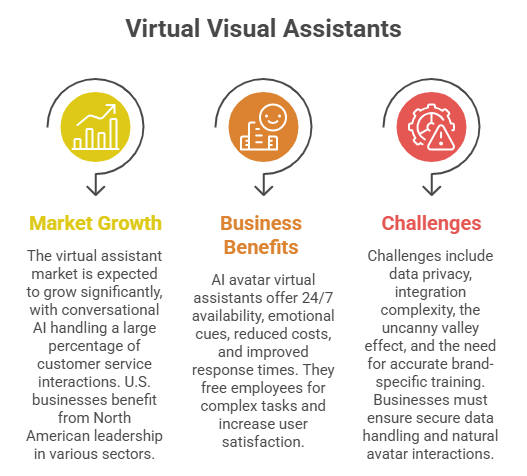
The convergence of generative AI, real-time animation, and large language models has accelerated the shift toward virtual visual assistants. The intelligent virtual assistant market is expected to grow significantly from USD 19–25 billion in 2025–2026 at CAGRs around 28–31%. Approximately 20% of customer service interactions will be handled by conversational AI by 2025. U.S. businesses benefit from North American leadership in finance, healthcare, retail, and e-commerce.
2. Benefits for Businesses and Users
AI avatar virtual assistants offer always-on availability with emotional cues through facial expressions and voice. They reduce costs compared to human staff while improving response times. They free employees for complex work by handling routine tasks. Users report higher satisfaction with visual empathy over text interfaces.
3. Challenges and Considerations
Challenges include data privacy under U.S. laws, integration complexity, the uncanny valley effect, and the need for accurate brand-specific training. Businesses must ensure that customer data is handled securely, integrations work smoothly with existing CRM or support systems, and avatar interactions feel natural rather than robotic. High-quality services provide enterprise-grade security, customization, staff training, and ongoing support. Careful platform selection and pilot testing help overcome adoption barriers while building user trust.
Top AI Avatar Platforms for Virtual Assistants in 2026

Several leading platforms deliver powerful AI avatar solutions with strengths in realism and interactivity. Businesses can choose based on real-time or video needs.
- Synthesia stands out for training and professional assistants with 230+ avatars.
- HeyGen excels in marketing with excellent lip-sync and translation.
- UneeQ focuses on interactive digital humans for live deployments.
- D-ID provides quick photo-to-talking-head custom avatars.
- Colossyan delivers lifelike avatars for training content.
- Creatify, Elai, Microsoft, and Google offer specialized features and API support for personalized lead generation systems.
How to Choose the Right AI Avatar Service
Selecting the ideal AI avatar service requires evaluating multiple factors aligned with business goals, customer expectations, and existing workflows. The right choice balances features, cost, integration, and long-term scalability. Proper assessment ensures maximum ROI through paid online marketing from deployments while reducing technical and operational risks.
1. Key Features to Evaluate
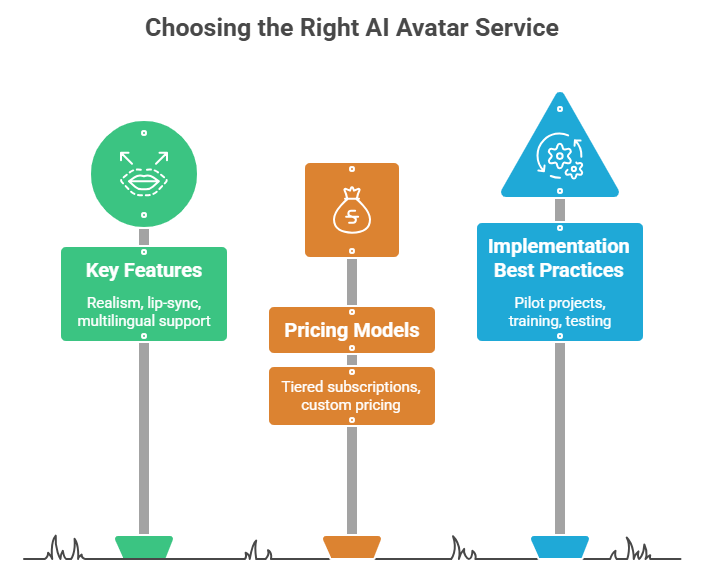
Prioritize realism, lip-sync accuracy, and multilingual support for U.S. audiences. Consider real-time capabilities, customization, analytics tracking, and ease of content updates. Enterprise needs include SOC 2 compliance, data protection, role-based access, and scalability. Integration with Zapier, Salesforce, HubSpot, CRM systems, and customer support tools ensures seamless functionality.
2. Pricing Models and Budgeting
Most platforms use tiered subscriptions based on usage volume, features, avatar quality, and video or interaction minutes. Starter plans often begin around $20–50 per month, while enterprise solutions may require custom pricing. Factor in training time, setup support, integrations, content creation, and hardware costs where needed. Budgeting should align investment with expected returns, such as reduced support workload, better engagement, or improved lead conversion.
3. Implementation Best Practices
Start with pilot projects in low-stakes areas like FAQs, onboarding, or internal training. Train avatars on brand voice, approved scripts, and knowledge bases to ensure consistent communication. Test for bias, accessibility, response accuracy, user feedback, and performance across devices. Combine with human oversight for complex queries, and use analytics to refine scripts, workflows, and avatar behavior over time.
Use Cases Across Industries
AI avatars deliver strong value across sectors by improving engagement, efficiency, and personalization. Their versatility supports both customer-facing and internal uses, helping businesses provide consistent service while reducing manual workload. This aligns with broader AI adoption trends, as 78% of organizations reported using AI in at least one business function in 2024, showing how AI tools are becoming useful across multiple departments and industries.
- AI avatars handle inquiries and demos 24/7 in sales.
- Retail sees higher conversions with visual guidance.
- Healthcare avatars manage scheduling and patient education.
- Education platforms support tutoring and administration.
- HR benefits from consistent onboarding and training.
- Avatars create scalable marketing and brand content.
Technical Considerations for Businesses
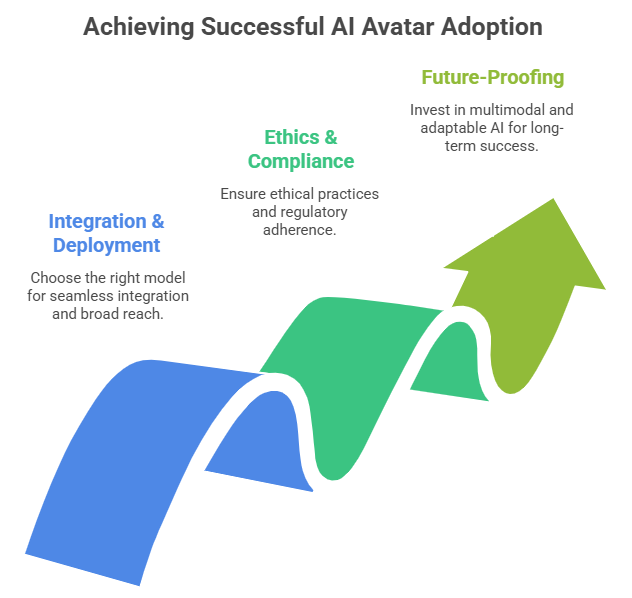
U.S. businesses must address technical, ethical, and compliance factors when adopting AI avatars. Strategic planning ensures smooth deployment, secure data handling through data entry virtual assistance, and reliable performance. Attention to these areas builds user trust and supports long-term compliance.
1. Integration and Deployment Options
Cloud solutions dominate for quick setup, flexibility, and ease of management. Hybrid options address data sovereignty, security, and internal system requirements. Web, mobile, and AR/VR deployment expands reach across different user touchpoints. The right model should support scaling, API access, and smooth integrations with existing tools.
2. Ethics, Bias, and Compliance
Choose providers with transparent data practices, bias mitigation, and strong privacy controls. Comply with CCPA, WCAG standards, and relevant industry-specific regulations. Disclose AI use clearly to build trust with customers and employees. Regular audits help sustain ethical practices and reduce compliance risks.
3. Future-Proofing Your Investment
Look for multimodal AI with voice, vision, gestures, and real-time interaction capabilities. Seek platforms with easy updates, open APIs, and flexible customization. No-code or low-code tools can simplify maintenance for non-technical teams. Forward-looking choices protect investments as avatar technology continues to evolve.
Getting Started: Step-by-Step Guide
Implementing AI avatar virtual assistants requires a structured approach for smooth adoption. Clear steps help reduce risks, improve setup quality, and speed up results.
- Define clear objectives and specific use cases.
- Audit your current virtual assistant setup.
- Research and demo 3–5 platforms.
- Pilot with a small team or department.
- Measure key KPIs, including engagement and savings.
- Scale and iterate based on data.
How virtual assistants help businesses with AI avatar services

Virtual assistants powered by AI avatars provide scalable, human-like support with AI visual search that enhances customer and employee experiences. They combine advanced visuals with intelligent responses to deliver consistent service across channels.
- They manage 24/7 customer inquiries with natural conversations and emotional expressions.
- AI avatars deliver personalized training and onboarding for faster employee productivity.
- They handle sales demos and lead qualification while maintaining brand voice.
- Virtual assistants reduce operational costs through efficient routine task automation.
- They ensure compliance and consistent messaging across distributed teams.
- AI avatars provide scalable marketing support with interactive brand engagement.
TaskVirtual: Your Partner in AI Avatar Virtual Assistants

TaskVirtual offers expert support to help businesses implement and manage AI avatar services for virtual assistants. They simplify platform selection, setup, customization, deployment, and ongoing optimization of lifelike digital humans for customer service, training, sales, marketing, and operations. Taskvirtual AI virtual assistants that help companies adopt AI avatar technology with less complexity, better consistency, and stronger long-term results.
1. Expert Consultation and Review
TaskVirtual’s skilled team assists in selecting the right AI avatar platforms, comparing features, reviewing business needs, customizing avatars, and integrating them with existing systems for optimal performance and smoother adoption.
2. Affordable and Flexible Pricing
Hiring a full-time personal assistant can be expensive, but TaskVirtual makes it cost-effective. With pricing plans starting from just $3.12/hour to $14.99/hour, their services are budget-friendly and accessible to individuals, families, startups, small businesses, and growing enterprises.
3. Comprehensive AI Avatar Support Solutions
From platform selection and avatar customization to knowledge base training, end-to-end workflow automation, testing, deployment, and content updates, TaskVirtual covers it all. Their scalable services adapt to whether you need occasional help, campaign-based assistance, customer support coverage, or full virtual assistant management.
4. Ongoing Support and Quality Assurance
TaskVirtual provides continuous monitoring, updates, troubleshooting, content refinement, performance tracking, and quality checks to keep your AI avatars accurate, effective, compliant, and engaging over time.
5. Proven Track Record of Excellence
With 364 positive reviews and a 4.7-star rating on trusted VA platforms, TaskVirtual is recognised as a reliable partner worldwide. Clients count on their expertise to simplify AI avatar implementation, improve customer interactions, reduce administrative workload, support business growth, and streamline daily operations.
FAQ Section
1. What are the best AI avatar services for virtual assistants in 2026?
Top options include Synthesia for enterprise, HeyGen for marketing/dynamic use, D-ID for quick custom avatars, and UneeQ-style platforms for real-time interaction. Choice depends on real-time needs vs. video content focus.
2. How much do AI avatar virtual assistant services cost?
Pricing varies widely—from free tiers/limited plans to $29+/month for pros and custom enterprise licensing. Budget for usage volume and features like custom training.
3. Can small businesses afford an AI avatar or virtual assistants?
Yes. Many platforms have accessible entry points with pay-as-you-go options, allowing SMBs to start small and scale without high upfront costs.
4. Are AI avatars better than traditional chatbots?
For engagement and trust, yes—visual and emotional cues improve user satisfaction. However, they work best combined with robust backend AI for intelligence.
5. What industries benefit most from AI avatar virtual assistants?
Customer service, healthcare, education, HR, retail, and marketing see the strongest ROI through improved personalization and availability.
6. How do I ensure my AI avatar complies with U.S. privacy laws?
Choose providers with strong compliance certifications, data residency in the U.S., and transparent policies. Consult legal experts for your specific use case.
Conclusion
AI avatar services are practical tools reshaping virtual assistants for efficiency and growth. Organizations of any size can create human-like experiences with leading platforms. Many providers offer accessible entry points for all businesses. The technology advances rapidly with better realism.
Sources
- Global Market Insights, Precedence Research, and other market reports (various 2025–2026 data).
- Pew Research Center surveys on AI usage.
- U.S. Bureau of Labor Statistics reports on occupational impacts.
- Platform websites and reviews (Synthesia, HeyGen, D-ID, etc.).
- Industry analyses from Gartner, Mordor Intelligence, and similar.
For more such content, visit our website.
 Siddhartha Basu is a Technical Writer at Task Virtual. He loves online games, e-book reading, and Yoga.