

Contents
show
Bookkeeping VA Pricing: Hourly vs Monthly Cost
Running a small business means wearing many hats, and bookkeeping often sits near the top of the time-drain list. Many American owners still spend evenings reconciling transactions or chasing receipts when they could focus on growth. Bookkeeping VA pricing has become a practical solution as remote talent and specialized virtual bookkeepers make professional support accessible without the overhead of a full-time hire. According to the U.S. Bureau of Labor Statistics, the median annual wage for bookkeeping, accounting, and auditing clerks stands at $50,670, or roughly $24.36 per hour, underscoring why many owners look beyond traditional hires.
The core decision most owners face is hourly versus monthly pricing. One model offers flexibility for variable workloads; the other delivers predictability and often better value once the volume stabilizes. In 2026, with remote work normalized and accounting software more cloud-native than ever, understanding these two approaches helps you match cost to actual need. This guide breaks down current rates, real differences, when each model wins, and how to evaluate a bookkeeping virtual assistant or accounting virtual assistant so your financial records stay accurate and audit-ready without draining cash or focus.
Current Bookkeeping VA Pricing Landscape in the U.S. Market
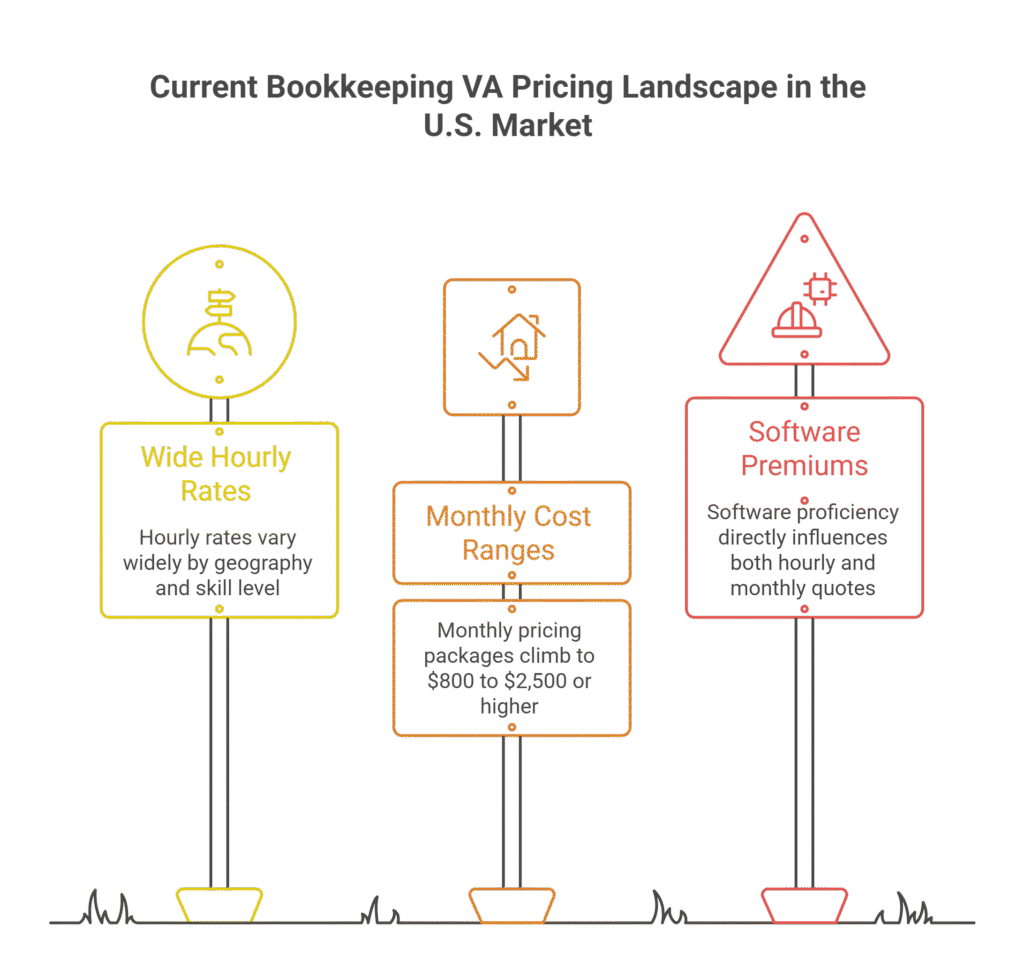
Understanding today’s bookkeeping VA pricing landscape helps small business owners set realistic budgets and avoid overpaying for either underused capacity or incomplete support. Rates differ by location, experience, software skills, and whether the arrangement is hourly or monthly, so a clear overview of the current market is the best starting point.
1. Typical Hourly Rates by Location and Experience
Hourly rates for a virtual bookkeeper vary widely by geography and skill level, with U.S.-based professionals typically charging $25 to $50 per hour for those experienced in QuickBooks Online, Xero, or comparable platforms, while more senior or specialized work can push higher; offshore and nearshore talent from the Philippines, Latin America, and similar regions commonly falls in the $8 to $20 per hour range for capable bookkeeping virtual assistants handling categorization, reconciliations, and basic reporting, and entry-level virtual assistant bookkeepers focused mainly on data entry and receipt matching sit at the lower end of these bands while mid-level professionals who manage monthly closes, accounts payable and receivable, and clean financial statements command more, reflecting the gap between the Bureau of Labor Statistics median employee wage of $24.36 per hour and the higher billed rates freelancers and agencies must charge to cover overhead and profit.
2. Monthly Retainer Ranges for Different Business Sizes
Monthly pricing packages for virtual bookkeeping usually begin around $200 to $400 for very small operations with limited transactions and climb to $800 to $2,500 or higher for growing businesses that need fuller support, with freelancers and solo virtual bookkeepers often structuring retainers around estimated hours or transaction volume while managed services and agencies frequently offer part-time blocks of 20 to 80 hours per month or dedicated full-time equivalents; a typical small service business processing 50 to 200 transactions each month commonly lands in the $300 to $800 range depending on whether the package covers only categorization and reconciliation or also includes invoicing follow-up and basic reporting, and higher-volume e-commerce or multi-entity setups push costs upward, giving owners a fixed line item rather than fluctuating invoices.
3. How Software Proficiency Affects Pricing
Proficiency in QuickBooks Online, Xero, FreshBooks, or Wave directly influences both hourly and monthly quotes. A virtual bookkeeper already certified or highly experienced in your primary platform reduces onboarding time and error risk, justifying a premium. Those who also understand bank feeds, rules automation, and basic inventory or sales-tax tracking command higher rates because they deliver cleaner books faster. Businesses that insist on software familiarity often see better long-term value even if the sticker price is slightly higher.
Hourly Pricing Model Explained

Hourly pricing gives business owners maximum flexibility by charging only for time actually worked. This model is especially useful when bookkeeping needs fluctuate or when a company is still defining the exact scope of support required from a virtual bookkeeper.
1. How Hourly Billing Operates in Daily Practice
- Time is logged through dedicated tracking platforms and submitted on a weekly or bi-weekly cycle for review and payment.
- The scope of work can expand or shrink from one period to the next without requiring a full contract rewrite.
- Clear statements of work and agreed turnaround times prevent misunderstandings about what constitutes billable activity.
- Owners receive itemised summaries that show exactly how hours were allocated across categorization, reconciliation, and reporting tasks.
2. Flexibility Advantages When Workloads Shift
- Seasonal businesses or project-based firms avoid paying for unused capacity during slower months.
- Startups still refining their processes can begin with a limited engagement and increase hours only after proving the relationship works.
- Owners gain transparency into the precise effort required for specific tasks such as bank feed cleanup or invoice generation.
- Testing a new virtual bookkeeper becomes lower risk because the commitment remains short-term and adjustable.
3. Common Challenges and Hidden Cost Drivers
- Unpredictable spikes from messy bank feeds, multiple credit cards, or year-end cleanup can produce larger invoices than anticipated.
- Owners must invest their own time reviewing timesheets and managing scope boundaries to keep costs in check.
- Tracking-tool fees and the administrative burden of invoice approval add modest but recurring overhead.
- Consistent high usage over several months often reveals that a monthly retainer would have delivered a lower effective rate.
4. Practical Steps for Managing an Hourly Arrangement
- Establish weekly check-ins early so both sides stay aligned on priorities and emerging issues.
- Require the virtual bookkeeper to flag potential overages before they occur rather than after the hours are logged.
- Maintain a shared document that lists approved tasks and excludes out-of-scope work such as tax advice.
- Review the running total of hours every two weeks and decide whether to continue, expand, or pause the engagement.
Monthly Pricing Model Explained
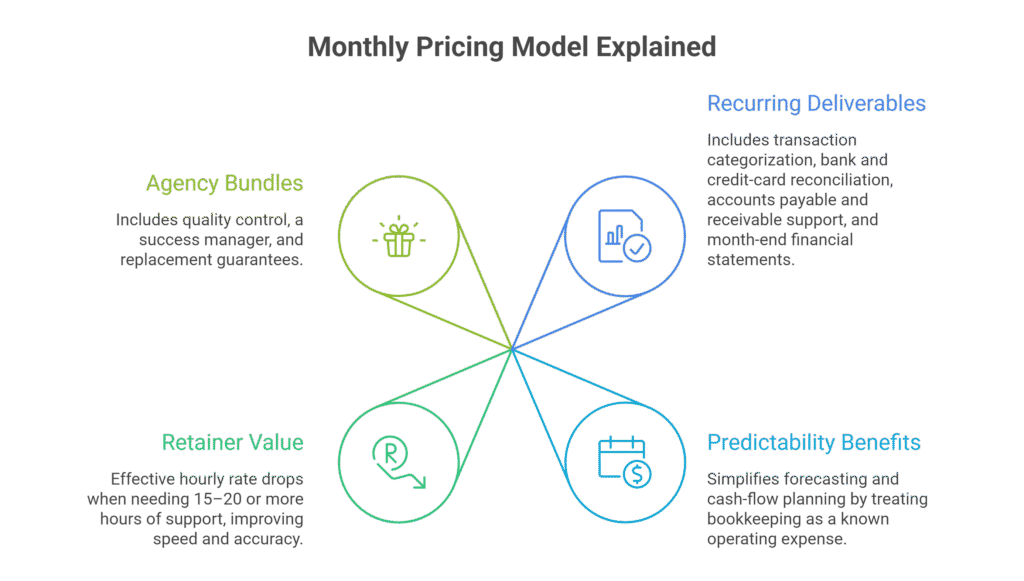
Monthly pricing shifts the focus from tracked hours to consistent deliverables, giving owners a predictable expense and a steady cadence of clean financial records. Many growing businesses eventually prefer this structure once their transaction volume settles into a reliable pattern.
1. Structure of Typical Monthly Packages
Monthly packages usually define a set of recurring deliverables—transaction categorization, bank and credit-card reconciliation, accounts payable and receivable support, and month-end financial statements—for a fixed fee. Some include limited hours of additional support or a soft cap on transactions. Others are pure retainers tied to estimated effort. Agencies often bundle quality control, a success manager, and replacement guarantees.
2. Predictability Benefits for Budgeting and Cash Flow
A fixed monthly cost simplifies forecasting and cash-flow planning. Small business owners can treat bookkeeping as a known operating expense rather than a variable one. This predictability is especially valuable when preparing for tax season, loan applications, or investor updates. Many report lower stress once the books are on a reliable monthly cadence.
3. When Monthly Retainers Deliver Better Value
Once a business consistently needs 15–20 or more hours of bookkeeping support each month, the effective hourly rate under a retainer frequently drops below pure hourly billing. The virtual bookkeeper develops deeper knowledge of your chart of accounts, vendors, and processes, which improves speed and accuracy. Long-term relationships also reduce the friction of repeated onboarding.
Direct Comparison: Hourly vs Monthly Cost Scenarios

Choosing between hourly and monthly bookkeeping VA pricing becomes clearer when you examine real workload levels. The right model depends less on the sticker price and more on how consistently your books need attention each month.
1. Solo Operators and Micro-Businesses with Light Volume
- Hourly arrangements keep monthly spend low when transactions stay under fifty per month.
- Five to ten hours at a competitive rate usually covers categorization, basic reconciliation, and simple reporting.
- Owners avoid paying for unused capacity during quiet periods.
- A short pilot engagement lets the business test the relationship before any longer commitment.
2. Growing Service Businesses Processing Moderate Volume
- The total cost of hourly and monthly models often converges once volume reaches fifty to two hundred transactions.
- Monthly packages begin to deliver stronger consistency and deeper familiarity with the chart of accounts.
- Owners who previously handled the books themselves commonly free eight to twelve hours each month.
- Cleaner monthly records improve the quality of information handed to a CPA at tax time.
3. Established Firms with Steady Higher Volume
- Hundreds of transactions, inventory tracking, or payroll postings make pure hourly tracking cumbersome.
- Monthly or dedicated arrangements allow the virtual bookkeeper to build institutional knowledge that speeds future work.
- The effective rate under a retainer typically falls below the cumulative hourly total once usage stabilizes.
- Fixed monthly costs simplify cash-flow forecasting and reduce invoice-review overhead.
4. Multi-Entity or Complex Operations
- Multiple entities, multi-currency activity, or sophisticated sales-tax requirements favour structured monthly support.
- Full-time or near-full-time monthly capacity still costs substantially less than an in-house employee once benefits and taxes are included.
- The virtual bookkeeper’s growing understanding of inter-company transactions reduces error rates over time.
- Owners gain reliable month-end closes without the administrative burden of managing variable invoices.
Factors That Influence Bookkeeping VA Pricing Beyond the Model
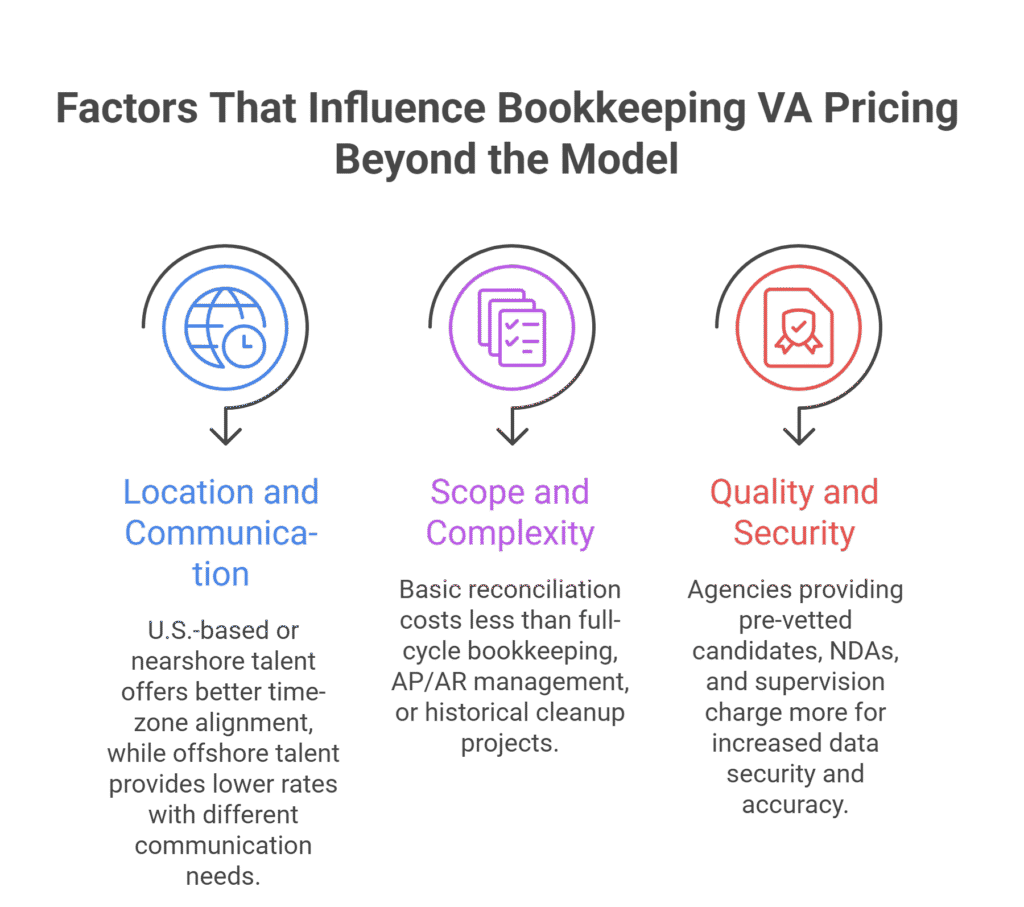
Beyond the basic choice of hourly versus monthly, several practical factors shape the final cost of a bookkeeping virtual assistant. Location, scope, and quality controls all play meaningful roles in what you ultimately pay and the results you receive.
1. Location, Time Zone, and Communication Preferences
U.S.-based or nearshore virtual assistants often overlap better with American business hours and cultural norms around communication. Offshore talent can deliver strong technical work at lower rates but may require more structured handoffs. Time-zone alignment affects how quickly questions about ambiguous transactions get resolved.
2. Scope of Services and Complexity of Books
Basic categorisation and reconciliation cost less than full-cycle bookkeeping that includes AP/AR management, 1099 tracking, inventory adjustments, or multi-currency work. Cleanup of historical messes is almost always quoted separately, whether hourly or as a project fee. Clear scoping at the start prevents later disputes.
3. Quality Controls, Security, and Experience Level
Agencies that pre-vet candidates, require NDAs, use secure file-sharing, and provide supervision typically charge more than pure freelance platforms. Experience with U.S. tax reporting needs, sales-tax rules, or specific industries also raises rates. For many small businesses, the extra cost buys peace of mind around data security and accuracy.
How to Choose the Right Pricing Model for Your Business
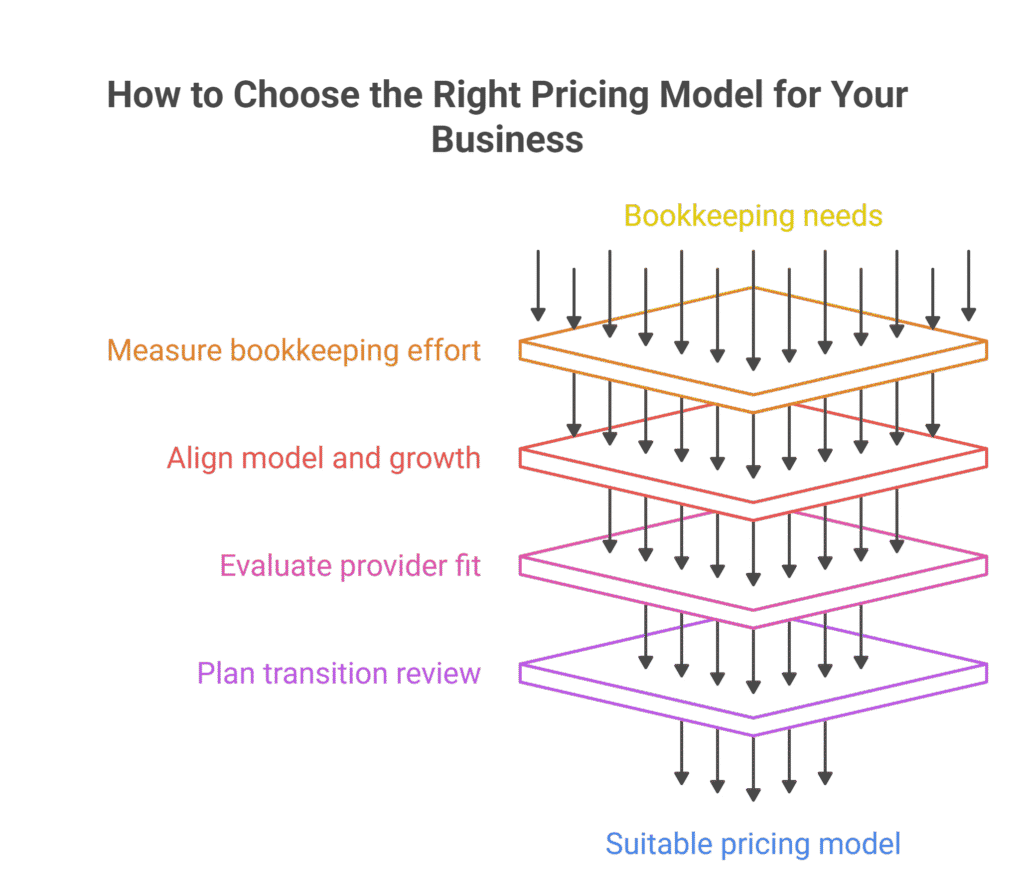
Selecting the better pricing model starts with an honest look at your current workload and future plans. Matching the structure to your actual needs prevents both under-support and unnecessary expense.
1. Measuring Actual Bookkeeping Effort
- Track the hours currently spent on books across one or two full months.
- Count monthly transactions, bank and credit-card accounts, and the frequency of formal reporting.
- Note any recurring cleanup tasks or seasonal spikes that inflate effort.
- Use the resulting baseline to determine whether volume is low and variable or steady and growing.
2. Aligning the Model with Cash Flow and Growth Stage
- Choose hourly when cash flow is tight, and transaction volume remains unpredictable.
- Shift toward a monthly retainer once the business needs reliable financials for decision-making or external reporting.
- Many firms begin with an hourly pilot and convert after the relationship and volume stabilize.
- Factor in the value of freed owner time when calculating true return on either model.
3. Evaluating Provider Fit and Contract Terms
- Confirm software certifications, average client volume, and sample report formats before signing.
- Ask about communication cadence, security practices, and how overages or scope changes are handled.
- Request references from similar-sized U.S. businesses operating in comparable industries.
- Clarify whether quoted rates are all-in or exclude software seats, add-on tools, or tax-related work.
4. Planning for Transition and Long-Term Review
- Build an exit or conversion clause into the initial agreement so switching models later remains straightforward.
- Schedule a formal review after ninety days to compare actual hours or deliverables against original estimates.
- Document process improvements that reduce future effort and share them with the virtual bookkeeper.
- Reassess the arrangement annually as the business grows or systems change.
Practical Tips for Controlling Bookkeeping Costs Long-Term
Once a pricing model is in place, disciplined habits and process improvements keep ongoing costs under control while protecting the quality of the financial records. Consistent attention to these areas produces more savings than simply chasing the lowest quoted rate.
1. Leveraging Automation and Clean System Design
Well-configured bank rules, receipt-capture applications, and a thoughtfully designed chart of accounts significantly reduce the time a virtual bookkeeper must spend on routine categorization. Investing a modest amount of effort at the outset in process hygiene lowers billable hours under both hourly and monthly arrangements and improves the accuracy of every subsequent close.
2. Establishing Clear Communication and Review Rhythms
Weekly or bi-weekly check-ins paired with shared dashboards and defined turnaround expectations keep both the owner and the virtual bookkeeper aligned. Regular reviews surface small discrepancies early, before they escalate into costly cleanup projects or strained relationships.
3. Knowing When to Adjust the Model or Provider
If cumulative hourly invoices consistently exceed the cost of a comparable monthly package, conversion is usually the smarter move. Conversely, a monthly retainer that includes unused capacity can be renegotiated or replaced. Annual cost-versus-value reviews ensure the arrangement continues to match the business’s evolving needs.
TaskVirtual: Your Partner in Bookkeeping Virtual Assistant Services

Choosing between hourly and monthly bookkeeping VA pricing is only the first step; finding a reliable partner who can deliver consistent, accurate support is equally important. TaskVirtual specializes in virtual bookkeeping assistance that helps U.S. small businesses manage transaction categorization, bank reconciliations, accounts payable and receivable, and month-end reporting without the overhead of a full-time hire. Their team adapts to either flexible hourly engagements or structured monthly retainers, giving owners the freedom to match support levels to actual workload while keeping books clean and decision-ready.
1. Expert Bookkeeping Guidance and Process Review
TaskVirtual’s experienced virtual assistants help owners evaluate their current bookkeeping processes, identify gaps in categorization or reconciliation routines, and recommend the most suitable pricing model. They assist with software setup in QuickBooks Online or Xero, refine chart-of-accounts structures, and ensure recurring tasks such as invoice tracking and bank feed management run smoothly from the start.
2. Affordable and Flexible Pricing
Hiring a full-time bookkeeper can be expensive, but TaskVirtual makes professional support cost-effective. With pricing plans starting from just $3.12/hour to $14.99/hour, their services remain budget-friendly and accessible whether a business needs occasional hourly help or consistent monthly coverage.
3. Comprehensive Virtual Bookkeeping Solutions
From daily transaction entry and multi-account reconciliations to preparing clear monthly financial summaries, TaskVirtual covers the full range of routine bookkeeping work. Their scalable approach adjusts easily whether a solo operator requires light support or a growing company needs steadier month-end close assistance.
4. Ongoing Support and Quality Assurance
TaskVirtual provides regular updates, proactive reminders for outstanding items, and quality checks that keep records accurate. Their structured communication ensures owners stay informed without needing to manage every detail, reducing the risk of missed transactions or delayed closes.
5. Proven Track Record of Excellence
With 364 positive reviews and a 4.7-star rating on trusted VA platforms, TaskVirtual is recognised as a reliable partner worldwide. Clients rely on their expertise to simplify bookkeeping workflows and maintain dependable financial records under either hourly or monthly arrangements.
FAQ
- What is the average hourly rate for a bookkeeping VA in the United States?
U.S.-based rates commonly fall between $25 and $50 per hour for experienced virtual bookkeepers; offshore options are often lower. - How much does monthly bookkeeping VA support typically cost for a small business?
Many small businesses pay $300–$1,200 per month depending on transaction volume and scope. - Is hourly or monthly pricing better for startups?
Hourly is usually better while processes and volume are still changing; monthly becomes preferable once activity stabilizes. - Do virtual bookkeepers handle tax filing?
Most focus on bookkeeping and month-end close; tax returns and advisory work typically stay with a CPA. - How does a bookkeeping VA compare in cost to an in-house employee?
A virtual arrangement almost always costs less once benefits, taxes, equipment, and management time are included. The BLS median wage alone is $50,670 before those extras. - What software should a bookkeeping virtual assistant know?
QuickBooks Online and Xero are the most requested; familiarity with your specific stack reduces onboarding friction and cost.
Conclusion + CTA
Choosing between hourly and monthly bookkeeping VA pricing is less about finding the absolute lowest number and more about matching the model to your actual workload, cash-flow needs, and growth stage. Hourly offers flexibility when volume is unpredictable; monthly delivers predictability and often superior value once the books require consistent attention. Real data from the Bureau of Labor Statistics and current market rates show that outsourcing to a skilled virtual bookkeeper or accounting virtual assistant remains one of the highest-ROI moves available to American small businesses.
Review your last three months of transactions, calculate the hours currently spent, and request two or three comparable quotes—one hourly and one monthly—from qualified providers. Clean, timely books free you to focus on the work that actually grows revenue. Start the conversation with a short pilot engagement this month and measure the time and stress you reclaim.
Sources
- U.S. Bureau of Labor Statistics, Occupational Employment and Wage Statistics, Bookkeeping, Accounting, and Auditing Clerks (May 2025 data)
- U.S. Bureau of Labor Statistics, Employer Costs for Employee Compensation
- Additional industry rate surveys and provider-published pricing observed across 2025–2026 market reports
For more such content, visit our website.
 Siddhartha Basu is a Technical Writer at Task Virtual. He loves online games, e-book reading, and Yoga.