
Contents
show
Bookkeeping VA vs hiring an accountant: cost comparison
Running a small or growing business in the United States means keeping accurate financial records without draining cash flow. Many owners face the same decision: hire a bookkeeping virtual assistant or bring on a full accountant. The bookkeeping VA vs hiring an accountant cost comparison has become especially relevant in 2026 as remote talent, software automation, and flexible staffing reshape how companies manage day-to-day ledgers versus higher-level financial analysis.
A bookkeeping VA handles transaction categorization, bank reconciliations, accounts payable and receivable, and monthly closes. An accountant or CPA interprets those records, prepares financial statements, handles tax strategy, and provides advisory support. The cost gap is substantial. According to the U.S. Bureau of Labor Statistics, the median annual wage for bookkeeping, accounting, and auditing clerks was $50,670 in May 2025, while accountants and auditors earned a median of $83,680. Fully loaded costs push those figures higher once benefits and overhead enter the picture. This guide walks through real 2026 pricing, hidden expenses, role differences, decision frameworks, and practical scenarios so American business owners can match the right resource to their needs and budget.
Understanding the Roles: Bookkeeping VA vs Accountant
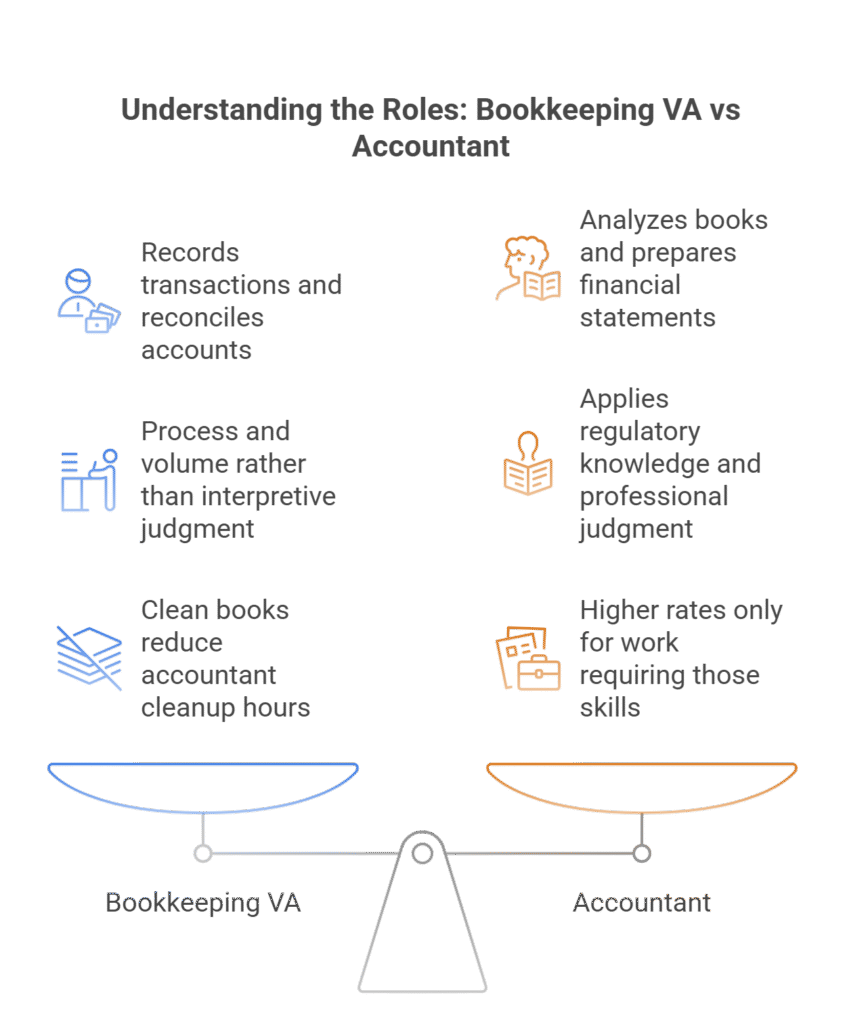
Choosing between a bookkeeping virtual assistant and an accountant starts with a clear picture of what each role actually delivers. One focuses on accurate, timely records; the other applies professional judgment to those records. Understanding the boundary prevents paying premium rates for routine work and ensures the right expertise is available when complexity or compliance demands it.
1. Core Responsibilities of a Bookkeeping VA
- Records and categorizes daily or weekly transactions, reconciles bank and credit card accounts, and manages invoices and bill payments inside platforms such as QuickBooks Online or Xero. Learn more about the differences between bookkeepers and accountants.
- Prepares basic monthly reports and maintains organized source documents so the ledger stays current and audit-ready.
- Operates primarily on process and volume rather than interpretive judgment, making the role highly suitable for consistent, repeatable financial operations.
2. What an Accountant or CPA Delivers
- Analyzes the completed books, prepares formal financial statements, and develops tax strategies tailored to the business structure and goals.
- Handles compliance filings, entity-level decisions, and, when licensed as a CPA, can provide attestation or full IRS representation.
- Applies regulatory knowledge and professional judgment that go well beyond data entry, justifying higher rates only for work that requires those skills.
3. Why the Distinction Directly Affects Cost
- Routine categorization and reconciliation do not require CPA-level expertise; assigning them to an accountant inflates monthly spend without improving outcomes.
- Clean books maintained by a VA reduce the hours an accountant later spends on cleanup, lowering overall annual cost.
- Matching the resource to the task—VA for volume work and accountant for analysis—produces the most efficient and accurate finance function for most small and mid-sized U.S. businesses.
Current Cost Benchmarks for Bookkeeping VAs

Bookkeeping virtual assistant pricing in 2026 varies mainly by location, experience, and transaction volume. Understanding the typical ranges helps owners budget realistically and avoid both under- and over-spending.
1. Offshore and Nearshore Bookkeeping VA Rates
Offshore and nearshore bookkeeping VAs based in markets such as the Philippines or Latin America commonly bill $7–$20 per hour all-in through specialized platforms. Full-time monthly arrangements frequently land between $1,000 and $2,500. These rates usually cover the contractor’s pay and platform fees with no employer payroll taxes, health insurance, or office overhead. For a business needing 20–40 hours of support each month, annual costs often fall in the $6,000–$20,000 range depending on seniority and complexity. Entry-level categorization sits at the lower end while full-cycle bookkeeping with inventory or multi-currency work moves toward the higher end.
2. U.S.-Based Bookkeeping VA and Freelance Rates
Domestic bookkeeping VAs and freelancers typically charge $25–$60 per hour, with specialists reaching $70–$90. Monthly retainers for small businesses most often range from $400 to $1,500 for standard volume. Full-time U.S. remote bookkeepers approach the BLS median wage of roughly $50,670 before benefits. Online bookkeeping services that combine software with human review publish entry prices around $99–$649 per month, with market medians near $300–$400 for basic packages at national providers. These options provide timezone alignment and familiarity with U.S. conventions at a higher absolute cost than offshore talent.
3. What Influences VA Pricing
Transaction volume, number of accounts, payroll complexity, inventory tracking, multi-entity structures, and required software certifications all affect final pricing. Clean source data and well-documented processes keep costs predictable and lower. Catch-up work or poorly organized books raise them quickly. Businesses that standardize their chart of accounts and bank-feed rules before engaging a VA typically secure more favorable long-term rates.
Cost of Hiring an In-House or Contract Accountant
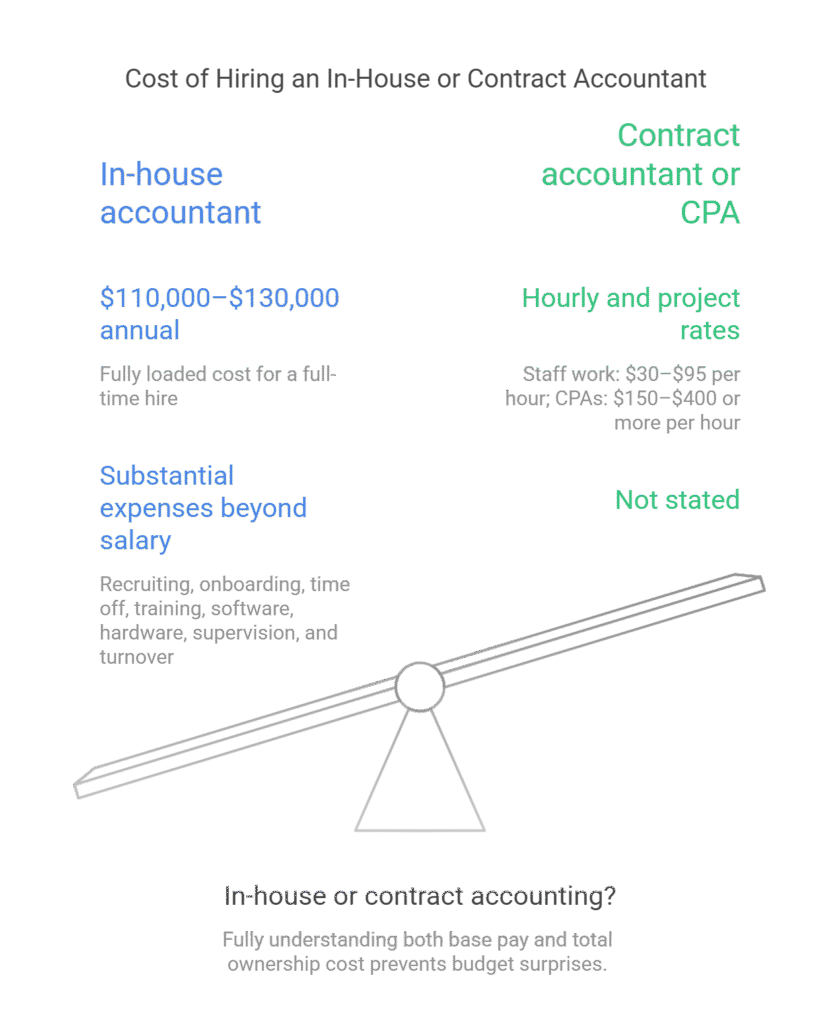
Hiring an accountant or CPA carries a different cost structure from bookkeeping support. Salaries, benefits, and billable rates reflect the higher level of judgment and credentialing required. Fully understanding both base pay and total ownership cost prevents budget surprises.
1. Median Salaries and Fully Loaded Costs
- The U.S. Bureau of Labor Statistics reports a May 2025 median annual wage of $83,680 ($40.23 per hour) for accountants and auditors.
- The 10th percentile sits near $56,020 while the 90th exceeds $144,000, reflecting wide variation by experience and industry.
- Fully loaded costs—including payroll taxes, benefits (often 25–35 percent of wages), software, equipment, recruiting, and management time—commonly push the annual figure into the $110,000–$130,000 range for a full-time hire.
2. Hourly and Project Rates for Accountants and CPAs
- Contract or freelance accountants typically bill $30–$95 per hour for staff-level work.
- CPAs frequently charge $150–$400 or more per hour for tax, advisory, or complex projects.
- Business tax returns range from several hundred dollars for simple filings to several thousand for partnerships, S-corps, or multi-state entities; monthly advisory retainers often fall between $250 and $900.
3. Hidden Costs of Full-Time Hires
- Recruiting fees, onboarding time, paid time off, ongoing training, software licenses, and hardware add substantial expense beyond base salary.
- Owner supervision and the opportunity cost of management attention further increase the true cost of an in-house seat.
- Turnover risk amortizes additional recruiting and training expenses across the employee’s tenure, making the effective annual cost higher than the headline wage.
Side-by-Side Cost Comparison for Typical U.S. Small Businesses

Direct comparisons across business sizes reveal how quickly costs diverge between a bookkeeping VA model and traditional accountant or full-time hires. The right choice depends on revenue, transaction volume, and the balance between routine and judgment work.
1. Scenario: Solo or Micro Business (Under $300K Revenue)
A bookkeeping VA or online service at $200–$500 per month plus an annual tax return prepared by a CPA ($500–$1,500) often totals $3,000–$8,000 per year. An in-house bookkeeper would cost several times that amount even on a part-time basis. An accountant handling everything would bill judgment rates for routine work and still leave gaps in daily records. For most solopreneurs and micro-businesses, the hybrid of low-cost VA support plus limited CPA engagement delivers clean books and compliance at the lowest total cost.
2. Scenario: Growing Small Business ($500K–$2M Revenue)
Monthly bookkeeping via VA or outsourced firm at $400–$1,200, combined with quarterly or annual accountant support for tax and statements, frequently lands in the $8,000–$20,000 annual range. A full-time bookkeeper approaches $70,000 or more when fully loaded; a full-time accountant exceeds $110,000. Hybrid models—VA for the ledger plus fractional accountant for review and tax—consistently deliver the best balance of accuracy and cost control in this revenue band.
3. Annual Cost Ranges Summary
Bookkeeping VA or outsourced basic support typically runs $3,600–$15,000 per year. A full-time U.S. bookkeeper, once benefits and overhead are included, commonly costs $70,000–$100,000 or more. A full-time accountant reaches $110,000–$140,000 loaded. Hybrid arrangements that pair VA books with CPA tax and advisory support usually fall between $6,000 and $25,000 depending on complexity. These figures exclude one-time catch-up or system implementation costs, which can add several thousand dollars if books begin in poor condition.
Factors That Influence the Total Cost of Ownership
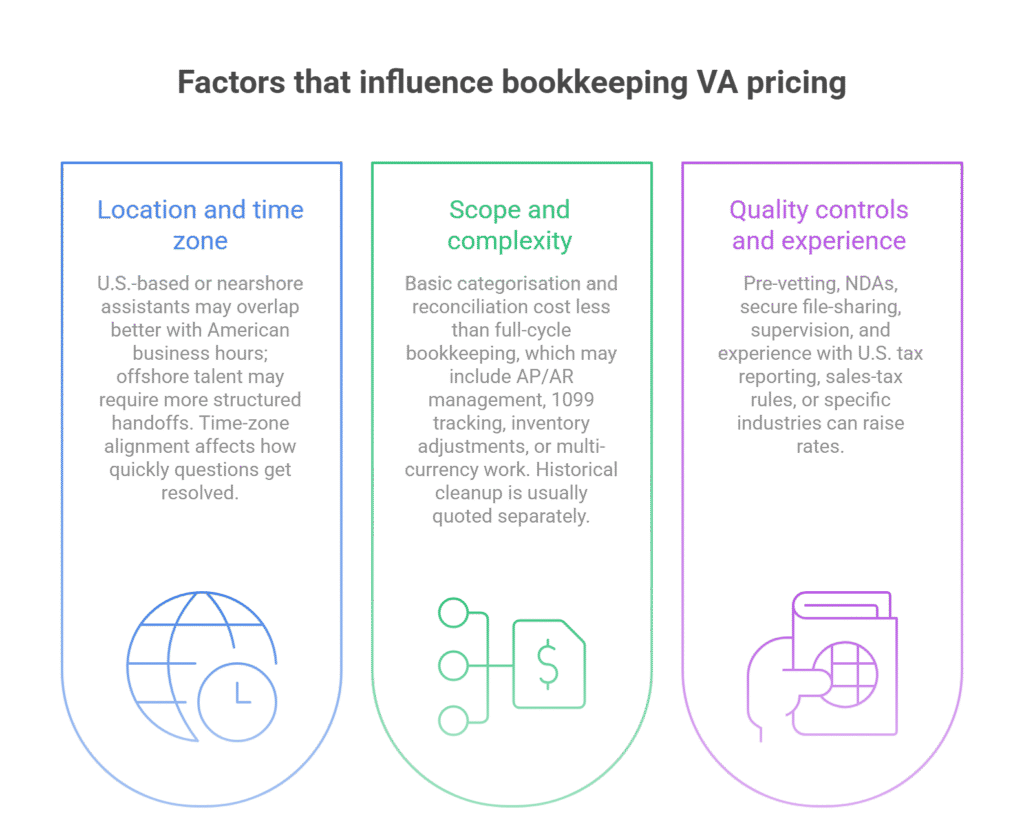
Beyond headline rates, several operational and structural factors determine the true long-term cost of either a bookkeeping VA or an accountant. Addressing these variables early keeps spending predictable and aligned with actual business needs.
1. Transaction Volume and Complexity
- High-volume ecommerce, multi-location retail, or businesses with inventory and job costing require more hours or higher-skilled support.
- Service-based solo operators need far fewer hours and can operate successfully with lighter, lower-cost coverage.
- Matching resource capacity to actual monthly volume prevents both under-staffing and chronic overpayment.
2. Software and Process Maturity
- Businesses already using cloud accounting software with bank feeds and clear categorization rules pay less for human support.
- Messy spreadsheets or mixed personal and business accounts drive expensive cleanup fees that can exceed a full year of routine bookkeeping.
- Standardizing processes before engaging external help produces immediate and ongoing savings.
3. Compliance and Risk Tolerance
- Lender, investor, or regulatory requirements for CPA-reviewed or audited statements make an accountant non-negotiable for those specific deliverables.
- Routine monthly closes rarely require CPA-level credentialing and can be handled efficiently by a well-managed VA.
- Clear identification of which outputs truly need attestation versus which need only accuracy keeps costs proportional to risk.
When a Bookkeeping VA Makes the Most Sense
A bookkeeping VA is the higher-value choice in several common business situations. Recognising these conditions helps owners avoid over-hiring while still maintaining reliable financial records.
1. Early-Stage and Cost-Conscious Businesses
Startups and solopreneurs rarely need a full-time finance person. A reliable bookkeeping VA keeps records current at a fraction of the cost of an employee or senior accountant, freeing cash for growth activities. The lower fixed commitment also reduces risk during periods of uncertain revenue. Many early-stage companies successfully operate with part-time VA support plus annual CPA tax preparation for several years before needing deeper resources.
2. Businesses With Predictable, High-Volume Transaction Work
Once the chart of accounts and processes are set, most monthly activity is repetitive. A VA executes that work efficiently and consistently. Pairing the VA with periodic accountant review captures accuracy on the ledger and professional oversight on the interpretation side. This combination keeps the day-to-day cost low while still providing the higher-level input when it is actually required.
3. Companies Seeking Scalability Without Headcount
Remote VAs can ramp hours up or down with seasonal volume far more easily than employees. Hiring and later reducing staff carries higher friction, recruiting cost, and potential disruption. Month-to-month or flexible-hour arrangements allow the finance function to expand and contract with the business without the fixed overhead of a permanent seat.
Hybrid Approaches That Optimize Cost and Quality
Most growing U.S. businesses achieve the best results by combining a bookkeeping VA with selective accountant or CPA support rather than choosing one exclusively. Hybrid models deliver clean records, professional oversight, and controlled spending.
1. VA for Daily Books Plus Accountant for Review and Tax
- The VA maintains clean, timely records through daily or weekly transaction work and monthly closes.
- The accountant reviews the monthly package, prepares statements, handles tax returns, and provides occasional advisory calls.
- Total annual spend stays well below a full-time hire while still delivering professional-grade financial outputs.
2. Fractional or Outsourced Controllership
- As volume and complexity increase, a part-time controller can oversee the VA or bookkeeping team and report directly to the owner.
- Monthly costs for such arrangements often range from $2,000 to $6,000 depending on scope—still far below a full-time senior hire.
- This layer adds process discipline and higher-level reporting without creating a permanent high-salary position.
3. Matching Scope to Growth Stage
- Early-stage companies typically need only VA books plus annual tax preparation.
- Mid-stage businesses benefit from monthly VA support plus quarterly accountant review.
- Larger or more complex operations can layer fractional controllership on top of the VA foundation as investor or lender requirements intensify.
Practical Steps to Choose and Implement the Right Option
Selecting and onboarding the right mix of bookkeeping VA and accountant support follows a straightforward sequence. Clear assessment and structured trials reduce risk and accelerate results.
1. Assess Your Current State
Count monthly transactions, list required reports, identify software already in use, and note any compliance or lender requirements. Calculate how many hours of pure data work versus judgment work exist each month. This inventory reveals whether the primary need is volume capacity, professional interpretation, or both, and prevents hiring the wrong resource level.
2. Request Detailed Quotes and Compare Scope
Ask VAs and firms for sample deliverables, turnaround times, software experience, and references. Clarify what is included in the base rate and what triggers extra fees. For accountants, distinguish bookkeeping cleanup rates from true advisory rates. Side-by-side comparison of total expected annual cost under each model produces a clearer decision than hourly rates alone.
3. Start With a Pilot and Build Oversight
Many VAs and firms offer month-to-month or short trial periods. Use the first 30–60 days to evaluate accuracy, communication, and process fit before committing long-term. Document the chart of accounts, categorisation rules, and review checklist. Schedule regular brief check-ins so clean source documents and consistent owner input keep costs predictable and quality high.
TaskVirtual: Your Partner in Bookkeeping Virtual Assistant Services

Keeping accurate books while controlling costs is one of the biggest challenges for U.S. small and growing businesses. Between daily transaction entry, reconciliations, and preparing clean records for tax season, finance work can quickly consume owner time or inflate payroll. TaskVirtual supplies dedicated bookkeeping virtual assistants who handle the operational side of your ledger so you can stay focused on growth while keeping expenses far below the cost of a full-time hire or traditional accountant.
1. Expert Bookkeeping Support and Process Guidance
TaskVirtual’s trained virtual assistants manage transaction categorization, bank and credit-card reconciliations, accounts payable and receivable, and monthly close preparation inside the accounting software you already use. They help establish clear processes, organize source documents, and deliver consistent, review-ready books that reduce the hours your accountant later spends on cleanup.
2. Affordable and Flexible Pricing
Hiring a full-time bookkeeper or staff accountant quickly becomes expensive once benefits and overhead are added. TaskVirtual offers cost-effective remote support with pricing plans starting from just $3.12/hour to $14.99/hour, giving businesses of every size access to reliable bookkeeping help without the fixed burden of a permanent employee.
3. Comprehensive Bookkeeping Coverage
From daily data entry and invoice management to multi-account reconciliations and basic monthly reporting, TaskVirtual covers the full operational cycle. Services scale easily whether you need part-time assistance for a solo operation or consistent full-cycle support as transaction volume grows, aligning perfectly with the hybrid models that deliver the best cost-to-value ratio.
4. Ongoing Support and Quality Assurance
TaskVirtual provides regular updates, proactive communication, and structured quality checks so your books remain accurate and current. Their assistants work within defined processes and deliver outputs ready for accountant or CPA review, helping you maintain clean records month after month without constant owner oversight.
5. Proven Track Record of Excellence
With 364 positive reviews and a 4.7-star rating on trusted VA platforms, TaskVirtual is recognized as a reliable partner for businesses seeking dependable remote bookkeeping support. Clients rely on their assistants to keep ledgers organized, reduce finance overhead, and free owners to focus on higher-value activities.
FAQ
1. Is a bookkeeping VA cheaper than hiring an accountant?
A. Yes in almost every routine scenario. VA rates and outsourced packages typically run a fraction of accountant hourly fees or full-time salaries. Use the accountant for judgment work only.
2. What is the average monthly cost of a bookkeeping VA for a small U.S. business?
A. Most small businesses pay $300–$1,200 per month for solid outsourced or VA bookkeeping support, depending on volume and location of the talent.
3. Can a bookkeeping VA handle taxes?
A. No. VAs maintain the records. Tax preparation, strategy, and filing require an enrolled agent, accountant, or CPA.
4. How much does a full-time bookkeeper really cost once benefits are included?
A. Starting from the BLS median of $50,670, fully loaded costs commonly reach $70,000–$90,000 or more after payroll taxes, insurance, paid leave, and overhead.
5. When should a business switch from a VA to an in-house accountant?
A. When transaction volume fills most of a full-time week, when complex multi-entity or regulatory work becomes ongoing, or when strategic financial leadership is needed daily.
6. Do offshore bookkeeping VAs produce reliable work?
A. Many do when properly screened, given clear processes, and paired with U.S. oversight or review. Quality varies by provider and individual; references and trial periods matter.
Conclusion
The bookkeeping VA vs hiring an accountant cost comparison in 2026 clearly favors specialized, right-sized support for most American small and mid-sized businesses. Routine ledger work belongs with a cost-effective bookkeeping VA or outsourced service. Higher-value analysis, tax strategy, and compliance belong with an accountant or CPA used on a fractional or project basis. Hybrid models deliver accuracy, compliance, and cash-flow protection without the full burden of full-time salaries and benefits.
CTA
Calculate your monthly transaction load, identify the judgment-heavy tasks that truly require credentials, and request parallel quotes for VA support plus accountant review. Clean books maintained at the right cost level, free capital and attention for the activities that actually grow the business. Start the evaluation this quarter—your next tax season and cash-flow forecast will be smoother for it.
Sources
- U.S. Bureau of Labor Statistics, Occupational Employment and Wage Statistics, May 2025 data for Bookkeeping, Accounting, and Auditing Clerks and Accountants and Auditors (bls.gov)
- U.S. Bureau of Labor Statistics, Occupational Outlook Handbook entries for the same occupations
- Aggregate published 2026 rate reports and provider pricing pages reflecting market ranges for remote bookkeeping and accounting services
For more such content, visit our website.
 Siddhartha Basu is a Technical Writer at Task Virtual. He loves online games, e-book reading, and Yoga.