Contents
show
What bookkeeping services actually cover
In short: Bookkeeping services record, sort and reconcile your business money every month, so your numbers are ready for a tax pro. They don’t replace a CPA, and most of the routine work can be handed off.
Nobody hunts for bookkeeping help because they love spreadsheets. They go looking after another evening spent reconciling transactions or chasing receipts, with the real work waiting. That’s the moment this post is for.
If you want to see what 20 or 160 hours a month costs in practice, Task Virtual lists its plans with hourly rates on its pricing page. The rest of this guide is about the work itself: what is in a bookkeeping service, what isn’t, and how to decide who should do it.

The short list of jobs
Bookkeeping is the day-to-day record of where money came from and where it went. A bookkeeping service takes that record off your plate. The work usually falls into these jobs:
- Recording income and expenses as they happen, and sorting each one into a category (rent, software, ads, supplies).
- Matching your books to your bank and card statements. This is bank reconciliation: checking that what you wrote down is what the bank shows.
- Sending invoices and keeping track of who owes you (accounts receivable).
- Tracking bills you owe and when they fall due (accounts payable), and paying them when you approve.
- Running payroll or paying contractors on time.
- Producing basic reports each month: profit and loss, balance sheet, cash position.
- Cleaning up past messes: uncategorised transactions, missing months, an old file nobody trusts.
That’s the core. Some providers add tax preparation, budgeting or financial advice. Those are different skills, and it pays to know where bookkeeping stops. We’ll get to that in a moment.
The U.S. Small Business Administration says that someone in your business should be responsible for receivables, payables, available cash, bank reconciliation and payroll. In its guide to managing your finances, it adds that proper bookkeeping “can help keep your business running smoothly.” Read that list again and you have the job description of a bookkeeper.
Bookkeeping, accounting and tax are three different jobs
People use the words as if they mean the same thing. They don’t, and the mix-up is why some owners pay a CPA to categorise coffee receipts, or trust a bookkeeper with a tax decision.
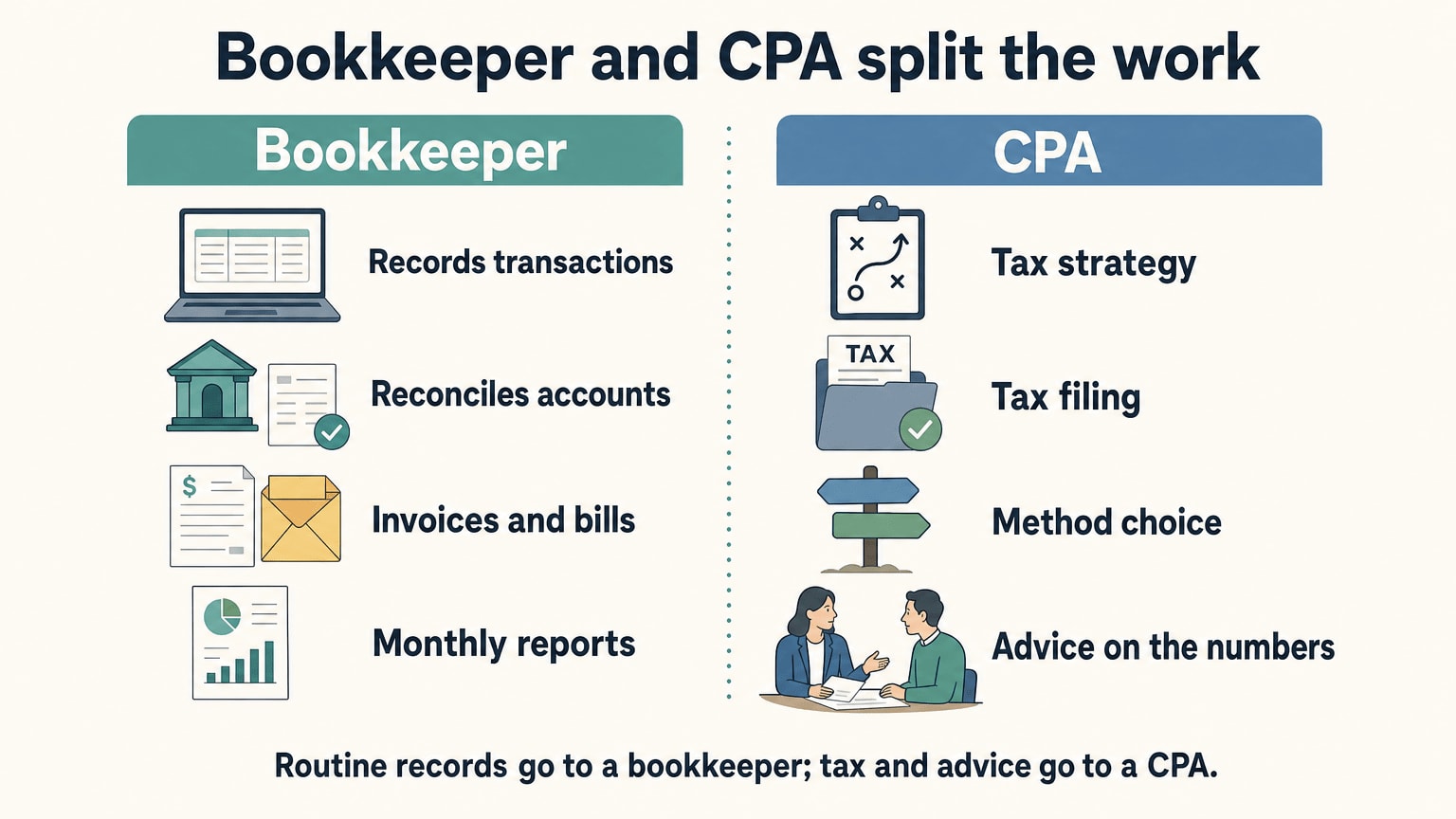
The SBA draws the line in its description of hiring help. A bookkeeper can provide basic day-to-day functions at a lower cost, but won’t have the formal accounting education of a CPA. A CPA typically costs more than online services. So the sensible split is simple: pay the lower-cost person for the repeating, rule-based work, and pay the expert for judgement.
Who does what
| Job | Bookkeeper or service | Accountant or CPA |
|---|---|---|
| Record and categorise transactions | Yes, this is the core work | Reviews, rarely does |
| Bank and card reconciliation | Yes | Checks the result |
| Invoices, bills, payroll runs | Yes | Advises on setup |
| Monthly profit and loss | Yes, prepares it | Interprets it |
| Tax strategy and filing | No | Yes |
| Choosing cash or accrual method | Follows the choice | Recommends it |
Source: SBA, Manage your finances, with the last column our reading of it.
One more point on that last row. The SBA explains that the accrual method puts transactions on the books immediately upon completing the sale, while the cash method only records them once payment has been received. Cash shows your cash flow more plainly. Accrual gives a fuller picture but is harder to manage. Which one you use affects your taxes, so ask a tax professional once, then let the bookkeeper follow that choice every month.
What a month of bookkeeping looks like
A good service runs on a rhythm, not on panic. Here is the routine most small businesses end up with, whether the person doing it is you, a hire or a remote assistant.
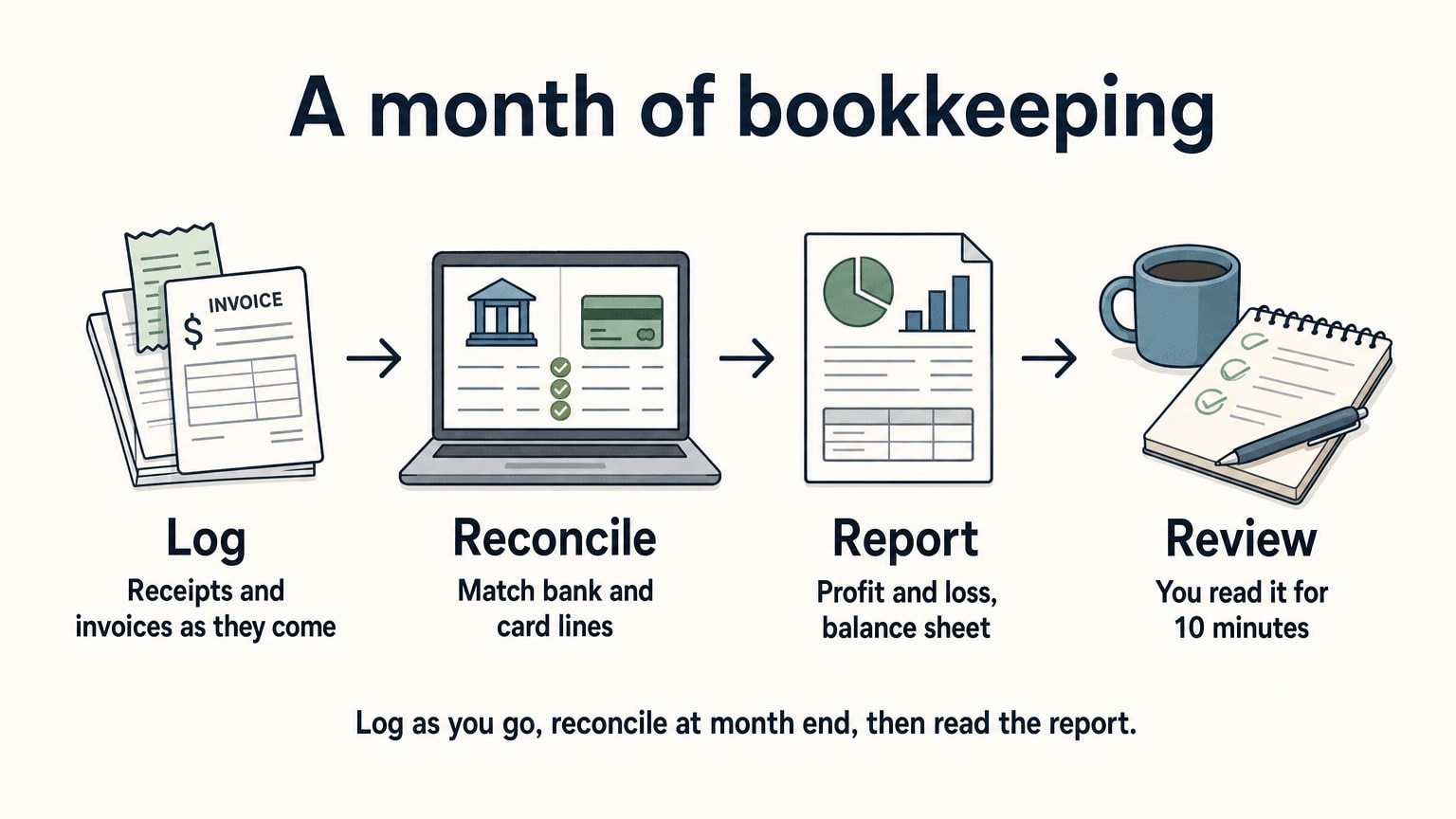
During the month. Receipts and invoices come in. Someone logs them, or checks that the bank feed has logged them. Bills get entered when they arrive, not when they are overdue. Customer invoices go out the day the work is done. If a payment is late, someone chases it politely.
At month end. The books are matched to the bank and card statements, line by line. Anything that doesn’t match gets a question: whose charge is this? Then the reports come out: profit and loss, balance sheet, and a list of unpaid invoices.
Once the month is closed. You look at the numbers for 10 minutes. Are sales up? Is one cost climbing? Who owes you money? A bookkeeper’s best output is a page you actually read.
This is where a lot of owners go wrong, and it isn’t their fault. Nobody tells you that the hard part is not entering the data. It’s the regularity. Books done in one big sitting every quarter take longer, and you’ve forgotten what half the charges were. A service gives you the boring rhythm for free.
Why the records matter beyond tax
Your books are also your proof. The IRS says you “must keep your records as long as needed to prove the income or deductions on a tax return.” How long that is depends on what the record documents. For employment tax records, the IRS recordkeeping page says to keep them for at least four years.
The same page makes a point that surprises many owners: you may choose any recordkeeping system suited to your business that clearly shows your income and expenses. There is no required format. So whoever keeps your books, what matters is that the record is clear, complete and findable years later.
Who can do your bookkeeping
You have four realistic options. None is wrong. They fit different sizes of business and different amounts of your own time.
The four ways to get it done
| Option | Best when | Watch out for |
|---|---|---|
| You, with software | Few transactions, you like it | It eats evenings and slips when you’re busy |
| A local bookkeeper | You want someone in the room | Hard to cover holidays and sick days |
| A bookkeeping firm | You want a finished, reviewed result | Scope is fixed by the contract |
| A virtual assistant | Steady admin plus bookkeeping tasks | Not a CPA; you must define the jobs |
The first option costs no cash and a lot of attention. That’s fine early on. It stops working when the evenings run out.
A local bookkeeper or firm is the traditional answer, and for many businesses it’s right, particularly where you need advice with the work. The cost is that you’re buying a package, and the package is whatever the firm sells.
The fourth option is where we come in. Task Virtual is a virtual assistant company headquartered in Kolkata, India. Clients send tasks to remote assistants, and bookkeeping upkeep sits alongside data entry, research, customer support and other admin. Think of it as delegating a defined set of recurring tasks to a dedicated person, rather than buying a finished accounting product. The pricing page puts it this way: the point isn’t just a cheaper hire, it’s a different staffing model. It also means you have to say clearly what you want done. We’ll come back to how to do that.
Be honest with yourself about one thing. A virtual assistant who enters transactions, reconciles accounts and chases invoices is doing bookkeeping tasks. That’s not the same as holding a CPA licence, and nobody should present it that way. Tax filing, tax strategy and anything needing a signature from a licensed professional stays with your accountant. We don’t claim otherwise, and you shouldn’t let any provider blur it.
So what can we do for your books? Our bookkeeping services cover the recurring work described above, including bank reconciliation and financial reporting, with related help on accounting and budgeting. Your assistant works from the task list you write, and you can read how we work on our process page. If bookkeeping is only one of several jobs you want covered, the One Team™ plan puts a team of specialists behind one subscription. You can also browse the tasks other owners delegate, read the client testimonials, or learn who we are. If you would rather ask first, you can request a quote.
What it costs in hours, not guesses
Most pages about bookkeeping services dodge the price, because the price depends on how many transactions you have and what you want done. So instead of a number we can’t back up, let’s work in hours. Hours are something you can estimate yourself.
Take a small business with about 200 transactions a month. (This is an illustration, not a benchmark.) Say the owner wants these done by someone else:
- Entering and categorising transactions.
- Reconciling the bank and card accounts.
- Sending invoices and chasing late ones.
- Paying bills the owner has approved.
- A short report at month end.
If that adds up to about 5 hours a week, you’re looking at roughly 20 hours a month. Change the numbers to suit yourself: if your business is quieter, it may be less; if you’ve got 500 transactions and a payroll, more. At 1,000 a month, it’s a different job again. The method matters more than the example. List the jobs, guess the time for each, add them up, then add a margin.
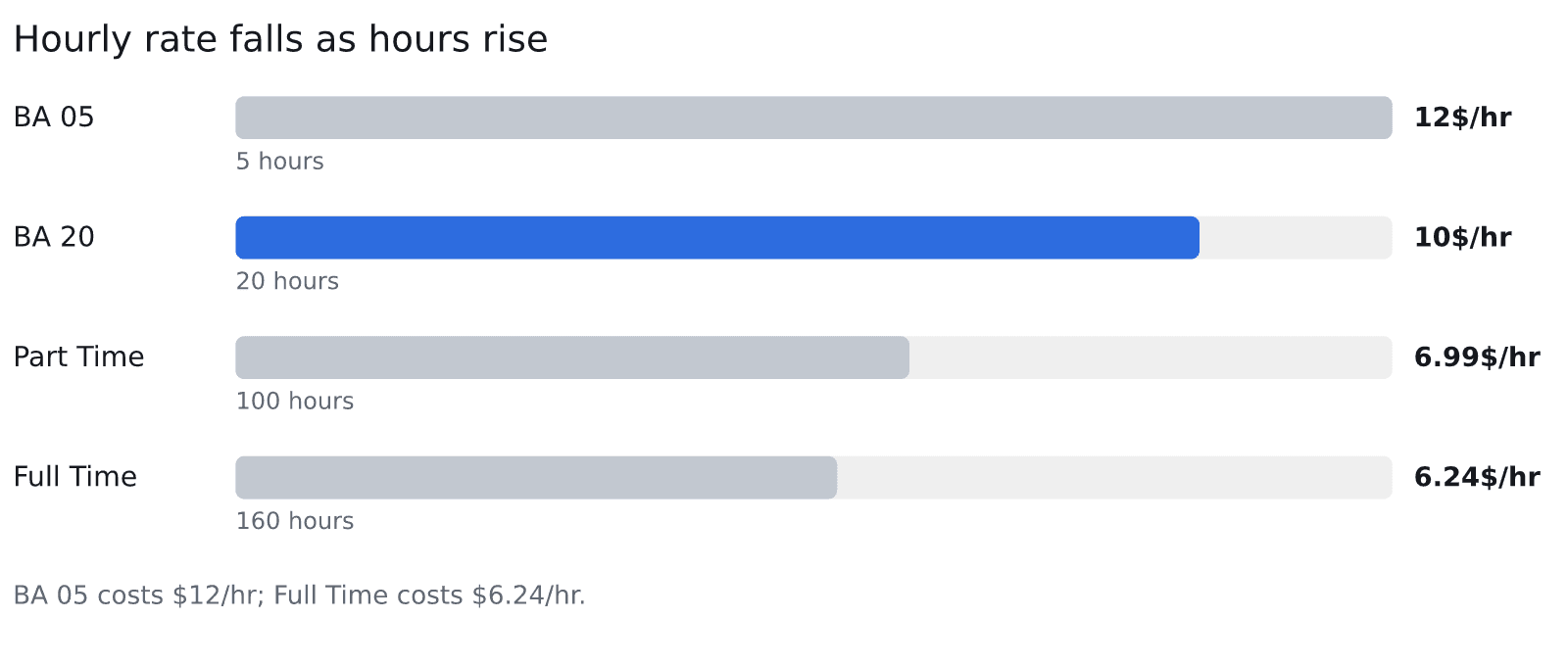
Now match it to a plan. These are the figures on Task Virtual’s pricing page:
Plans by hours and hourly rate
| Plan | Hours | Price | Hourly rate |
|---|---|---|---|
| BA 05 (monthly block) | 5 | $60 | $12/hr |
| BA 20 (monthly block) | 20 | $200 | $10/hr |
| Part Time (dedicated assistant) | 100 | $699 a month | $6.99 |
| Full Time (dedicated assistant) | 160 | $999 a month | $6.24 |
Source: Task Virtual, plans and pricing page.
So 20 hours of bookkeeping upkeep in a month fits the BA 20 block at $200. A business whose bookkeeping is one piece of a bigger admin load might need the Part Time plan, with 100 hours and a dedicated assistant. Plans are monthly with no long-term commitment, and hour blocks are valid for one month, so you can move up or down as your workload changes. The pricing page lists the other blocks and the quarterly ones if you want to compare. Our post on bookkeeping VA pricing, hourly versus monthly goes through the trade-off.
Is the lower rate the whole story?
No. The price per hour is only half of it. The other half is how many hours the work takes. A less experienced person might take longer, or make more errors, and you pay for the second pass. A cheap hour is not cheap if it needs checking.
That’s why the first month matters more than the rate. Give the assistant a small, well-defined slice of the job. Check the reconciliation yourself against the bank statement. See if the categories match your own sense of the business. If it’s clean, widen the scope. If it isn’t, you’ve lost little.
Don’t read this as a guarantee of savings either. Our pricing page compares against the cost of a U.S. hire, and it calls its own monthly difference illustrative. Treat any such comparison the same way: useful for thinking, not a promise about your books.
Giving someone access to your money, safely
This is the question owners ask after price, and they’re right to ask it. Bookkeeping means access to bank accounts, card feeds, invoices and sometimes payroll. Here’s a plain way to think about it.
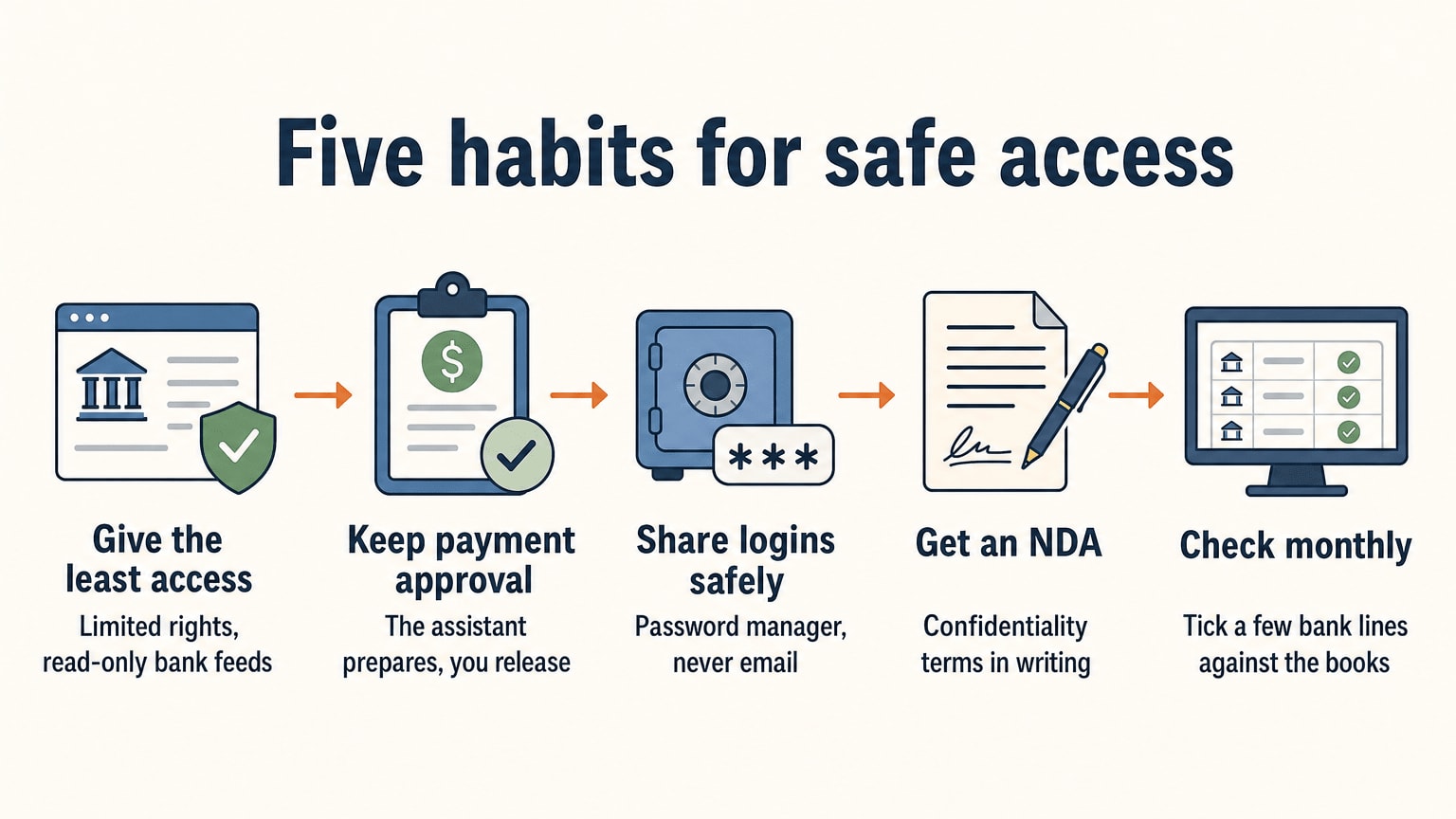
Give the least access that gets the job done. Many accounting tools let you add a user with limited rights. Bank feeds can be read-only: the assistant sees transactions but cannot move money. If someone only needs to reconcile, they don’t need permission to send payments.
Keep payment approval with you. Let the assistant prepare bills for payment. You release them. That one habit prevents most nightmares.
Don’t share passwords in an email. Use a password manager that lets you share a login without showing it, and remove access when the work ends.
Ask for an NDA. Task Virtual’s assistants sign one before client work starts, according to our FAQ, which also explains how assistant changes and refunds work if you want the details before trying anyone. Whoever you use, get the confidentiality terms in writing.
Check the work on a rhythm. Open the bank statement yourself once a month and tick a few lines against the books. It takes 10 minutes. It’s the cheapest control there is.
We don’t claim any compliance certification. Nobody should assume one from a friendly website. If your business holds especially sensitive data, ask direct questions about how it’s handled and keep your accountant in the loop.
How to choose a bookkeeping service
Whichever route you take, the same questions sort the good from the vague. For a longer list, see how to choose an outsourcing partner.
What exactly is included? “Bookkeeping” is a loose word. Ask for the list: reconciliation, invoicing, bill pay, payroll, reports, cleanup. If a provider can’t say what’s in and out, you’ll find out on the first invoice.
Who looks at the reports? Bookkeepers prepare the numbers. Someone, you or your accountant, has to read them. Agree who.
What software will it live in? Pick the software with your accountant first, then hire to match. The data is yours, so make sure you can export it.
How do you test it? Start with one account and one month, or a short trial. Task Virtual offers a free trial of 3 hours, valid for 2 days, which is enough to hand over a slice such as a single month’s reconciliation and see how it comes back. Treat any trial as a way to check accuracy and communication, not volume.
What happens when it isn’t working? Ask about replacement, refunds and notice. On our side, plans are monthly with no long-term commitment, and the refund is 85% of the subscription minus used hours, if you claim it within 2 days of the transaction. Read the equivalent terms from anyone else you consider.
Will they work in your language and your time zone? Our assistants handle tasks in English only. If you need a different language, we are not the right fit, and it’s better to know now.
When a bookkeeping service is the wrong move
Sometimes it isn’t. If your books are months behind and a tax deadline is close, call an accountant first. If you have complicated inventory, multiple entities or investor reporting, you need accounting judgement, not just data upkeep. And if you have only a handful of transactions a month, software and an hour a week may be all you need.
The best setup for many small businesses is both halves: a bookkeeper or assistant who keeps the books current, and a CPA who reviews them and handles tax. The bookkeeping is what makes the CPA’s time cheaper, because they start from clean records. Our cost comparison of a bookkeeping VA and an accountant covers that split in more detail.
A note on what the reports are for
Reports are not a ritual. The profit and loss answers one question: did the business make money this month, and from where? The balance sheet answers another: what do we own and owe today? A list of unpaid invoices answers a third, and it’s the one that moves cash fastest. If your service sends reports you never open, ask for fewer and better ones. A few pages you read beat a stack you don’t.
Signs it’s time to stop doing it yourself
Nobody sends a notice when it’s time. You just notice small things going wrong, and they are the same few every time.
You can’t say how much cash the business has without logging in to two places. You find out about a late customer payment weeks after it was due. You pay a bill twice, or miss one and get a late fee. Reconciliation moves from “monthly” to “when I get round to it”. You open a tax conversation with your accountant and spend the first hour finding receipts.

None of that means you’re bad at running a business. It means the work grew and the system didn’t. Bookkeeping is the one job that gets worse the longer you leave it, because every skipped week makes the next one harder to reconstruct.
Clean up first, then hand over
If the books are messy, say so up front. A handover on top of a pile of uncategorised transactions just passes the pile along. Ask for a cleanup pass as a separate, bounded task: get every account reconciled up to a recent date, then switch to the monthly routine from there. It’s easier to judge a cleanup (done or not done) than an open-ended “sort out my books”.
Write the task request like a recipe
The most common reason a delegated task comes back wrong is that the request was a sentence in your head. Write down, once, what good looks like:
- Which accounts and cards to reconcile, and by what date each month.
- The categories you use, with an example or two of tricky ones.
- Which expenses need your approval before they’re booked.
- Who to ask when a charge is unfamiliar, and how.
- What the monthly report should contain, and where to put it.
Keep it to a page. Update it when a question comes up twice. That page is also your insurance: if the person changes, the process stays. Our outsourcing checklist has 20 questions to answer before you delegate.
What to hand off first
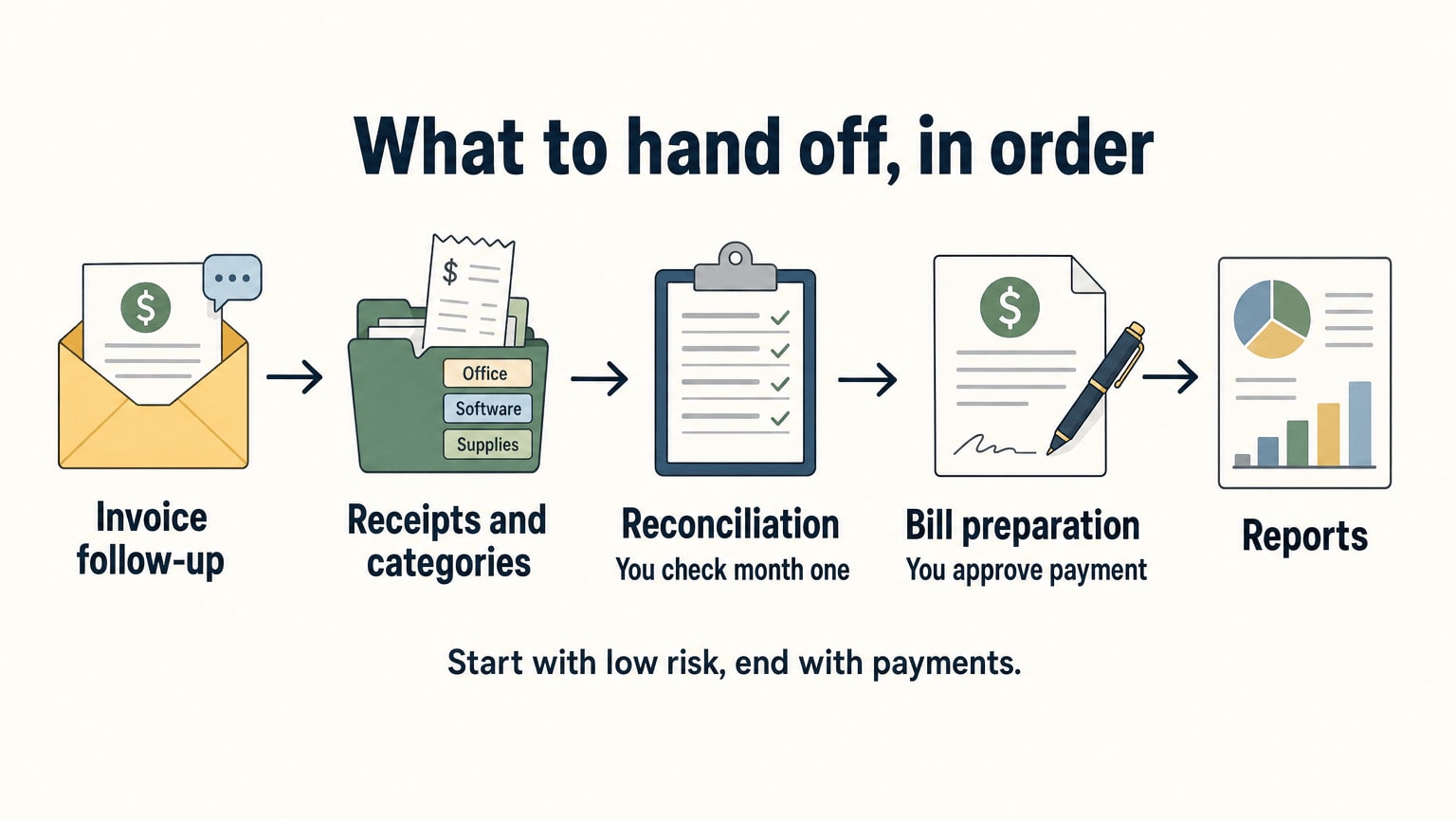
If you’re new to delegating this, don’t hand over everything at once. A sensible order:
- Invoice follow-up. Low risk, visible result.
- Receipt collection and categorising.
- Bank and card reconciliation, with you checking the first month.
- Bill preparation, with you approving the payment.
- Monthly reports, read together once.
Payroll and payments come last, once you trust the process. That sequence builds confidence without putting your cash at risk on day one. For more on what is safe to pass on, read outsourced bookkeeping and admin support.
Frequently asked questions
What do bookkeeping services include?
Recording and categorising transactions, reconciling bank and card accounts, managing invoices and bills, running payroll or contractor payments, and preparing monthly reports. Some providers also clean up old records. Tax filing and tax advice are usually separate and belong with a CPA.
What’s the difference between bookkeeping and accounting?
Bookkeeping is the day-to-day record of transactions. Accounting interprets that record, prepares tax strategy and gives advice. The SBA notes that a bookkeeper provides basic day-to-day functions at lower cost but lacks the formal accounting education of a CPA.
How long should I keep my business records?
It depends on what the record documents. The IRS says to keep records as long as needed to prove income or deductions on a return, and to keep employment tax records for at least four years. Your accountant can tell you the periods that apply to you.
Can a virtual assistant do my bookkeeping?
A virtual assistant can take on recurring bookkeeping tasks such as data entry, categorising, reconciliation support and invoice follow-up. They aren’t a substitute for a CPA on tax or advice. Define the tasks, limit access, and check the first month yourself.
Is it safe to give someone access to my accounting software?
It can be, if you limit what they can do. Use a separate login with the lowest rights that still let them work, keep payment approval for yourself, share passwords through a password manager, and get confidentiality terms in writing.
Should I use cash or accrual accounting?
It changes when a sale or bill counts. The SBA says accrual records a sale immediately upon completing it, while cash records it once payment is received. Cash is simpler and shows cash flow clearly. Accrual shows more of the long-term picture. Ask your accountant before you pick, because the choice affects your taxes and can be hard to change later.
What should I check in the first month?
Open the bank statement and tick 10 or 20 lines against the books. Look at whether categories match how you think about the business, whether every account is reconciled, and whether questions came back clearly. A short, well-defined first task tells you more than a big one.
How do I know how many hours I need?
List each recurring job, estimate the time for each, add them up and add a margin. A small business might land near 5 hours a week, about 20 a month. Then check it against the first month’s real time and adjust.