Contents
show
How Claude AI Enhances End-to-End Workflow Automation with VAs
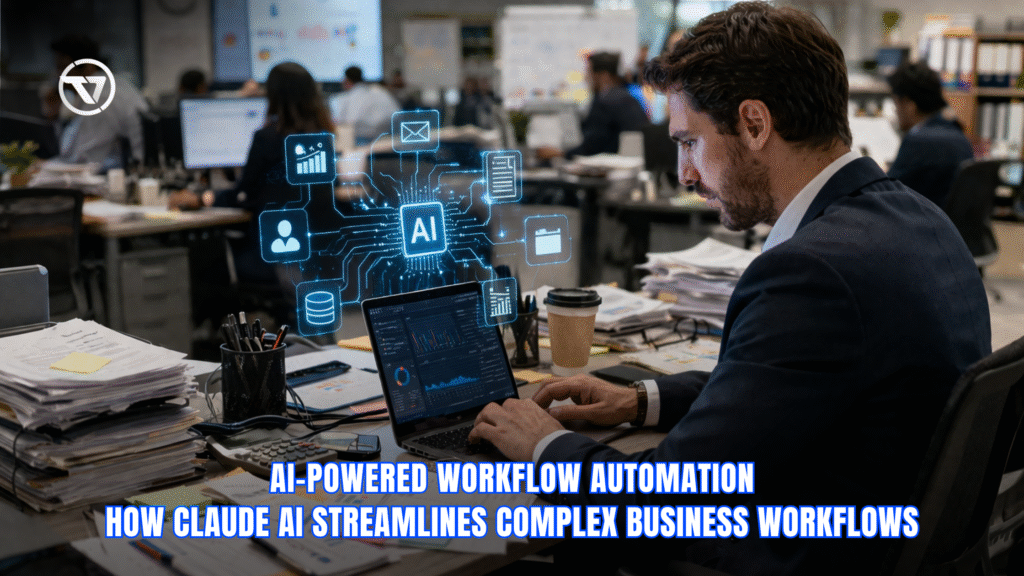
Claude AI is Anthropic’s latest large language model family (Claude 4 series, with Opus 4.6 as the flagship in 2026), designed for complex, multi-step reasoning and agentic task execution. When paired with trained virtual assistants, it enables end-to-end workflow automation that spans departments without custom software builds. Virtual assistants use Claude AI’s API, 1M-token context window, tool-calling capabilities, and structured output to process, route, and complete cross-department tasks at scale.
| Aspect | In-House Team | VA + Claude AI |
|---|---|---|
| Monthly Cost | $8,000–$15,000 | $1,200–$2,500 |
| Implementation Time | 3–6 months | 2–4 weeks |
| Scalability | Limited by headcount | Instant scaling via API |
| Error Handling | Manual oversight | VA + Claude’s self-checking loops |
| Cross-Department Reach | Siloed | Unified 1M context across all tools |
What This Means for Businesses
Departments no longer wait for IT tickets. A VA instructs Claude AI once; the model then extracts data from invoices, validates against policy, routes approvals, and updates QuickBooks and Slack automatically—allowing businesses to have these workflows efficiently managed by experts. Marketing briefs move from intake to SEO-optimized assets and CRM updates without human touchpoints. The result: 60–80% reduction in process cycle time and elimination of most repetitive administrative work.
How This Actually Works
Claude AI processes tasks through three core mechanisms that are directly relevant to workflow automation, enabling more structured and reliable execution. These mechanisms define how it interprets inputs, structures reasoning, and systematically executes outputs, aligning with findings that automation can improve operational efficiency by up to 30% in business workflows. Together, they enable efficient and adaptable task handling across a range of automated workflows:
- The model performs multi-step reasoning and planning by breaking any request into sequential steps, self-validating its outputs, and iterating autonomously without requiring human intervention.
- Claude uses APIs and the Model Context Protocol (MCP) to call external tools like CRM, email, and databases within a secure loop.
- The 1M-token context window allows entire histories, policies, and live data to remain in context, preventing fragmentation common in shorter-context models.
- This works in business workflows because Claude AI follows constitutional AI principles—prioritizing accuracy, safety, and refusal of unsafe actions—while the VA supplies domain-specific prompts, exception handling, and final quality gates.
Core Capabilities of Claude AI for This Use Case
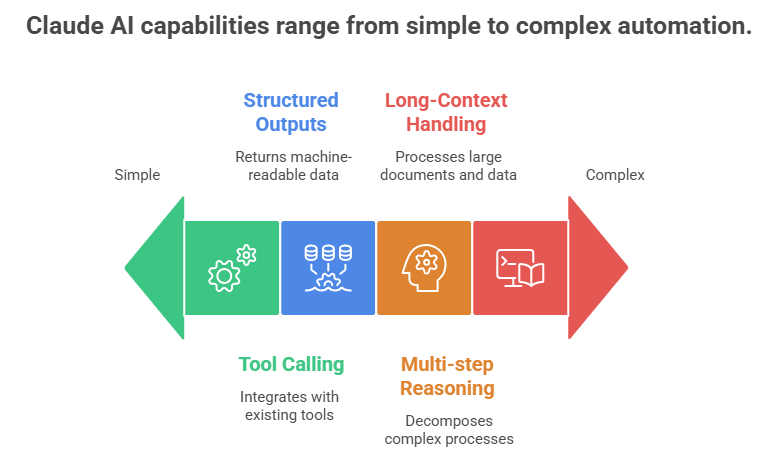
Claude AI delivers targeted capabilities that power reliable end-to-end workflow automation. Its design focuses on multi-step execution, secure tool integration, and long-context processing, making it highly effective when managed by virtual assistants. These features allow businesses to automate complex cross-department processes without building custom software.
1. Advanced multi-step reasoning
Claude Opus 4.6 decomposes complex processes (e.g., “qualify lead, score against ICP, route to sales, create follow-up sequence”) into ordered actions, checks intermediate results, and corrects deviations. In practice, VAs feed it live CRM data; the model returns JSON-ready outputs for downstream systems. Businesses gain consistent execution without custom scripts.
2. Tool calling and MCP integrations
Claude natively calls functions to read/write in Google Workspace, HubSpot, Xero, or Slack. VAs configure secure tool definitions once; Claude then executes end-to-end flows (pull invoice → extract line items → validate tax → post to accounting). This eliminates Zapier bloat and fragile scripts.
3. Long-context document and data handling
With 1M tokens, Claude processes entire quarterly reports, contract repositories, or multi-department Slack threads in one pass, maintaining full context without truncation. VAs use this capability to automate compliance checks or cross-department reporting that previously required hours of manual collation and data stitching. This results in faster, more accurate insights and eliminates version-control errors common in fragmented processes.
4. Structured outputs and self-verification
Claude returns machine-readable JSON or Markdown tables that integrate directly into business systems with perfect compatibility. Built-in self-checking and verification loops reduce hallucinations to near-zero in scoped workflows. This ensures reliable, audit-ready outputs that virtual assistants can confidently route across departments without additional validation steps.
Why Companies Use Claude AI
Claude AI delivers 70–85% cost savings versus dedicated automation platforms and scales instantly across departments without additional infrastructure. API pricing is predictable (pay-per-token), allowing precise budgeting even as workflow volume grows. Its constitutional safety alignment minimizes compliance risk—critical for US/UK-regulated small businesses operating under strict data and audit requirements.
Tasks Virtual Assistants Perform Using Claude AI
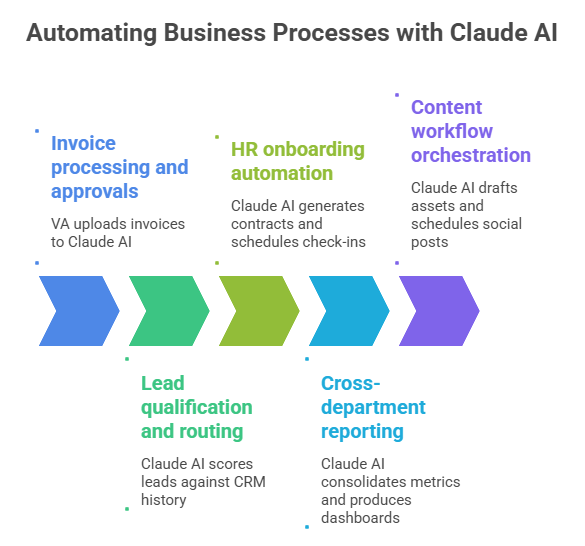
Virtual assistants leverage Claude AI to transform fragmented departmental tasks into seamless automated workflows, improving consistency and execution speed. By combining natural language instructions with tool calling and long-context processing, they handle repetitive and analytical work with high accuracy, supported by findings that 85% of organizations believe automation will help them remain competitive. This section highlights practical tasks where this combination delivers immediate efficiency gains for small businesses and agencies.
1. Invoice processing and approvals
The VA uploads batch invoices to Claude AI, which extracts line items, matches against purchase orders, flags policy violations, routes for approval via Slack/Email, and posts to accounting software. This cuts finance cycle time from days to hours and eliminates data-entry errors that cost small businesses thousands monthly.
2. Lead qualification and routing
Sales leads enter a shared inbox; the VA prompts Claude AI to score against the ideal customer profile using full CRM history in context, enriches with public data via tools, generates personalized outreach sequences, and updates pipeline stages. Marketing and sales teams receive only high-intent leads, boosting close rates by 25–40%.
3. HR onboarding automation
New hire data triggers Claude AI to generate personalized contracts, populate HRIS fields, assign training modules based on role, and schedule manager check-ins using the full employee policy context. The VA monitors exceptions only, reducing onboarding time from two weeks to two days while ensuring full compliance with company and legal standards. This frees HR teams, whereas virtual assistants handle administrative work and deliver a smoother, consistent experience for every new employee.
4. Cross-department reporting
The VA feeds Claude AI data from CRM, accounting, and project tools in one pass; the model consolidates metrics, identifies anomalies, and produces executive dashboards with actionable recommendations. Leadership receives weekly insights instead of monthly manual spreadsheets, enabling faster decision-making across departments. This eliminates hours of data stitching and reduces the risk of overlooked issues in fragmented reporting.
5. Content workflow orchestration
Marketing briefs go to Claude AI, which drafts assets, applies brand guidelines from the full style guide in context, routes for legal review if needed, schedules social posts across platforms, and logs performance metrics. VAs handle only final sign-off, freeing creative teams for high-value strategy work. This creates consistent, on-brand output at scale while cutting content production time significantly.
Tools and Systems Used Alongside Claude AI
Virtual assistants integrate Claude AI via the Anthropic API with Make.com or n8n for reliable orchestration, plus native connections to Google Workspace, Microsoft 365, HubSpot/Salesforce, QuickBooks/Xero, Slack/Teams, and Notion/Airtable. MCP enables direct computer-use actions when desktop apps are involved. All connections run in VA-managed secure sandboxes to maintain data privacy and compliance.
Step-by-Step Workflow Used by Virtual Assistants
- Input refers to a raw trigger such as an email, form submission, or scheduled pull.
- Tools used include the Anthropic API and MCP connectors to business systems.
- Process steps involve the VA uploading context and a system prompt, after which Claude reasons, calls tools, and validates outputs, looping on exceptions until completion, while the VA reviews only edge cases.
- Output consists of updated records, notifications, and an audit log.
- Efficiency gain refers to a 75–90% reduction in manual steps, with the process running continuously 24/7.
Real Example (Use Case)
A UK digital agency with 18 staff has automated the lead-to-project workflow. Before: 14-day cycle with 40% drop-off. VA configured Claude AI to score inbound inquiries against 12 ICP criteria, enrich via tools, create Notion tasks, draft proposals, and update HubSpot. Outcome: cycle time dropped to 38 hours, conversion rose 32%, and the agency saved £42,000 annually in admin costs while handling 3x volume without extra hires.
Common Challenges and Limitations
- API token costs accumulate on high-volume workflows (mitigated by Haiku/Sonnet tiers for lighter tasks).
- Initial prompt engineering requires 1–2 VA iterations to reach 99% reliability.
- Complex legacy systems may need custom MCP wrappers.
- Data privacy requires VA-managed enterprise plans with SOC 2 compliance.
- Real-time sub-second decisions still need lighter models or rules engines.
Benefits of Outsourcing to Virtual Assistants
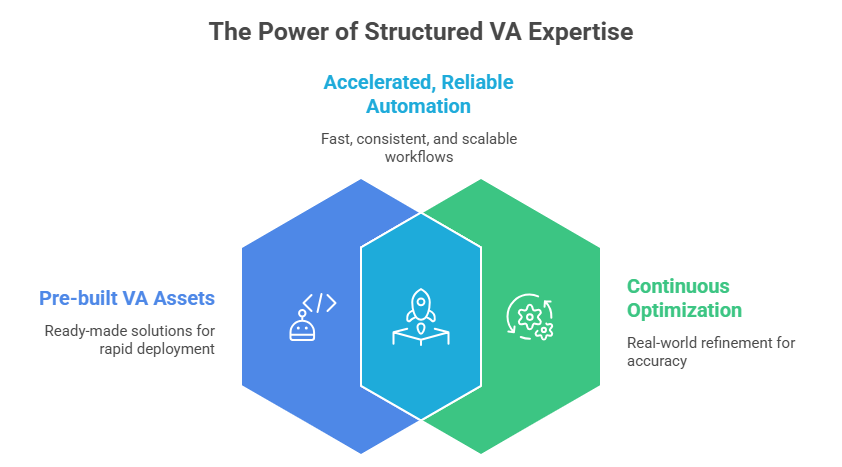
Virtual assistants (VAs) bring pre-built Claude AI prompt libraries, integration templates, and exception-handling protocols refined across multiple client implementations, enabling fast and reliable deployment. These assets are continuously optimized through real-world use, reducing setup time while improving accuracy and consistency from the outset. By leveraging this structured expertise, businesses avoid the steep learning curve of prompt engineering, integrations, and workflow design, along with the ongoing maintenance burden and risks of misconfigured automations common in in-house efforts.
This allows teams to focus on core growth activities such as revenue generation and strategic planning, rather than operational overhead. With proven frameworks ensuring scalability and auditability, organizations can achieve production-ready workflows in weeks instead of months, accelerating time-to-value and delivering measurable efficiency gains.
Cost and Efficiency Comparison
In-house automation (developer + tools) averages $120k first-year cost and a slow 4-month rollout with ongoing maintenance overhead. VA + Claude AI setup costs just $3,500–$6,000 and delivers ROI within 30 days through reclaimed staff time and sharp error reduction. This makes enterprise-grade workflow automation accessible and profitable for small businesses and startups from day one.
How Virtual Assistants Help In End-to-End Workflow Automation
Virtual assistants help businesses turn Claude AI into a practical workflow automation system for daily operations. They manage prompts, integrations, approvals, and exceptions so cross-department tasks run faster with less manual effort.
- Virtual assistants design Claude AI prompts for repeatable business workflows.
- They connect tools like CRMs, email, accounting apps, and Slack using MCP.
- They automate invoice approvals, API lead generation, onboarding, and reporting tasks.
- They review exceptions, validate outputs, and keep workflows accurate and safe.
- They maintain prompt libraries and update rules as business processes change.
- They create audit logs and summaries so teams can track workflow performance.
TaskVirtual: Your Partner in Claude AI Workflow Automation

Managing cross-department workflows like invoice approvals, lead routing, and HR onboarding can overwhelm small teams. Coordinating tools, handling exceptions, and ensuring compliance often delays operations and increases errors. TaskVirtual provides expert virtual Claude AI assistants who leverage Claude AI to automate these end-to-end processes seamlessly.
1. Expert Consultation and Review
TaskVirtual’s skilled virtual assistants audit existing workflows, design AI prompts for multi-step automation, configure tool integrations, and monitor performance. They handle exceptions while ensuring outputs align with business policies and compliance needs.
2. Affordable and Flexible Pricing
Hiring a full-time automation specialist is often costly, but TaskVirtual provides a more economical alternative. With pricing plans ranging from $3.12/hour to $14.99/hour, it delivers accessible, scalable automation support for individuals, families, and businesses without the overhead of full-time hires.
3. Comprehensive Support Solutions
From setting up secure MCP connections and optimizing long-context prompts to executing full department workflows and generating audit-ready reports, TaskVirtual covers it all. Their scalable services adapt to whether you need occasional optimization or consistent AI automation support for task management.
4. Ongoing Support and Quality Assurance
TaskVirtual extends beyond initial setup by offering continuous monitoring, prompt refinement, and ongoing performance optimization. This proactive support ensures workflows operate reliably around the clock and adapt seamlessly to evolving business requirements without disruption.
5. Proven Track Record of Excellence
With 364 positive reviews and a 4.7-star rating on trusted VA platforms, TaskVirtual is widely recognized as a reliable global partner with a strong track record of client satisfaction. Businesses and individuals consistently rely on its expertise to simplify Claude AI automation, optimize workflows, and streamline departmental operations with greater efficiency and consistency.
Conclusion
Claude AI, combined with skilled virtual assistants, transforms fragmented and inefficient department processes into cohesive, reliable, end-to-end automated workflows. By integrating structured reasoning, tool usage, and persistent context, it enables seamless coordination across functions such as operations, finance, customer support, and data management. As a result, small businesses and agencies can access enterprise-grade automation capabilities—improving accuracy, reducing manual effort, and accelerating execution—while maintaining startup-friendly costs, flexibility, and deployment speed.
Workflow automation becomes more valuable when it supports both efficiency and better decisions. Learn how AI consulting and automation can help businesses connect AI tools with measurable operational outcomes.
Key Takeaways
- Claude AI’s 1M context and tool-calling enable true cross-department automation.
- Virtual assistants provide the domain expertise and oversight that AI alone cannot.
- Typical results: 60–85% time savings and 25–40% cost reduction.
- Implementation is measured in weeks, not months.
- Focus on structured, scoped workflows to yield the highest reliability.
FAQ Section
1. What is the latest Claude AI version for business automation?
Claude Opus 4.6 (2026) leads for agentic workflows; Sonnet 4.6 offers the best speed/price balance.
2. How does Claude AI pricing work for API automation?
Pay-per-token via Anthropic API; VAs optimize usage to keep monthly costs under $500–$1,500 for most SMB workflows.
3. Can Claude AI replace ChatGPT for business workflows?
Claude excels in long-context reasoning and safety; many companies use both for complementary strengths.
4. Is data secure when using Claude AI with virtual assistants?
Enterprise plans include SOC 2, HIPAA options, and zero-data-retention policies when configured correctly.
5. How quickly can we see results?
Most clients achieve their first automated workflow live within 10–14 days.
For more queries, visit our website.
 Siddhartha Basu is a Technical Writer at Task Virtual. He loves online games, e-book reading, and Yoga.