Contents
show
Outsourcing Checklist for Small Businesses: 20 Questions to Answer Before You Delegate
Small businesses in the U.S. face constant pressure to do more with limited time and capital. Owners juggle sales, operations, customer service, and administration, often at the expense of growth. An effective outsourcing checklist for small businesses turns that overload into a structured decision process. Recent data shows that 37% of small businesses already outsource at least one core function, while 83% plan to maintain or increase their outsourcing spend, reflecting a clear shift toward deliberate capacity building rather than pure cost cutting.
In 2026, with hybrid work normalised and specialised remote talent more accessible than ever, the question is no longer whether to outsource but how to do it without creating new risks or wasted spend. This small business outsourcing guide walks through readiness, task design, access and security, provider selection with clear KPIs, and a practical 14-day pilot scorecard. It fills the common gap left by simpler checklists that stop at vendor choice. By answering the 20 questions embedded throughout, you build an outsourcing readiness checklist that protects quality, data, and your own time while freeing capacity for core work.
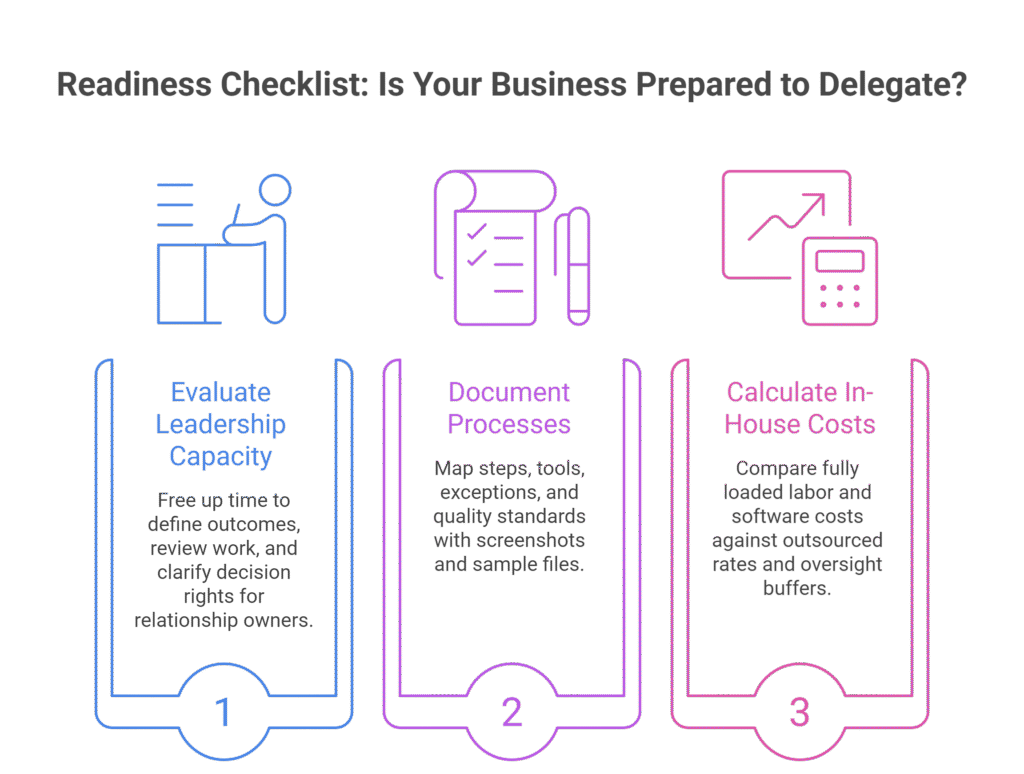
Readiness Checklist: Is Your Business Prepared to Delegate?
Before listing tasks or contacting providers, assess internal readiness thoroughly because rushing this step can create outsourcing friction for small teams. A clear look at leadership bandwidth, process documentation, and true in-house costs prevents wasted effort and misaligned expectations. Completing this evaluation first gives every later decision a stronger foundation and raises the odds that the partnership will deliver real capacity. The SBA’s business planning guidance offers a useful starting point for evaluating business priorities and costs.
1. Evaluate Leadership Capacity and Ownership
Owners must free up enough time to define outcomes and review early work. Clarify who owns the relationship and who approves exceptions. Without clear decision rights, even a strong Virtual Assistant arrangement can create bottlenecks instead of relief.
2. Document Processes and Capture Institutional Knowledge
Map every step of the candidate work, including tools, exceptions, and quality standards. Incomplete documentation is a primary reason first-time efforts stall. Capture screenshots and sample files so a Personal Assistant or specialized provider can ramp quickly.
3. Calculate True In-House Costs Versus Expected Value
Include fully loaded labor, software, management time, and opportunity cost. Compare those figures against realistic outsourced rates plus a modest oversight buffer. Businesses that complete this step first make sharper go/no-go decisions.
Task and Process Checklist: What Should You Outsource First?
 Choosing the right starting work determines whether outsourcing delivers quick wins or ongoing frustration. Focus on volume, clarity, and clear separation from core strategy so early results build momentum rather than create new coordination load. According to Xero’s research on UK small businesses, business owners spend only 46% of their working week on core responsibilities, highlighting the importance of identifying routine tasks that can be delegated to free up time for higher-value work.
1. Prioritise high-volume rules-based activities.
- Target processes that follow documented rules more often than exceptions and generate steady weekly volume.
- Confirm the work would still need to be performed if the business doubled tomorrow.
- Begin with contained functions such as Bookkeeping Services that produce measurable output and visible quality signals.
2. Separate strategic judgment from support execution.
- Keep final pricing decisions, major client relationships, and brand direction inside the company.
- Move repeatable execution layers outward while retaining oversight of outcomes.
- Apply this filter to Digital Marketing support so creative direction stays internal while production scales externally.
3. Define success metrics and sequence the first hand-offs.
- Write explicit cycle-time, accuracy, and escalation targets before any work leaves the building.
- Launch with one or two narrow processes rather than an entire department.
- Use early wins to justify the next wave only after the first process proves stable.
Access and Security Checklist: Protect Data and Systems
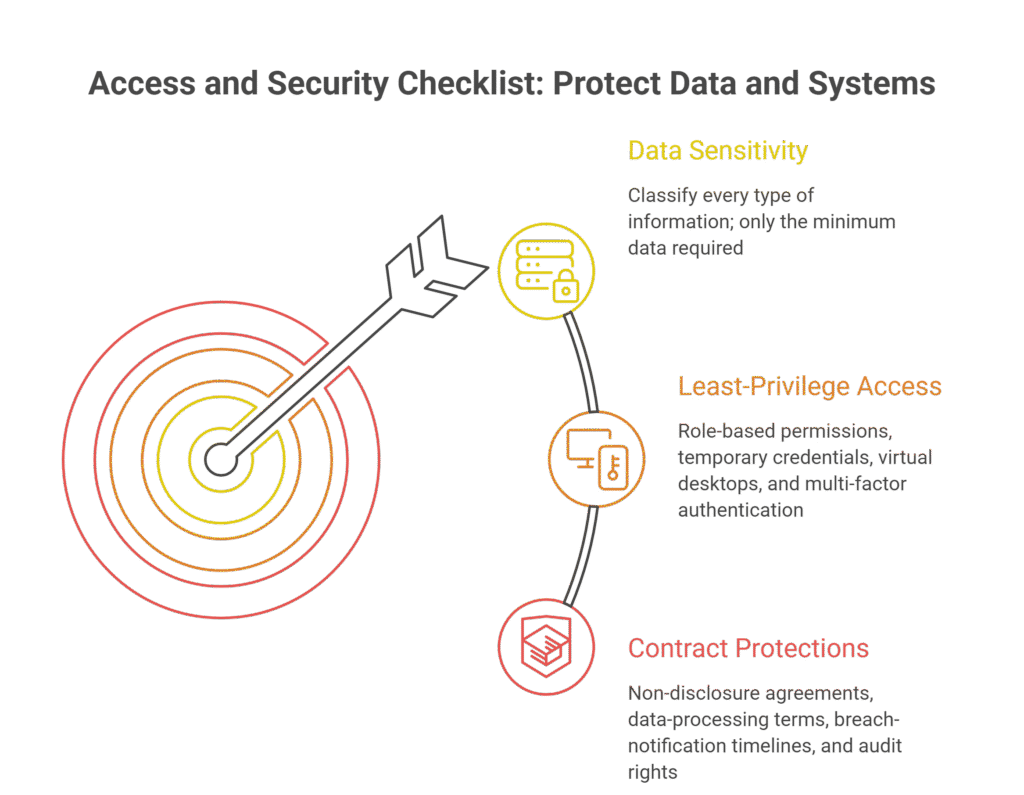
Security failures destroy trust faster than almost any other outsourcing problem. Treat access design as a first-class requirement rather than an afterthought so the partnership begins on solid ground and remains sustainable.
1. Map Data Sensitivity and Regulatory Scope
Classify every type of information the provider will touch—public, internal, confidential, or regulated—and note any industry rules or client contractual obligations that apply. Only the minimum data required for the defined tasks should ever leave the company’s control.
2. Implement Least-Privilege Access Controls
Prefer role-based permissions, temporary credentials, virtual desktops, and multi-factor authentication over broad system rights. Maintain an access log and revoke credentials immediately when a project ends or a team member rotates off the account. A Virtual Receptionist handling inbound calls, for example, needs far narrower system rights than a provider managing financial records.
3. Lock Protections into the Contract
Include non-disclosure agreements, data-processing terms, breach-notification timelines, and audit rights. Specify data-residency preferences where relevant and require the provider to maintain documented cybersecurity practices. Build clear exit language so knowledge and access can be returned or destroyed cleanly.
Provider and KPI Checklist: Selecting and Measuring Partners

Vendor choice and ongoing measurement determine whether an outsourcing arrangement creates lasting capacity or simply shifts problems outside the business. Strong selection criteria and clear KPIs turn subjective satisfaction into objective progress. According to the Project Management Institute’s 2024 research, 81% of projects had a well-established measurement system to guide decisions, highlighting the importance of tracking performance and defining clear expectations from the start.
1. Define required capabilities and cultural fit.
- List must-have skills, tool familiarity, time-zone coverage, and communication style expectations.
- Request recent references from clients of similar size and complexity.
- Evaluate responsiveness during the sales process itself as an early indicator of working style.
2. Align commercial terms with desired outcomes.
- Prefer fixed retainers for predictable volume and unit-based elements for variable work.
- Clarify inclusions, exclusions, and the change-order process in writing.
- Attach specific performance targets when including services such as Facebook Marketing & Ads.
3. Establish governance and a short list of KPIs.
- Schedule frequent check-ins in the first month, then shift to a sustainable review rhythm.
- Track turnaround time, accuracy, stakeholder satisfaction, and escalation frequency.
- Review the scorecard on a fixed cadence so both sides share the same definition of success.
14-Day Pilot Scorecard: Test Before You Scale
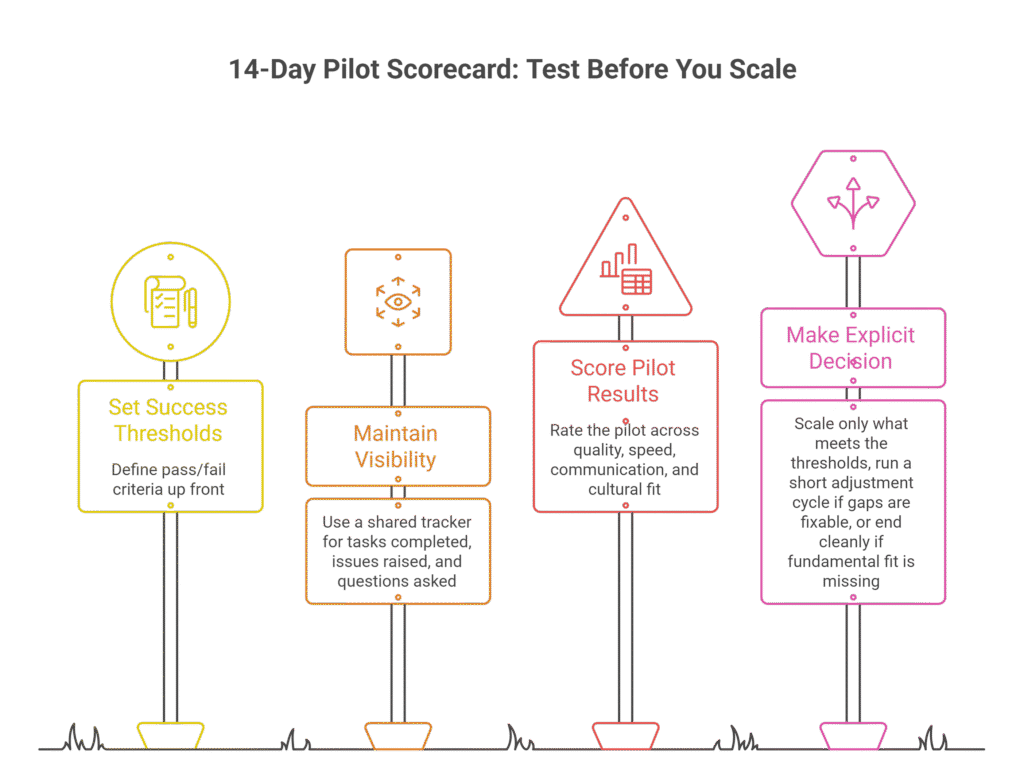
A tightly scoped pilot converts theory into evidence while financial and operational exposure remains small. Select one well-documented process, set quantitative thresholds in advance, and decide explicitly at the end of fourteen days whether to scale, adjust, or stop.
1. Design Scope and Success Thresholds
Choose a single process with clear volume and quality targets. Define pass/fail criteria up front—for example, on-time completion rate, error rate, and internal stakeholder feedback—so the evaluation stays objective rather than subjective.
2. Maintain Visibility and Collect Evidence
Use a shared tracker for tasks completed, issues raised, and questions asked. Daily visibility in the first week accelerates learning; a midpoint check allows course correction before the pilot ends. Incorporate specialized work such as LinkedIn Marketing & Ads or Video Editing Services only when the same rigorous thresholds apply.
3. Score Results and Make an Explicit Decision
Rate the pilot across quality, speed, communication, and cultural fit. Hold a short decision meeting on day fourteen. Scale only what meets the thresholds, run a short adjustment cycle if gaps are fixable, or end cleanly if fundamental fit is missing. Instagram Marketing & Ads can be added later once the initial process has proven stable.
Common Pitfalls and How to Avoid Them
Even well-planned outsourcing arrangements can fail when predictable challenges are overlooked. Clear expectations, documented processes, and practical safeguards help small businesses keep outsourced operations on track while protecting the time invested in readiness, provider selection, and onboarding.
1. Avoid scope creep and ambiguous goals.
- Freeze the initial process definition until the pilot concludes successfully.
- Require written change requests that update both metrics and commercial terms.
- Resist adding online Marketing Services or Social Media Marketing until the first process is stable.
2. Protect knowledge and internal ownership.
- Keep a living internal playbook that the provider updates but the company owns.
- Schedule regular knowledge-transfer checkpoints during the engagement.
- Plan the exit path so Data Handling rights and system access can be revoked cleanly.
3. Maintain realistic management attention.
- Block calendar time for reviews instead of hoping capacity will appear.
- Escalate early when communication or quality begins to drift.
- Expand only after SEO Services, Website Design Services, or Website Development pilots have met their targets.
TaskVirtual: Your Partner for Small Business Outsourcing Support

When small business owners are ready to implement the readiness, task selection, security, and pilot steps outlined in this guide, the right partner can turn planning into reliable execution. TaskVirtual helps U.S. companies manage outsourced business operations by providing trained virtual professionals who handle documented processes, maintain clear communication, and support operational continuity. This allows business owners to delegate routine responsibilities with confidence while keeping their focus on strategic priorities and sustainable growth.
1. Expert Guidance for Outsourcing Readiness
TaskVirtual’s team works with clients to clarify priorities, refine process documentation, and match the right skill sets to the tasks identified in a readiness assessment. They support structured hand-offs so the transition from internal work to external support stays organized and measurable.
2. Affordable and Flexible Pricing
Hiring a full-time personal assistant can be expensive, but TaskVirtual makes it cost-effective. With pricing plans starting from just $3.12/hour to $14.99/hour, their services are budget-friendly and accessible to individuals, families, and businesses.
3. Comprehensive Coverage Across Core Functions
From administrative coordination and Bookkeeping Services support to Digital Marketing execution and routine IT Support Services, TaskVirtual adapts to the specific processes a small business chooses to outsource first. Services scale from focused pilots to ongoing capacity as results prove out.
4. Ongoing Oversight and Quality Control
Regular updates, shared trackers, and proactive issue flagging help maintain the visibility and KPI discipline recommended in the pilot and provider sections of this guide. The goal is consistent performance without constant owner intervention.
5. Proven Track Record of Excellence
With 364 positive reviews and a 4.7-star rating on trusted VA platforms, TaskVirtual is recognised as a reliable partner worldwide. Clients count on their expertise to simplify daily operations and free leadership time for higher-value work.
FAQ
1. What should a small business outsource first?
A. Begin with high-volume, rules-based work that is well documented and not core to competitive advantage—bookkeeping, basic customer support, scheduling, or digital marketing execution are common starting points.
2. How do I know if my business is ready to outsource?
A. You are ready when leadership has bandwidth to define outcomes and review work, processes are documented, costs of keeping the work in-house are understood, and basic security and access controls can be put in place.
3. What security steps are essential when outsourcing?
A. Classify data sensitivity, grant least-privilege access, require multi-factor authentication, put NDAs and breach terms in the contract, and plan for orderly knowledge return or destruction at exit.
4. How long should a pilot last?
A. A focused 14-day pilot with clear success criteria is long enough to test quality, communication, and cultural fit without committing large resources.
5. What KPIs matter most for small business outsourcing?
A. Prioritize turnaround time, accuracy/error rate, stakeholder satisfaction, cost per unit of work, and escalation frequency. Review them on a fixed schedule.
6. Can outsourcing actually free the owner’s time?
A. Yes—when the work is properly scoped, documented, and measured. Many owners report reclaiming 10–20 hours per week once the relationship stabilizes, provided they invest the necessary setup and governance time upfront.
Conclusion and Next Step
An outsourcing checklist for small businesses is not a one-time form; it is a decision framework that reduces risk and increases the odds of real capacity and cost gains. By working through readiness, task selection, security, provider and KPI design, and a disciplined 14-day pilot, you move from hopeful delegation to managed, measurable results.
Start today: pick one process that consumes disproportionate owner or staff time, run it through the questions in this guide, and design a short pilot. The businesses that treat outsourcing as a managed capability rather than a quick cost cut consistently extract more value. Use this small business outsourcing guide as your working document, update it with every engagement, and scale only what the data proves works. Consider adding IT Support Services only after the foundational processes have proven stable.
Sources
- Deloitte Global Shared Services and Outsourcing / GBS Survey materials (2024–2025 findings on savings and governance).
- Clutch small business outsourcing surveys (widely cited 37% adoption and 83% maintain-or-increase spend figures).
- ISG Market Lens Business Process Outsourcing Study (average ~15% cost savings).
- Statistics Canada analysis of businesses outsourcing work (first quarter 2025 data on prevalence by size).
- Statista Business Process Outsourcing market outlook and related industry reports.
For more such content, visit our website.
 Siddhartha Basu is a Technical Writer at Task Virtual. He loves online games, e-book reading, and Yoga.