Contents
show
Will AI replace teachers and shape the future of human learning
The question “Will AI replace teachers?” dominates headlines as generative AI tools flood classrooms. In 2026, the AI in education market is projected to reach around $9.58 billion. Anxiety is understandable amid ongoing teacher shortages and burnout. Yet evidence clearly points to augmentation rather than replacement.
AI excels at routine tasks and scaling personalized practice. It cannot replicate emotional intelligence, real-time classroom management, ethical guidance, and student inspiration. Nearly 55% of teachers worry that AI could reduce meaningful human connections in the classroom. For American families, educators, and policymakers, understanding this distinction is critical. This guide examines the landscape, benefits, limitations, and hybrid future with teachers at the center.
The Current State of AI in Education
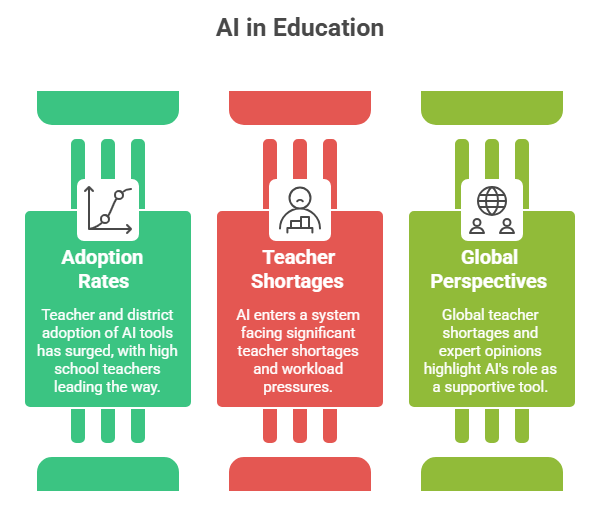
AI is rapidly integrating into American schools in 2026, while the education system faces significant challenges. Teacher adoption has increased sharply as districts seek solutions for personalization and workload management through AI for task management. However, gaps in training and resources create uneven implementation across regions. Understanding current realities helps separate hype from practical impact.
1. Adoption Rates Among Teachers and Districts
AI adoption has surged dramatically, with teacher use of AI tools jumping from 32% in 2024 to 61% in 2025, and many are integrating it weekly for lesson planning and materials, while high school teachers lead at around 69% for generative AI. Approximately 74% of school districts provided AI training in 2025, though gaps remain, as 71% of K-12 teachers report no formal AI training in some surveys. This rapid uptake reflects pressure to personalize learning while managing heavy workloads.
2. Teacher Shortages and Workload Pressures
AI enters a strained system where an estimated 411,549 teaching positions were unfilled or filled by underqualified educators in 2025, about 1 in 8 nationwide. Public K-12 teachers report overwhelming conditions, with 70% saying schools are understaffed and 84% lacking enough time for grading, planning, and administrative tasks. Teachers work about 50 hours weekly, with less than half in direct student interaction, and RAND and NCES data show nearly 10 hours per week on lesson planning and grading alone. These realities fuel burnout and attrition, making AI’s time-saving potential particularly relevant.
3. Global and Expert Perspectives
UNESCO projects a need for 44 million more primary and secondary teachers worldwide by 2030, underscoring a global shortage. A World Economic Forum report found 78% of education experts believe AI will augment, not replace, teachers. Pew Research notes nearly a third of experts see some job risk over two decades, yet most evidence supports transformation over elimination. This consensus highlights AI as a supportive tool amid persistent demand for human educators.
How AI Is Already Transforming Teaching Tasks
AI is easing teacher workloads and improving student learning across U.S. classrooms. It handles routine tasks and supports adaptive learning at scale. A Gallup-Walton Family Foundation survey found that 60% of U.S. K-12 public school teachers used AI tools during the 2024–2025 school year, helping educators focus more on meaningful student interactions.
- Teachers using AI weekly save 5.9 hours on planning, grading, and communications.
- Tools draft messages, create worksheets, and summarize student data quickly.
- AI boosts engagement by up to 60% and efficiency by 57% through adaptive paths.
- Intelligent tutors deliver strong learning gains in recent trials.
- Automated grading flags issues early and suggests timely interventions.
- AI offers 24/7 practice and feedback to address the 2 Sigma Problem.
Limitations of AI: What Machines Cannot Replace
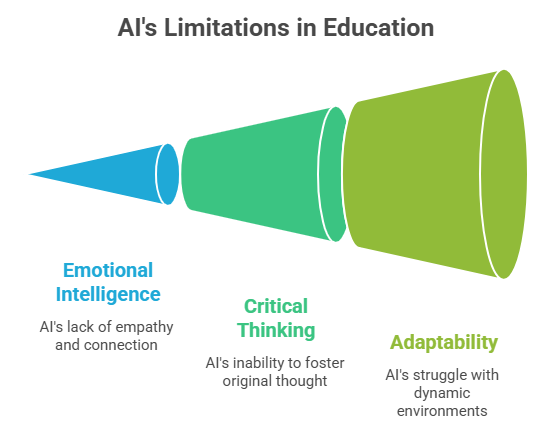
AI offers powerful capabilities but falls short in the human side of teaching. Machines process data efficiently, yet they cannot truly understand emotions or classroom dynamics. Pew Research Center found that 25% of U.S. public K-12 teachers say AI tools do more harm than good in education, reinforcing the need for human guidance. Teachers remain irreplaceable for building trust and supporting students holistically.
1. Emotional Intelligence and Human Connection
AI lacks empathy, nuance, and the ability to build trusting relationships that students need. Classroom management, motivation during frustration, and reading subtle cues require human judgment that technology cannot provide. Over half of public K-12 teachers in Pew surveys express concerns about reduced human interaction. Students thrive with role models who demonstrate resilience, ethics, and passion—qualities AI simulates but does not embody.
2. Critical Thinking, Creativity, and Ethical Guidance
While AI generates content quickly, teachers foster original thought, debate, and moral reasoning essential for student development. AI can hallucinate facts or reflect biases in training data, requiring educators to provide proper context, source evaluation, and responsible use modeling. Many teachers worry about plagiarism risks and unequal access across different student groups. Effective teaching demands guiding students through complex ethical questions and creative problem-solving that pure algorithms cannot replicate authentically.
3. Adaptability in Dynamic Environments
Real classrooms involve constant distractions, group dynamics, cultural sensitivities, and unexpected moments that demand flexible responses. AI struggles with real-time improvisation and holistic student well-being that experienced teachers navigate instinctively every day. Teachers adjust lessons on the fly based on emotional climate and interpersonal cues that no current system fully processes. This human adaptability ensures learning remains responsive and supportive in varied American school settings.
The Hybrid Future: Teachers + AI Collaboration
The future of education lies in thoughtful collaboration between teachers and AI tools. Digitizing the education business will help educators evolve into orchestrators who leverage technology while maintaining human leadership. Successful integration keeps teachers central to the learning process.
- Educators act as AI-fluent orchestrators who curate outputs and lead discussions.
- Teachers gain time for mentoring and individual student support.
- Districts succeed with AI tools, training, and clear policies.
- Best practices focus on teacher input and ongoing training.
- Pilots track efficiency and student outcomes.
- The shift emphasizes coaching and social-emotional development.
Challenges and Risks of AI Integration
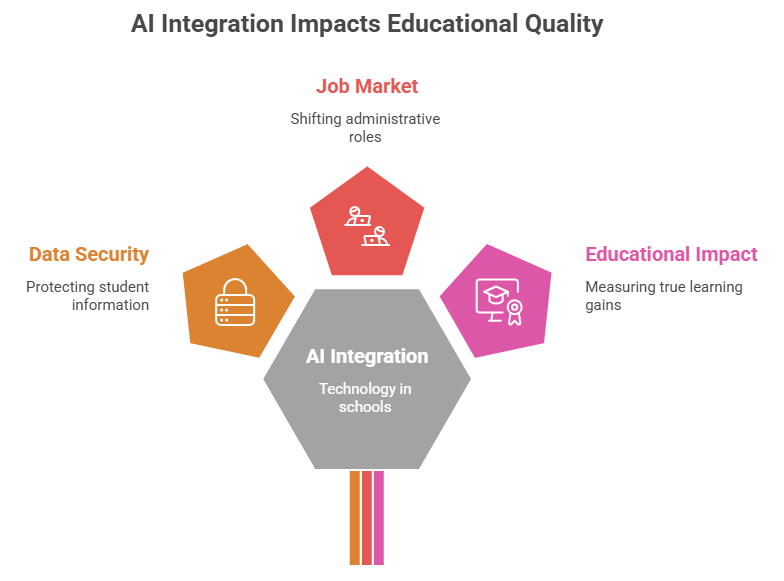
AI integration brings significant benefits but also introduces important challenges that schools must address proactively. Data security, fairness, and balanced AI implementation require careful attention from all stakeholders. Without proper safeguards, technology could exacerbate existing inequalities. Thoughtful oversight ensures AI supports rather than undermines educational quality.
1. Data Privacy, Bias, and Over-Reliance
Student data security is paramount, and AI systems must comply with FERPA while protecting privacy at all times. Biases in models can disadvantage certain student groups, making teacher monitoring essential for fairness and equity. Over-reliance on AI may reduce student self-monitoring and critical thinking skills if not carefully balanced with human instruction. Schools must implement strong safeguards and maintain active human oversight in all educational decisions.
2. Job Market and Professional Development Needs
Core teaching jobs face low automation risk, while some administrative and support roles may shift due to AI capabilities. The profession requires substantial investment in AI literacy, as only a minority of teachers currently feel fully prepared to teach AI responsibly. Ongoing teacher shortages mean AI should help retain talent by reducing burnout rather than cutting headcount. Continuous professional development focused on ethical integration remains vital for long-term success.
3. Measuring True Educational Impact
Not all AI applications deliver lasting gains in real classroom settings. Research shows many benefits require consistent human oversight, with gains often fading without it. Rigorous evaluation frameworks are essential to separate effective tools from temporary solutions. Schools must track meaningful metrics, including long-term learning outcomes and student well-being, beyond basic efficiency.
Preparing for 2026 and Beyond: Actionable Strategies
Educators should experiment with free or district-provided AI tools for planning and differentiation while focusing professional growth on effective prompting, ethical integration, and high-touch skills. 69% of teachers report that AI tools have improved their teaching methods. Collaboration with peers helps share successful practices and accelerate adoption. Teachers must prioritize building irreplaceable human competencies alongside technical fluency. Staying informed about new developments ensures that they lead AI integration effectively in their classrooms.
Administrators and policymakers need to prioritize teacher-led AI adoption supported by comprehensive training, equitable resource distribution, and transparent policies. Investing in proven hybrid models can improve both efficiency and student outcomes across diverse districts. Tracking key metrics such as teacher retention, engagement levels, and achievement gaps provides valuable guidance. Clear guidelines and ongoing evaluation will help schools maximize benefits while minimizing risks for all American students.
How Virtual Assistants Help Empower Teachers With AI
A virtual assistant enhances online education by filling the gap between AI technology and effective classroom use for busy educators. They provide hands-on support to integrate tools smoothly while preserving the human elements essential to teaching. This partnership helps teachers save time and implement AI confidently.
- Assistants help select AI tools and create personalized student pathways.
- They generate materials, draft communications, and organize data.
- Experts ensure ethical use, bias checks, and FERPA compliance.
- They deliver quick training on prompting and tool troubleshooting.
- Assistants monitor results and adjust for better balance.
- They free teachers for mentoring and human-focused instruction.
TaskVirtual: Your Partner in AI-Empowered Teaching Support
Teachers today juggle heavy workloads, AI tool integration, lesson personalization, and administrative demands while striving to maintain human connection in the classroom. Navigating AI platforms, generating materials, and managing data insights can feel overwhelming without proper support. TaskVirtual offers expert AI virtual assistants specialized in education technology to help educators implement AI effectively and reclaim time for what matters most.
1. Expert AI Integration and Task Support
TaskVirtual’s skilled virtual assistants help teachers select and use the best AI tools for lesson planning, differentiated materials, automated grading, and personalized student pathways while ensuring alignment with classroom goals.
2. Affordable and Flexible Pricing
Hiring a full-time personal assistant can be expensive, but TaskVirtual makes it cost-effective. With pricing plans starting from just $3.12/hour to $14.99/hour, their services are budget-friendly and accessible to individual teachers, schools, and districts.
3. Comprehensive Hybrid Teaching Solutions
From curating AI-generated content through educational content development services and analyzing student data to supporting ethical AI use and reducing administrative burdens, TaskVirtual covers everything needed for successful teacher-AI collaboration in American classrooms.
4. Ongoing Support and Quality Assurance
TaskVirtual provides continuous guidance, updates on new AI tools, and proactive assistance to maintain a balance between technology and human instruction, ensuring smooth implementation without added stress.
5. Proven Track Record of Excellence
With 364 positive reviews and a 4.7-star rating on trusted VA platforms, TaskVirtual is recognised as a reliable partner worldwide. Educators count on their expertise to simplify AI adoption and enhance teaching effectiveness.
FAQ Section
1. Will AI completely replace teachers by 2030?
No. Shortages and expert consensus show AI augments roles. Teachers remain essential for human elements that AI cannot provide.
2. How much time can AI save teachers weekly?
Frequent users save about 5.9 hours per week on administrative tasks, reducing burnout.
3. What subjects or tasks is AI best suited for?
AI excels in personalized practice, grading routine work, language drills, math procedures, and content generation. Human teachers dominate complex discussion, creativity, and socio-emotional support.
4. Are students learning more with AI tutors?
Evidence shows strong gains in targeted skills and efficiency, often outperforming traditional methods in controlled studies, but the best results combine AI with human guidance.
5. What training do teachers need for AI?
Comfort with lesson planning/grading tools is high (~69%), but many need support in teaching AI literacy and ethics. Districts should expand accessible professional development.
6. How can schools ensure equitable use of AI?
Provide device/internet access, conduct bias audits, provide teacher training, and implement policies that prioritize human oversight in high-stakes decisions.
Conclusion
Will AI replace teachers? The data and expert analysis in 2026 say no—it will empower them. By handling routine work and scaling personalization, AI addresses key pain points like shortages, workloads, and diverse learner needs, allowing educators to focus on irreplaceable human connections that shape young lives.
America’s education system faces real challenges, but AI offers a path to stronger outcomes when teachers lead integration. The winners will be students who experience both technological precision and human inspiration.
Sources
- Pew Research Center surveys on teachers and AI
- RAND Corporation and National Center for Education Statistics
- UNESCO Global Report on Teachers
- EdWeek, Gallup-Walton Family Foundation, and other education surveys
- Grand View Research, Precedence Research, and market analyses on AI in education
- Learning Policy Institute teacher shortage data
- Various peer-reviewed studies on intelligent tutoring systems (2025)
For more such content, visit our website.
 Siddhartha Basu is a Technical Writer at Task Virtual. He loves online games, e-book reading, and Yoga.