Contents
show
Will AI replace accountants in the future of finance careers
Will AI replace accountants? This pressing question shapes finance conversations in 2026 as generative AI tools rapidly automate routine tasks. Yet official data and industry reports confirm AI serves as a powerful enhancer rather than a full replacement. Accountants who integrate AI shift toward higher-value advisory work amid ongoing talent shortages. Regulatory complexity further demands human oversight and professional judgment.
Demand for accountants stays strong due to economic growth and compliance needs. Firms report using AI to manage workloads instead of cutting staff. 81% of accountants say AI improves their productivity, delivering clear advantages and expanded client services. The future belongs to accountants who combine AI efficiency with strategic insight.
Current State of AI in Accounting (2026)
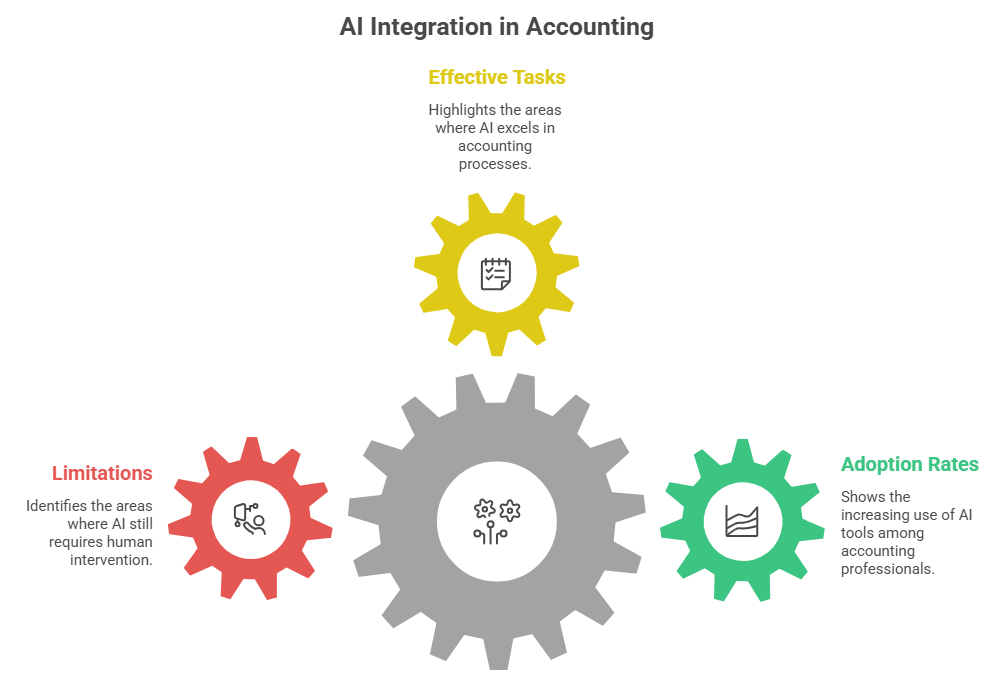
AI integration in accounting accelerates in 2026 with widespread tool availability and proven benefits. Firms adopt automation for compliance and daily operations while addressing implementation challenges. Professionals report notable efficiency gains alongside persistent concerns over accuracy. Overall adoption reflects a balanced approach to technology and human expertise.
1. Adoption Rates Among Professionals
46% of accountants now use AI tools daily, up sharply from 18% in 2023. Over 50% of accounting professionals utilize AI within software and key workflows. 63% of finance teams actively explore AI solutions, though full implementation lags at lower percentages. Larger firms lead adoption while smaller practices follow with cloud-based tools.
2. Tasks AI Handles Effectively
AI excels at data entry, transaction categorization, a virtual assistant for invoice processing, and basic reconciliations. Accountants using AI close books 7.5 days faster on average and support more clients weekly. Tools deliver 12% higher reporting granularity and reallocate 8.5% of time from routine tasks to value-added work. Automation covers up to 80% of repetitive bookkeeping activities.
3. Limitations of Current AI Systems
Current AI struggles with nuanced regulatory interpretations and complex ethical decisions. Systems require human oversight to prevent errors and ensure compliance accuracy. Client relationship management and contextual business judgment remain firmly human domains. Professional liability and final sign-offs demand licensed CPA involvement.
BLS and Official Job Outlook Data
BLS data provides clear guidance on accounting employment trends through 2034. Projections show steady demand despite automation of routine functions. Talent shortages amplify opportunities for skilled professionals, with 83% of financial leaders reporting difficulty finding qualified accounting talent. AI helps address capacity gaps rather than reduce overall headcount.
- Employment of accountants and auditors is projected to grow 5% from 2024 to 2034, faster than average.
- About 72,800 openings are expected annually due to growth and replacements.
- Bookkeeping and basic auditing clerk roles face declines from automation.
- Overall, business and financial occupations show faster-than-average growth.
- Persistent talent shortages drive strong hiring demand for qualified accountants.
- AI adoption supports existing staff rather than replacing them amid retirements.
How AI Transforms Accountant Roles
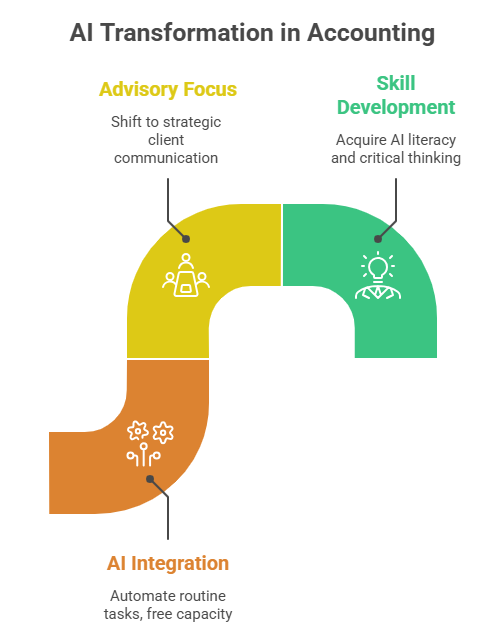
AI reshapes daily workflows by handling repetitive activities and freeing capacity for strategic contributions. Professionals report higher job satisfaction and expanded service offerings. Firms achieve greater scalability without proportional staff increases, as 76% of accounting firms report handling higher client volumes with existing staff. The transformation emphasizes advisory expertise over traditional compliance work.
1. Shift to Advisory and Strategic Services
Accountants spend less time on back-office processing and more on client communication and forecasting. AI enables deeper business analysis and proactive advisory relationships. Firms deliver higher-value insights on strategy and performance optimization. This evolution strengthens the accountant’s relevance in executive decision-making.
2. Productivity and Efficiency Gains
81% of accountants note significant productivity increases from AI assistance. Monthly close times drop substantially while client capacity rises. Reducing mental load on routine tasks improves focus and accuracy. Leading firms handle 2-3 times more workload without added headcount.
3. New Skill Requirements
Success now requires strong AI literacy alongside traditional accounting knowledge. Critical thinking, data interpretation through data mining service, and communication skills gain prominence. Professionals must evaluate AI outputs and integrate technology effectively. Big Four and mid-size firms invest in upskilling programs to build these competencies.
Risks and Challenges of AI Adoption

AI implementation brings both opportunities and important considerations for accounting practices through accounting virtual assistant support. Firms must balance efficiency gains with oversight and security needs. Professional standards continue to require human accountability. Careful adoption strategies minimize potential downsides while maximizing benefits.
- Many accountants express concerns about potential errors and hallucinations in AI outputs.
- Human review remains essential for regulatory compliance and final accuracy.
- Complex tax and audit standards cannot be fully managed by current AI systems.
- Cybersecurity risks increase with greater data sharing and automation reliance.
- Professional liability stays with licensed CPAs who must oversee AI work.
- Data privacy regulations demand strict controls around AI-processed financial information.
Strategies for Accountants to Future-Proof Careers
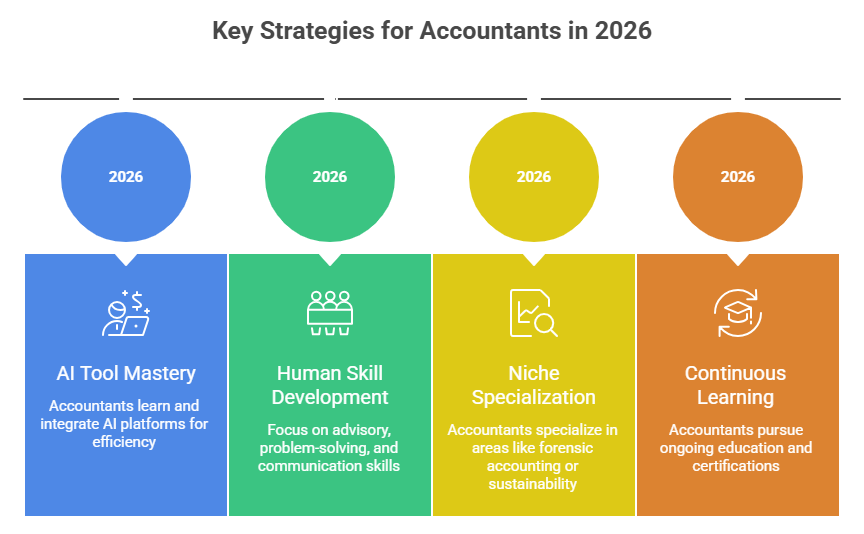
Accountants can thrive by proactively adapting to technological changes in 2026. Strategic skill development ensures continued relevance and career growth. Firms and individuals benefit from targeted upskilling and specialization. Embracing AI as a partner creates new opportunities in advisory services.
1. Master AI Tools and Integration
Learn leading platforms for automation, analytics, and generative AI tasks. Develop prompt engineering skills and the ability to evaluate tool outputs. Integrate AI into daily workflows for maximum efficiency gains. Regular practice builds confidence and competence with evolving technologies.
2. Develop High-Value Human Skills
Focus on client advisory, complex problem-solving, and ethical decision-making abilities. Strengthen communication and leadership capabilities that AI cannot replicate. Build expertise in interpreting data within business contexts. These interpersonal and judgment skills differentiate professionals in the AI era.
3. Specialize in Niche Areas
Target forensic accounting, sustainability reporting, or international tax compliance. Industry-specific knowledge in healthcare or technology adds unique value. Deep expertise in emerging areas like crypto assets creates differentiation. Specialization reduces automation vulnerability while increasing earning potential.
4. Continuous Learning and Certification
Pursue ongoing education in AI applications and data analytics. Maintain and expand professional certifications to enhance marketability. Attend industry workshops and monitor regulatory updates. Lifelong learning ensures adaptability to rapid technological and compliance changes.
How virtual assistants help enhance accounting with AI
A virtual assistant for accountant bridge the gap between AI technology and practical accounting needs in 2026. They handle implementation details while accountants focus on strategic client work. This partnership accelerates AI adoption without overwhelming internal teams. Firms gain efficiency and compliance support through expert assistance.
- Virtual assistants set up and manage AI tools for data entry and reconciliation tasks.
- They review AI outputs for accuracy and flag issues before final reporting.
- Virtual assistants maintain client data organization and automate recurring processes.
- They track regulatory updates and ensure AI workflows stay compliant.
- Virtual support handles invoice processing and basic bookkeeping automation.
- They train accounting staff on new AI features and daily best practices.
TaskVirtual: Your Partner in AI-Powered Accounting Support

Integrating AI into accounting workflows while maintaining compliance and client service standards can feel complex for many professionals. From selecting the right tools to managing daily automation and upskilling, the process often consumes significant time. TaskVirtual offers expert AI virtual assistance tailored for accountants and firms navigating AI adoption and routine task management. Their trained specialists help streamline operations so you can focus on high-value advisory work.
1. Expert AI Integration and Accounting Consultation
TaskVirtual’s virtual assistants support accountants with AI tool selection, workflow automation setup, data reconciliation, and report generation. They also assist in prompt engineering, output review, and transitioning routine tasks to AI while maintaining accuracy and compliance.
2. Affordable and Flexible Pricing
Hiring a full-time personal assistant can be expensive, but TaskVirtual makes it cost-effective. With pricing plans starting from just $3.12/hour to $14.99/hour, their services are budget-friendly and accessible to individuals, families, and businesses.
3. Comprehensive Accounting and AI Support Solutions
From automating bookkeeping processes and managing client data to supporting niche reporting and compliance tracking, TaskVirtual covers it all. Their scalable services adapt to whether you need occasional AI implementation through a virtual assistant for AI implementation help or consistent workflow support.
4. Ongoing Support and Quality Assurance
TaskVirtual provides continuous monitoring, updates on AI tool improvements, and proactive reminders for deadlines and regulatory changes. Their dedicated support ensures smooth operations without added stress on your practice.
5. Proven Track Record of Excellence
With 364 positive reviews and a 4.7-star rating on trusted VA platforms, TaskVirtual is recognised as a reliable partner worldwide. Clients count on their expertise to simplify AI adoption and streamline accounting tasks.
FAQ Section
1. Will AI completely replace accountants by 2030?
No. BLS forecasts growth, not decline, with AI handling routine tasks while humans focus on strategy.
2. Which accounting jobs face the highest automation risk?
Bookkeeping and basic data entry roles; professional accountants shift to advisory.
3. How much can AI boost accountant productivity?
Studies show faster closings, more clients served, and significant time savings on routine work.
4. What skills should aspiring accountants learn in 2026?
AI tools, data analytics, critical thinking, and communication, alongside core accounting knowledge.
5. Are accounting firms hiring fewer due to AI?
Most report using AI to handle workload amid shortages, not to cut staff. Demand for skilled talent remains strong.
6. How should small firms adopt AI?
Start with automation for compliance and bookkeeping, then scale to advisory tools with proper training.
Conclusion
Will AI replace accountants? No—AI automates routine work and elevates the profession toward strategic advisory services. Accountants who adapt will benefit from strong job growth, talent shortages, and higher-value opportunities. The combination of AI efficiency and human expertise creates more impactful careers. Embrace tools, build new skills, and position yourself as an indispensable business advisor in 2026 and beyond.
Sources
- U.S. Bureau of Labor Statistics Occupational Outlook Handbook
- Stanford Graduate School of Business research
- AICPA, Intuit, Sage, and industry surveys (2025-2026)
- CPA.com and official reports
For more such content, visit our website.
 Siddhartha Basu is a Technical Writer at Task Virtual. He loves online games, e-book reading, and Yoga.