Contents
show
How Claude AI API Scales Personalized Lead Generation Systems
The Claude AI API from Anthropic gives developers and teams programmatic access to Claude’s advanced language models through clean RESTful endpoints. It also provides official SDKs for streamlined integration. It powers custom AI applications that handle complex reasoning, long-context analysis, and nuanced text generation. This helps avoid the generic outputs common in other APIs. When paired with virtual assistants, the Claude AI API becomes the engine for lead generation systems that research prospects, craft hyper-personalized messages, and qualify leads in real time. It then feeds results directly into CRMs, turning hours of manual work into automated, scalable pipelines.
Small businesses, agencies, startups, and entrepreneurs in the US and UK face a consistent constraint. Lead generation is expensive, slow, and increasingly ineffective when executed manually. Buyers now expect relevance at the first touch. Most teams still depend on generic templates or limited outreach volume. True personalization at scale requires significant time and expertise. In fact, 81% of consumers ignore irrelevant messages, underscoring how ineffective generic outreach has become. The Claude AI API changes this equation. Virtual assistants leverage Anthropic’s Claude API integration to build end-to-end systems that deliver highly personalized campaigns and qualify prospects through conversational workflows. These systems also maintain accurate pipelines without the overhead of hiring full-time developers or expanding sales teams.
| Aspect | Manual / In-House Approach | VA + Claude AI API System | Efficiency Gain |
|---|---|---|---|
| Daily lead volume | 20–50 prospects (limited by team hours) | 200–1,000+ prospects (automated) | 5–10x scale |
| Personalization level | Generic templates or basic mail-merge | Research-driven, context-aware emails and messages | 3–5x higher response rates |
| Time per campaign | 10–20 hours for research + writing | 1–3 hours of VA oversight | 80–90% time saved |
| Cost per qualified lead | $50–$150 (staff time + tools) | $8–$25 (API tokens + VA hours) | 60–80% lower |
| Scalability | Requires new hires or overtime | Add API credits and VA capacity instantly | On-demand growth |
| Accuracy & compliance | Human error is common; manual checks | Grounded prompts + VA review; built-in safety guardrails | Fewer compliance risks |
What This Means for Businesses
For US and UK companies evaluating AI tools and outsourcing, Claude AI API + virtual assistants means lead generation stops being a bottleneck. Teams generate hundreds of personalized touches per week instead of dozens. Conversion rates rise because every message references real prospect context—recent funding, product launches, or industry pain points. Operations become predictable: virtual assistants monitor API performance, refine prompts, and handle exceptions, while the business focuses on closing deals. The result is lower customer acquisition cost, faster pipeline velocity, and the ability to test new markets or offers without proportional headcount growth.
How This Actually Works
At its core, a lead generation system built with the Claude AI API turns raw prospect data into intelligent action. Virtual assistants send structured prompts to Anthropic’s Messages API. It returns reasoned outputs based on Claude’s training in complex reasoning and long-context understanding. Current models support contexts up to 200K+ tokens.
Claude processes tasks by decomposing them into structured internal steps. It analyzes input data and applies business rules defined in the prompt. It invokes tool calls when enabled and generates outputs aligned with safety and relevance constraints. In business workflows, this architecture is effective because the API is stateless yet conversation-aware. Virtual assistants preserve context across multiple calls and enrich inputs with CRM data. They also loop outputs into downstream tools such as email platforms. This matters in practice, as companies using AI-driven personalization report up to a 40% increase in productivity, highlighting the efficiency gains from structured automation. The Anthropic Claude API is particularly strong in this model due to its constitutional AI principles. These principles reduce hallucinations and maintain a brand-aligned tone. The outputs remain human-like and strategically consistent.
Core Capabilities of Claude AI for This Use Case
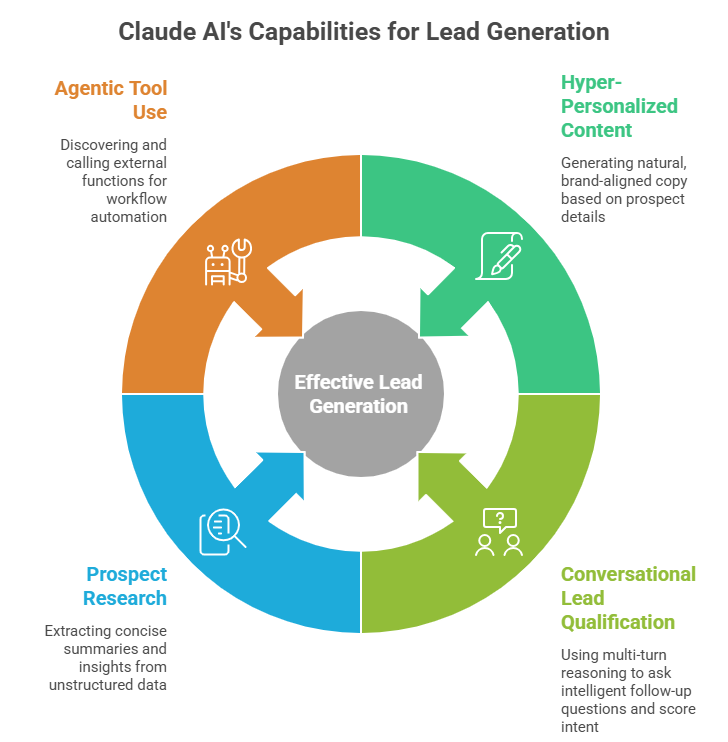
The Claude AI API delivers targeted strengths that directly power effective lead generation systems when combined with virtual assistants. Its advanced reasoning, long context handling, and tool integration capabilities make it well-suited for transforming raw prospect data. These features enable actionable, personalized outreach at scale. These focused features enable virtual assistants to automate complex workflows while maintaining quality and compliance.
1. Hyper-Personalized Content Generation
Claude’s models excel at producing natural, brand-aligned copy that references specific prospect details without sounding robotic. In practice, a virtual assistant uploads a prospect’s LinkedIn profile or company page summary, adds your value proposition and past campaign data, then calls the Claude AI API to generate full email sequences, LinkedIn messages, or call scripts. Businesses benefit because open and reply rates routinely double compared with templated outreach—personalization at scale becomes operationally feasible instead of a luxury.
2. Conversational Lead Qualification
Using the API’s strong multi-turn reasoning, virtual assistants build chatbots or qualification flows that ask intelligent follow-up questions and score intent in real time. The VA defines qualification criteria once in a system prompt; Claude then maintains context across the conversation and routes high-intent outsourced lead generation to sales or updates the CRM automatically. This matters because it filters noise early, so sales teams spend time only on ready-to-buy prospects rather than chasing every download.
3. Prospect Research and Insight Extraction
Claude handles large unstructured inputs exceptionally well. Virtual assistants paste website copy, earnings transcripts, or news articles into API calls and receive concise summaries, pain-point lists, or buying signals. The long context window lets Claude synthesize information from multiple sources in one pass. For businesses, this means every outreach message is grounded in current, relevant facts instead of outdated assumptions—dramatically improving relevance and trust.
4. Agentic Tool Use and Workflow Automation
Advanced tool-use features let Claude discover and call external functions (via Zapier MCP, custom APIs, or Make.com) during reasoning. A virtual assistant can instruct Claude to enrich a lead in a CRM, check calendar availability, or trigger a follow-up sequence—all within a single API conversation. This capability turns static prompts into autonomous agents, giving businesses reliable automation without maintaining complex codebases.
Why Companies Use Claude AI
Companies adopt the Claude AI developer API because it consistently produces higher-quality, more professional outputs for customer-facing content. Efficiency gains are driven by reduced revision cycles—virtual assistants report that 70–80% of generated copy requires only light editing. This aligns with broader industry data, where 56% of businesses report improved efficiency after adopting AI tools, reinforcing the operational advantage of AI-assisted workflows. Cost reduction is immediate: token-based pricing (roughly $3–$15 per million input/output tokens for balanced models like Sonnet) is predictable and significantly lower than hiring a full-time copywriter or developer. Scalability is inherent; the same prompt template can support 10 or 10,000 leads, while virtual assistants manage rate limits and optimize prompts dynamically. Compared with OpenAI API equivalents, many teams find Claude’s deeper reasoning and lower hallucination rate justify the investment, particularly in high-stakes B2B lead generation contexts.
Tasks Virtual Assistants Perform Using Claude AI
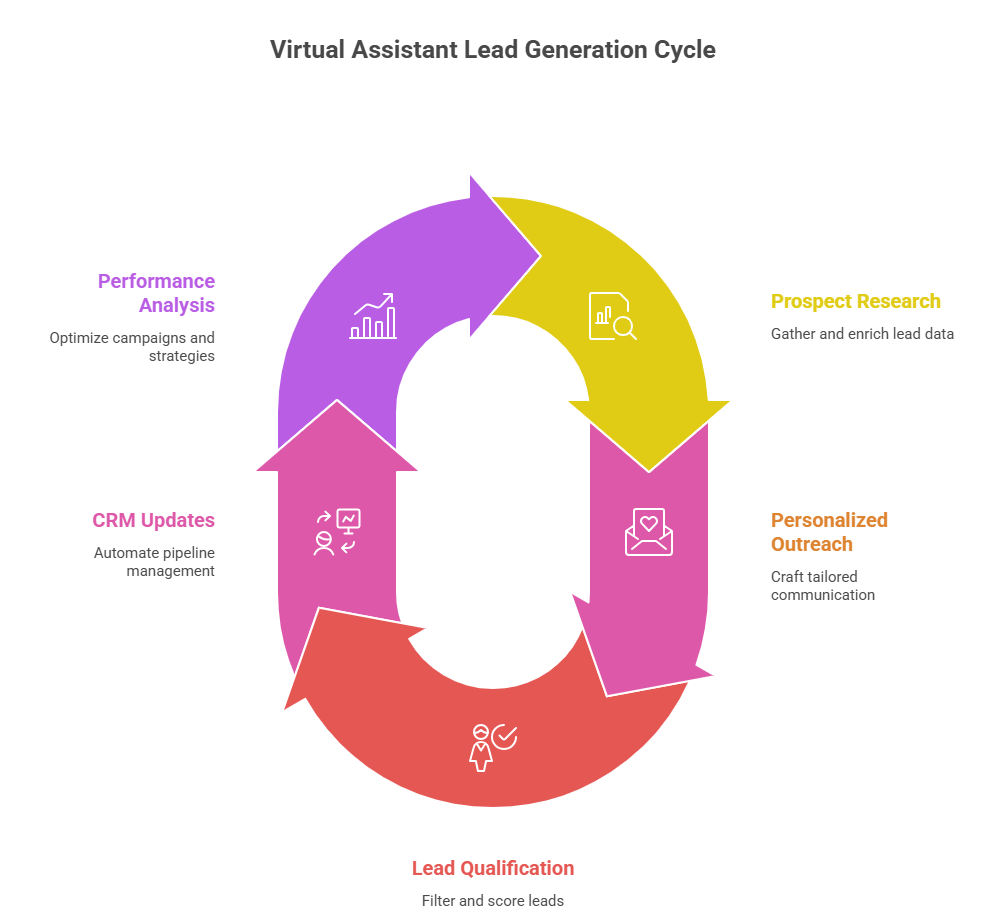
Virtual assistants leverage the Claude AI API to execute high-value lead generation tasks with precision and scale. By combining structured prompts, long-context analysis, and seamless tool integrations, they transform raw data into actionable pipelines while maintaining quality control. These practical workflows allow small businesses and agencies to achieve consistent results without building complex internal systems.
1. Prospect research and data enrichment
Virtual assistants feed target company URLs, news, or financial data into the Claude AI API and receive structured summaries of key decision-makers, recent initiatives, and buying signals. They then cross-reference this with your ICP criteria to build enriched lead profiles. This matters because sales teams receive pre-vetted, insight-rich records instead of raw lists, shortening the sales cycle by days or weeks.
2. Crafting hyper-personalized outreach sequences
The VA assembles research output with your messaging framework and calls the Anthropic Claude API to generate complete multi-touch email or LinkedIn campaigns that reference specific triggers. Each message is reviewed once for tone before scheduling. Content Development VA helps to gain higher engagement without writing from scratch.
3. Real-time lead qualification via chat interfaces
Virtual assistants embed Claude-powered qualification bots on landing pages or in messaging platforms. The API handles nuanced objection handling and intent scoring, passing only warm leads to the CRM with a confidence score. This operational task prevents sales teams from wasting time on unqualified inquiries.
4. Automated CRM pipeline updates and lead scoring
After every interaction or API-generated insight, the VA triggers Claude to analyze conversation transcripts or form responses and assign dynamic scores based on predefined rules. The output updates HubSpot or Salesforce fields automatically via Zapier. This analytical task keeps pipelines accurate and surfaces opportunities faster.
5. Performance analysis and campaign optimization
Virtual assistants pull open, reply, and convert data into Claude via the API and ask for trend reports, A/B test recommendations, and next-best-action suggestions. The resulting insights inform prompt refinements and strategy adjustments. Businesses avoid guesswork and continuously improve ROI through online marketing.
Tools and Systems Used Alongside Claude AI
Virtual assistants integrate the Claude AI API with no-code platforms like Zapier (via official Anthropic connector and MCP) and Make.com for trigger-action workflows. Common pairings include HubSpot or Salesforce for CRM, Google Sheets for staging data, Instantly or Lemlist for email delivery, and Apify for compliant data collection. These tools handle authentication, token management, and error logging, letting the VA focus on prompt engineering rather than infrastructure. The combination creates reliable, auditable lead generation systems without custom engineering.
Step-by-Step Workflow Used by Virtual Assistants
- Clean prospect data is provided as a CSV or CRM export, along with optional research notes or company URLs.
- Tools used include the Claude API (Sonnet or Haiku), Zapier or Make.com, a CRM, and an email platform.
- A VA uploads data to the Claude API, validates insights, generates personalized copy, triggers delivery, and updates CRM based on replies.
- Delivered and tracked campaigns generate qualified leads in the pipeline with performance dashboards.
- A campaign that once took 15–20 hours now requires 2–4 hours of VA oversight, delivering 5–10× more volume with higher response rates.
Real Example (Use Case)
A mid-sized SaaS startup in the UK targeting US marketing agencies used a virtual assistant to build a lead generation system with the Claude AI API. The VA connected Apify for list building, Claude for research and copy, and HubSpot via Zapier. In the first 30 days, the system processed 1,200 prospects, generated 850 personalized emails, and achieved a 28% open rate and 9% reply rate—compared with the previous 12% open and 3% reply using templates. The startup closed three new enterprise deals directly attributable to the system within 45 days, while the VA’s monthly hours stayed under 25. Measurable outcomes: cost per qualified lead dropped 68%, and the founder regained 12 hours per week previously spent on outreach.
Common Challenges and Limitations
API token costs can add up quickly at very high volumes unless prompt caching and efficient models (Haiku) are used strategically. Rate limits require careful queuing during peak campaigns. Outputs, while strong, can still hallucinate details if prompts lack grounding data—virtual assistants mitigate this with retrieval-augmented prompts, but must still perform final human review. Data privacy and anti-spam regulations (GDPR, CAN-SPAM) demand explicit consent flows and audit logs. Finally, integration maintenance is ongoing; changes in CRM schemas or platform policies require prompt or Zapier updates.
Benefits of Outsourcing to Virtual Assistants
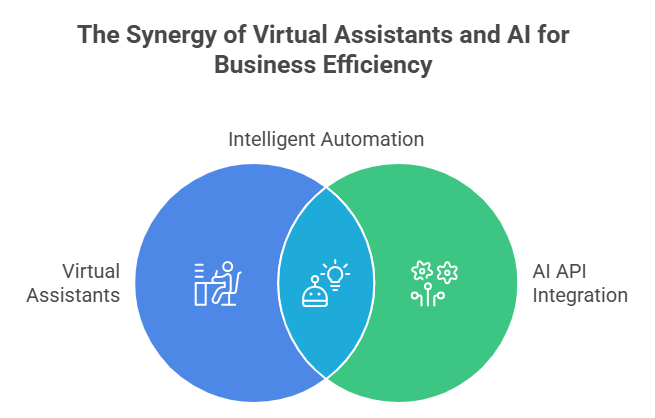
Virtual assistants bring domain-specific prompt libraries, API key security practices, and workflow monitoring that most internal teams lack. They handle the full implementation cycle—setup, testing, optimization, and exception management—freeing business owners from technical overhead. Because VAs treat the Claude AI API as one tool in a larger system, they ensure human oversight at critical points, maintaining quality and compliance that pure automation often misses.
Cost and Efficiency Comparison
The table shown earlier illustrates the shift. In practice, a typical small business spends $400–$800 monthly on a dedicated VA plus Claude API credits to run 5,000–10,000 lead touches. In-house, the same output would require a $5,000–$8,000/month specialist plus developer time. Efficiency compounds: campaigns launch in days instead of weeks, iteration cycles shrink from weeks to hours, and ROI becomes visible in weekly dashboards rather than quarterly reports.
When Businesses Should NOT Use Claude AI
Avoid the Claude AI API for lead generation if your industry faces strict regulatory hurdles (e.g., healthcare or finance) without dedicated compliance review layers, or if lead volume is under 100 per month—setup costs outweigh benefits. Purely visual or multimodal campaigns may need complementary tools. Teams without any process discipline or data hygiene will see poor results regardless of AI quality. Finally, if your buyers demand exclusively human-first interaction (certain high-trust B2B niches), automation can feel impersonal.
How Virtual Assistants Help in Lead Generation using Claude
Virtual assistants help businesses turn the Claude AI API into a scalable lead generation system. They manage prospect research, personalization, qualification, CRM updates, and campaign optimization so outreach becomes faster, more relevant, and easier to scale.
- Virtual assistants enrich prospect data using Claude AI API research prompts.
- They handle email and inbox management and LinkedIn sequences for each lead segment.
- They build qualification flows that score intent and route warm leads to sales.
- They update CRM records, lead scores, and pipeline stages through integrations.
- They monitor reply rates, conversions, and campaign data to refine outreach.
- They manage API prompts, errors, and reviews to keep campaigns accurate.
TaskVirtual: Your Partner in AI-Powered Lead Generation

Building scalable lead generation systems with the Claude AI API requires expert prompt engineering, seamless tool integrations, and continuous optimization that most teams struggle to manage internally. From setting up API keys to refining research and personalization workflows, the process can quickly become complex and time-consuming. TaskVirtual provides specialized virtual Claude AI outsourced lead generation services that handle end-to-end Claude AI API lead generation systems, letting businesses focus on closing deals instead of technical details.
1. Expert Consultation and Review
TaskVirtual’s skilled virtual assistants assist in mapping your ICP, building prompt libraries, and optimizing Claude API workflows for research, personalization, and qualification. They review performance data and refine prompts to ensure every outreach campaign delivers maximum relevance and response rates.
2. Affordable and Flexible Pricing
Hiring a full-time AI specialist or developer can be expensive, but TaskVirtual makes it cost-effective. With pricing plans starting from just $3.12/hour to $14.99/hour, their services are budget-friendly and accessible to small businesses, agencies, and startups.
3. Comprehensive Support Solutions
From prospect research and hyper-personalized outreach to conversational qualification and automated CRM updates using the Claude AI API, TaskVirtual covers it all. Their CRM Virtual Assistant can adapt to whatever you need, from occasional campaign support to full ongoing lead generation management.
4. Ongoing Support and Quality Assurance
TaskVirtual goes beyond initial setup by offering continuous monitoring, AI prompt optimization, and performance reporting. Their proactive support ensures campaigns run smoothly, compliance is maintained, and results improve week after week without added stress.
5. Proven Track Record of Excellence
With 364 positive reviews and a 4.7-star rating on trusted VA platforms, TaskVirtual is recognised as a reliable partner worldwide. Clients count on their expertise to simplify Claude AI API implementation and deliver consistent lead generation results.
Conclusion
Lead generation systems built with the Claude AI API and virtual assistants give small businesses and agencies the ability to compete on personalization and volume without enterprise budgets. The combination of Claude’s reasoning power, practical API integrations, and skilled virtual assistant execution creates reliable, measurable pipelines that deliver higher-quality leads at lower cost. Teams that implement thoughtfully see immediate efficiency gains and long-term competitive advantage.
Key Takeaways
- The Claude AI API excels at personalized content, conversational qualification, and research summarization—core needs for modern lead generation.
- Virtual assistants turn API access into complete systems by handling prompting, integration, review, and iteration.
- Expected results include 3–5x higher engagement and 60–80% lower cost per lead when compared with manual processes.
- Success depends on clean data, grounded prompts, and human oversight at key decision points.
- Outsourcing implementation to experienced VAs removes technical barriers and accelerates time-to-value.
FAQ Section
1. What exactly is the Claude AI API?
It is Anthropic’s official REST API and SDKs that let developers send prompts to Claude models and receive structured responses for building custom applications.
2. How do virtual assistants access and use the Claude API integration?
VAs obtain an Anthropic API key, use official Python or JavaScript SDKs or no-code connectors like Zapier, and manage prompts, context, and tool calls within defined workflows.
3. Is Claude AI more expensive than the OpenAI API for lead generation?
Pricing is comparable on balanced models, but many teams find Claude’s superior writing quality and lower revision needs deliver better overall ROI for outreach content.
4. Can small businesses afford to run lead generation with Claude AI?
Yes—budget-friendly Haiku models and efficient prompting keep monthly costs low; a VA typically manages everything for under $1,000/month, including API usage.
5. What compliance steps are required when using Claude for B2B lead gen?
Obtain consent where required, log all API interactions, avoid scraping restricted sources, and ensure opt-out mechanisms meet CAN-SPAM and GDPR standards.
For more queries, visit our website.
 Siddhartha Basu is a Technical Writer at Task Virtual. He loves online games, e-book reading, and Yoga.