Contents
show
How Does AI Visual Search Work for Business Growth in 2026
AI visual search lets users find information, products, or similar images by uploading or pointing a camera at a photo instead of typing keywords. As smartphones and AI advance, this technology powers everyday tools like Google Lens and Pinterest Lens, delivering faster, more intuitive results. In 2026, with multimodal AI and improved computer vision, visual search transforms e-commerce, education, and daily life for American consumers seeking instant, accurate matches.
This shift from text to visuals makes discovery more natural and efficient, especially on mobile devices where quick camera-based queries outperform traditional typing for many daily tasks. In fact, 27% of searches across ten major search properties are for images, highlighting the growing role of visual discovery.
What Is AI Visual Search?
AI visual search represents a major evolution in how people interact with digital information. It combines advanced computer vision with machine learning to deliver relevant results directly from images. This technology continues to gain popularity as users prefer visual inputs for faster, more accurate outcomes, with 59% of consumers saying visual information is more important than text when shopping online.
1. Definition and Core Concept
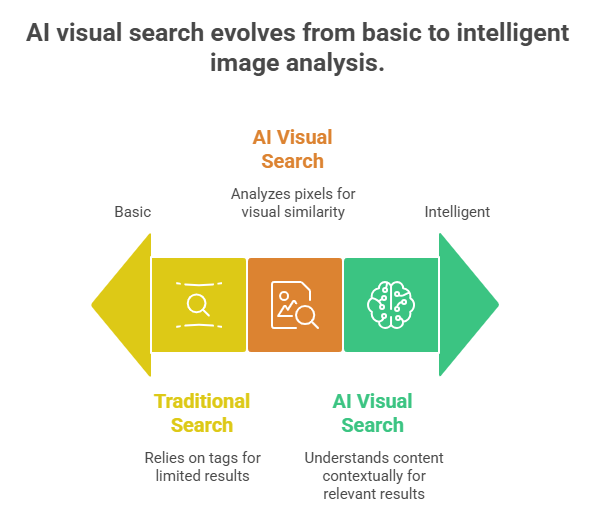
AI visual search uses computer vision and machine learning to analyze images and retrieve relevant results based on visual similarity, objects, colors, patterns, and context rather than text. It identifies key elements and matches them against vast databases for instant recommendations. The system processes millions of visual data points to understand content semantically, going far beyond simple image matching.
2. Evolution from Traditional Search
Early image search relied on metadata or tags, often yielding limited results. Modern AI systems understand image content deeply at pixel and semantic levels. This enables powerful reverse image search and product discovery without precise keywords while delivering contextual suggestions that feel intelligent and helpful.
3. Real-World Examples
Snap a photo of shoes on the street with Google Lens to find similar pairs for purchase. Use Pinterest Lens to discover matching home decor instantly. Travelers can identify landmarks or translate text in real time, while shoppers compare prices across retailers with a single image.
How AI Visual Search Works: Step-by-Step
AI visual search follows a structured pipeline that turns a simple photo into precise, actionable results. Multiple AI layers work together seamlessly for impressive speed and high accuracy, supporting a smoother experience as 36% of consumers have conducted a visual search. The entire process happens in milliseconds, making visual search feel instant and intuitive for users.
- Users upload or capture an image; the system resizes, normalizes, and enhances it while preserving key features.
- CNNs detect edges, textures, shapes, colors, and objects through hierarchical feature extraction.
- The image converts into a high-dimensional vector embedding for database comparison.
- Cosine similarity enables fast nearest-neighbor searches to find closest matches.
- AI ranks results by relevance, user context, location, and trends with multi-object support.
- Final results deliver tailored links, shopping options, and information.
Key Technologies Powering AI Visual Search
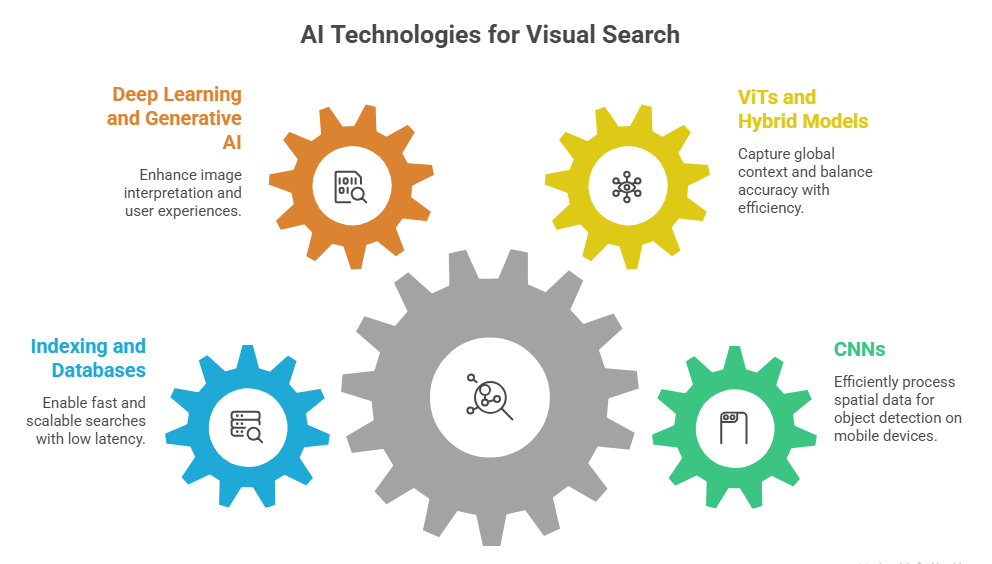
Several core AI technologies work together to power an AI-powered virtual assistant that makes visual search fast, accurate, and scalable. These models continuously improve through larger datasets and better training methods. Hybrid approaches deliver superior real-world performance across varied conditions and use cases, ensuring reliable results in everyday scenarios.
1. Convolutional Neural Networks (CNNs)
CNNs remain foundational, using filters and pooling layers to process spatial image data for object detection and classification. They efficiently capture local patterns while reducing computational needs, making them ideal for mobile devices with limited processing power. Their proven architecture continues powering many real-time visual search applications with reliable accuracy
2. Vision Transformers (ViTs) and Hybrid Models
ViTs treat image patches as tokens with self-attention for global context understanding. They often outperform CNNs on large datasets with better long-range dependency capture. Hybrid models combine the strengths of both architectures for balanced accuracy, efficiency, and adaptability in complex visual scenarios.
3. Deep Learning and Generative AI Integration
Models combine detection, segmentation, and generation for refined results like virtual try-ons and multi-object understanding. Generative components help reconstruct or enhance unclear image parts for better matching. This integration allows for more intelligent interpretation of scenes and improved user experiences in shopping and identification tasks.
4. Indexing, Databases, and Scalability
Vector databases and ANN algorithms enable billion-scale searches in milliseconds for real-time performance. This infrastructure supports continuous indexing of new images while maintaining low latency even during peak usage. Advanced indexing techniques ensure visual search remains responsive as databases grow rapidly every day.
Major Applications and Platforms

AI visual search finds use across industries and consumer platforms. Its applications continue expanding rapidly with ongoing technology advances. From everyday consumer tools to professional environments, visual search is becoming an essential part of modern digital experiences.
- E-commerce via online shopping assistant boosts conversions with Google Lens, handling billions of monthly searches.
- Pinterest drives purchases through strong visual query growth.
- Everyday tasks include identifying plants, landmarks, and real-time text translation.
- Healthcare and manufacturing use it for diagnostics and quality control.
- Social platforms like TikTok and Instagram power recommendations and AR filters.
- Education tools support research and visual data analysis.
Benefits, Challenges, and Statistics
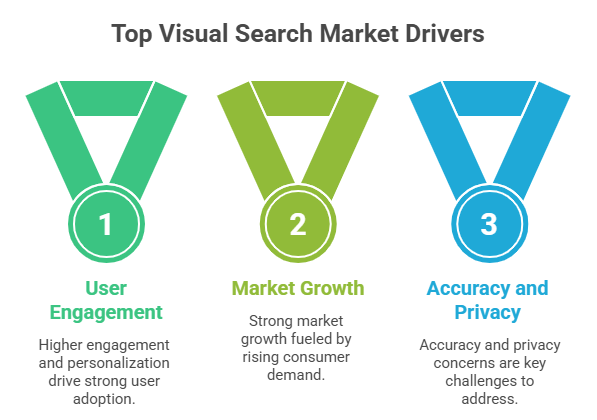
AI visual search delivers clear advantages while facing technical and ethical hurdles. Understanding both sides helps users and businesses maximize value, improve adoption, and avoid common implementation risks. As more consumers rely on camera-based discovery for shopping, research, and daily identification, market growth continues to show strong momentum and practical demand.
1. Key Benefits
Higher engagement, personalization, and accessibility for non-text queries drive strong user adoption. Visual searches often yield 20-40% higher retail conversion rates and suit all users, including those with disabilities or language barriers. The intuitive nature reduces search friction and improves overall user satisfaction significantly.
2. Challenges: Accuracy, Privacy, and Bias
Performance varies with lighting, angles, and rare items, which can affect the quality. Dataset biases and image upload privacy concerns remain key issues addressed through better training data and on-device processing options. Developers continue working on robust solutions to minimize errors and build greater user trust.
3. Market and Adoption Stats
The global visual search market was $5.2 billion in 2023, projected to reach $27.8 billion by 2032 at a 20.5% CAGR. Google Lens processes billions of searches monthly while Pinterest shows over 300% YoY visual query growth. North America leads adoption amid rising generative AI use, reflecting strong consumer demand for smarter visual discovery tools.
The Future of AI Visual Search
Advancements will make visual search more seamless, powerful, and integrated into daily life. With multimodal AI, real-time video search, and AR-enabled devices, visual discovery will become faster, more accurate, and useful across more everyday scenarios.
- Multimodal systems combine images with natural language for precise queries.
- Real-time video search and AR glasses enable instant discovery.
- Deeper retail personalization uses user preferences and history.
- Improved accessibility features support diverse user needs.
- Bias reduction and privacy tech build greater trust.
- Energy-efficient models support sustainable global deployment.
Optimizing Content for AI Visual Search
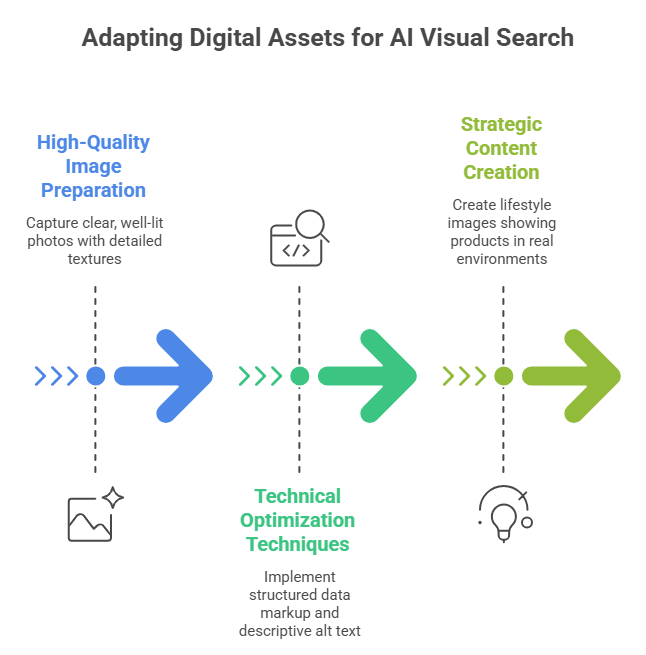
Businesses and creators must adapt their digital assets to perform well in AI visual search environments. High-quality visuals and proper technical setup improve visibility and ranking in image-based results. Following best practices ensures maximum reach as this search method grows rapidly among American consumers.
1. High-Quality Image Preparation
Capture clear, well-lit photos from multiple angles with detailed textures visible. Use high resolution while keeping file sizes optimized for fast loading. Consistent lighting and backgrounds help AI models recognize products more accurately and deliver better matches. Assistants recommend shooting in natural light and avoiding clutter to boost recognition rates significantly.
2. Technical Optimization Techniques
Implement structured data markup and descriptive alt text focused on visual attributes. Use a relevant schema for products and images to aid indexing. Optimize site speed and mobile responsiveness since most visual searches occur on smartphones. These steps help AI systems index and rank your content faster in tools like Google Lens.
3. Strategic Content Creation
Create lifestyle images showing products in real environments rather than plain backgrounds. Include contextual details that AI can interpret alongside pure visuals through a digital content development service. Regularly update catalogs with fresh images to maintain strong performance in dynamic search databases. This approach improves contextual understanding and increases the chances of appearing in relevant visual search results.
How Virtual Assistants Help with AI Visual Search

Virtual assistants make AI visual search tools more practical for everyday users and businesses. They bridge the gap between advanced technology and real-world application by handling image uploads, result interpretation, and follow-up actions. This combination boosts productivity and maximizes the benefits of visual search.
- Expert VAs guide optimal use of Google Lens and Pinterest Lens for shopping and global marketing research services.
- They organize visual search results, compare product options, and complete purchases efficiently.
- VAs handle batch image processing for businesses, such as product cataloging or competitor analysis.
- They manage multi-object searches and filter results based on user preferences and budgets.
- Virtual assistants ensure privacy compliance and help refine queries for better accuracy.
- They train users on new features like multimodal and AR-integrated visual search.
TaskVirtual: Your Partner in AI Visual Search Assistance

Leveraging AI visual search for shopping, product discovery, and daily identification tasks can be time-consuming without proper guidance. From capturing effective images to interpreting complex results and executing actions, the process often requires expertise. TaskVirtual provides skilled AI virtual assistants who specialize in AI visual search tools like Google Lens and Pinterest Lens to simplify and optimize your experience.
1. Expert Consultation and Review
TaskVirtual’s trained assistants help select the right visual search platforms, capture high-quality images, and interpret results for shopping, product identification, and research needs. They guide users on the best angles, lighting, and techniques to improve AI accuracy. Assistants also analyze returned results to highlight the most relevant options and assist with follow-up searches.
2. Affordable and Flexible Pricing
Hiring dedicated support is budget-friendly with pricing plans starting from just $3.12/hour to $14.99/hour, making expert AI visual search assistance accessible for individuals and businesses. Plans are flexible and can be scaled based on usage. This cost-effective approach delivers professional help without the expense of full-time staff.
3. Comprehensive Visual Search Support
From product discovery and price comparison to organizing results and completing purchases using tools like Google Lens, TaskVirtual covers complete end-to-end support. Assistants manage batch searches, filter options by budget and preference, and handle multi-object queries efficiently. They streamline the entire workflow from image capture through e-commerce photo editing service to final decision-making.
4. Ongoing Support and Quality Assurance
TaskVirtual offers continuous assistance with real-time guidance, result filtering, and follow-up actions to ensure accurate and timely outcomes every time. They monitor trends, refine search strategies, and provide regular updates. This proactive support helps users stay ahead with evolving AI visual search features.
5. Proven Track Record of Excellence
With 364 positive reviews and a 4.7-star rating on trusted VA platforms, TaskVirtual is a reliable partner for streamlining AI visual search tasks. Clients praise the accuracy and efficiency in handling Google Lens and Pinterest workflows. Their consistent performance makes them a trusted choice for both personal and business visual search needs.
FAQ Section
1. How accurate is AI visual search?
Highly accurate for common objects but varies with image quality, lighting, and rarity. Top systems achieve strong performance on benchmark datasets.
2. What is the difference between Google Lens and traditional image search?
Google Lens understands image content via AI for actionable results, unlike keyword or metadata-based traditional search.
3. Does visual search work for all products?
Best for distinct visual items like fashion, home goods; less effective for generic or highly similar items without context.
4. Is my privacy protected when using visual search?
Major platforms process images server-side with privacy policies; many offer on-device options for sensitive data.
5. How can businesses optimize for AI visual search?
Use high-quality images, structured data, descriptive alt text, and schema markup for better indexing.
6. Will AI visual search replace text search?
No—it complements text search, excelling in scenarios where visuals convey more than words.
Conclusion
AI visual search revolutionizes how Americans discover and shop by making image-based queries intelligent and instantaneous. As technology matures with better models and broader adoption, it promises even more seamless experiences across daily life, work, and commerce. Start using tools like Google Lens today to explore the visual web.
Sources
- Google Blog and official reports
- Statista, Zion Market Research, Grand View Research, DataIntelo (market data)
- LeewayHertz, Viso.ai, and technical explainers
- Pinterest and eMarketer usage stats
For more such content, visit our website.
 Siddhartha Basu is a Technical Writer at Task Virtual. He loves online games, e-book reading, and Yoga.