Contents
show
E-commerce VA pricing guide (Amazon vs Shopify vs general)
Running an online store in 2026 means juggling listings, customer messages, inventory alerts, and ads while still trying to grow. U.S. retail e-commerce sales reached $1.23 trillion in 2025 and continued climbing into 2026, with second-quarter sales hitting $340.2 billion – up 12.2 percent year-over-year – according to the U.S. Census Bureau. That growth creates opportunity, but it also multiplies the operational load. Many American sellers now turn to ecommerce virtual assistants to handle the day-to-day work without the full cost of a U.S. employee.
Ecommerce VA pricing varies widely by platform, location, experience, and engagement model. This guide breaks down realistic 2026 rates for Amazon virtual assistants, Shopify virtual assistants, general ecommerce support, and specialized roles such as product listing optimization or dropshipping virtual assistant work. You will see clear ranges, what drives the cost, common ecommerce virtual assistant tasks, and how to decide what fits your store.
Why Ecommerce VA Pricing Matters in 2026
Understanding realistic ecommerce VA pricing helps American store owners make smarter hiring decisions and protect profit margins as online competition intensifies. Rising operational complexity on major platforms means founders can no longer handle every listing update, customer reply, and inventory check themselves without sacrificing growth. Accurate cost knowledge prevents both underpaying for unreliable support and overpaying for basic tasks that do not require premium rates.
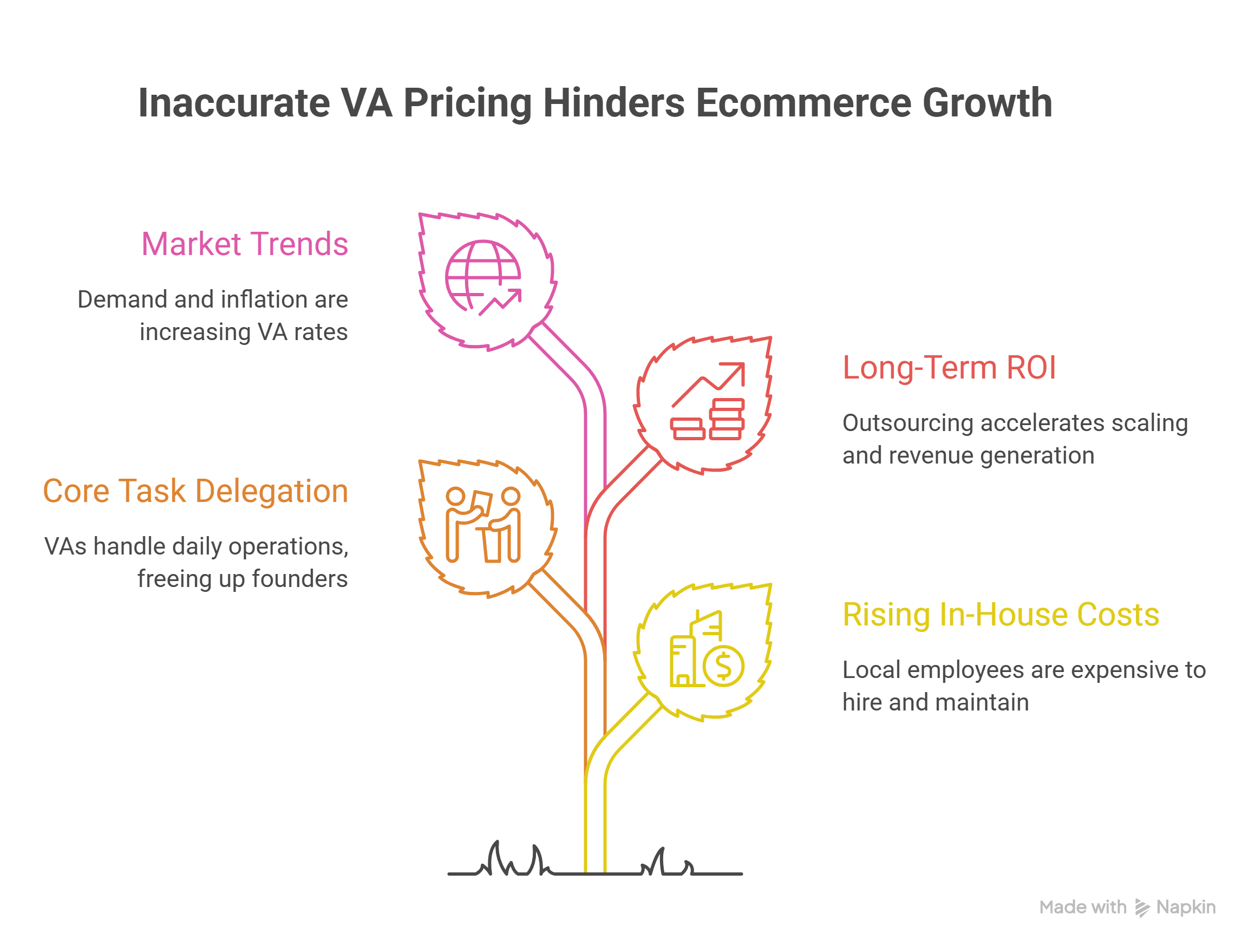
The Rising Cost of In-House Support Compared to Remote Talent
The median annual wage for secretaries and administrative assistants in the United States stood at $48,310 in May 2025, or about $23.23 per hour, according to the U.S. Bureau of Labor Statistics. Employer benefit costs for private-industry workers averaged 30.1 percent of total compensation in March 2026, pushing the true cost of a full-time local hire well above base salary once taxes, insurance, and overhead are added. Many growing stores therefore find that a fully loaded U.S. employee exceeds $60,000–$70,000 per year.
Remote ecommerce talent from regions with strong English skills and platform experience frequently delivers comparable output at a fraction of that total. This cost difference allows sellers to reinvest savings into advertising, product development, or additional specialized support. The gap between domestic employment costs and competent offshore rates continues to make virtual assistants one of the highest-leverage operational decisions available to ecommerce brands.
Core Ecommerce Virtual Assistant Tasks That Drive Daily Operations
Ecommerce virtual assistant tasks typically cover product research, listing creation and optimization, order processing, customer service replies, inventory monitoring, basic advertising support, and returns handling. Specialists focused on Amazon Seller Central or Shopify admin complete these workflows faster and with fewer costly mistakes than general administrative help. Clear task ownership frees the founder to concentrate on strategy, supplier relationships, and marketing rather than repetitive daily maintenance.
When these responsibilities remain with the owner, growth often stalls because strategic work competes with operational fires. Delegating them to a trained VA creates measurable time savings that compound over months. Stores that document processes and assign clear ownership report smoother scaling without proportional increases in founder hours.
The Long-Term ROI of Strategic Outsourcing
Hiring a skilled VA often delivers faster scaling without the fixed overhead of traditional employment. Stores that systematically delegate operational work commonly reclaim 15–25 hours per week, time that can be redirected into revenue-generating activities such as new product launches or advertising optimization. The financial return becomes visible once response times improve, listing quality rises, and stockouts decline.
Accurate pricing knowledge helps owners select the right experience level rather than defaulting to the lowest available rate. Underpaying frequently leads to high turnover and repeated training costs, while paying fairly for proven expertise reduces management burden and improves consistency. Over twelve months the difference in total cost of ownership is often substantial.
Market Trends Shaping 2026 Pricing Expectations
Demand for platform-specific talent has risen alongside ecommerce sales growth, pushing competent full-time support above the ultra-low rates common several years ago. Currency movements, local wage inflation in popular outsourcing destinations, and increased competition for reliable English-speaking VAs have established a practical floor that most serious operators now respect. Sellers who ignore these trends risk high churn and inconsistent performance.
At the same time, managed providers and experienced freelancers have refined training and quality-control systems that improve output reliability. Understanding both the upward pressure on rates and the value of stronger processes allows owners to budget realistically and negotiate from a position of knowledge. Pricing literacy has become a core operational skill for American ecommerce businesses.
General Ecommerce VA Hourly Rates and Monthly Costs
General ecommerce VAs handle multi-channel or platform-agnostic work and remain the most flexible option for many growing stores. Rates vary primarily by location, experience, and whether the arrangement is freelance or managed. Clear budgeting starts with understanding these ranges and matching them to actual task complexity.
Entry-Level to Mid-Level Rate Ranges
- Entry-level offshore rates commonly start around $5–$10 per hour for basic data entry and simple order processing.
- Mid-level talent with proven store experience typically falls in the $10–$20 range and can handle product uploads and customer replies independently.
- U.S.-based or highly specialized freelancers often command $25–$50 or more per hour depending on niche expertise.
- These figures reflect current marketplace averages across major platforms and managed service providers in 2026.
- Higher rates generally correlate with stronger English communication and reduced need for daily supervision.
Full-Time and Part-Time Monthly Pricing
- Full-time monthly costs for roughly 160 hours of competent offshore support frequently land between $800 and $2,500.
- Part-time arrangements of 20 hours per week commonly run $400–$1,200 depending on skill level.
- Agencies that include backups, quality control, and account management usually sit at the higher end of these bands.
- Many sellers begin with 40–80 hours per month and expand once processes prove stable.
- Monthly retainers often deliver better consistency than pure hourly arrangements at similar total cost.
Location and Experience as Primary Cost Drivers
- Philippine and Indian talent pools continue to offer the most competitive rates for routine ecommerce work.
- Latin American VAs typically cost more but provide stronger time-zone overlap with the continental United States.
- Eastern European specialists command higher rates for technical tasks or multi-language support.
- Prior experience with product listing optimization or multi-channel inventory tools reduces training time and error rates.
- Sellers who prioritize documented platform experience usually achieve faster productivity gains than those who hire purely on price.
Additional Cost Considerations for Long-Term Arrangements
- Onboarding and initial training often require 20–40 hours of founder or manager time regardless of the VA’s background.
- Turnover risk rises sharply when rates fall below sustainable local living costs in the VA’s country.
- Managed providers may charge a premium but reduce the administrative burden of recruiting and replacing talent.
- Tool access, software licenses, and communication platforms add modest ongoing costs that should be factored into budgets.
- Clear performance metrics help justify rate increases or expanded hours as the relationship matures.
Amazon Virtual Assistant Pricing Breakdown
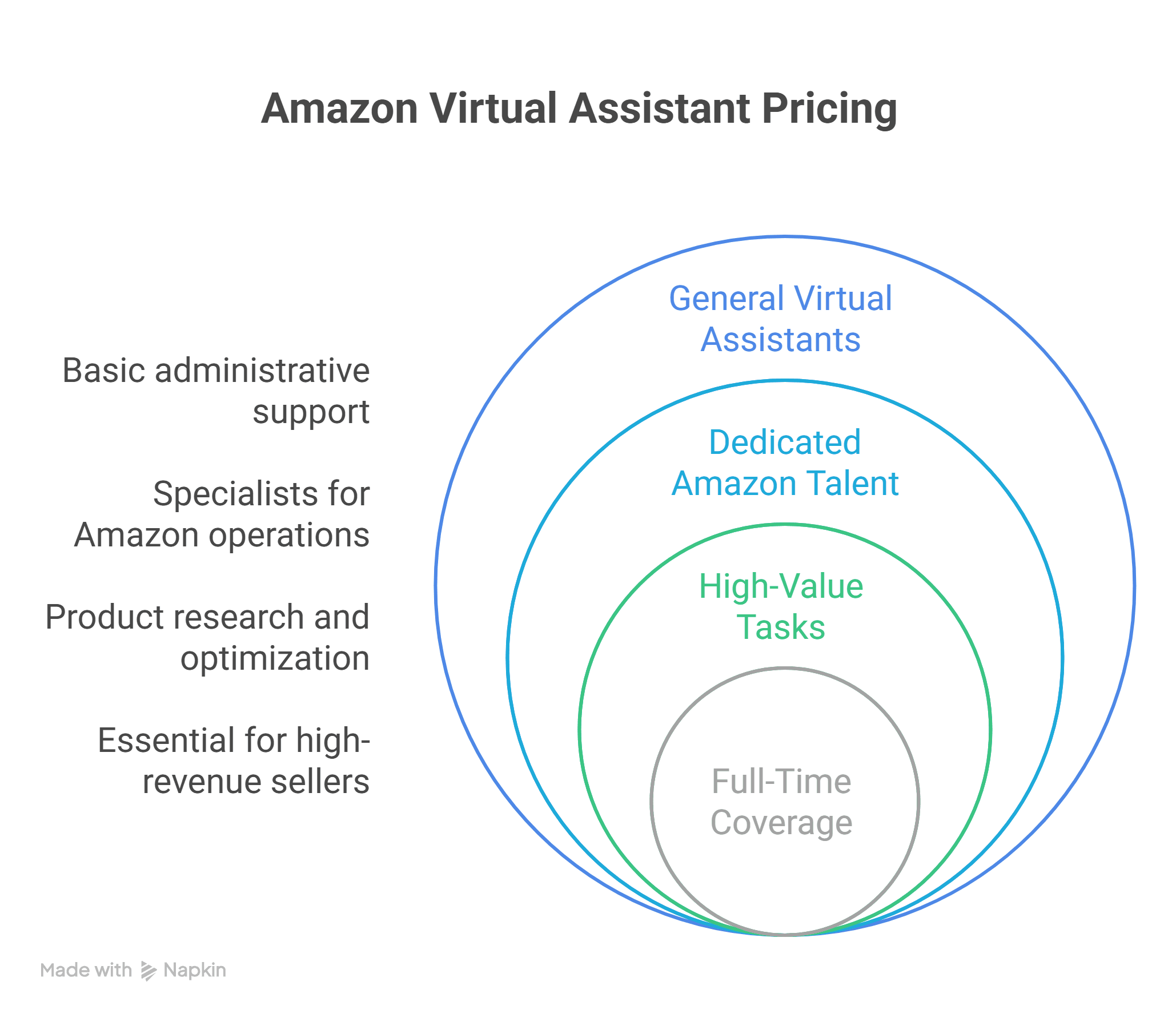
Amazon virtual assistants specialize in Seller Central operations, FBA logistics, and marketplace-specific compliance, which often places them at a modest premium over generalists. Accurate pricing knowledge helps sellers avoid both underqualified support and unnecessary overspending on routine tasks. The following ranges reflect typical 2026 market conditions for dedicated Amazon talent.
Typical Hourly and Monthly Rates for Amazon Specialists
Dedicated Amazon talent with solid Seller Central experience commonly ranges from $6–$15 per hour for competent offshore support. Full-time monthly costs for mid-level help frequently fall between $1,000 and $2,000, while entry-level arrangements can start lower. PPC-focused or senior operations roles push rates higher, and U.S.-based Amazon specialists often charge $25–$50 per hour.
These figures already incorporate the additional complexity of Amazon’s policies, performance metrics, and account-health requirements. Sellers who treat Amazon support as interchangeable with general admin work frequently encounter costly errors or delayed responses. Budgeting within realistic bands improves the likelihood of finding reliable, long-term talent.
High-Value Tasks Including Product Research and Listing Optimization
Amazon product research remains one of the highest-leverage tasks many sellers outsource early in their growth. A skilled VA can evaluate competition, estimated sales volume, fees, and review patterns more efficiently than a founder still learning the research tools. Listing creation and ongoing product listing optimization—titles, bullet points, backend keywords, and A+ content updates—also justify higher rates because incremental improvements compound across ranking and conversion.
Account-health monitoring, case management with Amazon support, and FBA shipment coordination form another critical cluster of responsibilities. Delays or errors in these areas can trigger suppressions, lost Buy Box ownership, or even account suspensions. Paying for demonstrated experience in these workflows usually proves less expensive than recovering from preventable problems.
When Full-Time Amazon Coverage Becomes Necessary
Sellers generating $500,000 or more in annual Amazon revenue often transition from part-time to full-time coverage once daily oversight becomes essential. At that volume, the cost of delayed inventory alerts or slow buyer-message responses can quickly exceed the monthly expense of a dedicated VA. Full-time support also reduces the founder’s exposure to account-health issues that threaten selling privileges.
Many brands begin with 20 hours per week focused on listings and customer messages, then expand as order volume and SKU count grow. Documented processes and clear escalation paths allow the VA to operate with increasing independence. This progression keeps costs aligned with actual business needs rather than locking the seller into excess capacity too early.
Balancing Cost Against Risk on the Amazon Platform
Amazon’s strict policies and competitive environment mean that low-cost, untrained support can create outsized financial risk. A VA unfamiliar with suppressed listings, policy warnings, or inventory reconciliation may generate problems that take weeks to resolve. Slightly higher rates paid to experienced talent frequently reduce both error rates and management overhead.
Sellers should evaluate total cost of ownership rather than headline hourly rates alone. Training time, error recovery, and founder attention all carry real costs that accumulate when quality is insufficient. Realistic pricing expectations help owners select partners capable of protecting and growing the Amazon channel.
Shopify Virtual Assistant Rates and Scope

Shopify virtual assistants manage store administration, product workflows, customer communication, and app integrations with greater platform flexibility than pure marketplace roles. Rates reflect skill level, task complexity, and whether the engagement is freelance or managed. Clear understanding of these ranges helps owners match budget to actual operational needs.
Shopify VA Pricing Tiers by Skill Level
- Entry-level offshore help typically ranges from $5–$12 per hour for basic product uploads and simple order tracking.
- Mid-level talent comfortable with collections, Klaviyo support, and customer replies usually falls between $12–$25 per hour.
- Advanced or U.S.-based specialists with theme or app expertise can charge $30–$ 40+ per hour.
- Full-time monthly costs for capable support often sit between $800 and $2,000 depending on hours and experience.
- Managed agency retainers that include backups and oversight frequently start around $1,800 and scale upward.
Platform Flexibility and Expanding Task Variety
- Shopify’s open architecture allows VAs to handle theme updates, app integrations, and conversion-focused page edits beyond basic listings.
- A dropshipping virtual assistant on Shopify commonly manages supplier communication, bulk imports, price monitoring, and tracking updates.
- DTC brands often require additional emphasis on customer experience, email flows, and seasonal collection management.
- Product listing optimization remains important through clear titles, structured data, and SEO-friendly descriptions.
- The same VA can often expand into light marketing support once core operations are stable.
Scaling Hours According to Order Volume
- Stores processing 50–300 orders per month frequently begin with 10–20 hours of support per week.
- Higher-volume operations typically scale to full-time coverage or multiple specialized VAs.
- Part-time packages of 40–80 hours per month commonly cost $400–$1,500 depending on skill level.
- The ability to increase or reduce hours without long-term employment commitments provides valuable flexibility.
- Clear volume thresholds help owners avoid both under-support during peaks and excess capacity during slower periods.
Additional Value Drivers Specific to Shopify Stores
- Experience with popular apps such as Klaviyo, Gorgias, or Recharge reduces onboarding time and improves output quality.
- Strong written communication skills matter especially for customer-facing roles that shape brand perception.
- VAs familiar with basic Liquid or theme customization can handle more advanced store improvements.
- Documented SOPs for order exceptions and returns protect margins and customer satisfaction scores.
- Regular performance reviews focused on response time and error rates maintain accountability as the relationship grows.
Comparing Amazon vs Shopify vs General Ecommerce VA Pricing
Platform choice significantly influences both the required skill set and the resulting price range for virtual assistant support. Amazon specialists often command a modest premium because of stricter compliance requirements, while Shopify roles show wider variance based on technical depth. General ecommerce VAs offer the greatest flexibility for multi-channel operators but may need more platform-specific training.
Platform Complexity and Resulting Rate Differences
Amazon specialists tend to sit at a slight premium over generalists due to the platform’s policy complexity and the financial risk of ranking losses or account issues. Shopify VAs display wider price variance: basic product-upload work remains inexpensive, while advanced theme or marketing support costs more. General ecommerce VAs provide the broadest flexibility for sellers operating across multiple channels yet often require additional training on any single platform’s specific workflows.
These differences mean that a one-size-fits-all rate comparison can mislead owners. Task complexity, required judgment, and potential downside risk should weigh as heavily as the headline hourly figure. Sellers who match expertise level to actual platform demands usually achieve better long-term results than those who optimize solely for the lowest rate.
Evaluating True Cost Beyond the Stated Hourly Rate
A $7-per-hour VA who requires constant correction and revision can ultimately cost more in founder time than a $15-per-hour specialist who works independently. Time-zone alignment, English fluency for customer-facing communication, and proven experience with specific tools such as Helium 10, Jungle Scout, Klaviyo, or Gorgias often justify mid-range pricing. Many American sellers therefore adopt a hybrid model that pairs an offshore VA for routine operations with a higher-cost specialist for strategy or complex troubleshooting.
Total cost of ownership includes training time, error recovery, communication overhead, and turnover risk. Focusing exclusively on the lowest available rate frequently increases these hidden costs. A realistic comparison evaluates both direct compensation and the management burden each option creates.
Matching Pricing Models to Business Stage and Channel Mix
Early-stage stores usually benefit from general or part-time platform-specific support that keeps fixed costs low while processes are still forming. Mid-stage brands generating $500,000–$2 million in revenue often move to dedicated full-time VAs with clear specialization in either Amazon or Shopify. Larger multi-channel operations frequently combine several VAs or a managed team to cover different functions without creating single points of failure.
Channel mix also influences the optimal structure. Pure Amazon sellers may prioritize deep Seller Central expertise, while Shopify-first brands value flexibility and customer-experience skills. Multi-channel operators often start with a strong generalist and later add platform specialists as volume justifies the investment. Aligning pricing and structure with current stage prevents both under-support and premature overhead.
Practical Decision Framework for American Sellers
Owners should begin by listing the highest-volume or highest-risk tasks on each platform and estimating the weekly hours required. Comparing those requirements against realistic rate bands reveals whether a generalist, platform specialist, or hybrid arrangement delivers the best value. Documented processes and clear success metrics further improve the return on whatever rate is ultimately paid.
Regular review of results—response times, error rates, listing performance, and hours reclaimed—allows owners to adjust scope or specialization as the business evolves. Pricing decisions made with this framework tend to remain effective longer than those based solely on initial cost. The goal is sustainable operational capacity that scales with revenue rather than a one-time bargain.
Key Factors That Influence Ecommerce VA Pricing

Multiple variables determine the final rate a seller pays for ecommerce virtual assistant support. Understanding these drivers helps owners budget accurately and negotiate effectively. The most influential factors include specialization, engagement model, location, and reliability expectations.
Specialization and Depth of Platform Expertise
- An Amazon product research expert or Shopify VA skilled in product listing optimization commands higher rates than someone limited to basic data entry.
- Customer-facing roles that require consistent brand voice and polished written communication also sit at a premium.
- Documented experience with the exact tools and workflows used by the store reduces ramp-up time and improves early output quality.
- Specialists who already understand marketplace policies or Shopify app ecosystems make fewer costly mistakes.
- Sellers who prioritize proven specialization usually experience lower total management costs despite higher hourly rates.
Engagement Model and Associated Management Burden
- Pure hourly freelancers on open marketplaces offer the lowest sticker price but shift recruiting, training, and quality control to the seller.
- Monthly retainers or agency packages cost more per hour yet reduce turnover risk and often include backup coverage.
- Task-based pricing works well for defined projects such as bulk listing creation but can become expensive at continuous high volume.
- Managed providers absorb much of the administrative overhead in exchange for a higher effective rate.
- The optimal model depends on the founder’s available management time and tolerance for variability.
Location, Time-Zone Alignment, and Communication Quality
- Offshore rates from the Philippines and India remain the most competitive for routine operational work.
- Latin American talent typically costs more but offers stronger overlap with U.S. business hours.
- Eastern European VAs often command higher rates for technical or multi-language requirements.
- Strong written and spoken English is essential for any role that interacts with customers or suppliers.
- Time-zone compatibility reduces delays in decision-making and exception handling.
Reliability Expectations and Peak-Season Requirements
- Guaranteed response times, weekend coverage, or peak-season capacity increase the rate.
- VAs who maintain consistent quality over twelve months or longer justify modest rate increases.
- High turnover at ultra-low rates frequently creates repeated training costs that erase initial savings.
- Clear performance metrics and regular feedback help maintain standards regardless of the base rate.
- Sellers who budget for sustainable compensation experience fewer disruptions during critical sales periods.
Common Ecommerce Virtual Assistant Tasks and Their Value
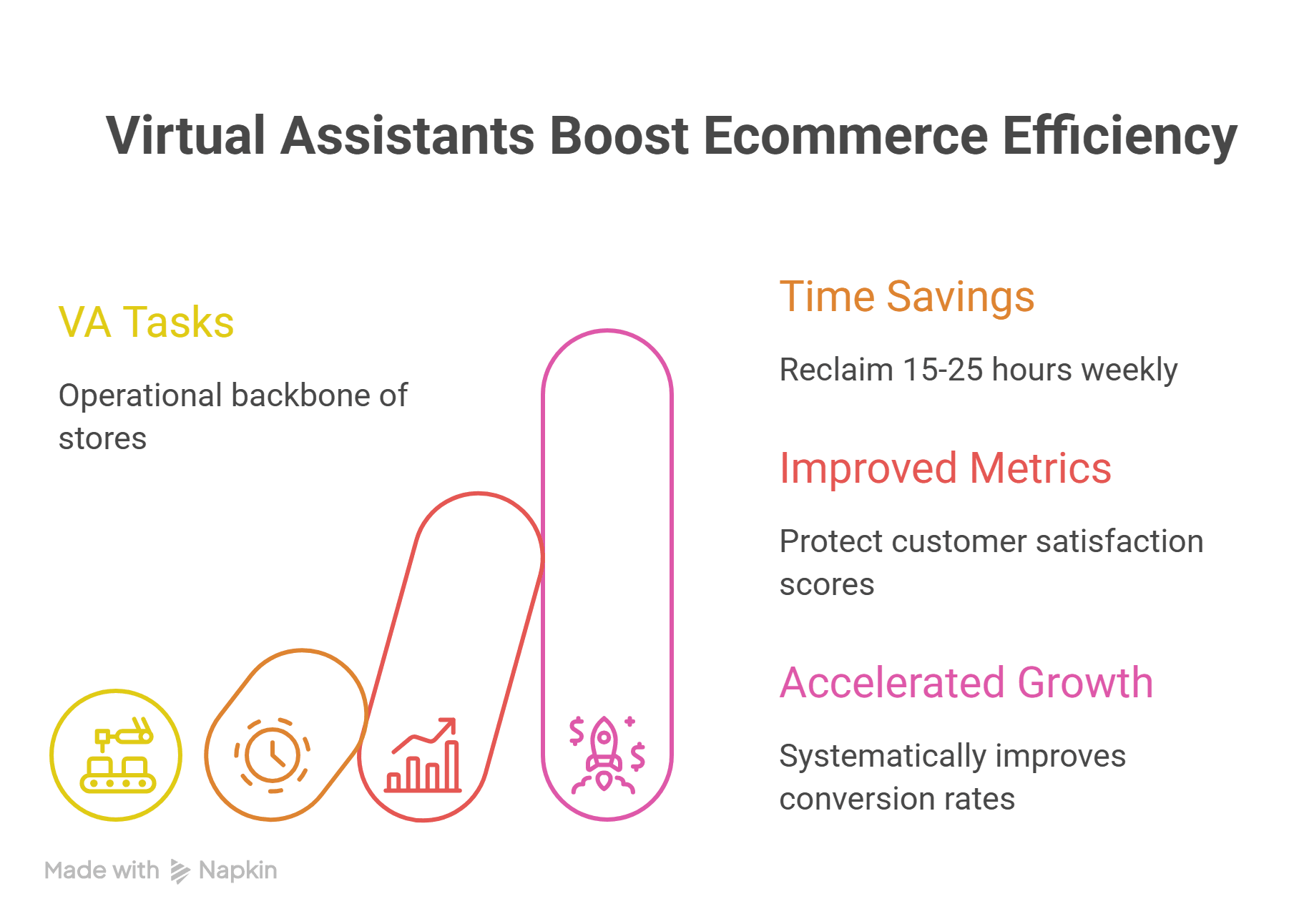
Ecommerce virtual assistant tasks form the operational backbone of most online stores and directly influence both efficiency and customer experience. When these responsibilities remain with the founder, strategic work is constantly interrupted by daily maintenance. Delegating them to trained support creates measurable time savings and often improves consistency across key performance metrics.
Operational Tasks That Free Significant Founder Time
Core operational tasks include order processing, inventory updates, customer service replies, returns handling, and basic reporting. These activities consume substantial weekly hours for most growing stores yet require relatively standardized processes once documented. Assigning them to a reliable VA allows the owner to reclaim 15–25 hours per week that can be redirected toward product development, advertising strategy, or supplier negotiations. Consistent execution of these workflows also protects customer satisfaction scores and review ratings that influence future sales velocity. Over time, the cumulative effect of reduced context-switching and faster response times becomes one of the largest returns on the VA investment.
High-Leverage Specialized Work Including Research and Optimization
Higher-leverage specialized work includes Amazon product research, competitor analysis, product listing optimization, A+ content updates, collection setup, email sequence support, and light advertising adjustments. A VA who systematically improves conversion rates or prevents stockouts frequently generates returns that far exceed the monthly cost of support. Dropshipping virtual assistant responsibilities center heavily on supplier communication, tracking-number updates, and resolution of fulfillment exceptions—areas where speed and accuracy directly protect both margins and customer reviews. When these tasks are performed by someone already familiar with the relevant tools and platform rules, the quality of output rises while the need for constant oversight declines. Many sellers find that investing in this specialized layer accelerates growth more effectively than simply adding more hours of basic support.
Measuring and Sustaining Task Impact Over Time
Clear task documentation and regular performance reviews keep quality high regardless of the rate paid. Owners should track metrics such as average response time, error rate on listings or orders, changes in conversion after optimization work, and total hours reclaimed each month. These numbers make it straightforward to justify expanded scope, rate adjustments, or additional specialized support as the business scales. Establishing simple weekly or bi-weekly check-ins further ensures that priorities remain aligned and that emerging issues are addressed before they affect customers or rankings. Sustained measurement transforms the VA relationship from a cost center into a measurable operational advantage.
How to Choose and Budget for the Right Ecommerce VA
- Begin by listing the specific tasks that currently consume the most time or create the biggest operational bottlenecks, then match those tasks to the required platform expertise and estimate realistic weekly hours.
- Calculate the fully loaded cost of performing the work yourself or hiring a local employee, including benefits and overhead, and compare that figure against current ecommerce VA pricing ranges for the needed skill level.
- Budget explicitly for onboarding, recognizing that even experienced talent typically requires two to four weeks and 20–40 hours of training and feedback to learn brand voice, tools, and priorities.
- Test new hires with a limited scope or part-time hours before committing to full-time arrangements, and evaluate work samples, platform-specific experience, and references focused on reliability and communication quality.
- After 30–60 days, review concrete results such as hours saved, response times, error rates, and any revenue or ranking impact, then adjust hours or specialization based on data rather than assumptions.
TaskVirtual: Your Reliable Partner for Ecommerce Virtual Assistant Services

Managing an online store involves constant attention to product listings, customer messages, inventory updates, order processing, and platform-specific tasks. As ecommerce businesses grow, handling every operational detail can limit the time available for strategy and expansion. TaskVirtual provides professional ecommerce virtual assistant services that help store owners manage daily operations, streamline workflows, and maintain consistent support across platforms like Amazon, Shopify, and other ecommerce channels.
Expert Ecommerce Support and Consultation
TaskVirtual’s experienced virtual assistants help businesses manage essential ecommerce activities, including product uploads, listing optimization, customer support, order management, inventory monitoring, and marketplace-related tasks. Their team supports sellers by reducing operational workload and helping maintain accuracy across critical store processes.
Affordable Pricing for Scalable Ecommerce Assistance
Building an in-house ecommerce team can involve significant expenses, including salaries, benefits, and management costs. TaskVirtual offers flexible virtual assistant solutions that allow businesses to access skilled support while maintaining cost efficiency. With pricing plans starting from just $3.12/hour to $14.99/hour, their services provide an affordable option for startups, growing brands, and established ecommerce businesses.
Complete Ecommerce Operations Support
From managing Amazon Seller Central activities and Shopify store updates to handling product research, customer communication, and routine administrative tasks, TaskVirtual provides comprehensive ecommerce assistance. Their services can be customized based on store requirements, whether businesses need occasional support or ongoing operational help.
Reliable Assistance for Growing Online Stores
TaskVirtual focuses on providing consistent support that helps ecommerce businesses improve efficiency and maintain smooth daily operations. Their virtual assistants assist with process management, updates, and task coordination, allowing business owners to focus more on growth, marketing, and revenue-generating activities.
Trusted Ecommerce Virtual Assistant Partner
With 364 positive reviews and a 4.7-star rating on trusted VA platforms, TaskVirtual is recognised as a reliable partner worldwide. Clients rely on their expertise to simplify ecommerce management, reduce operational challenges, and receive dependable virtual assistance for their online businesses.
FAQ
What is the average ecommerce VA hourly rate in 2026?
Offshore rates commonly range from $5–$20 per hour depending on experience and specialization. U.S.-based talent typically starts around $25 and can exceed $50 for specialists.
How much does a full-time Amazon virtual assistant cost per month?
Competent full-time offshore Amazon support often falls between $1,000 and $2,000 per month. Higher-end or managed options cost more.
Are Shopify virtual assistants cheaper than Amazon VAs?
Basic Shopify work can be slightly less expensive, but advanced Shopify support and specialized Amazon roles overlap significantly in price. Platform complexity and required judgment matter more than the platform name alone.
What tasks should I outsource first to an ecommerce VA?
Start with repetitive, high-volume work such as order processing, customer service, inventory checks, and product uploads. Move to product research and product listing optimization once those are stable.
Is a dropshipping virtual assistant different from a regular ecommerce VA?
Yes. Dropshipping roles emphasize supplier communication, tracking updates, and exception handling more heavily. Rates are usually similar to general mid-level ecommerce support.
How do I avoid low-quality cheap VAs?
Require platform-specific experience, request work samples or test tasks, start with limited hours, document processes clearly, and measure outcomes rather than hours alone.
Conclusion and Next Steps
Ecommerce VA pricing in 2026 reflects a mature market: low rates still exist for basic work, but reliable, specialized support for Amazon, Shopify, or multi-channel stores clusters in clearer mid-range bands. Comparing fully loaded U.S. employment costs against remote options shows substantial savings while preserving flexibility as sales grow.
Map your highest-volume or highest-risk tasks, set a realistic monthly budget, and hire for the specific expertise you need—whether that is Amazon product research, Shopify store management, product listing optimization, or broader ecommerce virtual assistant support. Start small, measure results, and scale the arrangement that delivers the best combination of quality, reliability, and cost.
Ready to free up your time and focus on growth? Review your current operational bottlenecks this week and request quotes from vetted candidates or agencies that match your platform and volume. The right VA often becomes one of the highest-ROI investments a growing online store can make.
Sources
- U.S. Census Bureau, Quarterly Retail E-Commerce Sales reports (2025–2026)
- U.S. Bureau of Labor Statistics, Occupational Outlook Handbook: Secretaries and Administrative Assistants (May 2025 data)
- U.S. Bureau of Labor Statistics, Employer Costs for Employee Compensation (March 2026)
For more such content, visit our website.
 Siddhartha Basu is a Technical Writer at Task Virtual. He loves online games, e-book reading, and Yoga.