

Contents
show
How Task Virtual runs a marketing campaign for clients
Running a marketing campaign successfully has never been more complex—or more measurable. In 2026, American brands face AI-driven personalization expectations, fragmented attention across platforms, and intensifying competition for every dollar of spend. Whether you manage campaigns in-house or partner with an agency, understanding the full digital marketing campaign process separates campaigns that generate consistent pipeline from those that simply spend budget.
This guide covers the full marketing campaign workflow, from strategy and execution to measurement and optimization, with a practical focus on U.S. audiences and long-term growth. According to Nielsen’s 2025 Annual Marketing Report, only 32% of marketers measure traditional and digital media spending holistically, underscoring the need for stronger cross-channel campaign measurement.
Setting Clear Campaign Goals and Stakeholder Alignment
Clear goals form the foundation of every successful marketing campaign. Without them, teams risk misaligned efforts, wasted budget, and difficulty measuring true performance. Establishing shared objectives early creates accountability and keeps both internal teams and clients focused on meaningful business outcomes throughout the entire process.
1. Establishing Measurable Business Objectives
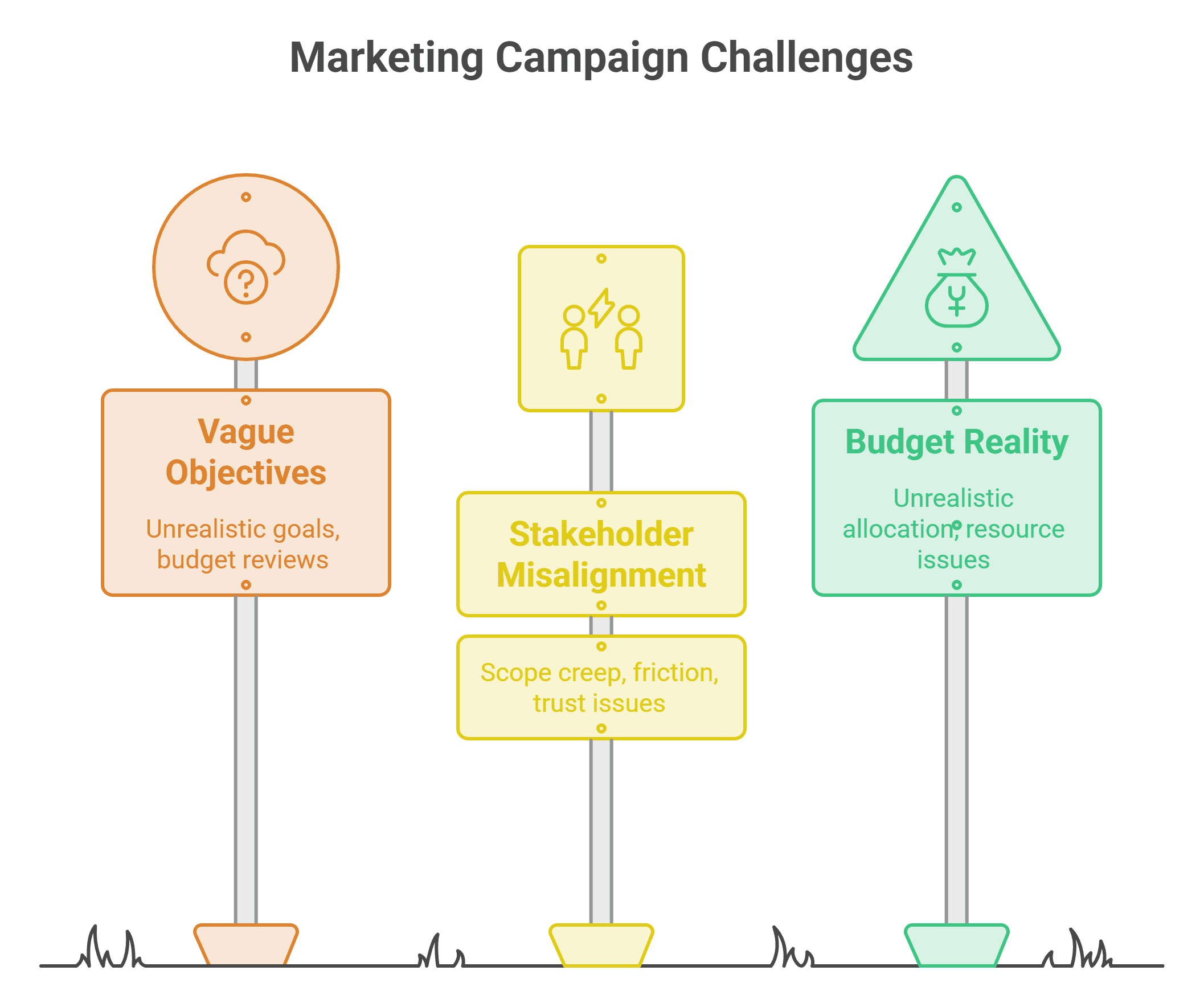
Every effective marketing campaign begins with crystal-clear objectives tied directly to business outcomes. Vague goals such as “increase awareness” rarely survive budget reviews. Instead, define primary and secondary KPIs early: revenue contribution, qualified leads, customer acquisition cost (CAC), lifetime value (LTV) impact, or brand lift metrics. For performance-focused campaigns, prioritize ROAS or pipeline influence. For brand campaigns, include metrics like aided awareness or consideration lift.
Document these targets in a shared brief so every team member works toward the same definition of success. This clarity allows for more accurate forecasting, better resource allocation, and stronger post-campaign analysis that links marketing activity to actual business results.
2. Aligning Internal and Client Stakeholders
For client work, this stage requires joint workshops. Map the client’s current funnel, revenue targets, and competitive position. Document constraints—budget ceilings, brand guidelines, compliance requirements (especially in regulated industries like finance or healthcare), and timeline. Establish a RACI matrix so decision rights are explicit from day one.
This prevents the common mid-campaign scope creep that erodes ROI. Regular alignment check-ins during the planning phase keep expectations realistic and reduce later friction. Open communication at this stage builds the trust needed for smoother collaboration when optimization decisions arise later.
3. Linking Goals to Budget Reality
Research consistently shows that campaigns with documented objectives outperform those without. Content marketing alone, when executed against clear goals, generates three times more leads at 62% lower cost than traditional outbound methods. Budget allocation follows goals and must remain realistic relative to the desired outcomes and competitive landscape.
U.S. digital advertising revenue reached $294.6 billion in 2025, up 13.9% year-over-year, according to the IAB/PwC Internet Advertising Revenue Report. This scale underscores why precise goal-setting and channel prioritization matter more than ever when deciding how to distribute limited resources across the marketing campaign.
Conducting Deep Audience Research and Segmentation

Audience understanding determines whether a marketing campaign resonates or falls flat. Modern buyers expect relevant experiences, and generic messaging no longer delivers strong results. Thorough research and precise segmentation allow teams to deliver the right message to the right people at the right time.
1. Building Detailed Buyer Personas
- Surface-level demographics no longer suffice for effective targeting.
- Build detailed audience segments using first-party data, CRM insights, website behavior, and privacy-compliant third-party signals.
- Create 3–5 primary personas that include pain points, media consumption habits, decision criteria, and objections.
- Include both rational and emotional drivers so creative teams can craft relevant messaging.
- Update personas regularly based on new campaign data and customer feedback.
2. Mapping the Full Customer Journey
- Layer in firmographic or technographic data for B2B and behavioral or psychographic data for B2C audiences.
- Test assumptions with small qualitative interviews or surveys when possible.
- Map the full customer journey—awareness, consideration, decision, and post-purchase—to identify content and channel gaps.
- Note friction points where prospects drop off so the campaign can address them directly.
- Use journey insights to prioritize touchpoints that influence conversion and retention.
3. Applying Predictive and Lookalike Modeling
- Advanced teams now incorporate predictive scoring and lookalike modeling early in the planning process.
- The goal is not the largest audience but the highest-propensity one that is most likely to convert.
- This precision reduces wasted spend and improves relevance scores across paid platforms.
- Continuous refinement of segments based on early campaign data further improves efficiency throughout the flight.
- Combine modeling outputs with human judgment to maintain brand alignment and avoid over-reliance on algorithms alone.
Performing Competitive and Market Analysis
Competitive and market analysis provides essential context for positioning and opportunity identification. Understanding what others are doing—and where they are falling short—helps shape stronger strategies. This step also surfaces external factors that can influence campaign timing and messaging.
1. Reviewing Competitor Campaign Activity
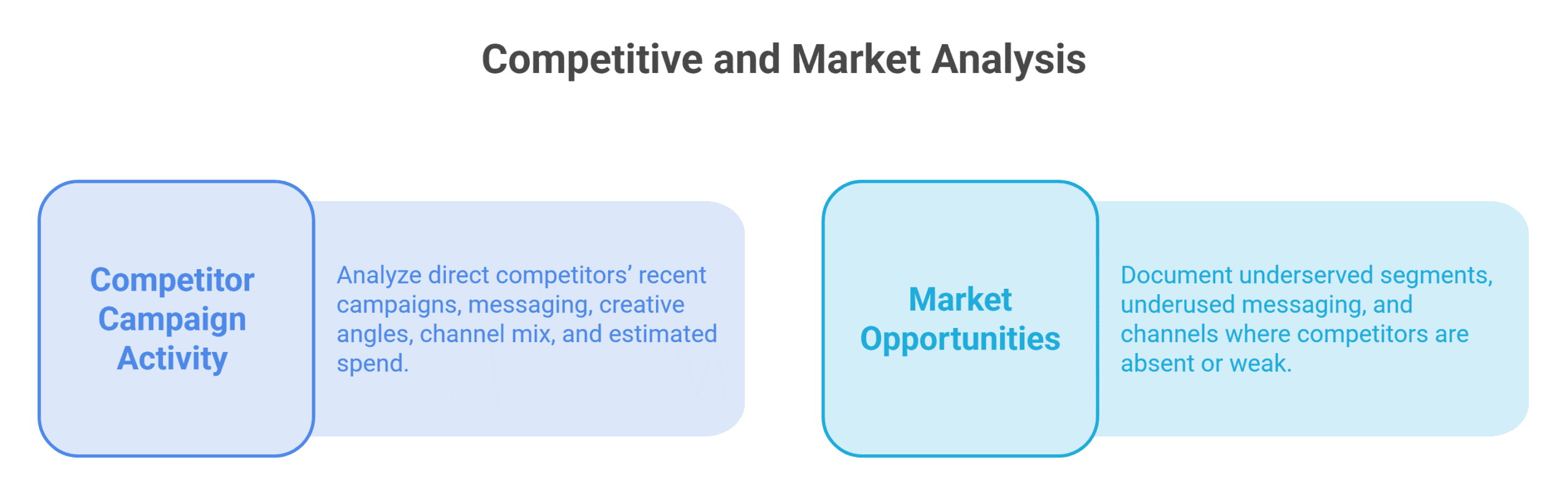
Analyze direct competitors’ recent campaigns, messaging, creative angles, channel mix, and estimated spend. Tools for ad libraries, search volume trends, and social listening reveal white space and current market activity. Note seasonal patterns, regulatory shifts, and cultural moments relevant to the American market.
Document both successful tactics worth adapting and weak approaches to avoid. This review helps prevent redundant creative or messaging while highlighting differentiation opportunities that can strengthen the overall marketing campaign.
2. Identifying Market Opportunities and Gaps
Document opportunities: underserved segments, messaging that resonates but remains underused, or channels where competitors are absent or weak. This analysis informs both positioning and realistic performance benchmarks. Include broader market trends such as shifts in media consumption or emerging platform preferences that could influence channel selection.
Translating these findings into actionable recommendations ensures the campaign strategy addresses real market needs rather than relying solely on internal assumptions or past performance data.
Developing Channel Strategy and Media Mix
Channel selection directly affects reach, efficiency, and overall campaign performance. A thoughtful media mix balances proven channels with room for experimentation. Matching channels to audience behavior and campaign objectives produces stronger results than simply following industry trends.
1. Selecting Channels Based on Objectives
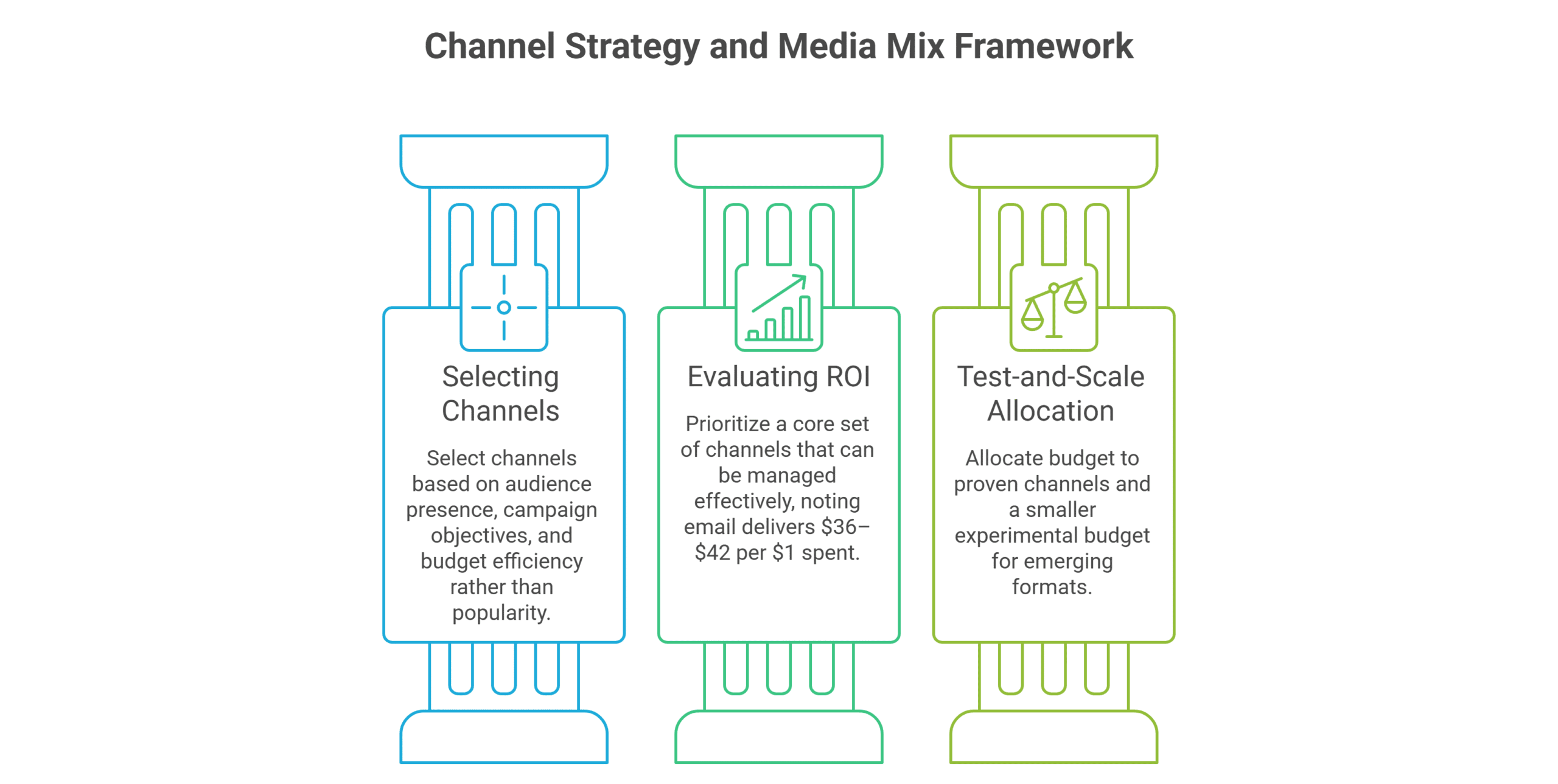
Select channels based on audience presence, campaign objectives, and budget efficiency rather than popularity. A typical modern mix balances owned (website, email, organic social), paid (search, social, display, CTV), and earned (PR, influencers, community). Match channel strengths to funnel stages—search and retargeting for conversion, social and video for awareness and consideration.
2. Evaluating Channel-Level ROI Potential
Email marketing continues to deliver exceptional returns, often $36–$42 for every $1 spent, making it a core retention and conversion channel. Short-form video and organic search frequently rank among the highest-ROI formats according to recent marketer surveys. Search still captures a large share of digital spend, while social and video continue rapid growth. Prioritize a core set of channels that can be managed effectively rather than spreading budget too thin.
3. Planning Test-and-Scale Allocation
For client campaigns, recommend a test-and-scale approach: allocate a portion of budget to proven channels and a smaller experimental budget for emerging formats. Document the rationale so stakeholders understand trade-offs. Build flexibility into the media plan so funds can shift quickly toward stronger performers once data becomes available.
Creating Messaging Frameworks and Creative Assets

Messaging and creative bring the strategy to life for the audience. Strong frameworks ensure consistency across channels while allowing flexibility for different formats. Testing and refinement keep creative performance high throughout the campaign lifecycle.
1. Building a Clear Messaging Hierarchy
- Creative is not decoration; it is the vehicle for the value proposition.
- Develop a messaging hierarchy: core brand promise, campaign-specific benefit, proof points, and clear calls to action.
- Produce modular assets that can be adapted across formats and platforms while remaining on-brand.
- Ensure every piece of creative supports the same strategic narrative.
2. Prioritizing Authenticity and Testing
- Prioritize authenticity and usefulness in all creative development.
- American consumers increasingly reward brands that demonstrate values through action rather than slogans.
- A/B test headlines, visuals, offers, and CTAs systematically.
- For video-heavy campaigns, plan for multiple lengths and aspect ratios from the outset and maintain a testing calendar so creative evolution continues throughout the campaign.
3. Integrating AI Tools with Human Oversight
- AI tools accelerate campaigns with variants and personalized versions.
- Human oversight remains essential for brand voice, cultural nuance, and emotional resonance.
- Teams using AI for personalization report higher productivity and better outcomes when paired with strong creative direction.
- Establish clear brand guidelines and review processes, so AI-assisted work stays on strategy.
Building Detailed Campaign Plans and Timelines
Detailed planning turns strategy into executable action. Clear timelines, defined roles, and disciplined budget management reduce the risk of delays and overspending. This stage creates the operational structure needed for smooth campaign delivery.
1. Constructing Realistic Production Schedules
Translate strategy into a detailed Gantt-style timeline that includes creative production, asset approvals, platform setup, launch windows, optimization checkpoints, and reporting cadences. Build in buffer for legal reviews and unexpected delays. Sequence tasks so dependencies are clear and bottlenecks are visible early. A well-constructed schedule helps teams anticipate resource needs and maintain momentum from planning through post-campaign analysis.
2. Defining Roles and Communication Cadence
Define roles clearly: strategy owner, creative lead, media buyer, analytics specialist, client point of contact. For agency-client relationships, establish weekly or bi-weekly syncs and a shared project management workspace. Set milestone approvals so progress is visible and decisions stay on schedule. Clear ownership reduces confusion and accelerates problem resolution when issues arise during execution.
3. Managing Budget Pacing and Contingency
Budget pacing plans should prevent front-loading or under-spending. Include contingency (typically 10–15%) for testing and rapid response to performance data. Review spend velocity weekly and adjust as needed to maintain consistent delivery against goals. Disciplined pacing protects overall campaign performance and allows room for opportunistic optimization.
Implementing Tracking, Measurement, and Launch Infrastructure
Accurate tracking and measurement infrastructure is essential for understanding campaign performance. Without reliable data, optimization becomes guesswork. Proper setup before launch ensures insights are trustworthy and actionable from the first day of activity.
1. Configuring Conversion Tracking and Analytics
- Configure conversion tracking, UTM parameters, CRM integrations, and analytics dashboards before launch.
- Implement server-side tracking or enhanced conversions where possible to mitigate cookie deprecation.
- Establish a single source of truth for performance data—whether a shared Looker Studio, Tableau, or agency reporting tool.
- Verify all tracking elements function correctly through pre-launch testing.
2. Defining Multi-Level Success Metrics
- Define success metrics at three levels: campaign-level (ROAS, CAC, pipeline influenced), channel-level (CTR, CPC, conversion rate), and creative-level (engagement, view-through).
- Agree on attribution model (last-click, data-driven, or multi-touch), so results discussions stay productive.
- Document baseline benchmarks so improvements can be measured accurately.
- Align metrics with the original campaign goals established during the planning phase.
3. Executing Phased Launches with Monitoring Protocols
- Launch in phases when feasible – soft launch to a limited audience, then full rollout.
- Monitor early signals closely: delivery rates, engagement velocity, and any technical issues.
- Have a rapid-response protocol for creative fatigue, negative sentiment, or platform policy flags.
- Conduct daily or every-other-day checks during the first two weeks and use automated alerts for spend anomalies or conversion drops.
Running Optimization Cycles and Performance Iteration
Optimization turns initial performance data into improved results. Structured review cycles and systematic testing allow campaigns to improve continuously rather than remaining static after launch. Capturing and applying learnings strengthens both current and future marketing campaigns.
1. Establishing Structured Optimization Sprints
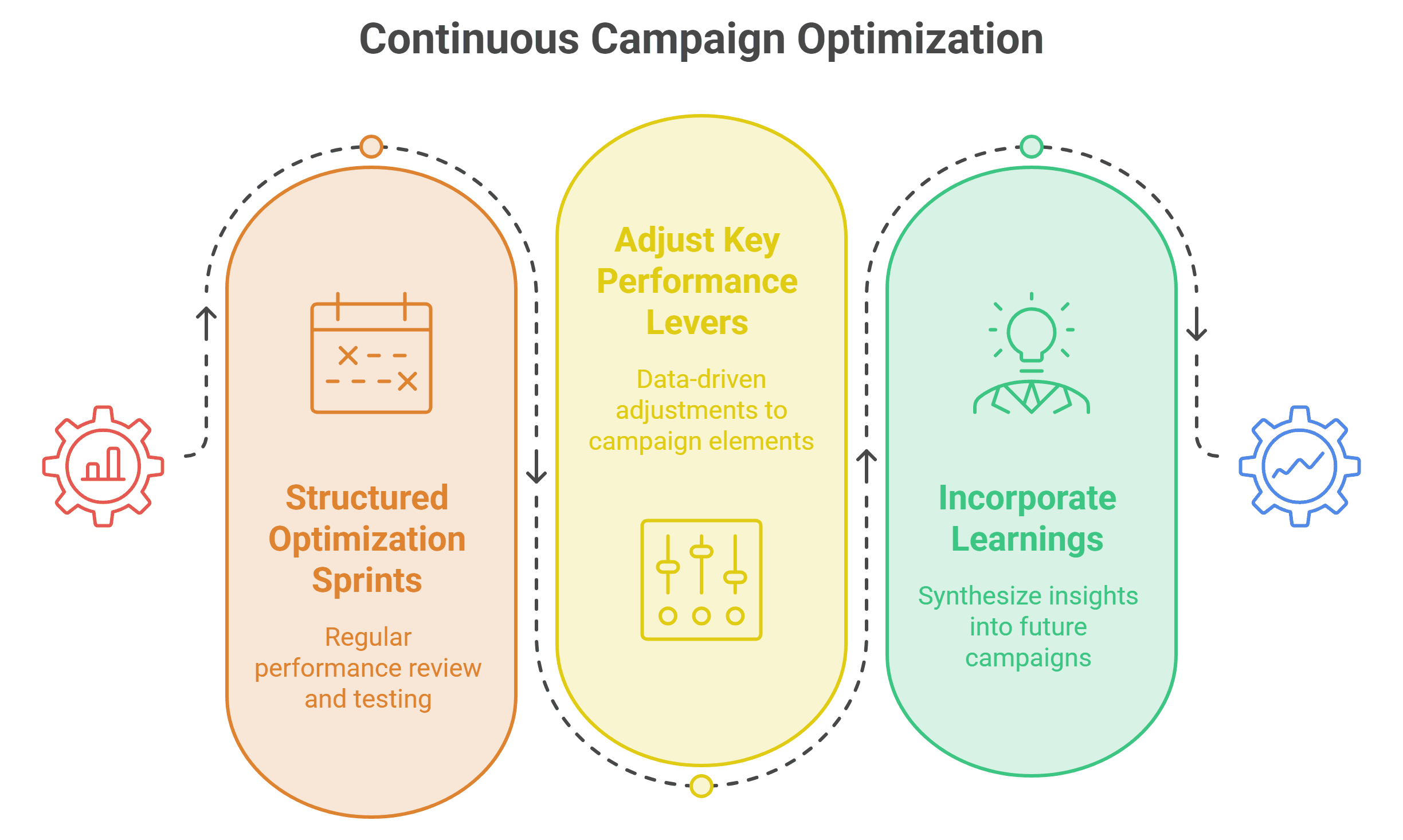
The strongest campaigns treat launch as the starting line, not the finish. Schedule structured optimization sprints every 7–14 days. Analyze performance against benchmarks, pause underperformers, scale winners, and test new hypotheses. Keep a living optimization log that records changes and observed impact.
2. Adjusting Key Performance Levers
Common key performance indicators include bid adjustments, audience refinement, creative rotation, landing page improvements, and offer testing. Document every change and its impact so learning compounds across campaigns. Clients appreciate transparent optimization logs that show proactive management rather than passive reporting. Focus first on high-impact changes that can move results quickly.
3. Incorporating Learnings into Future Campaigns
After each major flight, synthesize insights into playbooks or updated strategy documents. Capture what worked for specific audience segments, creative approaches, and channel combinations. This institutional knowledge becomes a competitive advantage over time and shortens the learning curve for subsequent marketing campaigns.
Delivering Transparent Reporting and Client Relationship Management
Transparent reporting and strong client relationships turn campaign results into long-term partnerships. Clear communication of both successes and challenges builds credibility. Focusing on business outcomes rather than vanity metrics helps clients see the true value of the work.
- Deliver reports that focus on business outcomes first, then supporting metrics, and include context on what worked, what did not, why, and recommended next actions.
- Use visual dashboards with clear annotations rather than dense data dumps, and schedule regular review meetings that allow discussion instead of one-way presentations.
- Share both wins and challenges early, educate clients on platform changes and measurement realities, and set realistic expectations around ramp time for organic and brand campaigns.
- Position agency teams as an extension of the client’s marketing function through shared goals, shared dashboards, and collaborative planning sessions.
- Track downstream impact on customer lifetime value, retention, and brand equity while recognizing that successful campaigns compound through growing email lists, improved organic rankings, expanded creative libraries, and sharper audience insights.
TaskVirtual: Your Partner in Marketing Campaign Support

Executing a full marketing campaign process requires consistent attention across research, content coordination, reporting, scheduling, and performance tracking. Many marketing teams and agencies find these operational tasks time-intensive while trying to stay focused on strategy and creative direction. TaskVirtual supplies skilled digital marketing assistants who handle the detailed support work that keeps digital marketing campaigns running smoothly from planning through optimization.
1. Expert Virtual Assistance for Campaign Execution
TaskVirtual’s trained virtual assistants help with audience research compilation, competitive monitoring, content calendar management, social post scheduling, email sequence setup, and basic performance data gathering. They support the day-to-day workflow so marketing managers and strategists can concentrate on higher-level decisions and client communication.
2. Affordable and Flexible Pricing
Hiring a full-time marketing coordinator can strain budgets, but TaskVirtual makes specialized support accessible. With pricing plans starting from just $3.12/hour to $14.99/hour, their services fit the needs of growing agencies, in-house teams, and independent marketers managing multiple client campaigns.
3. Comprehensive Support Across the Campaign Lifecycle
From organizing research notes and maintaining tracking sheets to coordinating asset delivery timelines and preparing draft performance summaries, TaskVirtual covers essential operational tasks. Their scalable assistance adapts whether a team needs short-term help during a campaign launch or ongoing support for always-on digital marketing programs.
4. Continuous Monitoring and Quality Assurance
TaskVirtual provides regular updates and proactive reminders so campaign tasks stay on schedule. Their structured approach helps maintain consistency in reporting cadence, content deployment, and data organization, reducing the risk of missed deadlines or incomplete tracking setups that can undermine campaign results.
5. Proven Track Record of Excellence
With 364 positive reviews and a 4.7-star rating on trusted VA platforms, TaskVirtual is recognised as a reliable partner worldwide. Marketing professionals count on their expertise to streamline campaign operations and free internal resources for strategy, creative development, and client relationship management.
FAQ
1. What is the typical timeline for a full digital marketing campaign?
Most comprehensive campaigns run 8–16 weeks from brief to final analysis, though always-on programs operate continuously with quarterly planning cycles. Ramp periods for paid media are often 1–2 weeks; organic and content efforts take longer to mature.
2. How much should a U.S. business budget for a marketing campaign?
Benchmarks vary widely by industry and growth stage. Many established companies allocate 7–10% of revenue to marketing overall, with a substantial portion directed to digital. Small businesses often start with monthly digital spends ranging from a few thousand dollars upward depending on goals and competition.
3. Which channels currently deliver the highest ROI?
Email marketing frequently tops ROI rankings at $36–$42 per dollar spent. Organic search/SEO and well-optimized paid search also perform strongly. Short-form video and content marketing show high effectiveness for both awareness and conversion when executed consistently.
4. How important is AI in modern marketing campaign management?
AI now supports personalization, content variant generation, bidding, audience prediction, and reporting. Adoption is widespread, but results depend on quality data, clear strategy, and human oversight of brand and creative judgment.
5. What are the biggest reasons marketing campaigns fail?
Common causes include unclear goals, weak audience targeting, insufficient testing, poor tracking setup, and lack of ongoing optimization. Misaligned stakeholder expectations and inadequate creative differentiation also contribute frequently.
6. How do agencies typically structure client marketing campaign workflows?
Leading agencies follow a structured process: discovery and goal alignment, research and strategy, creative and media planning, setup and launch, continuous optimization, transparent reporting, and post-campaign learning. Clear communication protocols and shared performance ownership are essential.
Conclusion and Call to Action
A disciplined marketing campaign process—rooted in clear goals, deep audience understanding, thoughtful channel selection, rigorous measurement, and continuous optimization—consistently outperforms ad-hoc efforts. In 2026, the tools are more powerful than ever, yet the fundamentals of strategy, creativity, and accountability remain decisive.
Whether you are refining an internal workflow or evaluating agency partners, use this framework as a checklist. Audit your current campaigns against each stage. Identify the weakest links and close them systematically. The difference between average and high-performing marketing campaigns usually lies in consistent process execution rather than larger budgets alone.
Ready to run more effective campaigns? Start by documenting your next campaign’s goals, audience segments, and success metrics this week. Apply the structure outlined here and measure the improvement in clarity, speed, and results.
Sources
- IAB/PwC Internet Advertising Revenue Report (2025 data)
- HubSpot State of Marketing Report
- Content Marketing Institute / Demand Metric research
- Litmus and industry email marketing ROI studies
- Statista and related digital advertising market analyses
For more such content, visit our website.
 Siddhartha Basu is a Technical Writer at Task Virtual. He loves online games, e-book reading, and Yoga.