
Contents
show
Outsourced Business Operations: What It Is, What to Outsource
American founders face constant pressure from talent gaps, rising costs, and the need to scale without expanding payroll. Outsourced business operations now serve as a practical growth tool, freeing teams to focus on product, customers, and strategy while specialized partners handle repeatable work. In 2026, with AI-augmented delivery and hybrid models mature, the right approach turns operations from a constraint into a competitive advantage.
This guide explains the model, shows clear signals that operations are limiting growth, distinguishes front- and back-office choices, identifies what must stay internal, and provides a decision checklist plus a realistic 30-day transition path. Throughout, we highlight how targeted services such as Administrative Assistant support, Real Estate VA (REVA) assistance, Social Media VA management, IT Support Services, and specialized offerings like Virtual Legal Assistant or Virtual Medical Assistant work fit into a modern outsourced operations model.
Defining Outsourced Business Operations and Its Boundaries
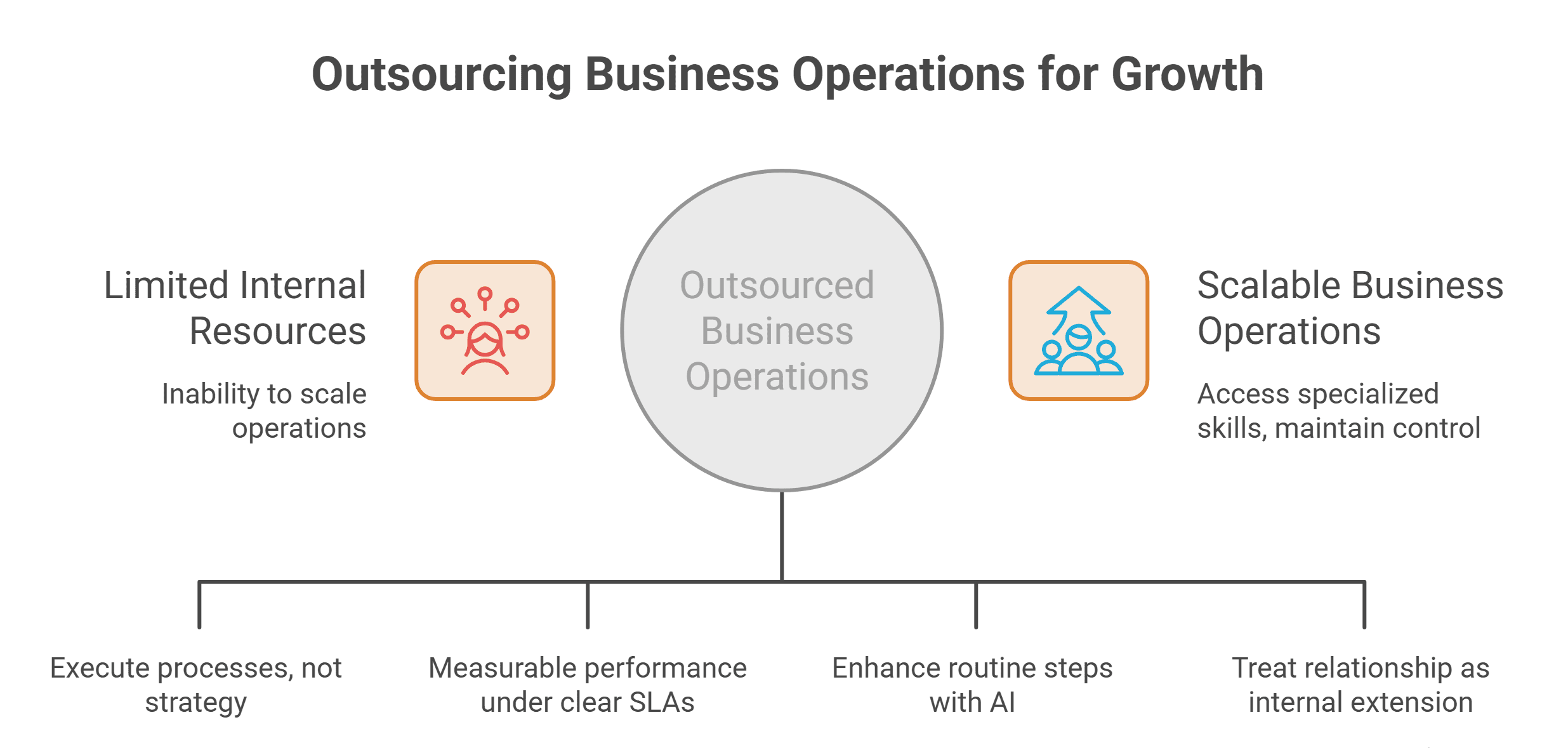
Outsourced business operations involve contracting external specialists to run defined, repeatable processes that keep a company functioning day to day. Providers deliver managed capacity under clear service levels rather than simple freelancing. This approach lets U.S. businesses access skills ranging from administrative support and Data Handling to AI Consulting and IT Support without adding permanent headcount.
1. Core Scope and Delivery Models
Outsourced business operations cover process execution and ongoing management rather than strategy ownership or proprietary product creation. Providers typically operate under documented playbooks and measurable SLAs while the client retains final decision rights and brand accountability. Delivery can occur through onshore, nearshore, or offshore teams, often enhanced by AI tools for routine steps and supported by services such as Ecommerce VA order handling or Real Estate VA (REVA) support.
Boundaries stay clear: providers execute; they do not set pricing, product vision, or regulatory ownership. Specialized offerings like Virtual Legal Assistant support for document workflows, Virtual Medical Assistant help for administrative medical tasks, Market Research gathering, and Data Handling fit inside these boundaries when properly scoped. Clients maintain control over sensitive outcomes while gaining scalable capacity.
2. Practical Fit for Small Businesses and Startups
For smaller U.S. companies, the model often takes the form of an outsourced operations team rather than a large enterprise BPO contract. Providers can support businesses with SEO Services, Website Development, and Digital Marketing functions such as Online Marketing Services and Social Media Marketing. These flexible solutions allow growing companies to access specialized expertise while maintaining operational efficiency without expanding permanent payroll.
Risks remain real and include knowledge loss, communication friction, data exposure, and underestimated coordination effort. IBM’s Cost of a Data Breach Report 2024 found that the average global cost of a data breach reached USD 4.88 million, highlighting the importance of strong documentation, security practices, and structured collaboration. Treating the relationship as an extension of the internal team with shared metrics and regular reviews reduces these risks. Services such as AI Consulting Services further strengthen the arrangement through process improvement and technical reliability.
7 Signs Operations Are Becoming a Growth Constraint
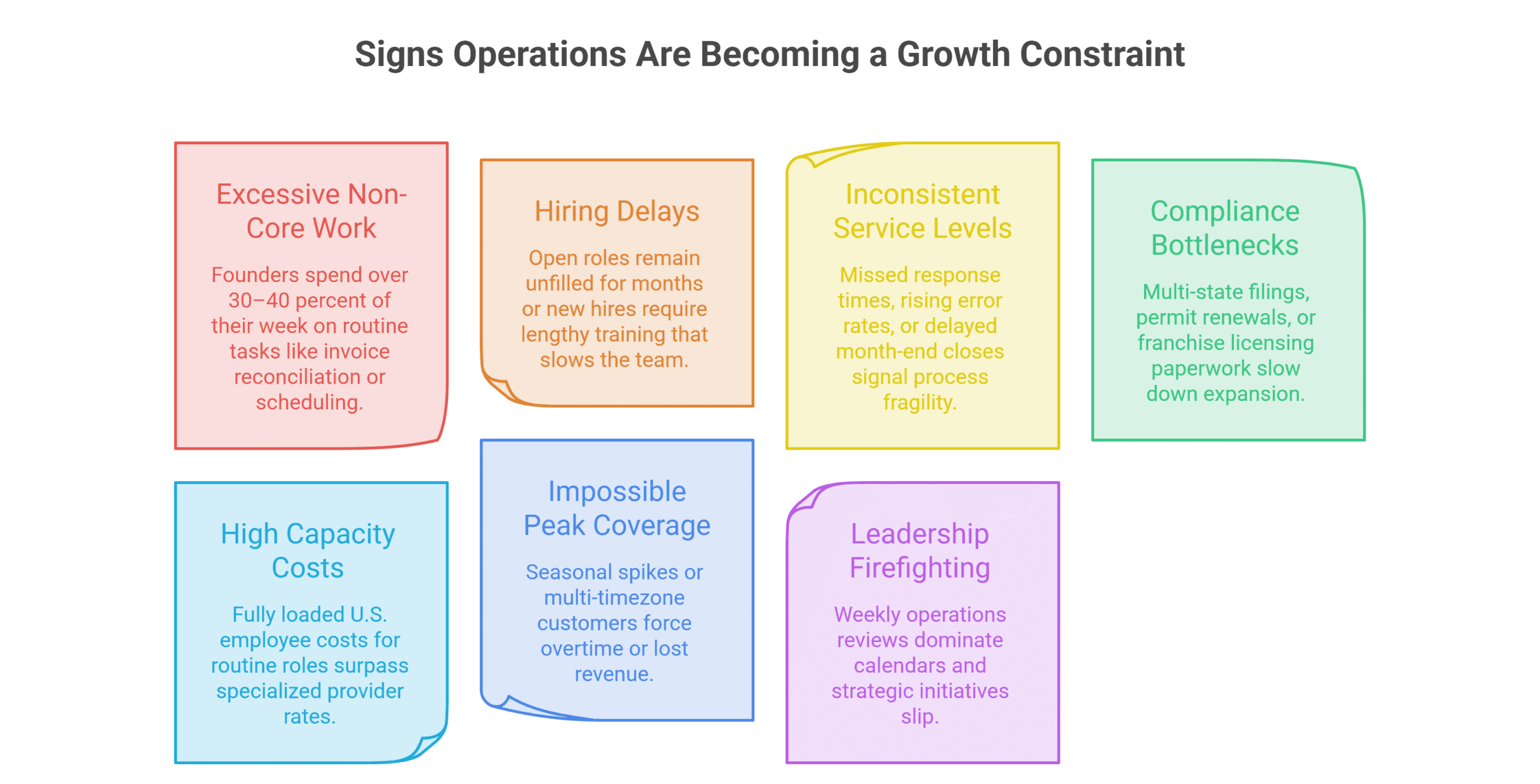
Operations turn into a growth constraint when internal capacity can no longer keep pace with revenue or product demands. Recognizing the signals early allows founders to shift work to specialized partners before momentum stalls. The following seven indicators show when outsourced business operations, including Virtual Receptionist coverage or Digital Marketing execution, become a practical next step.
1. Founders Spend Excessive Time on Non-Core Work
When founders or core team members spend more than 30 – 40 percent of their week on routine tasks such as invoice reconciliation, Tier-1 inquiries, or basic scheduling, strategic work suffers. An Administrative Assistant or Receptionist can absorb much of this volume. Ecommerce VA and Real Estate VA (REVA) support further free leadership time in specialized industries.
2. Hiring Delays and Quality Gaps Persist
Open roles for bookkeepers, support staff, or compliance coordinators remain unfilled for months or new hires require lengthy training that slows the whole team. Specialized providers offering Data Handling, IT Support Services, Virtual Legal Assistant capacity, or Virtual Medical help close these gaps faster than traditional recruiting.
3. Service Levels Become Inconsistent
Missed response times, rising error rates in order processing, or delayed month-end closes signal process fragility. Volume growth exposes manual bottlenecks. Online video Editing Services and SEO Services can stabilize customer-facing and content workflows that previously fluctuated.
4. Compliance and Licensing Create Expansion Bottlenecks
Multi-state filings, permit renewals, or franchise licensing paperwork slow growth. Virtual Legal Assistant support and structured Handling reduce this friction while keeping final accountability internal.
5. Internal Capacity Costs Exceed Control Value
Fully loaded U.S. employee costs for routine roles often surpass specialized provider rates once volume is sufficient. Comparing total cost per transaction against services such as IT Support Services clarifies the economics.
6. Peak Coverage and Extended Hours Become Impossible
Seasonal spikes or multi-timezone customers force overtime or lost revenue. Virtual Receptionist coverage, Ecommerce VA capacity, and proper VA teams flex more readily than permanent staff.
7. Leadership Bandwidth Is Consumed by Firefighting
Weekly operations reviews dominate calendars and strategic initiatives slip. Shifting routine Digital Marketing, Facebook Marketing & Ads, Instagram Marketing & Ads, LinkedIn Marketing & Ads, Online Marketing Services, Social Media Marketing, Logo Design Service, Online Business Services, Landing Page Design, and Website Development tasks to external partners restores leadership focus.
Front-Office vs. Back-Office Functions in Outsourcing

Not every process carries the same customer impact or risk profile. Separating front-office from back-office work helps prioritize what to outsource first. Hybrid functions that blend both categories also appear frequently and benefit from targeted services such as Market Research or Market Analyst.
1. Front-Office Candidates and Considerations
- Customer service queues and basic inquiry handling benefit from Virtual Receptionist and Administrative Assistant capacity that maintains response speed.
- Order intake and status updates work well with proper VA support that scales during peak periods.
- Appointment scheduling and light client communication fit Real Estate VA (REVA) or Virtual Medical Assistant administrative workflows.
- Social content engagement and basic brand interactions can leverage Social Media VA, Facebook Marketing & Ads, Instagram Marketing & Ads, and LinkedIn Marketing & Ads execution under clear brand guidelines.
2. Back-Office Strengths
- Bookkeeping, accounts payable and receivable, and routine payroll administration gain consistency through Data Handling and specialized support.
- Onboarding paperwork, benefits enrollment support, and basic HR administration transfer cleanly to structured providers.
- Document processing, compliance tracking, and filing tasks align with Virtual Legal Assistant capacity.
- Technical maintenance, system monitoring, and routine troubleshooting improve with IT Support Services and guidance from AI Consulting Services.
3. Hybrid and Emerging Areas
- Content creation, report generation, and light research combine Market Research with Video Editing Services, Photo Editing Services, and SEO Services.
- Website and landing-page updates sit between technical delivery and brand presentation and suit Website Design Services, WordPress Design Services, Landing Page Design & Development, and Logo Design Service work.
- Digital campaign execution and performance tracking blend Online Marketing Services, Social Media Marketing, and Digital Marketing with internal strategy oversight.
- Industry-specific administrative flows, such as real-estate transaction support or medical scheduling, benefit from Real Estate VA (REVA) and Virtual Medical Assistant resources while final decisions remain internal.
What to Keep In-House
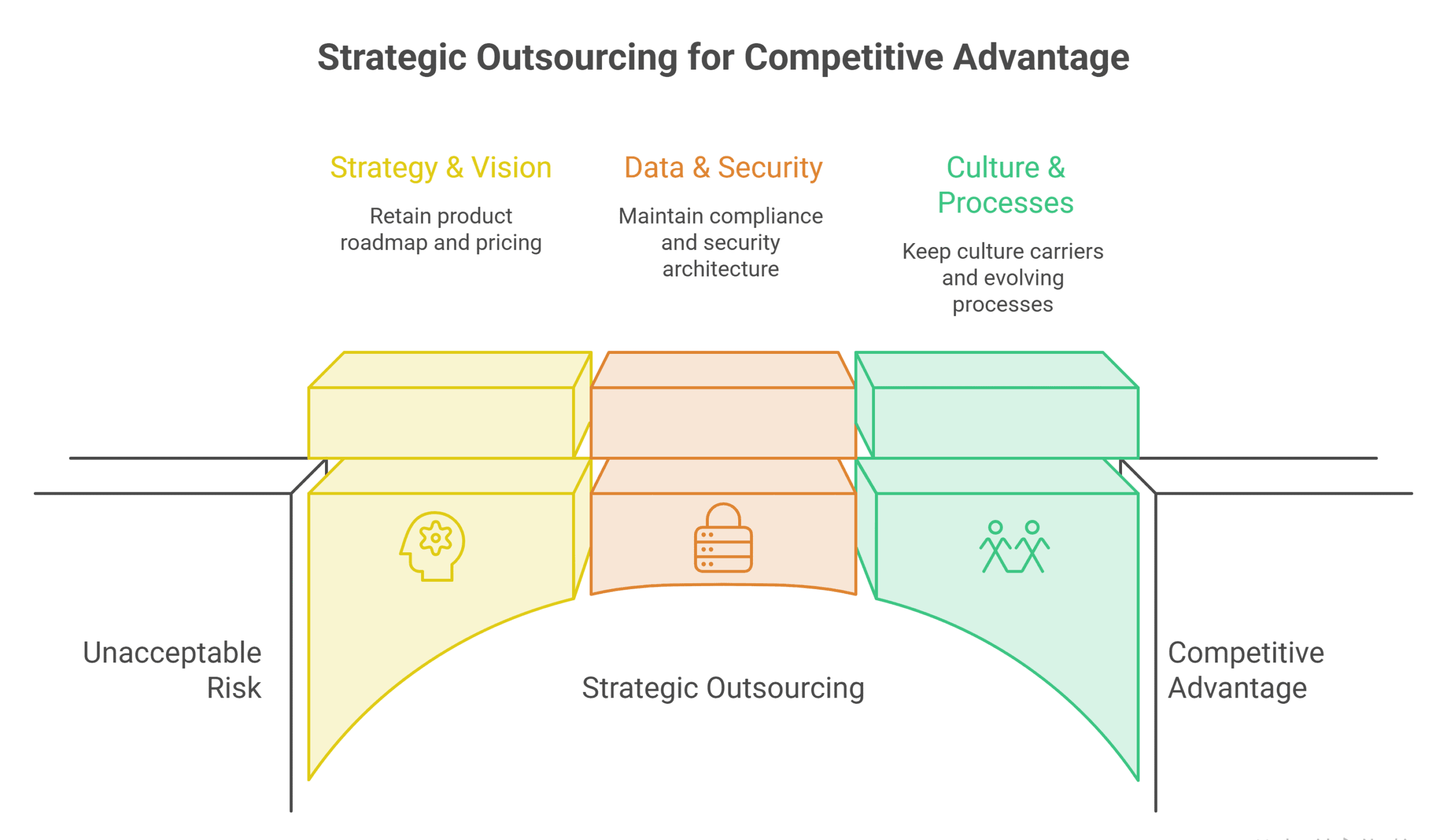
Certain activities create unacceptable risk or lose effectiveness when moved outside the company. Protecting these areas while outsourcing volume-oriented work preserves competitive advantage and regulatory control. The following categories should generally remain internal even when partners supply Administrative Assistant or Digital Marketing support.
1. Strategy, Vision, and Core Relationships
- Product roadmap ownership and major feature prioritization stay with the founding or executive team.
- Pricing strategy and margin decisions require full internal context.
- Key account relationships and high-stakes customer negotiations remain founder- or leadership-led.
- Brand narrative and long-term positioning decisions cannot be delegated without diluting identity.
2. Sensitive Data, Security, and Regulatory Judgment
- Final compliance sign-off and audit ownership stay internal even when Virtual Legal Assistant or Data Handling partners prepare materials.
- Security architecture choices and access-policy decisions require direct accountability.
- Highly regulated clinical, financial, or legal judgments retain internal control.
- Proprietary algorithms, unique process IP, and core data models remain inside the company.
3. Culture Carriers and Still-Evolving Processes
- Roles that train others and encode tribal knowledge are poor early outsourcing candidates.
- Processes that change weekly or remain undocumented should stabilize before any handoff.
- Functions whose management overhead exceeds potential savings stay internal.
- Activities that directly shape company culture and values continue under internal leadership.
Decision Checklist

A structured evaluation prevents costly missteps and ensures the chosen partner can deliver real capacity. According to McKinsey, organizations that redesign processes effectively can achieve 30–60% improvements in efficiency, highlighting the value of assessing workflows, documentation, and operational readiness before outsourcing. Review current volume, cost, documentation quality, security, cultural fit, and exit rights to maintain flexibility and reduce risk.
Define precise SLAs, escalation paths, and knowledge-transfer requirements while evaluating providers based on relevant experience with services such as Ecommerce VA, Real Estate VA (REVA), Social Media VA, IT Support Services. Model the total cost of ownership over 12–24 months, including transition efforts, and establish clear exit provisions so the company maintains flexibility and avoids dependency on a single provider.
30-Day Transition Scenario
- Days 1–7: Finalize scope document, complete security review, and execute the contract. Begin structured knowledge capture by recording processes, granting least-privilege system access, and introducing the provider team to internal stakeholders.
- Days 8–14: Conduct shadowing and parallel processing so the provider team works alongside internal staff on live volume while internal owners retain final approval. Hold daily stand-ups to surface gaps quickly.
- Days 15–21: Shift lower-risk queues or historical clean-up first under dual control. Run joint quality reviews and refine playbooks in real time. Launch shared reporting dashboards visible to both sides.
- Days 22–30: Complete full handoff of the scoped volume under agreed SLAs. Transition the internal team to exception handling, analysis, and relationship management. Hold a formal retrospective and establish a weekly operations review plus monthly business review cadence.
TaskVirtual: Your Partner in Outsourced Business Operations Support

Managing daily business operations while focusing on growth can become challenging for founders and teams. From administrative workloads and customer support coordination to data handling, digital tasks, and process management, repetitive operational responsibilities can reduce productivity and slow expansion. TaskVirtual provides reliable outsourced business operations support by connecting businesses with skilled virtual assistants who help streamline workflows, improve efficiency, and provide scalable operational assistance.
1. Expert Operational Support and Consultation
TaskVirtual’s experienced virtual assistants help businesses manage essential operational tasks such as administrative support, customer coordination, research assistance, and workflow management. Their structured approach allows companies to delegate repeatable processes while maintaining control over important business decisions and strategic priorities.
2. Cost-Effective and Flexible Outsourcing Solutions
Building an in-house team for every operational requirement can increase costs and limit scalability. TaskVirtual offers flexible outsourcing solutions designed for businesses that need dependable support without the expense of additional full-time employees. With pricing plans starting from just $3.12/hour to $14.99/hour, their services are budget-friendly and accessible for startups, small businesses, and growing companies.
3. Scalable Support for Growing Business Needs
Whether a company needs assistance with administrative processes, customer-facing tasks, digital operations, or specialized virtual support, TaskVirtual provides adaptable solutions that grow with business requirements. Their services help organizations reduce operational bottlenecks and create more time for leadership teams to focus on strategy and growth.
4. Reliable Assistance With Quality Assurance
TaskVirtual focuses on delivering consistent support through trained professionals, clear communication, and quality-focused processes. Their virtual assistants help maintain accuracy, improve workflow efficiency, and help businesses handle operational demands with confidence.
5. Trusted Partner With Proven Results
With 364 positive reviews and a 4.7-star rating on trusted VA platforms, TaskVirtual is recognised as a reliable partner worldwide. Businesses rely on their expertise to simplify operations, improve productivity, and build a more efficient outsourced support model.
FAQ
1. What is the difference between outsourced business operations and traditional BPO?
Outsourced business operations is the practical application of BPO principles to the day-to-day running of the company. Traditional BPO often implies larger-scale, multi-year contracts; modern outsourced operations for small businesses and startups can start smaller and more modular.
2. Is outsourcing business operations only for large companies?
No. Many U.S. small businesses and startups successfully use outsourced operations teams for accounting, support, and administrative functions once volume justifies it. The model scales down effectively with the right providers.
3. What are the biggest risks of outsourcing business operations?
Knowledge loss, quality inconsistency, data security incidents, cultural misalignment, and underestimating internal management effort. Strong documentation, clear SLAs, security diligence, and active governance mitigate most of these.
4. How do I decide between onshore, nearshore, and offshore?
Match time-zone needs, language/cultural requirements, data sensitivity, and cost targets. Customer-facing or highly regulated work often stays onshore or nearshore; high-volume standardized back-office work can leverage offshore with proper controls.
5. Can I outsource business licensing for franchise operations?
Yes, many providers specialize in multi-state licensing, permit tracking, and compliance filings. Keep strategic franchise decisions and final legal accountability internal.
6. How long does it take to see ROI from outsourced business operations management?
Well-scoped back-office transitions often show cost or capacity benefits within 60–90 days. Front-office and more complex functions typically require 3–6 months of refinement before full returns appear.
Conclusion and Call to Action
Outsourced business operations are no longer a last resort for cost-cutting. For American founders and operators, they form a practical operating model that removes growth constraints while preserving control over what truly differentiates the business. Define clear boundaries, watch for the seven constraint signals, distinguish front-office from back-office opportunities, protect the functions that must stay internal, and follow a disciplined checklist and transition plan.
The companies that treat outsourcing as a managed extension of their team – rather than a black-box vendor relationship – capture both efficiency and strategic focus. Start by mapping one high-volume, well-documented process against the checklist above. Measure the current fully loaded cost and leadership time. Then evaluate whether an outsourced operations partner can deliver equal or better outcomes with less internal drag. If operations are already constraining growth, the cost of inaction is higher than the effort of a structured pilot. Begin the evaluation this quarter.
Sources
- GlobalData Global Outlook Report on Business Process Outsourcing (market size figures).
- IBISWorld Business Process Outsourcing Services in the US Industry Analysis.
- U.S. Bureau of Labor Statistics and SBA small-business employment and job-creation data.
- Deloitte Global Outsourcing Survey insights on investment trends and insourcing patterns.
- Additional industry analyses from Fortune Business Insights, Statista projections, and related official reports referenced for market context.
For more such content, visit our website.
 Siddhartha Basu is a Technical Writer at Task Virtual. He loves online games, e-book reading, and Yoga.