

Contents
show
How Agencies Can Benefit From a Custom Virtual Assistant
Agency life in 2026 moves fast. Client demands shift overnight, campaigns need constant optimization, and internal teams stretch thin across strategy, creative, reporting, and admin work. Many marketing, PR, digital, and creative agencies face the same pressure: deliver more without ballooning headcount—making a Custom Virtual Assistant an increasingly practical solution.
A custom virtual assistant—a skilled human professional who works remotely and is tailored to your agency’s workflows—offers a practical solution. These assistants handle client onboarding, social media management, research, scheduling, and reporting, freeing senior staff for high-value work while supporting lower costs, stronger scalability, and sharper strategic focus. This post examines the concrete benefits, implementation considerations, and data-backed reasons agencies turn to custom virtual assistants.
Cost Efficiency and Reduced Overhead
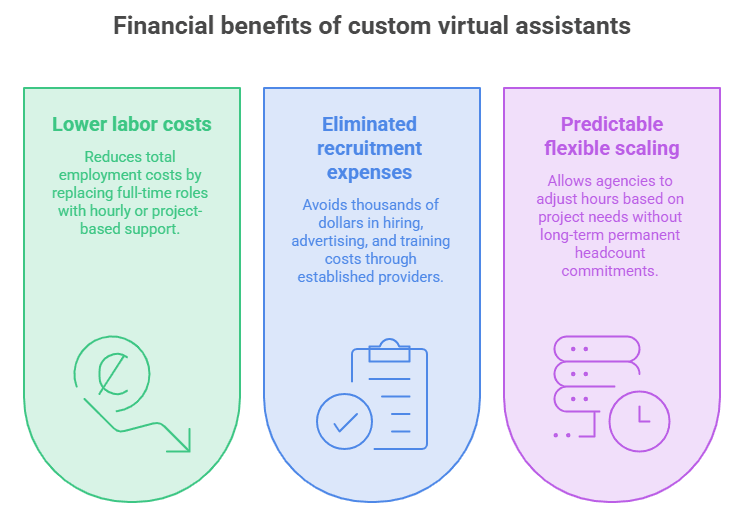
Agencies constantly balance rising client expectations against tight margins and limited budgets. A custom virtual assistant directly addresses this by replacing or supplementing expensive full-time support roles with flexible, lower-overhead capacity. The financial impact shows up quickly in labor costs, hiring expenses, and overall budgeting flexibility.
1. Lower Labor Costs Compared to Full-Time Hires
Hiring a full-time in-house employee involves base salary, benefits, payroll taxes, equipment, and office space. A custom virtual assistant typically works on an hourly or project basis without those extras, delivering substantial reductions in total employment costs for administrative and support roles.
Agencies often see savings in the 40–80% range depending on location and specialization when comparing virtual support to equivalent U.S. full-time roles. These savings free budget for client acquisition, technology, or senior talent and compound across multiple support functions.
2. Elimination of Recruitment and Onboarding Expenses
Filling a position carries direct costs. A Society for Human Resource Management analysis has placed average cost-per-hire figures in the thousands of dollars when accounting for advertising, interviewing, background checks, and initial training.
With a custom virtual assistant, agencies often work through established providers that handle vetting, reducing or eliminating those internal expenses. Onboarding focuses only on agency-specific tools and processes, allowing capacity to be added in days or weeks instead of months.
3. Predictable Budgeting and Flexible Scaling
Monthly or hourly arrangements make expenses more predictable than full-time salaries plus variable benefits. Agencies can increase hours during campaign launches or new-business pushes and scale back afterward.
This flexibility supports healthier cash flow, especially for agencies with project-based or seasonal revenue patterns common in the U.S. market, and avoids the long-term commitments of permanent headcount.
Enhanced Productivity and Focus on Core Work
Agency teams perform best when they concentrate on strategy, creative direction, and client relationships rather than routine support tasks. A custom virtual assistant removes much of that friction and restores focus where it creates the most value.
1. Freeing Senior Talent from Administrative Burdens
- Agency leaders and account managers often spend significant time on appointment scheduling, data entry, research compilation, and routine client communication.
- These tasks dilute time available for strategy, creative direction, and relationship building.
- A custom virtual assistant absorbs much of that load so executives and specialists regain hours each week.
- Productivity research supports the broader remote model; a well-known Stanford study found productivity gains of about 13% in certain controlled settings linked to fewer interruptions and more focused work time.
2. Faster Turnaround on Routine and Specialized Tasks
- Custom virtual assistants develop deep familiarity with an agency’s clients, brand guidelines, reporting templates, and preferred tools.
- This familiarity shortens the learning curve for recurring work such as social calendar assembly, competitive research, or performance report drafting.
- Turnaround times improve because the assistant already understands context and quality standards.
- Agencies gain consistent output without repeatedly explaining the same processes to temporary help.
3. Improved Team Morale and Reduced Burnout Risk
- When core team members constantly handle low-value tasks, burnout risk rises.
- Delegating those duties to a dedicated custom virtual assistant helps maintain healthier workloads.
- Agencies that protect their creative and strategic talent often see better retention of high performers.
- Higher-quality output on client work follows naturally from reduced internal friction and clearer role focus.
Scalability and Operational Flexibility
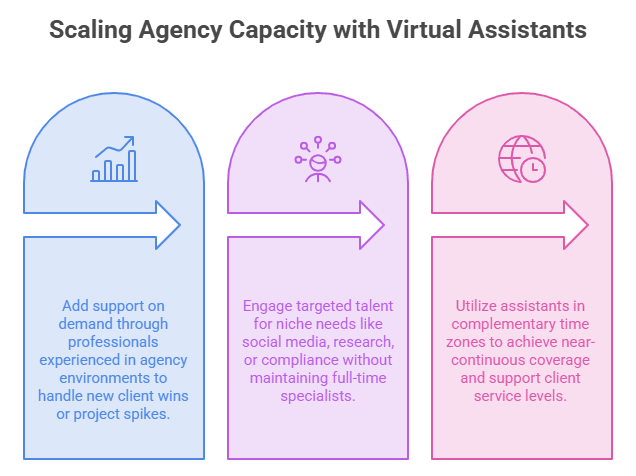
Growth can be unpredictable. Agencies must expand capacity quickly without permanent costs or office space. Since 75% of remote-capable U.S. employees work remotely at least sometimes, custom virtual assistants provide flexible support while maintaining quality standards.
1. Rapid Capacity Expansion Without Permanent Headcount
New client wins or sudden project spikes create immediate needs that traditional hiring rarely matches. A custom virtual assistant allows agencies to add support almost on demand through professionals experienced in agency environments. U.S. remote work patterns reinforce this viability; Bureau of Labor Statistics data show that roughly 22.6% of workers teleworked in March 2026, reflecting a stable post-pandemic baseline far above pre-2020 levels.
2. Access to Specialized Skills on Demand
Agencies need varied expertise: social media specialists, research analysts, bookkeeping support, graphic production help, or industry-specific knowledge (healthcare marketing compliance, financial services regulations, etc.). A custom virtual assistant can be selected or trained for those niches. Agencies avoid maintaining full-time specialists for intermittent needs and instead engage targeted talent when required.
3. Geographic and Time-Zone Advantages
U.S. agencies working with virtual assistants in complementary time zones can achieve near-continuous coverage for client support or content pipelines. Even same-time-zone domestic assistants provide flexibility around peak periods. This arrangement supports client service levels without requiring round-the-clock in-office staff.
Improved Client Service and Agency Reputation

Clients notice consistency, responsiveness, and thoughtful counsel. With 80% rating experience equal to offerings, integrated virtual assistants help agencies differentiate in competitive markets.
1. Consistent, High-Quality Support Delivery
- A well-integrated custom virtual assistant maintains documentation, follows established processes, and delivers consistent output.
- Clients experience reliable communication, timely reports, and polished deliverables.
- Over time, this consistency strengthens the agency’s reputation for professionalism and responsiveness.
2. Better Responsiveness and Coverage
- When primary team members are in client meetings or focused on strategy, the virtual assistant can handle routine inquiries, schedule coordination, or preliminary research.
- Response times improve, and clients notice the smoother experience.
- In competitive agency markets, this operational polish differentiates firms.
3. Capacity for Higher-Value Client Engagements
- By offloading support work, agencies free bandwidth for proactive strategy sessions, deeper analytics, and creative experimentation.
- Clients receive more thoughtful counsel rather than stretched reactive service.
- This shift often correlates with stronger retention and opportunities for expanded scopes of work.
Risk Management, Compliance, and Long-Term Integration
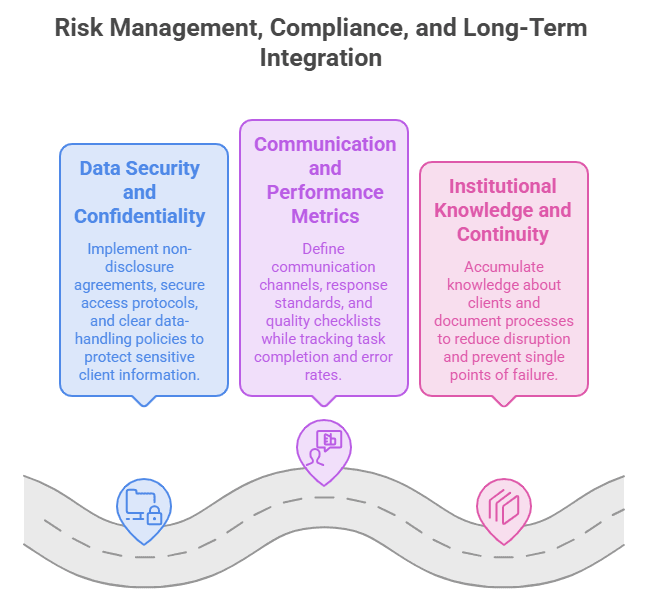
Any remote support arrangement must protect client data and maintain operational continuity. Thoughtful selection and clear processes turn a custom virtual assistant into a reliable, low-risk extension of the team.
1. Data Security and Confidentiality Practices
Agencies handle sensitive client information. Reputable custom virtual assistant arrangements include non-disclosure agreements, secure access protocols, and clear data-handling policies. Selecting professionals or firms that follow established security standards reduces risk compared with ad-hoc freelancing. Agencies should still maintain internal oversight, access controls, and regular reviews.
2. Clear Communication Protocols and Performance Metrics
Successful integrations rely on defined expectations: preferred communication channels such as email writing service, response-time standards, quality checklists, and regular feedback loops. Many agencies use shared project management tools and brief weekly check-ins. Measurable outcomes—task completion rates, error rates, client satisfaction proxies—help both sides improve over time.
3. Building Institutional Knowledge and Continuity
A long-term custom virtual assistant accumulates knowledge about clients, internal preferences, and historical campaigns. This continuity reduces disruption when team members change roles or leave. Documented processes further protect the agency against single points of failure.
Implementation Considerations for Agencies

Moving from interest to effective use requires deliberate planning. Agencies that define needs clearly and manage the relationship actively capture the greatest returns from a custom virtual assistant.
1. Assessing Needs and Defining the Role
- Start with a clear audit of time-consuming tasks currently handled by expensive or overextended staff.
- Prioritize high-volume, repeatable work that benefits from consistency.
- Define success metrics before engagement begins; common roles include administrative support, content coordination, research, reporting, and specialized production assistance.
2. Selecting the Right Custom Virtual Assistant
- Look for relevant agency or industry experience, proven reliability, strong communication skills, and cultural fit.
- Interviews, skills tests, and short paid trials help evaluate fit.
- Whether working with independent professionals or managed service providers, prioritize those who invest time understanding the agency’s specific workflows and standards.
3. Onboarding and Ongoing Management
- Provide structured access to tools, brand assets, and process documentation.
- Assign a primary internal point of contact and schedule regular reviews to refine priorities.
- Treat the relationship as a professional partnership rather than pure transaction; the highest returns come from mutual investment in continuous improvement.
TaskVirtual: Your Partner in Custom Virtual Assistant Services for Agencies

Agencies juggling client demands, campaign deadlines, and internal operations often struggle to free senior talent from repetitive support work. TaskVirtual delivers skilled personal virtual assistant services that are tailored to agency workflows, helping teams reclaim time for strategy, creative direction, and client growth while keeping overhead under control.
1. Expert Agency Support and Integration
TaskVirtual’s experienced virtual assistants integrate into your existing tools and processes. They handle client onboarding coordination, social media scheduling, research compilation, reporting, calendar management, and other recurring tasks so your core team can focus on high-value work.
2. Affordable and Flexible Pricing
Hiring full-time support staff can strain agency budgets, but TaskVirtual keeps costs manageable. With pricing plans starting from just $3.12/hour to $14.99/hour, their custom virtual assistant services remain accessible for agencies of all sizes seeking scalable support without long-term employment commitments.
3. Comprehensive Agency Support Solutions
From administrative coordination and performance reporting to specialized research and production assistance, TaskVirtual covers the full range of support needs. Their services scale with your workload, whether you require part-time help during peak campaign periods or consistent ongoing capacity.
4. Ongoing Support and Quality Assurance
TaskVirtual provides proactive communication, regular updates, and clear performance tracking. Their structured approach ensures tasks stay on schedule, quality standards remain consistent, and your agency maintains reliable client service without added internal strain.
5. Proven Track Record of Excellence
With 364 positive reviews and a 4.7-star rating on trusted VA platforms, TaskVirtual is recognized as a reliable partner for agencies worldwide. Clients rely on their expertise to streamline operations, improve focus, and support sustainable growth.
FAQ Section
1. What exactly is a custom virtual assistant for an agency?
A custom virtual assistant is a human remote professional selected or trained specifically for an agency’s tools, clients, processes, and quality standards rather than a generic or purely AI-based solution.
2. How much can agencies typically save?
Savings vary by role and location, but many agencies see significant reductions—often cited in the 40–80% range for total cost of comparable support—by avoiding benefits, office overhead, and full-time employment expenses.
3. Is a custom virtual assistant better than hiring full-time staff?
It depends on the function. For specialized, scalable, or fluctuating support needs, a custom virtual assistant frequently offers better cost control and flexibility. Core strategic or client-facing roles often remain better served by permanent team members.
4. How do agencies maintain quality and security?
Through careful selection, NDAs, secure access to tools, clear process documentation, regular performance reviews, and defined communication protocols.
5. Can a custom virtual assistant handle specialized agency work?
Yes. Many professionals specialize in social media management, research, reporting, graphic production support, or industry niches, and can be matched to or trained for agency requirements.
6. How quickly can an agency start working with one?
After needs assessment and selection, onboarding often takes days to a few weeks, far faster than traditional hiring cycles.
Conclusion + CTA
Agencies that treat support capacity as a strategic lever gain clear advantages in cost control, team focus, and the ability to scale. A custom virtual assistant frees senior talent for higher-value work, supports stronger client experiences, and avoids the full burden of permanent headcount.
The data on remote work adoption, productivity potential, and virtual assistant service growth all point to flexible, specialized human support as a practical model for American agencies. Begin with a simple internal audit of repetitive tasks, identify the highest-impact areas for delegation, and explore matched custom virtual assistant options. The operational breathing room and competitive edge are worth the focused effort.
Sources
- Future Market Insights, Virtual Assistant Services Market report (2025 projections and growth figures).
- U.S. Bureau of Labor Statistics, telework and remote work data (including March 2026 telework rate of 22.6%).
- Stanford University research on remote and hybrid work productivity (including the approximately 13% productivity finding from controlled studies).
- Society for Human Resource Management and related analyses on average cost-per-hire.
- Pew Research Center surveys on remote work preferences and participation among workers with remote-capable jobs.
- Additional industry analyses on virtual assistant cost comparisons and operational savings (commonly referenced ranges of 40–80% relative to full-time U.S. employment costs).
For more such content, visit our website.
 Siddhartha Basu is a Technical Writer at Task Virtual. He loves online games, e-book reading, and Yoga.