Contents
show
How HR Virtual Assistant Services Simplify Payroll and Benefits
Managing payroll and employee benefits has become challenging for American companies. Rising healthcare costs, changing tax regulations, hybrid workforces, and expectations for seamless self-service continue to strain HR teams. Many small and mid-sized businesses rely on staff or outdated systems, causing errors, compliance risks, and productivity losses—challenges an HR Virtual Assistant can address.
An HR virtual assistant offers a practical solution by managing routine yet critical tasks, including payroll calculations, benefits enrollment, compliance tracking, and employee inquiries, allowing internal teams to prioritize strategy and culture. A 2025 Pew Research Center survey found 72% of hybrid workers would choose a hybrid arrangement, reinforcing the value of flexible virtual support for employers. This guide explains how HR virtual assistant services streamline payroll and benefits, deliver measurable value for US employers, support effective implementation, and address common business questions.
What Is an HR Virtual Assistant and How Does It Work?
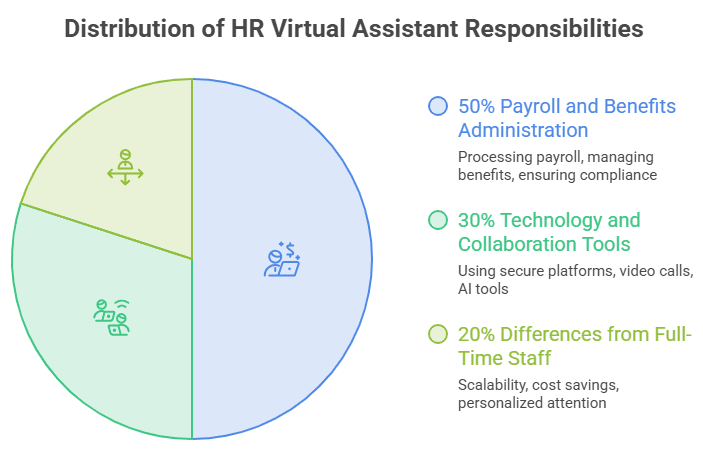
An HR virtual assistant is a trained remote professional who supports human resources functions without the overhead of a full-time, on-site employee. Unlike general virtual assistants, these specialists typically have experience or certifications in payroll systems, benefits administration, employment law basics, and HR software such as ADP, Gusto, BambooHR, or Workday.
1. Core Responsibilities in Payroll and Benefits
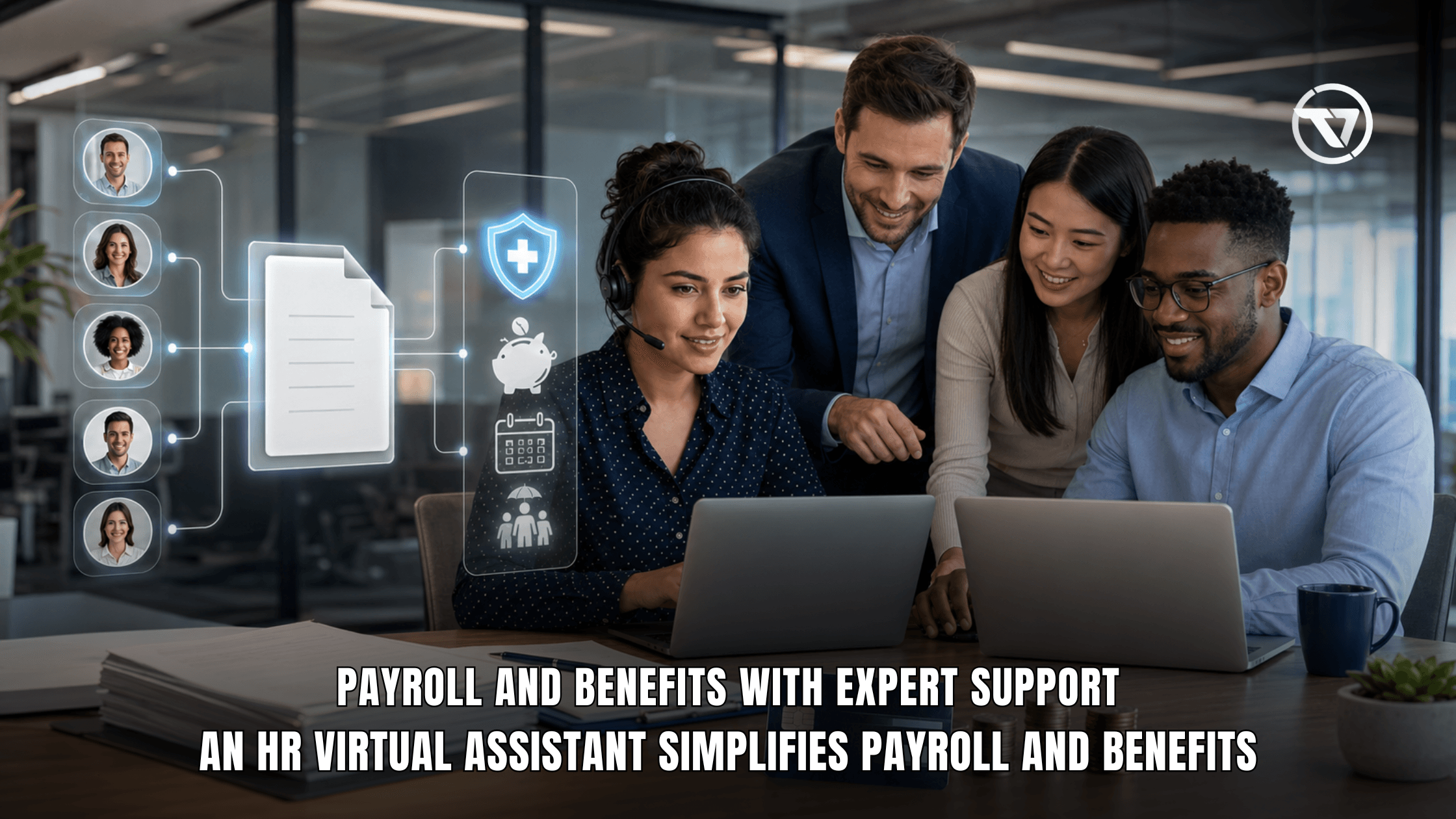
HR virtual assistants process timesheets, calculate wages and deductions with precision, prepare complete payroll packages for managerial approval, and reconcile reports against bank and tax records. They coordinate direct deposits, track garnishments, and ensure all statutory withholdings appear correctly on every pay cycle. On the benefits side, they manage open enrollment communications, monitor eligibility windows, process life-event changes such as marriage or birth, and answer employee questions about coverage options in plain language.
These professionals also maintain accurate carrier records, flag potential compliance gaps before they become problems, and prepare organized documentation for internal audits or government filings. Their dual focus on payroll accuracy and benefits administration creates a reliable administrative backbone for the organization. This support frees internal HR staff to concentrate on employee relations, talent strategy, and culture-building initiatives that drive long-term results.
2. Technology Stack and Collaboration Tools
Most HR virtual assistants operate through secure platforms that connect directly with existing HR information systems and payroll software. They use encrypted file sharing, video calls for onboarding and training, shared real-time dashboards, and carefully supervised AI-assisted recruiting tools. Clear service-level agreements outline expected response times, limited data access permissions, and defined escalation paths for complex issues.
This technology-enabled setup supports seamless daily collaboration with in-house HR and finance teams while upholding the data security standards required under US privacy and employment regulations. Regular system audits and multi-factor authentication further protect sensitive employee information. The result is a reliable remote partnership that functions as a natural extension of the company’s internal processes.
3. Difference from Full-Time Staff or Traditional Outsourcing
Unlike a full-time hire, an HR virtual assistant scales easily with business needs, offering part-time coverage for startups or full-time equivalent support during peak periods such as year-end closing or open enrollment. Companies avoid the fixed costs of salary, benefits, payroll taxes, equipment, and office space that accompany permanent employees. This flexibility allows organizations to adjust support levels quickly as headcount or administrative volume changes.
Compared with large traditional outsourcing firms, virtual assistants typically deliver more personalized attention and lower minimum hour commitments. The model proves especially practical for companies with 20 to 500 employees that need specialized help without the rigidity of a full outsourcing contract. Businesses gain expert capacity on demand while retaining full control over final decisions and strategic direction.
The Growing Complexity of Payroll and Benefits Administration
US employers face demanding regulatory and cost pressures that make manual or understaffed processes risky and expensive. KFF reports that family coverage premiums rose 6% in 2025, adding strain alongside tax, healthcare, paid leave, and multi-state requirements that teams struggle to manage alone.
1. Rising Healthcare and Benefits Costs
- Average annual premiums reached $9,325 for single coverage per the Kaiser Family Foundation 2025 survey.
- Family coverage premiums climbed to $26,993, continuing a multi-year upward trend.
- Workers contributed an average of $6,850 toward family coverage each year.
- Employers must manage plan options, eligibility, and communications under budget pressure.
2. Payroll Accuracy Challenges and Error Costs
- The average cost to correct a single payroll error is about $291, according to EY analysis.
- Many organizations operate at roughly 80 percent payroll accuracy each cycle.
- Direct processing costs and labor time add up quickly for mid-sized firms.
- Repeated errors also damage trust and raise potential penalty risks.
3. Hybrid and Remote Work Realities
- The BLS American Time Use Survey found 35 percent of workers did some work at home in 2025.
- About 34.9 percent of full-time workers performed part of their job from home.
- Distributed teams need consistent payroll processing across different time zones.
- Benefits communication must stay clear no matter where employees work.
How an HR Virtual Assistant Streamlines Payroll Processing
Payroll remains one of the most time-sensitive and detail-oriented functions inside any organization, leaving little room for error or delay. An experienced HR virtual assistant reduces friction at every stage of the cycle by applying consistent processes and specialized knowledge. This support helps companies meet deadlines, maintain accuracy, and free internal staff for higher-priority responsibilities.
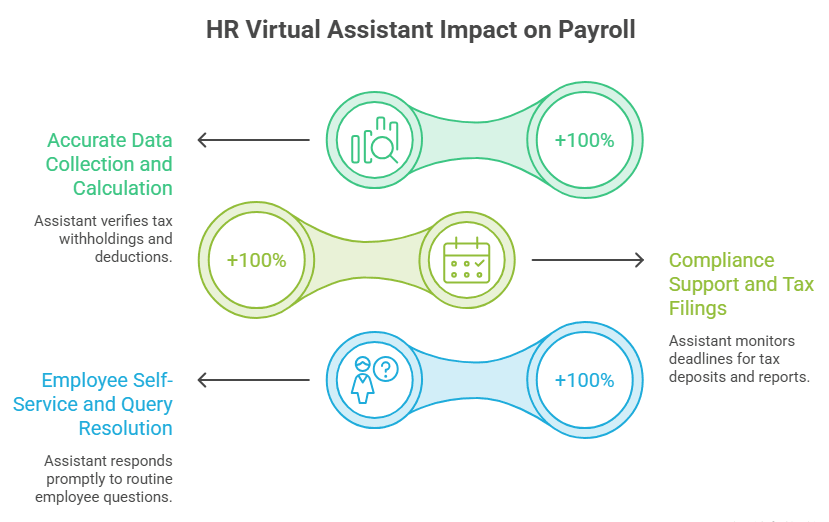
1. Accurate Data Collection and Calculation
The assistant gathers timesheets, commissions, bonuses, and leave data, then runs preliminary calculations in the company’s payroll platform. They verify tax withholdings, retirement contributions, garnishments, and other deductions before submitting for final approval. This second set of trained eyes catches discrepancies that busy managers might miss.
2. Compliance Support and Tax Filings
Federal, state, and local tax rules change regularly. Virtual assistants monitor deadlines for Form 941 deposits, W-2 preparation, and state unemployment insurance reports. They help maintain organized records that simplify year-end processes and reduce the risk of late-filing penalties. For multi-state employers, they track varying rules on paid leave or minimum wage adjustments.
3. Employee Self-Service and Query Resolution
Many assistants set up or maintain employee portals and respond promptly to routine questions about pay stubs, tax forms, or direct deposit changes. Faster, accurate answers improve employee trust and significantly reduce the volume of repetitive tickets that reach internal HR staff. This consistent support creates a smoother experience for both employees and the teams that serve them.
Simplifying Benefits Administration with Virtual Support
HR and benefits teams spend about 40% of their time on benefits administration, highlighting how routine work can overshadow strategic priorities. An HR virtual assistant adds structure and consistency, freeing internal teams to focus on plan design, employee well-being, and long-term talent strategy.
1. Enrollment and Life-Event Management
- The virtual assistant prepares communication calendars and tracks enrollment completion rates.
- Follow-up messages reach non-responders so coverage selections stay on schedule.
- Qualifying life-event changes are processed within required regulatory windows.
- Systems and carrier records receive updates that confirm accurate coverage.
2. Ongoing Communication and Education
- Clear plan summaries help employees better understand the benefits available to them.
- Virtual Q&A sessions address common questions and reduce confusion.
- An up-to-date knowledge base lets employees find answers independently.
- Better understanding of benefits often supports stronger employee retention.
3. Carrier Coordination and Reconciliation
- Invoice reviews identify discrepancies early and prevent unnecessary overpayments.
- Eligibility files receive attention so coverage matches employee status.
- Premium reconciliations occur regularly and flag issues before they grow.
- This support is valuable when companies offer multiple benefit plan types.
Measurable Business Benefits of HR Virtual Assistant Services
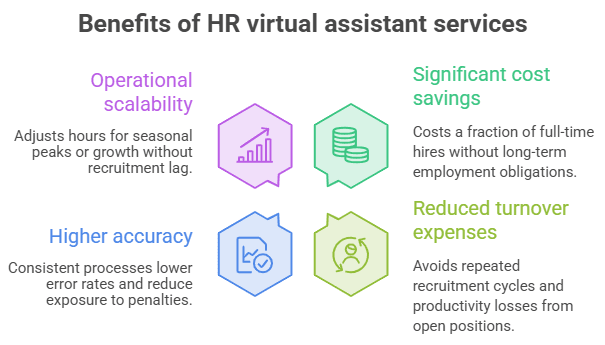
US companies adopt HR virtual assistant services primarily for stronger cost control, reduced operational risk, and greater internal capacity. The model delivers specialized support without the full financial and administrative burden of permanent headcount. Organizations that implement it thoughtfully often experience clearer processes and more reliable outcomes across payroll and benefits functions.
1. Significant Cost Savings Versus Full-Time Hires
The Bureau of Labor Statistics reports a median annual wage of $72,910 for human resources specialists and $140,030 for human resources managers (May 2024 data). Fully loaded costs—including benefits, payroll taxes, equipment, and office space—push the true expense much higher. An HR virtual assistant typically costs a fraction of that amount while delivering specialized support without long-term employment obligations.
2. Reduced Hiring and Turnover Expenses
According to SHRM’s 2025 Benchmarking Report, the average cost-per-hire for non-executive roles stands at $5,475. By using flexible virtual support instead of adding permanent headcount for administrative volume, companies avoid repeated recruitment cycles. They also reduce the productivity losses that typically accompany open positions and new-hire ramp-up periods.
3. Higher Accuracy and Lower Risk Exposure
Consistent processes and dual review of payroll and benefits data lower overall error rates across pay cycles. Fewer mistakes translate directly into reduced correction costs and lower exposure to potential IRS or Department of Labor penalties. Improved accuracy also strengthens employee confidence in the organization’s administrative systems.
4. Scalability for Growth or Seasonal Peaks
Businesses can increase or decrease virtual assistant hours around open enrollment, year-end closing, or periods of rapid hiring. This adjustment happens without the lag associated with traditional recruitment and onboarding. The resulting flexibility supports both steady-state operations and sudden growth while keeping administrative capacity matched to actual need.
Best Practices for Implementing HR Virtual Assistant Support
Successful implementation depends on clear setup, shared expectations, and ongoing management from the internal team. Organizations that invest time in the initial structure typically see faster productivity and fewer operational surprises after the partnership begins.
1. Define Scope and Success Metrics
- Document exact tasks such as bi-weekly payroll preparation and benefits changes.
- Establish measurable goals that include error rates below an agreed threshold.
- Set clear response-time targets for routine employee inquiries.
- Review these metrics regularly so both parties can maintain performance.
2. Prioritize Security and Compliance
- Require background checks and signed confidentiality agreements before access.
- Enforce multi-factor authentication and limited data permissions.
- Confirm the provider understands US employment data privacy expectations.
- Address industry-specific rules such as HIPAA when health data is involved.
3. Integrate with Existing Systems and Train Thoroughly
- Provide controlled access to necessary software with limited permissions.
- Schedule structured onboarding covering policies and communication channels.
- Conduct regular check-ins during the first 60 to 90 days.
- Update documentation promptly when processes or systems change.
4. Maintain Internal Oversight
- Designate an internal owner who reviews outputs and handles exceptions.
- Keep leadership responsible for strategy and high-level policy choices.
- Use the virtual assistant to multiply capacity rather than replace judgment.
- Schedule periodic performance reviews to meet evolving business needs.
TaskVirtual: Your Partner in HR Virtual Assistant Services
Handling payroll calculations, benefits enrollment, compliance tracking, and employee inquiries can quickly overwhelm internal teams. From managing multi-state tax rules to coordinating open enrollment and life-event changes, these responsibilities pull focus away from strategic HR work. TaskVirtual delivers specialized HR virtual assistant services that streamline payroll processing, benefits administration, and related tasks so your organization operates with greater accuracy and efficiency.
1. Specialized HR Expertise and Guidance
TaskVirtual’s trained virtual assistants help manage timesheet collection, wage calculations, deduction verification, and benefits enrollment coordination. They also assist with carrier communications, eligibility updates, and routine employee questions to keep processes running smoothly.
2. Affordable and Flexible Pricing
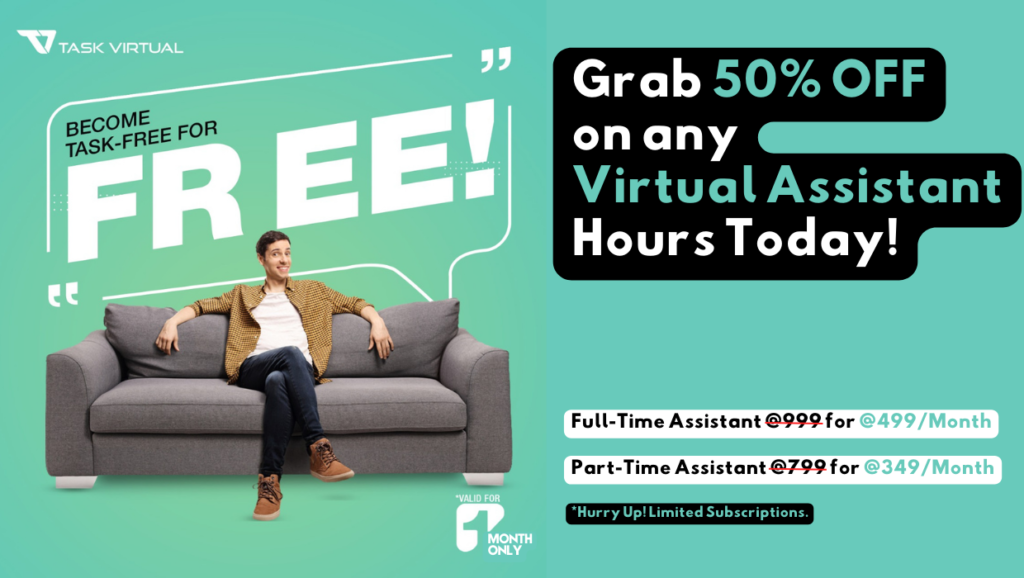
Hiring a full-time HR specialist can be costly, but TaskVirtual makes professional support accessible. With pricing plans starting from just $3.12/hour to $14.99/hour, their services remain budget-friendly for companies of various sizes.
3. Complete Payroll and Benefits Solutions
From preparing payroll reports and tracking tax deadlines to handling open enrollment follow-ups and premium reconciliations, TaskVirtual covers essential administrative needs. Their scalable approach adapts whether you require part-time help or consistent ongoing support.
4. Continuous Assistance and Reliability
TaskVirtual provides proactive updates, deadline reminders, and quality checks throughout each pay cycle and benefits period. Their consistent support helps reduce errors and keeps administrative work on track without adding stress to internal teams.
5. Established Record of Client Trust
With 364 positive reviews and a 4.7-star rating on trusted VA platforms, TaskVirtual is recognized as a dependable partner. Clients rely on their expertise to simplify payroll and benefits administration and improve day-to-day HR operations.
FAQ Section
1. What tasks can an HR virtual assistant handle for payroll?
They typically collect time data, run preliminary calculations, prepare reports for approval, process approved payroll, handle basic tax form requests, and answer routine employee pay questions. Final authorization and tax strategy remain with the employer.
2. Are HR virtual assistants qualified to manage benefits enrollment?
Experienced ones are. They coordinate communications, track elections, process qualifying events, and interface with carriers. Complex plan design or legal interpretation stays with benefits consultants or in-house experts.
3. How much does an HR virtual assistant cost compared with a full-time hire?
Costs vary by experience, hours, and location, but specialized virtual support generally represents substantial savings versus the fully loaded cost of a US-based HR specialist or manager, whose median wages alone exceed $70,000–$140,000 annually before benefits and overhead.
4. Is data security a concern with remote HR support?
Reputable providers use secure platforms, limited access permissions, and contractual protections. Companies should still conduct due diligence, require NDAs, and follow least-privilege access principles.
5. Can small businesses benefit, or is this only for larger firms?
Small and mid-sized companies often gain the most because they lack dedicated payroll or benefits specialists. Flexible hour packages make the model accessible without full-time headcount.
6. How quickly can an HR virtual assistant become productive?
With clear documentation and system access, many contribute meaningfully within two to four weeks. Complex benefits or multi-state payroll may require additional ramp-up time.
Conclusion + CTA
Payroll and benefits administration will only grow more intricate as regulations evolve, healthcare costs rise, and workforces remain distributed. An HR virtual assistant provides specialized, flexible support that reduces errors, controls costs, and frees internal teams for higher-value work. American employers that treat administrative excellence as a competitive advantage—not an afterthought—position themselves for stronger compliance, better employee experiences, and sustainable growth.
If your team spends too many hours on repetitive payroll calculations, benefits troubleshooting, or compliance paperwork, evaluate whether dedicated virtual support could reclaim that capacity. Start by auditing current processes, identifying high-volume tasks, and exploring providers with proven HR experience. The result is often simpler operations, lower risk, and more time focused on building the culture and strategy that set your organization apart.
Sources
- U.S. Bureau of Labor Statistics, Occupational Outlook Handbook: Human Resources Specialists and Human Resources Managers (May 2024 wage data)
- U.S. Bureau of Labor Statistics, American Time Use Survey 2025 Results
- Kaiser Family Foundation, 2025 Employer Health Benefits Survey
- Society for Human Resource Management (SHRM), 2025 Benchmarking Reports (cost-per-hire data)
- EY analysis on payroll error costs (widely reported figures on average correction cost of $291 and accuracy rates)
For more such content, visit our website.
 Siddhartha Basu is a Technical Writer at Task Virtual. He loves online games, e-book reading, and Yoga.