Contents
show
10 Tasks a Credit Repair Virtual Assistant Can Handle
A Credit Repair Virtual Assistant helps Americans navigate the pressure of elevated household debt, rising delinquencies, and the return of student loan reporting. Credit card balances have reached record levels near $1.2 trillion, while inaccurate marks continue to hold many scores back.
In this climate, a credit repair virtual assistant offers practical remote support for credit repair companies and specialists. These professionals handle specialized administrative, research, and compliance tasks so principals can focus on strategy and clients. Trained in FCRA timelines and bureau procedures, they deliver efficiency as average U.S. FICO scores remain in the low-to-mid 700s and collections issues persist for many consumers.
Foundational Credit Report Review and Analysis Tasks
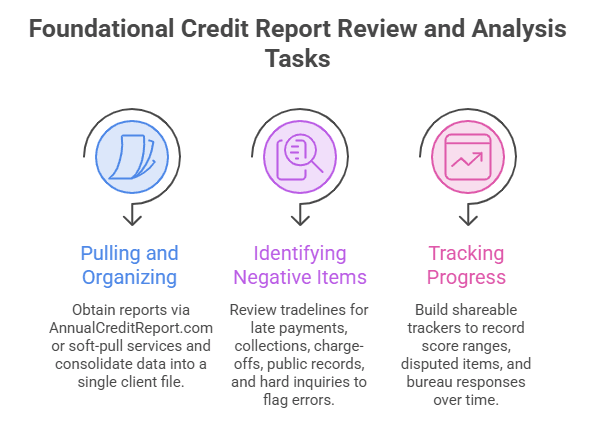
A strong credit repair process begins with complete visibility into a client’s reports from Equifax, Experian, and TransUnion. Virtual assistants trained in this niche excel at the careful work of gathering, organizing, and flagging issues so nothing important is missed. Their methodical approach creates a reliable foundation for every later dispute and client conversation, reducing wasted effort and strengthening the overall strategy.
1. Pulling and Organizing Multi-Bureau Credit Reports
Credit repair virtual assistants routinely obtain free annual reports via AnnualCreditReport.com or authorized soft-pull services, then consolidate the data into a single client file. They carefully note inquiry dates, account statuses, balances, and payment histories side by side so differences between bureaus become immediately visible.
This cross-bureau comparison surfaces discrepancies that a single report might miss. Given that credit reporting remains one of the top complaint categories received by the Consumer Financial Protection Bureau, systematic organization reduces the risk of overlooked errors and creates an audit-ready record for every subsequent action.
2. Identifying and Categorizing Negative Items and Potential Errors
Once reports are in hand, the assistant reviews tradelines for late payments, collections, charge-offs, public records, and hard inquiries. They flag items that appear outdated, duplicated, or inconsistent with supporting documents the client provides, creating clear categories for prioritization.
Older Federal Trade Commission research found that roughly one in five consumers had an error on at least one of their three reports, underscoring why careful categorization matters. The assistant then ranks items by age, dollar amount, and likely impact on score, so the repair strategy targets the highest-leverage disputes first and avoids scattering effort across low-value marks.
3. Creating Client Score Baseline and Progress Tracking Spreadsheets
Virtual assistants build simple, shareable trackers that record starting FICO or VantageScore ranges, list every disputed item, and log expected versus actual bureau responses. These living documents make it easy for the principal or client to see movement over 30-, 60-, and 90-day windows without digging through scattered emails or notes.
With national average scores recently reported around 713-715 depending on the source and timing, even modest documented gains become powerful client communication tools. The clear visual record also helps the firm demonstrate value, adjust strategy quickly, and maintain accountability throughout the engagement.
Dispute Preparation and Submission Workflows

Disputing inaccurate or unverifiable information is the core of legitimate credit repair. Virtual assistants handle the volume, precision, and documentation these workflows demand, ensuring every challenge is completed, timely, and compliant. Their support keeps the process moving steadily while protecting the firm’s regulatory standing.
1. Drafting FCRA-Compliant Dispute Letters and Online Submissions
- Assistants prepare letters or online portal submissions that cite specific FCRA sections and request a full investigation within the required 30-day (or 45-day) timeline.
- They attach relevant supporting evidence and reference exact account numbers, dates, and factual challenges so the dispute is clear and complete.
- Templates are kept current with bureau preferences while each letter is customized to the individual client’s situation.
- Consistency across large volumes of letters protects the firm’s compliance posture and improves the likelihood of thorough bureau responses.
2. Managing Supporting Documentation and Evidence Packets
- For each dispute, the assistant gathers proof of payment, identity theft reports, police reports, or creditor statements.
- Files are named clearly, converted to formats the bureaus prefer, and organized so nothing is omitted.
- Transmission confirmations are logged to create a reliable record of what was sent and when.
- This careful packaging reduces the chance that a bureau rejects a dispute for incomplete documentation and shortens the overall repair cycle.
3. Tracking Bureau Responses and Escalating Incomplete Investigations
- After submission, the virtual assistant monitors response deadlines and records the exact investigation outcomes returned by each bureau.
- Cases where the bureau fails to respond or provides only a form letter are flagged for immediate follow-up.
- Follow-up letters or CFPB complaint preparation can then proceed on schedule without delay.
- Credit reporting complaints have risen sharply in recent years, making disciplined tracking essential for both results and regulatory readiness.
Creditor and Collection Communication Support
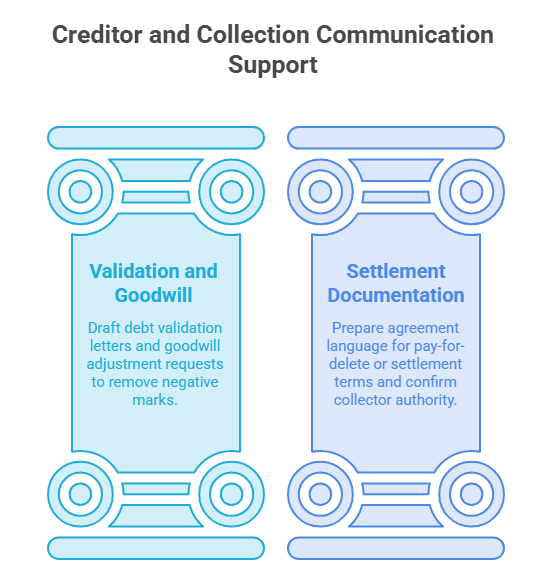
Beyond the bureaus, direct contact with original creditors and collection agencies can accelerate resolution of valid accounts. With 33% of consumers with credit reports carrying collection debt, virtual assistants manage written outreach, documentation, and follow-through, freeing principals to focus on higher-level negotiations and client strategy.
1. Preparing and Sending Validation and Goodwill Requests
Virtual assistants draft debt validation letters under the Fair Debt Collection Practices Act and goodwill adjustment requests that ask creditors to remove accurate but paid negative marks as a courtesy. They track which creditors historically respond favorably and maintain a log of outcomes so the firm can refine its approach over time.
2. Negotiating Pay-for-Delete or Settlement Documentation
When a client chooses to settle, the assistant prepares the written agreement language that conditions payment on deletion or update of the tradeline. They confirm the collector’s authority, record the exact terms, and ensure the client understands any tax implications of forgiven balances. Clear documentation protects both parties and prevents later disputes over what was promised.
Client Onboarding, Education, and Ongoing Support Tasks

Sustainable credit improvement depends on client behavior as much as disputes. Since payment history accounts for 35% of FICO Scores, virtual assistants keep clients informed and engaged, protecting dispute gains from late payments or rising balances. Consistent communication builds trust and supports long-term results.
1. Building Personalized Credit Education Packets and Checklists
- Assistants create short, plain-language guides covering payment history weight, utilization ratios, and the difference between soft and hard inquiries.
- Action checklists are tailored to the client’s starting score range so clients know exactly which habits will support the repair work already underway.
- Materials are written in accessible language and updated as needed so clients stay focused on the behaviors that matter most.
2. Scheduling Follow-Ups and Monitoring Utilization and New Activity
- Monthly or bi-weekly check-ins allow the assistant to review new inquiries, rising balances, or newly reported late payments before they compound.
- Early alerts let the principal intervene quickly and prevent small issues from becoming larger setbacks.
- With aggregate household debt remaining elevated and certain delinquency rates still elevated for lower-score segments, proactive monitoring prevents backsliding.
Compliance, Record-Keeping, and Administrative Backbone
Credit repair operates under strict federal and state rules, and virtual assistants protect the practice by handling the administrative detail that keeps everything defensible. With credit-reporting issues making up 85% of CFPB complaints in 2024, every letter, phone note, email, and bureau response should be filed with dates and outcomes. This complete paper trail supports potential audits and client record requests. In a scrutinized industry, thorough documentation remains non-negotiable and underpins a sustainable operation.
Where required, assistants help assemble the paperwork for state credit services organization registrations and ensure every client receives the mandated disclosures and cancellation rights. They track expiration dates for licenses and bonds so the firm never operates outside compliance windows, and they maintain organized client files that support both day-to-day efficiency and long-term accountability. This consistent record-keeping allows the principal to focus on growth while remaining fully prepared for any regulatory or client inquiry.
TaskVirtual: Your Partner in Credit Repair Virtual Assistance

Handling the detailed work of credit report analysis, FCRA-compliant disputes, creditor outreach, client education, and compliance documentation can quickly overwhelm credit repair professionals and small firms. Coordinating multi-bureau pulls, tracking investigation timelines, preparing evidence packets, and maintaining audit-ready files takes focused time that could otherwise go toward client strategy and business growth. TaskVirtual supplies expert credit repair virtual assistant services that specialize in these exact credit repair support tasks, helping practices streamline operations while staying accurate and compliant.
1. Specialized Credit Process Expertise
TaskVirtual’s virtual assistants assist with pulling and organizing multi-bureau reports, identifying negative items, drafting dispute letters, managing supporting documentation, and tracking bureau responses. They also support creditor validation requests, goodwill outreach, client education packets, and ongoing utilization monitoring so every stage of the repair workflow stays organized and on schedule.
2. Affordable and Flexible Pricing
Hiring a full-time in-house specialist can be costly, but TaskVirtual makes dedicated credit repair support accessible. With pricing plans starting from just $3.12/hour to $14.99/hour, their services remain budget-friendly for independent practitioners, growing firms, and established credit repair companies alike.
3. End-to-End Credit Repair Task Coverage
From creating score baselines and progress trackers to preparing pay-for-delete documentation and maintaining compliance logs, TaskVirtual covers the full range of administrative and process tasks outlined in this guide. Their scalable support adapts whether you need help with occasional dispute volume or consistent daily workflow management.
4. Reliable Ongoing Oversight
TaskVirtual provides continuous updates on dispute status, response deadlines, and new account activity so nothing slips through the cracks. Their proactive approach helps maintain clean client files and supports consistent progress toward stronger credit outcomes.
5. Proven Track Record of Excellence
With 364 positive reviews and a 4.7-star rating on trusted VA platforms, TaskVirtual is recognised as a reliable partner worldwide. Clients count on their expertise to handle the specialized tasks that keep credit repair practices efficient, accurate, and client-focused.
FAQ Section
1. What qualifications should a credit repair virtual assistant have?
Look for demonstrated knowledge of the FCRA, experience with the three major bureaus, strong attention to detail, and familiarity with secure document handling. Prior work in credit repair, collections, or consumer finance is a strong plus.
2. How long does it typically take to see results from these tasks?
Many legitimate disputes resolve within 30–45 days of bureau receipt. Score movement varies widely based on the number and severity of items removed; consistent tracking over 90 days provides the clearest picture.
3. Can a virtual assistant replace a licensed credit repair professional?
No. Virtual assistants support the process; they do not provide legal advice or guarantee score increases. The principal remains responsible for strategy and client relationships.
4. Are there legal limits on what a credit repair virtual assistant can do?
Yes. They must avoid any activity that violates the Credit Repair Organizations Act or state laws, including upfront fees for services not yet rendered in many jurisdictions and any guarantee of specific score results.
5. How does a credit repair virtual assistant protect client data?
Reputable assistants use encrypted file sharing, secure password managers, and written confidentiality agreements. Principals should verify these practices before granting access to reports or personal information.
6. Is hiring a credit repair virtual assistant cost-effective for small firms?
For most small practices, the answer is yes. The cost of remote specialized support is typically far lower than a full-time local hire while allowing the owner to take on more clients without sacrificing process quality.
Conclusion + CTA
A skilled credit repair virtual assistant can absorb the repetitive, detail-heavy work that slows credit repair practices: report analysis, dispute preparation, creditor correspondence, client education, and compliance record-keeping. In a market where millions of Americans still contend with imperfect credit data and elevated debt levels, this support translates directly into faster turnarounds, cleaner files, and stronger client outcomes.
If you run a credit repair business or are building one, evaluate which of these ten tasks currently consume the most of your time. Delegating even a subset to a trained virtual assistant can free capacity for growth while maintaining the accuracy and documentation standards regulators and clients expect. Start by defining clear standard operating procedures for the highest-volume tasks, then bring in support that already understands the credit repair workflow. Your clients’ scores—and your firm’s efficiency—will reflect the difference.
Sources
- Federal Reserve Bank of New York Household Debt and Credit Report
- Consumer Financial Protection Bureau reports on credit reporting complaints, medical collections, and consumer credit
- Federal Trade Commission study on credit report accuracy
- Experian and FICO published average score data
- Federal Reserve reports on the economic well-being of U.S. households
For more such content, visit our website.
 Siddhartha Basu is a Technical Writer at Task Virtual. He loves online games, e-book reading, and Yoga.