

Contents
show
The Founder’s Delegation Audit: 25 Tasks to Move Off Your Plate This Month
Founders in 2026 still carry too much operational weight even as tools and talent options expand. Many continue handling every calendar conflict, invoice follow-up, and content update themselves, which accelerates burnout and crowds out the strategic work only they can perform. A structured approach that treats delegation as a repeatable system rather than an occasional relief valve lets founders reclaim time without losing quality or visibility. Incorporating specialized support such as a Virtual Assistant early creates immediate capacity while establishing the habits needed for larger scale.
The practical path forward centers on diagnosing real bottlenecks, selecting high-leverage tasks, and installing clear processes so hand-offs stick. Research shows small-business leaders spend roughly 30% of their time on non-core activities, which can add up to about 77 workdays each year spent away from higher-value priorities. When founders systematically move repeatable work to capable support—including a Personal Assistant for daily coordination—they free attention for vision, relationships, capital decisions, and culture. This audit delivers a complete month-ready plan: identify where time disappears, transfer twenty-five concrete tasks by function, brief the work properly, protect what must stay founder-owned, and review progress weekly so momentum compounds.
Diagnose Bottleneck
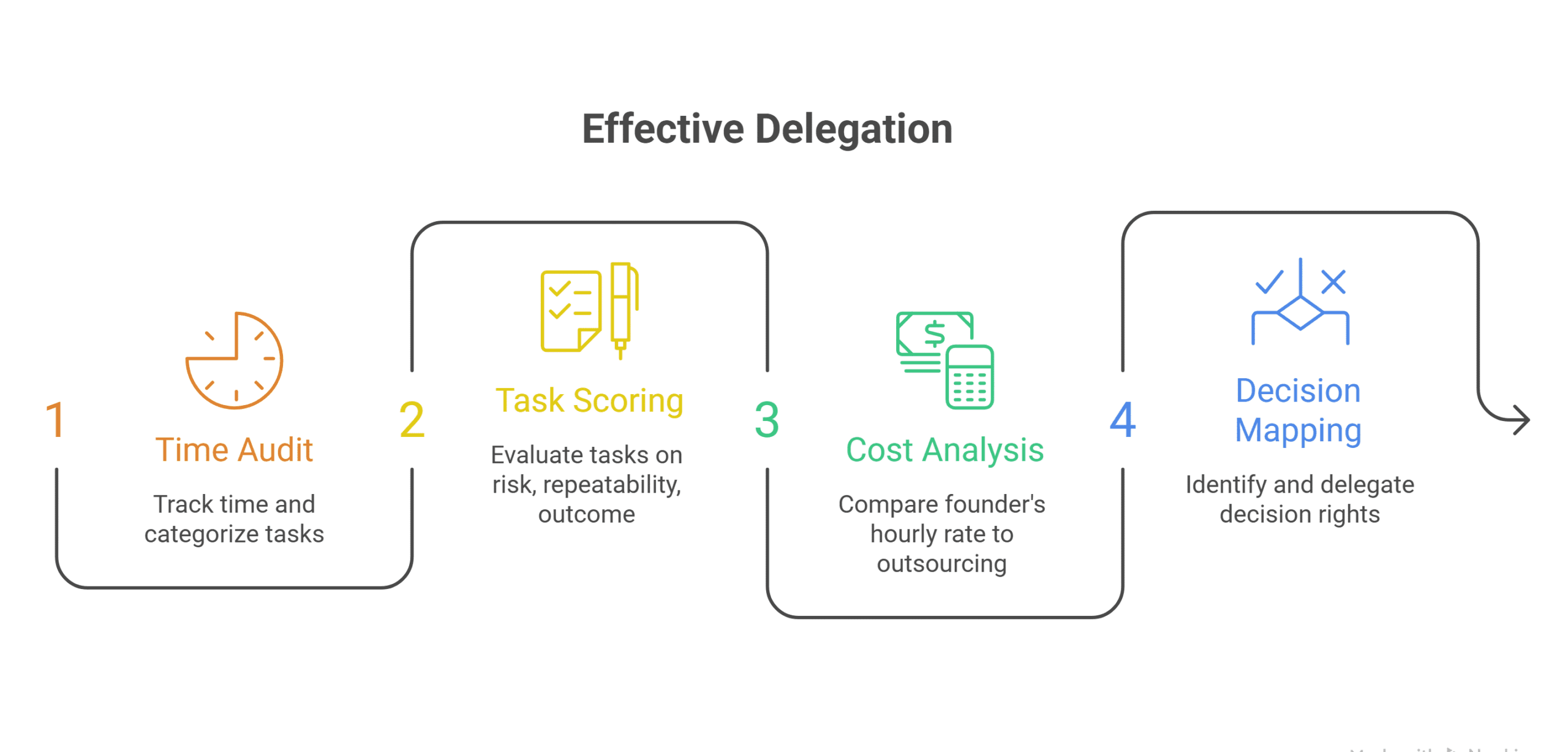
Effective delegation begins with accurate diagnosis rather than vague intentions to “do less.” Most founders discover that a surprising share of their week is spent on work that does not require their unique judgment once they examine the data. Mapping these patterns against risk, repeatability, and measurable outcomes reveals the highest-return opportunities, including areas such as Digital Marketing coordination that can be transferred with clear standards.
1. Run a two-week time audit
Track every thirty-minute block across ten working days and assign each interval to one of four categories: revenue-generating or strategic, customer-facing, administrative, or reactive firefighting. The resulting picture almost always shows that email triage, scheduling, basic reporting, and routine follow-ups consume far more hours than founders estimate. Research indicates small-business leaders spend roughly thirty percent of their time on non-core work, equivalent to about seventy-seven workdays each year, and the same pattern appears when founders examine Facebook Marketing & Ads campaign monitoring or similar recurring activities.
Once the data is collected, calculate the percentage of time spent in each category and note the tasks that appear most frequently. This quantitative baseline removes emotion from the decision of what to keep and what to transfer, making it easier to prioritize the next wave of hand-offs.
2. Score tasks on three criteria
Evaluate every recurring activity for three factors: risk (what is the cost of imperfect execution?), repeatability (can the work be documented and performed consistently by someone else?), and outcome visibility (can success be measured without constant oversight?). Tasks that score high on repeatability and visibility while remaining moderate on risk become the strongest candidates for immediate transfer. Activities such as Instagram Marketing & Ads scheduling and basic performance reporting typically score well on these dimensions and free meaningful blocks of founder time once standards are written.
Apply the scoring consistently across the audit results rather than relying on gut feel. The ranking that emerges usually highlights a short list of high-volume, documentable items that can be moved first, creating early wins and building confidence in the broader delegation system.
3. Identify the true cost of keeping work
Convert your target annual compensation or the opportunity cost of delayed strategic initiatives into an effective hourly rate. Global Outsourcing Survey found that 70% of organizations cite cost reduction as a primary objective when outsourcing, while many also use outsourcing to improve focus on core business priorities. Compare that figure against the fully loaded cost of external support for the same work. When the math clearly favors outsourcing, resistance to letting go declines because the decision becomes financial rather than emotional. LinkedIn Marketing & Ads content preparation and similar specialized tasks often show especially strong cost advantages once the founder’s hourly rate is applied.
Document both the direct time cost and the secondary cost of delayed decisions or reduced strategic bandwidth. This dual view makes the case for transfer more compelling and helps justify investment in the right support resources.
4. Map decision rights and single points of failure
List every decision that currently requires your personal sign-off and identify which of those decisions create waiting time for others. Expanding clear decision rights through documented guardrails removes bottlenecks without abandoning accountability. Even areas such as Video Editing Services coordination can be transferred once approval thresholds and quality standards are explicit.
The resulting map usually reveals a smaller set of truly founder-only decisions than expected. Protecting those while systematically expanding the rest accelerates team velocity and reduces the daily volume of interruptions.
25 Tasks by Function

Moving work off a founder’s plate requires a concrete, prioritized inventory rather than abstract intentions. The following twenty-five tasks are grouped by function so founders can match them to available support capacity and begin transferring immediately. Each item is selected because it is repeatable, documentable, and carries manageable risk when clear standards are in place, including work that falls under online Marketing Services.
1. Administrative and executive support
- Perform daily inbox triage and deliver a prioritized digest of messages requiring attention by a set morning deadline.
- Manage calendar coordination, meeting scheduling, and travel logistics according to established preferences and availability rules.
- Track expenses, organize receipts, and maintain clean records ready for review or export.
- Complete basic CRM data entry and ongoing hygiene so records remain accurate and usable.
- Prepare routine documents and maintain organized digital filing systems for easy retrieval.
- Handle inbound call routing and message taking as a Virtual Receptionist during defined coverage hours.
2. Finance and compliance
- Record bookkeeping entries and perform regular bank reconciliations to keep financial records current.
- Create and send invoices, then conduct polite follow-up on overdue payments within approved guidelines.
- Coordinate payroll processing steps while reserving final approval for the founder or designated lead.
- Organize tax-related documents and prepare supporting materials for accountant review.
- Schedule vendor payments within pre-approved limits and maintain a clear audit trail using Bookkeeping Services standards.
3. Marketing and content
- Schedule social posts and draft community engagement responses under Social Media Marketing guidelines.
- Produce first-draft blog posts or newsletter content from founder-supplied outlines and key points.
- Resize graphics and complete basic design updates for campaigns and channels.
- Set up email marketing sequences and compile straightforward performance reports.
- Conduct competitive research and keyword summaries to support SEO Services planning.
- Coordinate creative assets and revisions that support Website Design Services projects.
- Manage technical updates and content deployment related to Website Development needs.
4. Operations and customer experience
- Execute customer onboarding checklists and trigger welcome sequences according to the documented process.
- Triage support tickets and apply first-response templates before escalating complex issues.
- Place inventory or supply orders that stay within established par levels.
- Convert founder process recordings into clear standard operating procedure documents.
- Capture meeting notes, track action items, and send timely follow-up reminders.
- Perform routine Data Handling tasks such as cleaning lists and preparing simple reports.
- Address basic technical issues and escalate according to IT Support Services protocols.
5. People and project support
- Screen candidate applications and coordinate interview scheduling within defined criteria.
- Complete onboarding paperwork and provision tool access for new team members.
- Maintain project status dashboards and prepare concise weekly progress summaries.
- Research and assemble vendor shortlists for non-core tools or services.
- Extract data from existing systems and generate basic reports for review.
These tasks are deliberately chosen because they are repeatable, documentable, and carry manageable risk when clear standards exist. A survey cited by Clutch found that 52% of small businesses outsource tasks, with reducing operational costs being a major driver. Many founders begin with a virtual assistant handling items 1–5 and 6–10, then expand into marketing and operations as systems mature.
Delegation Brief Template
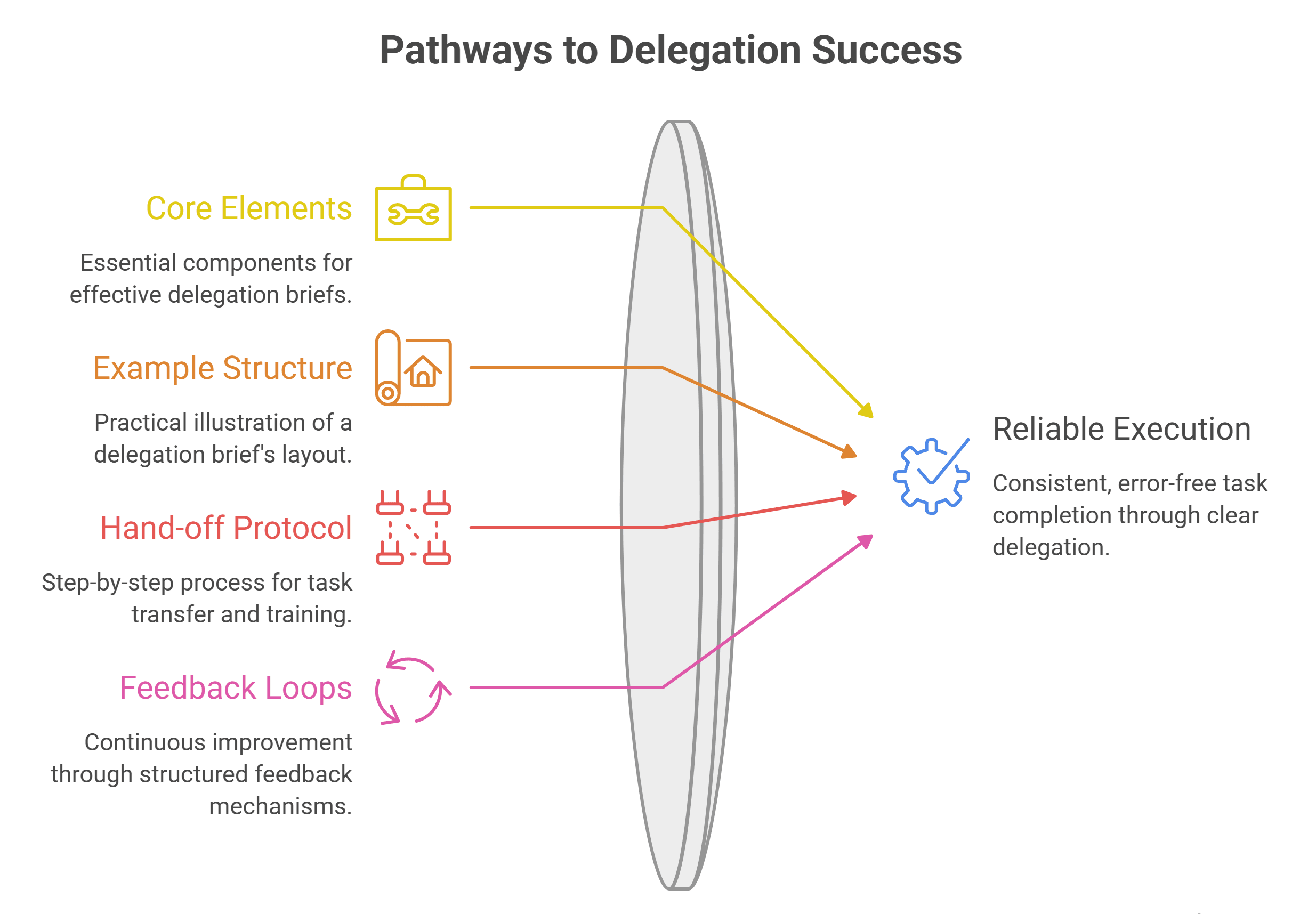
Clear written briefs turn good intentions into reliable execution and prevent the common frustration of having to redo work. A strong brief defines success in measurable terms, sets boundaries, and supplies the context the recipient needs to operate independently. Using a consistent template across every hand-off dramatically shortens the learning curve and reduces back-and-forth clarification.
1. Core elements every brief needs
Every effective brief states the desired outcome in a single clear sentence, lists explicit success metrics that can be checked without constant oversight, provides the current process or an example of acceptable output, defines decision boundaries so the recipient knows what can be decided alone versus what must be escalated, sets a realistic deadline and check-in cadence, and names the single source of truth for questions while linking to all relevant tools, templates, and past examples.
2. Example structure
- Outcome: Deliver a clean, prioritized inbox digest by 8 a.m. each weekday.
- Metrics: Zero critical emails missed and average response time under four hours for flagged items.
- Process: Apply the shared labeling system and archive or file according to the documented decision tree.
- Boundaries: Reply to routine inquiries with approved templates; escalate anything involving contracts, pricing exceptions, or key-account dissatisfaction.
- Cadence: Daily digest plus a Friday review of volume and exceptions.
3. Hand-off and training protocol
Record a short screen-share of yourself performing the task once so the recipient can see the exact sequence and standards. Have the person complete the work first with observation, then independently with structured feedback, and finally fully autonomously once consistency is demonstrated. Capture the refined process in a living standard operating procedure that both parties can reference and update as improvements appear.
4. Feedback loops that stick
Schedule short, recurring reviews that focus exclusively on outcomes and metrics rather than methods. Ask what remains unclear, what is taking longer than expected, and what the recipient would change to improve results. Adjust the brief promptly based on that input and resist the urge to reclaim the task unless risk has risen materially.
Weekly Review Example
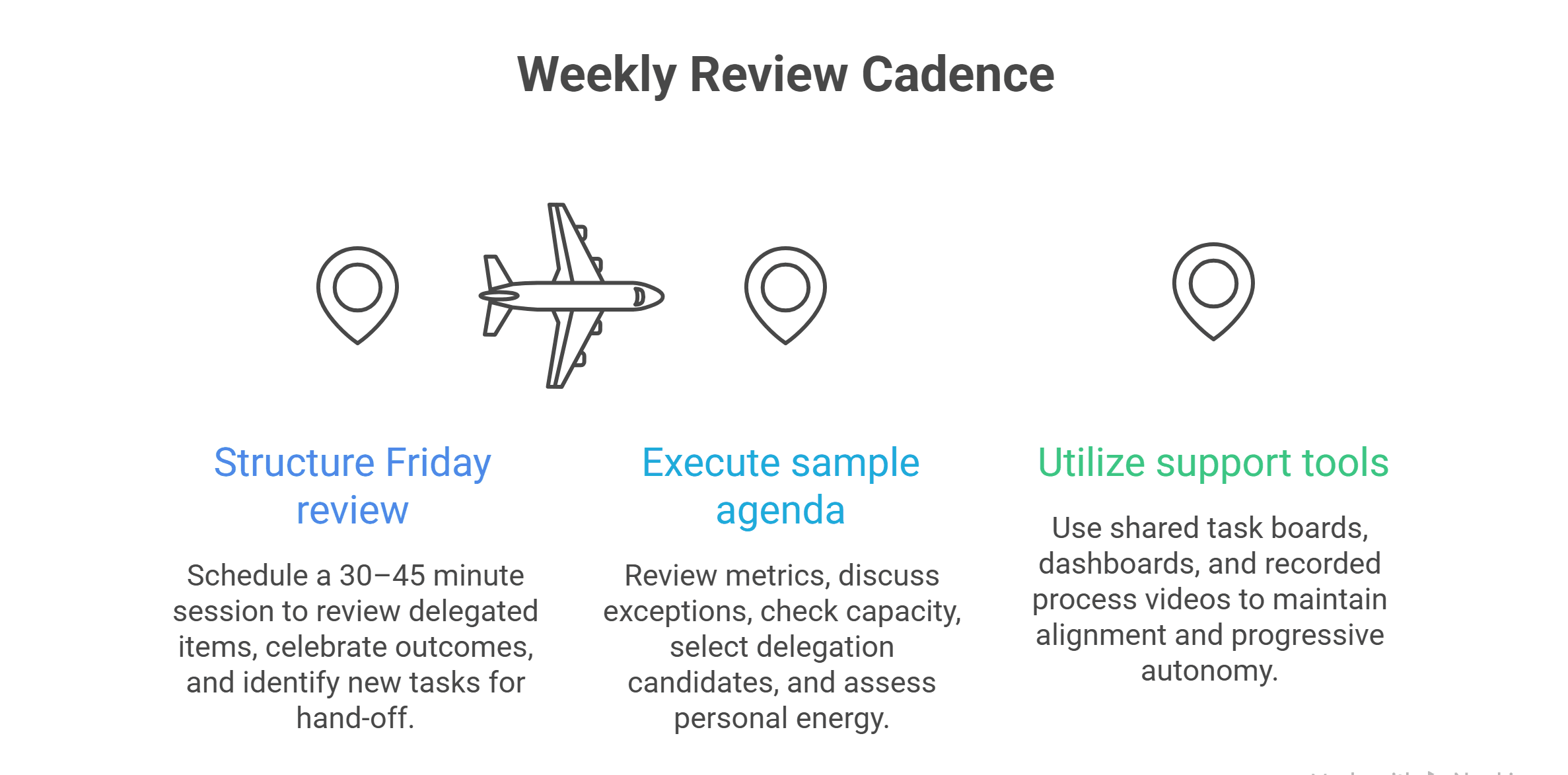
A lightweight weekly cadence converts one-time hand-offs into a durable operating system. Without regular inspection, delegated work drifts, standards erode, and founders gradually reclaim tasks they had intended to release. A short, consistent review keeps outcomes visible, surfaces process improvements, and identifies the next candidates for transfer.
1. Structure a 30–45 minute Friday review
Review open delegated items against the metrics in their briefs. Note exceptions and root causes. Celebrate completed outcomes. Identify the next one or two tasks ready for hand-off based on the time audit and scoring criteria. Update SOPs with any process improvements discovered during the week. Confirm the coming week’s priorities and decision rights.
2. Sample agenda
- Key Performance Metrics dashboard glance (5 min)
- Exception discussion and brief adjustments (10–15 min)
- Capacity check: what is still stuck with me that should not be? (10 min)
- Next delegation candidate selection and brief drafting (10 min)
- Personal energy and focus check (5 min)
3. Tools that support the loop
Shared task boards, simple dashboards, and recorded process videos keep everyone aligned without constant meetings. The goal is progressive autonomy: each successful cycle expands the set of work that runs without your daily involvement.
Building a Virtual Team That Scales with You

Once the first wave of tasks moves, expand deliberately rather than rushing to fill roles. Start with a reliable virtual assistant focused on administrative load so the founder immediately regains calendar and inbox capacity. As volume and complexity justify the next step, introduce specialized freelancers for marketing execution or bookkeeping support. Only later, when processes are stable and decision rights are clear, consider fractional operators for higher-level coordination.
Clear briefs, living documentation, and consistent feedback loops remain more important than headcount at every stage. A small, well-orchestrated virtual team that understands the standards and metrics multiplies output far more effectively than adding full-time generalists too early. Founders who treat team building as an extension of the same disciplined audit and review process protect both quality and focus while scaling capacity in line with actual need.
TaskVirtual: Your Partner in Founder Delegation Support

Founders who complete a delegation audit often need reliable capacity to execute the hand-offs without adding full-time headcount. TaskVirtual supplies trained outsourced business professionals who can absorb the exact categories of work outlined in this checklist – administrative coordination, finance support, marketing execution, operations follow-through, and project assistance—so founders can protect strategic focus while the operational load moves off their plate.
1. Skilled Assistance Matched to Founder Priorities
TaskVirtual’s virtual professionals help implement the tasks identified in a founder’s audit by managing inbox triage, calendar coordination, bookkeeping entries, content scheduling, customer onboarding sequences, and status reporting according to the briefs and standards you set.
2. Affordable and Flexible Pricing
Hiring dedicated internal support can strain early-stage budgets, but TaskVirtual keeps the economics practical. Pricing plans start from just $3.12/hour to $14.99/hour, giving founders a cost-effective way to test and scale delegated capacity as needs evolve.
3. Full Coverage Across the 25-Task Framework
From executive support and finance processes to marketing execution, operations checklists, and people-related coordination, TaskVirtual’s services align directly with the function-based inventory in this audit and can expand or contract with your weekly review cadence.
4. Consistent Oversight and Process Alignment
TaskVirtual maintains regular updates, adheres to documented success metrics, and supports the feedback loops that keep delegated work on track, helping founders avoid the common drift that occurs when hand-offs lack structured follow-through.
5. Proven Track Record of Excellence
With 364 positive reviews and a 4.7-star rating on trusted VA platforms, TaskVirtual is recognised as a reliable partner worldwide. Clients count on their expertise to simplify operational workloads and free founder time for higher-value decisions.
FAQ
1. How do I know which tasks to delegate first?
Score for high repeatability, moderate risk, and clear, measurable outcomes. Start with administrative and finance support tasks that free the largest blocks of founder time.
2. What if the person I delegate to makes mistakes?
Mistakes are expected during the training phase. Strong briefs, observed practice, and rapid feedback reduce frequency quickly. Reclaim the task only if risk becomes unacceptable.
3. How much does effective delegation actually improve results?
Gallup research on high-growth company CEOs found those with strong delegator talent generated 33 percent greater revenue than peers with limited delegation ability.
4. Can I delegate if I am still a solopreneur?
Yes. Virtual assistants and specialized freelancers let you outsource tasks for small business operations without hiring employees. Begin with a few hours per week.
5. How do I avoid micromanaging after I delegate?
Focus reviews on outcomes and metrics rather than methods. Expand decision rights as competence is demonstrated. Update the brief instead of intervening daily.
6. What if I feel guilty about handing work off?
Reframe: keeping low-leverage work is a tax on the business’s growth and on your own sustainability. Your highest-value contribution is the work only you can do.
Conclusion and CTA
Founder burnout operations are not inevitable. A deliberate delegation checklist for founders—built around diagnosis, a concrete list of 25 tasks, clear briefs, protected core responsibilities, and a weekly review—systematically moves work off your plate while protecting quality and control. The data is consistent: leaders who reclaim non-core time create more revenue and more sustainable companies.
Start this week. Complete a short time audit, choose three tasks from the list above, write the briefs, and hand them off with a training plan. Track the hours returned to strategy. Iterate. Consistent, outcome-focused delegation is one of the highest-leverage moves available to any founder.
Ready to implement? Download or adapt the brief template, pick your first three tasks, and schedule the first weekly review. Your future calendar—and your business—will thank you.
Sources
- Gallup: Delegating: A Huge Management Challenge for Entrepreneurs (news.gallup.com)
- Upwork: How Small Business Leaders Can Reclaim 77 Workdays Each Year (upwork.com)
- U.S. Small Business Administration Office of Advocacy: 2025 Small Business Profiles (advocacy.sba.gov)
- U.S. Bureau of Labor Statistics: Top Executives occupational outlook (bls.gov/ooh)
- Additional supporting data drawn from SCORE resources and related small-business time-use analyses referenced in the cited reports.
For more such content, visit our website.
 Siddhartha Basu is a Technical Writer at Task Virtual. He loves online games, e-book reading, and Yoga.