
Contents
show
How to Outsource Back-Office Operations: A 30-Day Implementation Playbook
Running a growing U.S. business often means drowning in invoices, payroll entries, data updates, and compliance paperwork while core revenue work sits unfinished. Back office operations—the administrative engine behind every company—consume disproportionate time and cost. According to the U.S. Bureau of Labor Statistics, office and administrative support occupations accounted for about 18.5 million jobs in May 2023, representing 12.2 percent of total employment.
Outsourcing these functions has moved from a cost-cutting tactic used mainly by large enterprises to a practical growth lever for mid-market and smaller firms. An Information Services Group study found that business process outsourcing programs deliver an average of 15 percent cost savings over in-house operations, alongside quality improvements. At the same time, roughly 37 percent of small businesses already outsource at least one function, a figure that has risen steadily in recent years.
This 30-day implementation playbook fills a common gap: most guides stop at high-level advice. Here you get a usable handoff plan covering process inventory and ranking, SOP creation that does not stall daily work, access and data controls including NDAs, a week-by-week rollout with clear owners, and a KPI scorecard that surfaces failure modes early. The focus remains commercial investigation—helping decision-makers evaluate and execute back office outsourcing, back office support services, and outsourced administrative tasks with measurable outcomes while also considering complementary capabilities such as a Virtual Assistant for overflow coordination.
Inventory and Rank Your Processes for Outsourcing
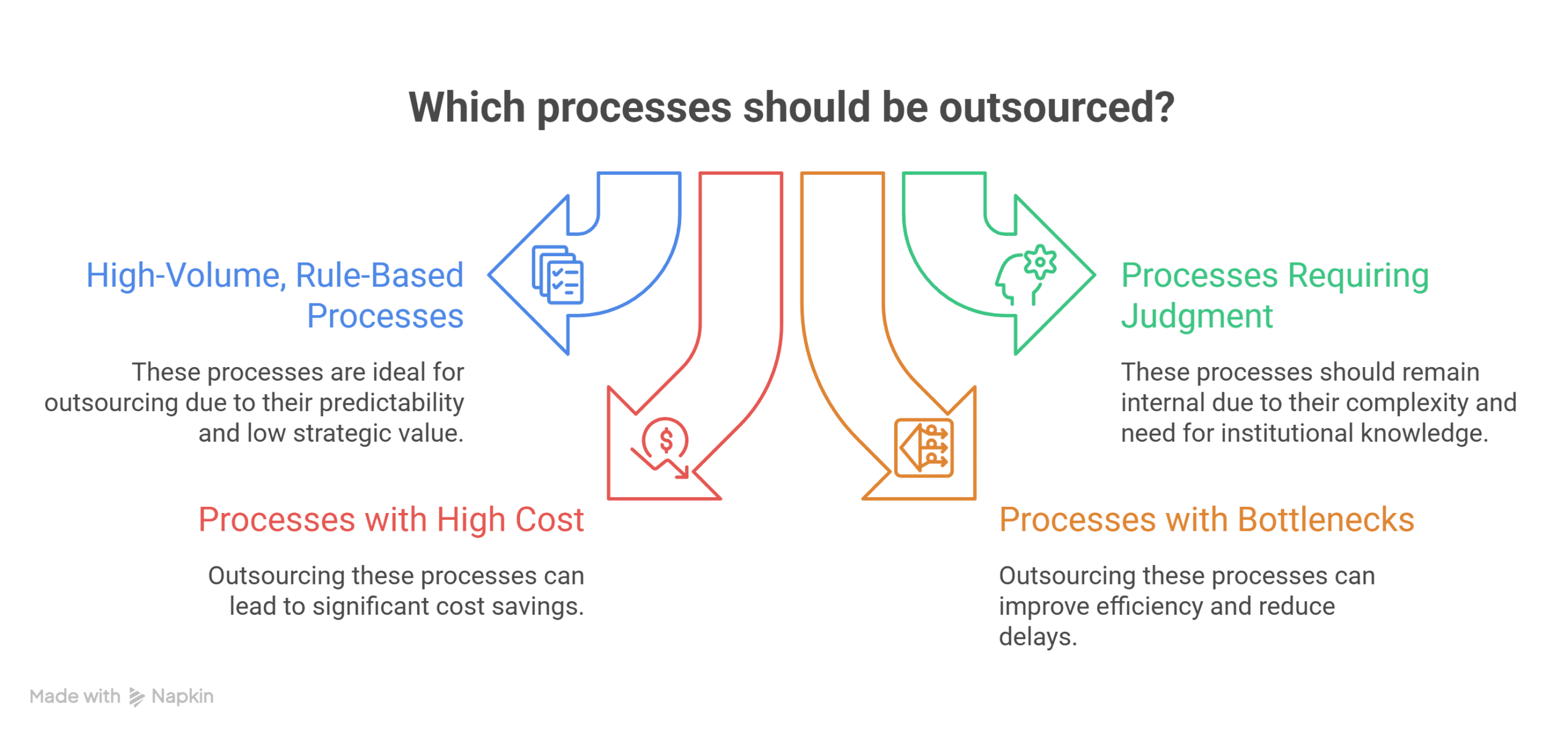
A structured inventory prevents teams from outsourcing the wrong work or creating hidden bottlenecks later. Ranking forces honest prioritization based on volume, risk, and strategic value rather than convenience. Completing this step in the first few days sets realistic boundaries for the entire 30-day timeline.
1. Build a Complete Process Inventory
List every recurring administrative activity across the organization, including accounts payable and receivable, payroll processing, benefits administration, expense reporting, data entry and cleansing, order processing, compliance filing, vendor onboarding, and basic reporting. Interview current process owners and shadow several complete cycles to capture actual volume (transactions per week or month), headcount or hours spent, tools in use, and exception rates. Document inputs, outputs, and every handoff point so the map reflects reality rather than idealized flowcharts.
This inventory becomes the single source of truth for deciding what remains internal and what can move to external partners. Include any informal workarounds or personal spreadsheets that staff currently rely on, because those hidden steps often cause the largest friction during transition. Once compiled, the list also reveals capacity that can later support higher-value work such as Personal Assistant coordination for executives.
2. Score Processes Against Clear Criteria
Rank each process on four practical dimensions: volume and predictability, level of standardization, risk and data sensitivity, and strategic uniqueness to the business. High-volume, rule-based activities with low strategic differentiation—such as invoice matching, routine data entry, or payroll calculations—score highest for immediate outsourcing. Processes that demand frequent judgment calls or deep institutional knowledge rank lower and stay internal for the first wave.
Assign simple numerical scores or clear tiers (prime candidates, secondary, hold) so the prioritization remains transparent and defensible. Limit the first wave to two or three processes so the 30-day window stays achievable. This scoring also highlights opportunities where specialized external capacity, for example in Digital Marketing support, can free internal teams without disrupting core operations.
3. Estimate Current Cost and Capacity Load
Calculate the fully loaded internal cost for each ranked process, folding in salary, benefits, payroll taxes, software licenses, management oversight time, and estimated turnover expense. Compare those figures against typical market rates for equivalent outsourced work to quantify potential savings. Many organizations discover that routine administrative tasks quietly consume 15–20 hours per week of key staff time that could otherwise advance growth initiatives.
The capacity analysis further surfaces chronic bottlenecks—processes that repeatedly delay month-end close or customer onboarding become natural first candidates. Document these findings so leadership can see both the financial and opportunity-cost case for change. Later phases can expand to related services such as Facebook Marketing & Ads once the initial administrative load is stabilized.
4. Document Ownership and Current State Metrics
Name a single internal process owner for every item on the ranked list and record baseline metrics before any external partner begins work. Capture cycle time, error rate, cost per transaction, and volume handled so progress can be measured objectively. These baselines prevent later debates about “how we always did it” and feed directly into the KPI scorecard.
Ownership clarity also accelerates decision-making during the transition weeks. When exceptions arise, the named owner already understands the process end-to-end and can authorize adjustments without delay. This foundation later supports expansion into areas such as Instagram Marketing & Ads once the core handoff proves reliable.
Create SOPs Without Slowing Daily Operations

Standard operating procedures are the highest-leverage investment in a clean transition, yet many teams treat them as a multi-month project that freezes progress. Capturing knowledge while work continues keeps momentum high. Lightweight methods deliver usable documentation inside the first week without disrupting service levels.
Use a Lightweight Capture Method
- Record processes in real time with screen recordings and voice-over rather than writing from memory.
- Pair each recording with a one-page checklist that lists decision points, required system logins, and common exceptions.
- Aim for “good enough to train a competent person” instead of exhaustive policy manuals that delay the timeline.
- Store everything in a shared repository that both internal owners and the future partner can access immediately.
Structure SOPs for Handoff Clarity
- Include purpose, scope, step-by-step actions, required tools, escalation paths, and quality checks in every document.
- Add sample or redacted data examples so trainees can see the expected format without guessing.
- Version-control the files so updates remain traceable and both parties work from the same source.
- Limit the initial set of SOPs to the highest-ranked processes only, expanding later as capacity allows.
Involve Frontline Staff and Iterate Quickly
- Ask the people who currently perform the work to draft or review the first version for accuracy.
- Run a short two-day pilot in which a colleague follows the SOP without coaching and notes every gap.
- Close those gaps immediately so the documentation reflects real operating conditions.
- Keep daily operations moving by treating the pilot as parallel work rather than a full stoppage.
Align SOPs with Tools and Permissions
- Note exact system screens, report names, and approval workflows inside each document.
- Flag any steps that currently rely on informal knowledge or personal spreadsheets so they become explicit.
- Convert informal steps into clear language that reduces the risk of knowledge loss when internal capacity later decreases.
- Confirm that the documented sequence matches the access levels the partner will receive, preparing the ground for LinkedIn Marketing & Ads or similar specialized support if needed later.
Establish Access, Data, and NDA Controls
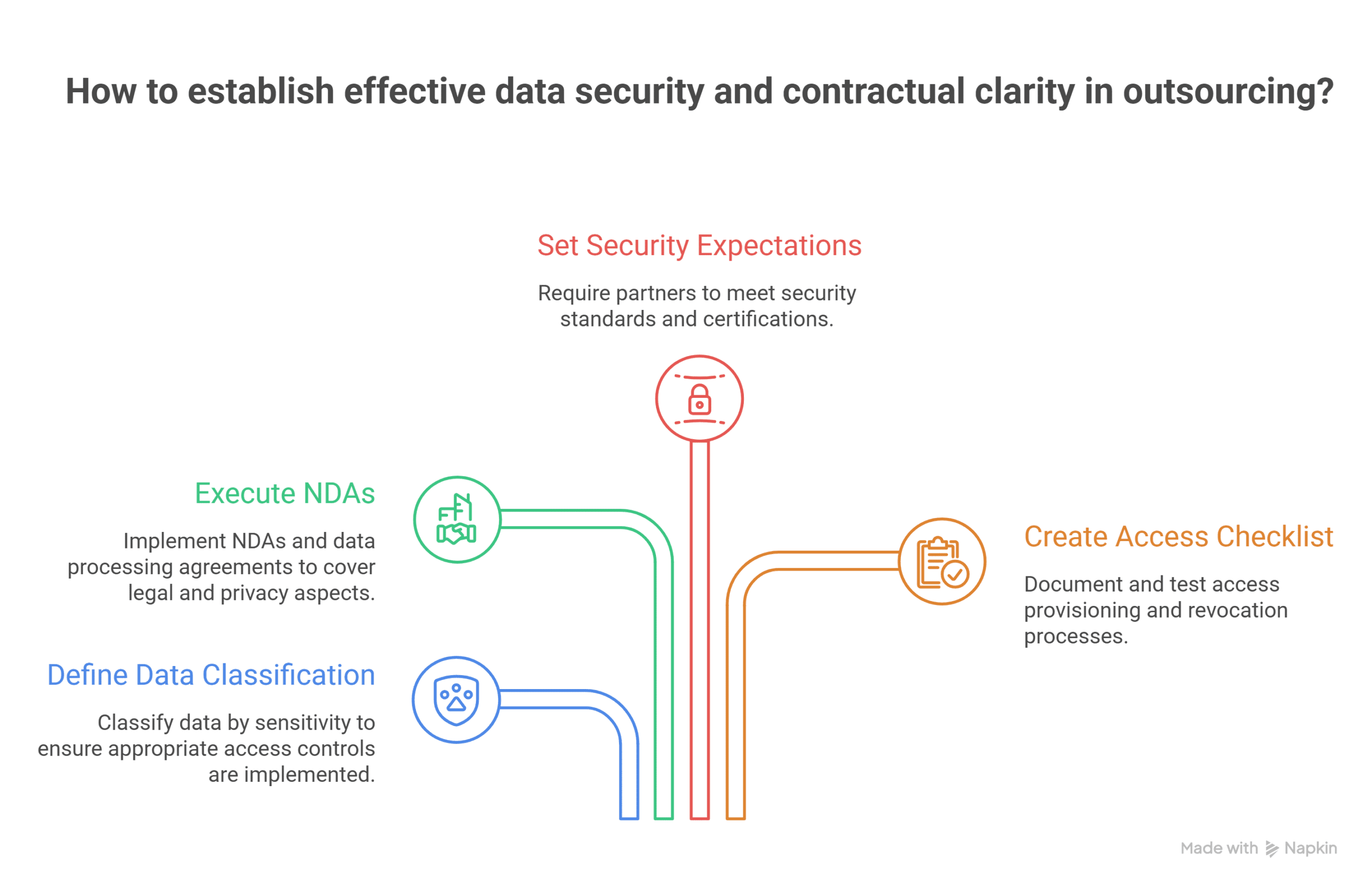
Data security and contractual clarity determine whether outsourcing reduces risk or multiplies it. Treat this phase as non-negotiable before any production work begins. Completing these controls early prevents costly rework and builds trust with both internal stakeholders and the selected partner.
Define Data Classification and Minimum Necessary Access
Classify every data type the partner will touch according to sensitivity—public, internal, confidential, and restricted (personally identifiable information, financial records, or health-related details). Grant only the least privilege required for the specific processes being transferred, using role-based access controls, multi-factor authentication, and time-bound credentials. Prefer read-only access wherever possible and ensure every session is logged for audit purposes. This disciplined approach also creates a clean foundation if the engagement later expands into Video Editing Services or other media-related support that may involve branded assets.
Execute NDAs and Data Processing Agreements Early
Have legal counsel review and execute a mutual nondisclosure agreement together with a data processing agreement that covers purpose limitation, retention periods, breach notification timelines, and audit rights. Align the language with applicable U.S. state privacy laws when consumer data is involved. Include explicit restrictions on subcontractors and requirements for secure destruction of data at the end of the engagement so residual risk is minimized.
Set Technical and Physical Security Expectations
Require the partner to maintain documented security controls, preferably SOC 2 Type II or ISO 27001 certification, along with encryption for data both in transit and at rest. Confirm that background checks are performed on any staff who will handle client information and that secure workspace standards are followed for remote or hybrid models. Schedule a pre-kickoff security questionnaire and, where justified by volume or sensitivity, a virtual or on-site review of the partner’s environment before credentials are issued.
Create an Access Provisioning and Revocation Checklist
Document every system the partner will touch, the named individuals who receive credentials, and the internal owner responsible for approving and later revoking access. Build a simple offboarding checklist so that when a partner resource leaves or the engagement ends, access is removed the same day. Test the full revocation process during the pilot phase to confirm it works under realistic conditions and to protect any future expansion into online Marketing Services.
Execute the Weeks 1–4 Rollout

A disciplined four-week calendar converts planning into live operations without chaos or service disruption. Each week has a clear focus, named owners, and exit criteria. Following the sequence keeps both internal teams and the partner aligned on progress and risk.
Week 1: Finalize Scope, Contracts, and Knowledge Transfer
- Confirm the ranked process list and success metrics with the selected partner.
- Complete all commercial and legal paperwork before any credentials are shared.
- Deliver the inventory, SOPs, access credentials, and baseline data in a single structured package.
- Conduct joint walkthroughs of the highest-volume processes and assign a single internal transition lead paired with a partner counterpart.
Week 2: Parallel Run and Exception Handling
- Increase transaction volume while internal staff retains final ownership of output.
- Hold daily stand-ups to surface mismatches in SOP interpretation or edge cases.
- Update documentation in real time as gaps appear.
- Begin measuring the partner against agreed service levels on a limited scale and resolve any access or system friction before full cutover.
Week 3: Controlled Cutover
- Shift ownership of the primary processes to the partner according to the pre-agreed calendar.
- Move internal owners into a review-and-exception role rather than day-to-day execution.
- Monitor volume, quality, and turnaround times closely with a mid-week checkpoint.
- Decide whether to accelerate, pause, or adjust scope, and communicate the change to any internal teams or external stakeholders who interact with the processes.
Week 4: Stabilize, Document Lessons, and Plan Expansion
- Run full production under partner ownership while capturing remaining exceptions.
- Conduct a formal lessons-learned session and update SOPs with real-world refinements.
- Confirm that all access logs and security controls are functioning as designed.
- Finalize the ongoing governance cadence and prepare the shortlist of processes for the next wave, which may later include Social Media Marketing capacity once the core administrative handoff is stable.
Build the KPI Scorecard and Anticipate Failure Modes
Without measurement, outsourcing drifts and early gains erode. A simple, shared scorecard keeps both parties accountable and surfaces problems while they are still small. Establishing the metrics and review rhythm in the final week of the rollout creates continuity beyond the initial 30 days.
Track cycle time or turnaround, accuracy or error rate, cost per transaction or per FTE equivalent, volume handled, and exception rate. Add at least one customer or internal stakeholder satisfaction measure. Set targets based on the pre-outsourcing baseline plus an improvement stretch—for example, 10–15 percent faster cycle time or lower error rate. Review the scorecard weekly for the first 60 days, then shift to bi-weekly or monthly.
The internal process owner owns the scorecard. The partner supplies the raw data on an agreed schedule. A short standing meeting reviews red and yellow items, decides corrective actions, and records decisions. Escalate unresolved issues according to the contract within a fixed number of business days.
Watch for common failure modes: scope creep when extra tasks are requested informally without adjusting price or capacity; quality erosion that appears as rising exception rates or rework; knowledge gaps that surface when SOPs prove incomplete for edge cases; security or access issues that cause delayed work or audit findings; and communication breakdowns that often stem from unclear escalation paths or timezone mismatches. Address each with a pre-agreed response—formal change-request process, root-cause analysis within 48 hours, SOP revision, access audit, and documented communication protocols. Use the scorecard not only for compliance but to identify automation opportunities or process redesign. Partners who surface improvement ideas should be recognized; pure cost-cutting without quality attention tends to erode over time. Revisit ranking and SOPs every quarter so the outsourcing relationship evolves with the business and can later incorporate SEO Services where relevant.
Additional Considerations for Sustained Success
Beyond the core 30-day sequence, treat the outsourcing partner as an extension of the team rather than a pure vendor. Joint process-improvement workshops and transparent volume forecasting build mutual investment and surface opportunities that neither side would identify alone. Maintaining a small internal capability for oversight, exception handling, and strategic process design preserves institutional memory while still capturing efficiency gains; complete transfer of all knowledge and control creates fragility.
A hybrid model therefore balances cost reduction with resilience. Once the administrative foundation is stable, the same disciplined approach can evaluate expansion into adjacent capabilities such as Website Design Services, Website Development, Data Handling, Virtual Receptionist coverage, IT Support Services, or Bookkeeping Services without repeating the full discovery cycle.
TaskVirtual: Your Partner in Back-Office Implementation Support

Executing a 30-day back-office outsourcing playbook requires reliable capacity for process documentation, parallel runs, exception handling, and ongoing scorecard maintenance. TaskVirtual supplies outsourced business solution who integrate directly into these phases, helping teams complete inventories, refine SOPs, monitor access controls, and keep KPI tracking current without adding permanent headcount.
Expert Process Support and Transition Assistance
TaskVirtual’s virtual assistants help capture process inventories, draft lightweight SOPs from screen recordings, and support parallel runs during the first two weeks of rollout. They also assist with exception logging and scorecard data collection so internal owners can focus on decisions rather than administrative detail.
Affordable and Flexible Pricing
Hiring a full-time personal assistant can be expensive, but TaskVirtual makes it cost-effective. With pricing plans starting from just $3.12/hour to $14.99/hour, their services are budget-friendly and accessible to individuals, families, and businesses.
Comprehensive Back-Office Execution Coverage
From updating ranked process lists and maintaining version-controlled SOPs to tracking cycle times and preparing week-four lessons-learned notes, TaskVirtual covers the practical tasks that keep a 30-day implementation on schedule. Services scale from short pilot support to ongoing post-cutover monitoring.
Ongoing Governance and Quality Monitoring
TaskVirtual provides regular status updates, exception summaries, and reminder systems that align with the recommended weekly scorecard reviews. This proactive layer helps surface failure modes early and keeps both internal leads and external partners aligned on metrics.
Proven Track Record of Excellence
With 364 positive reviews and a 4.7-star rating on trusted VA platforms, TaskVirtual is recognised as a reliable partner worldwide. Clients count on their expertise to simplify back-office transitions and maintain steady operational support.
FAQ
1. What types of back office operations are best suited for outsourcing?
High-volume, standardized, rule-based work such as invoice processing, data entry, payroll calculations, and routine compliance filing typically deliver the strongest results. Processes requiring frequent judgment or deep company-specific knowledge should stay internal initially.
2. How much cost savings can companies realistically expect?
Studies show average savings around 15 percent over in-house costs, with higher figures possible for pure labor arbitrage on routine tasks when combined with process improvements. Actual results depend on current internal efficiency and partner selection.
3. How long does a typical transition take?
A focused 30-day playbook can move selected processes into production. Full stabilization and expansion to additional processes often continue for another 30–60 days.
4. What security measures are essential?
Least-privilege access, signed NDAs and data processing agreements, preferred SOC 2 or equivalent certifications, encrypted data handling, and rapid access revocation procedures form the baseline.
5. Who should own the relationship internally?
A single transition lead during the first 30 days, then a process owner who retains accountability for outcomes, scorecard review, and continuous improvement.
6. What are the biggest risks and how are they mitigated?
Incomplete SOPs, unclear metrics, and weak access controls rank highest. Mitigation comes from early documentation, baseline measurement, parallel runs, and formal governance from day one.
Conclusion and Call to Action
Outsourcing back office operations is no longer an abstract strategy discussion. With a clear inventory and ranking, practical SOPs, rigorous access and NDA controls, a disciplined four-week rollout, and a living KPI scorecard, U.S. companies can shift administrative load, recover capacity, and redirect talent toward growth. The 30-day playbook turns commercial investigation into executable action.
Start today by listing your top five administrative processes and scoring them against volume, standardization, risk, and strategic value. That single exercise reveals whether back office outsourcing, outsourced administrative tasks, or broader back office support services belong in your next operating plan. When ready, select a partner who treats documentation, security, and measurement as seriously as you do—and execute the handoff with the same discipline you apply to any other critical business project.
Sources
- U.S. Bureau of Labor Statistics, “18.5 million office and administrative support jobs in May 2023”
- Information Services Group / Business Wire, “ISG Study Finds Enterprises Save an Average of 15 Percent with Business Process Outsourcing”
- Clutch / related small-business surveys on outsourcing adoption rates
- Additional market context drawn from publicly available Deloitte and McKinsey analyses on G&A and process efficiency
For such content, visit our website.
 Siddhartha Basu is a Technical Writer at Task Virtual. He loves online games, e-book reading, and Yoga.