

Contents
show
How Much Does Business Operations Outsourcing Cost? Pricing Models and Hidden Costs
Business operations outsourcing cost has shifted from a pure labor-arbitrage play to a strategic decision about capability, risk, and total ownership. In 2026, U.S. companies still chase meaningful savings – often 25 – 60% on back-office and administrative work—while demanding better quality, AI-augmented processes, and clearer accountability. Yet broad hourly ranges alone no longer answer the question. Decision-makers need to match pricing models to workload patterns, surface coordination and transition costs that erode first-year returns, and build a realistic budget that includes both the invoice and the internal effort required to make outsourcing succeed.
This guide focuses on the practical numbers American mid-market and growth-stage companies actually encounter. It compares the main BPO pricing models, walks through realistic 20-hour and 40-hour scenarios, flags the most common hidden costs, and ends with a quote checklist you can use when talking to providers. The goal is transactional clarity: enough detail to evaluate proposals, avoid surprises, and decide whether outsourcing a given process truly improves your operating economics.
Key Cost Drivers in Business Operations Outsourcing
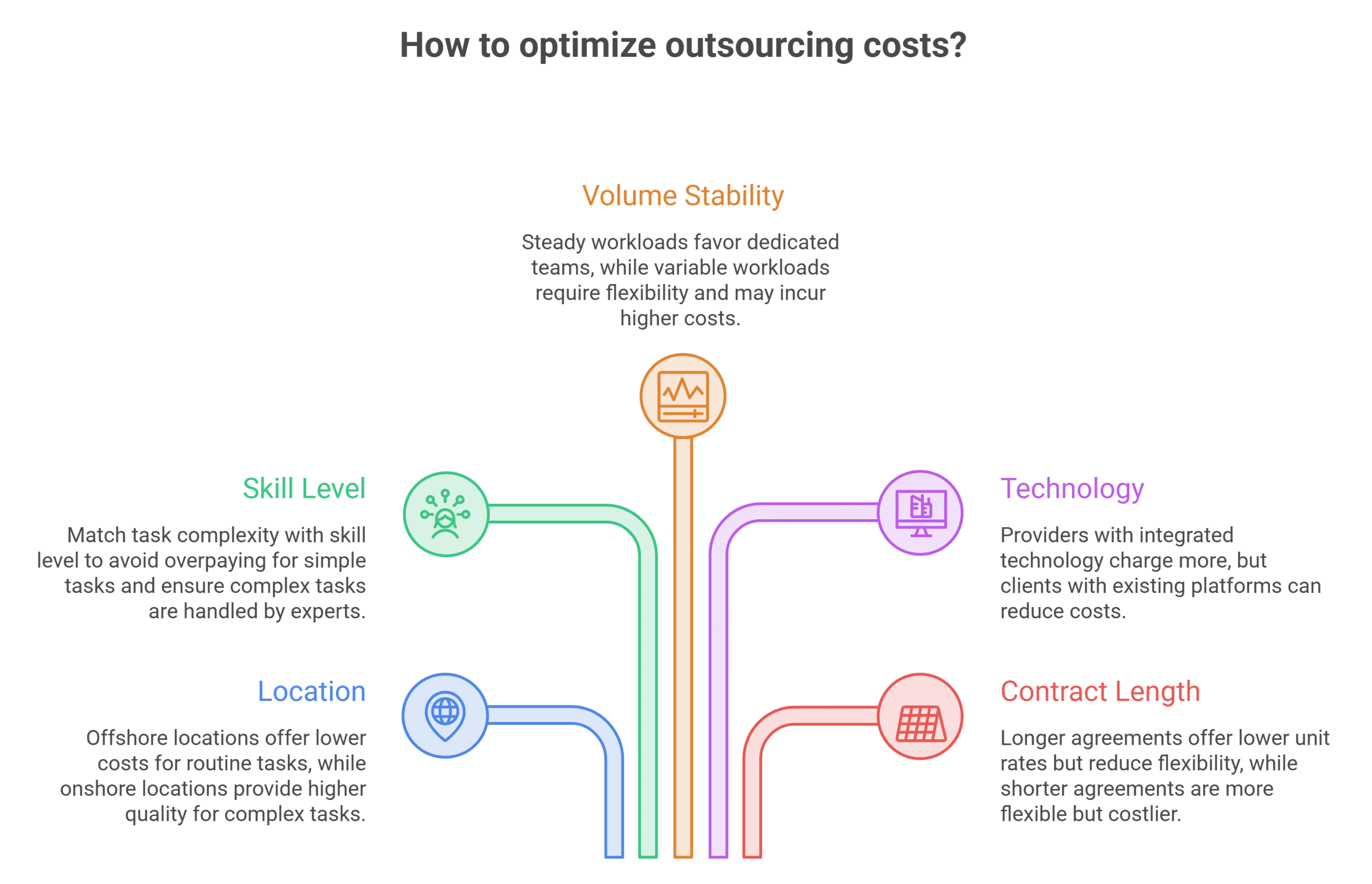
Several variables determine the final price more than any single rate card. Location, skill depth, volume patterns, technology needs, and contract terms interact in ways that can swing total cost by 30 percent or more. Understanding each driver helps buyers forecast realistic budgets and avoid underestimating the true expense of scaling support functions.
1. Location and labor arbitrage
Offshore delivery in markets such as the Philippines and India continues to offer the widest cost differential for routine administrative work. All-in rates for basic tasks commonly range from eight to sixteen dollars per hour, while nearshore options in Latin America or Eastern Europe typically sit between twelve and twenty-eight dollars. Onshore U.S. delivery for comparable roles usually begins at twenty-five dollars and can exceed forty-five dollars once full overhead is included.
These geographic differences remain large enough to drive steady market growth, with the global BPO sector valued near three hundred three billion dollars in 2024 and projected to reach five hundred twenty-five billion by 2030. Companies that carefully match process complexity to the right location capture most of the available savings without sacrificing quality. The same principle applies when evaluating specialized support such as Bookkeeping Services that benefit from lower-cost regions.
2. Skill level and process complexity
Routine data entry and simple transaction processing sit at the lower end of the pricing spectrum. Roles that require professional judgment, regulatory knowledge, or technical troubleshooting command higher rates, often fifteen to thirty-five dollars per hour offshore and substantially more onshore. Specialized knowledge-process work can exceed forty to sixty-five dollars depending on certification and experience requirements.
Buyers who accurately classify each task avoid overpaying for commodity work while ensuring complex processes receive appropriately skilled resources. Clear document processing helps to take decision rights, and exception handling further reduces the risk of rate inflation during the engagement. Providers that also offer complementary capabilities such as Data Handling can streamline multiple related functions under one contract.
3. Volume stability and service levels
Steady, high-volume, standardized workloads produce the most predictable unit economics and favor dedicated-team models. Variable or seasonal demand, tight service-level agreements, after-hours coverage, and multi-channel requirements add measurable premiums. Providers price these elements separately because they affect staffing ratios and technology load.
Organizations that forecast volume ranges accurately and define acceptable performance thresholds can negotiate more favorable terms. Building flexibility clauses for peak periods prevents costly ad-hoc rate increases later. Teams supporting functions such as Virtual Receptionist duties often need explicit coverage rules to keep costs aligned with actual usage.
4. Technology and integration requirements
Providers that supply the complete technology stack, quality-monitoring tools, and system integrations charge more than pure labor arrangements. When the client already owns the necessary platforms, the human-component price drops, yet setup, access provisioning, and ongoing license coordination still create expense. Custom reporting or API development frequently appears as one-time or recurring line items.
Early clarification of who owns each system and how data flows between environments prevents later disputes. Mapping integration points before contracting reduces both cost and timeline risk. Capabilities that overlap with IT Support Services should be scoped carefully so technology fees do not duplicate existing internal investments.
5. Contract length and commitment
Longer multi-year agreements and larger team sizes usually unlock lower unit rates because providers can amortize recruitment and training costs. Short-term or month-to-month arrangements carry higher prices and sometimes impose minimum-hour commitments. Volume discounts become available once a consistent baseline is established.
Buyers should weigh the savings of longer terms against the need for flexibility if business conditions change. Including clear exit and knowledge-transfer provisions protects both parties. When the scope expands to include areas such as Website Development, longer commitments often produce more attractive overall pricing.
Comparing BPO Pricing Models: Hourly, FTE, Per-Task, and Subscription

Choosing the right commercial structure is as important as selecting the right provider. Each model creates different incentives and suits different workload patterns. Matching the model to actual volume stability and quality needs prevents both overpayment and under-delivery.
1. Hourly (time-and-materials)
- You pay only for recorded hours worked, making the model ideal for fluctuating or project-based demand.
- Typical 2026 ranges run eight to twenty-five dollars offshore for basic to mid-complexity tasks, twelve to thirty-five dollars nearshore, and twenty-five to sixty dollars or higher onshore.
- Cost can drift upward if average handle times increase or staffing is inefficient, so monitoring tools are essential.
- Many smaller engagements that incorporate Digital Marketing support still rely on hourly or hour-block billing for flexibility.
2. Full-time equivalent (FTE) or dedicated agent
- A fixed monthly fee covers a dedicated individual who works primarily or exclusively on the client account.
- Offshore administrative and back-office FTE rates commonly fall between twelve hundred and twenty-eight hundred dollars per month; specialized finance or support roles can reach three to six thousand dollars.
- The model rewards consistent volume and quality-critical processes because the provider invests in training and the individual builds domain knowledge.
- Idle capacity during low-volume periods becomes a direct cost, so accurate forecasting is required when the role includes Personal Assistant responsibilities.
3. Per-task or per-transaction
- Pricing is tied to completed units such as invoices processed, tickets resolved, or records entered.
- Rates typically range from fifty cents to five dollars or more per transaction according to complexity and quality requirements.
- High-volume, highly standardized processes achieve the best unit economics under this structure.
- Strong quality gates must be written into the contract so the incentive for speed does not erode accuracy, particularly when tasks overlap with online Marketing Services.
4. Subscription or managed-service packages
- Providers offer monthly packages that include a set number of hours or a dedicated resource plus management, backup coverage, and sometimes tools.
- Full-time offshore packages often land between one thousand and twenty-five hundred dollars per month; U.S.-based managed packages are higher.
- The structure simplifies budgeting and reduces client-side management effort for smaller buyers.
- Hybrid arrangements that combine a core subscription with overflow capacity are increasingly common for teams handling Social Media Marketing needs.
Hidden Costs That Affect Total Business Operations Outsourcing Cost
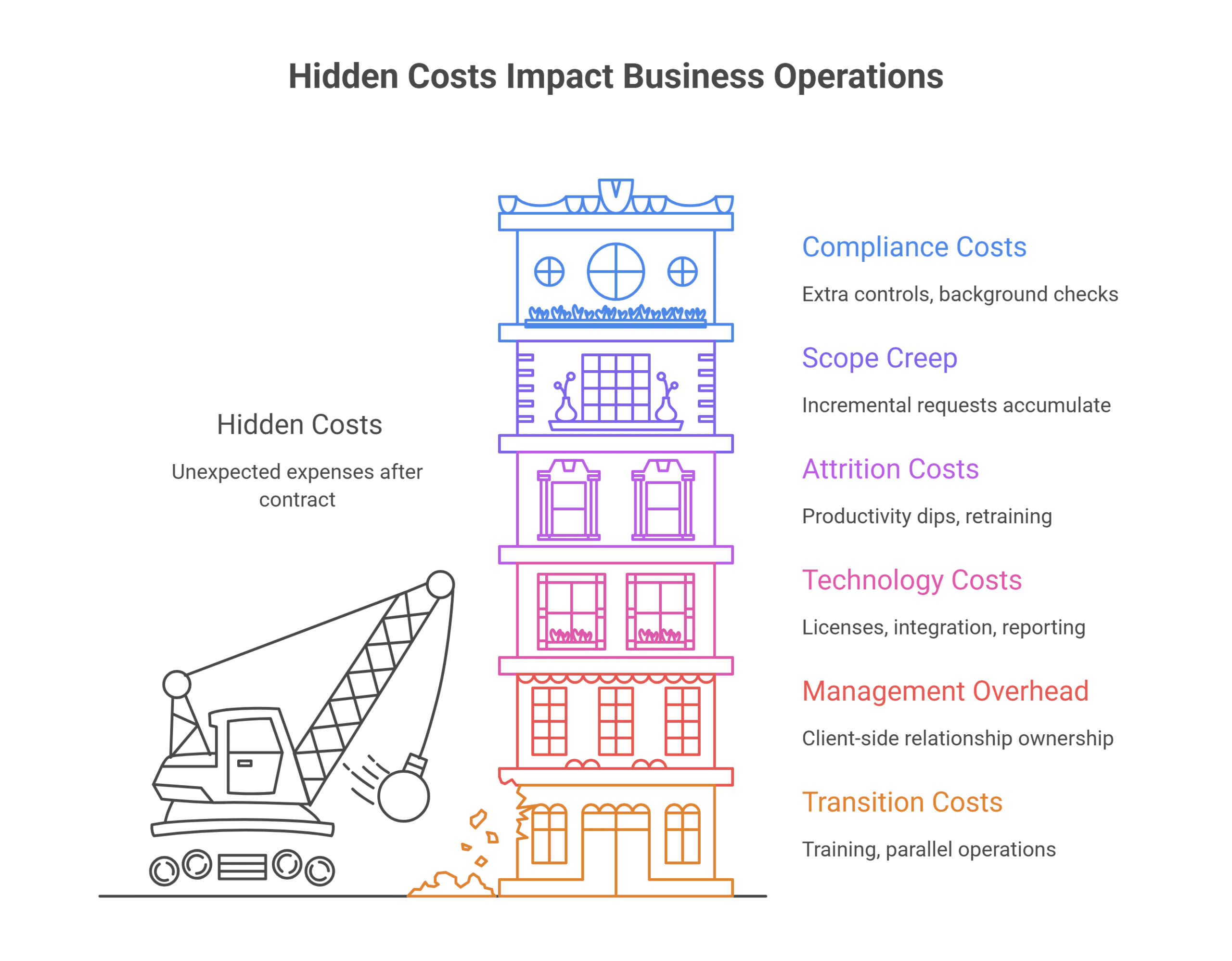
The quoted service fee rarely represents the full economic impact. Several categories of expense appear after the contract is signed and can erode first-year savings if they are not anticipated. Explicitly budgeting for these items produces more accurate return calculations and fewer mid-engagement surprises.
1. Transition and knowledge-transfer costs
Documenting processes, training the new team, running parallel operations, and validating outputs typically consume five to fifteen percent of first-year contract value and forty to eighty hours of internal staff time even for modest scopes. Productivity during the first sixty to ninety days often reaches only fifty to seventy-five percent of steady-state levels, so early results lag expectations. Allocating dedicated internal resources and realistic timelines prevents rushed handovers that create downstream quality issues. When the transition involves specialized functions such as SEO Services, extra documentation time is usually required.
2. Internal management and governance overhead
Someone on the client side must own the relationship, review performance reports, handle escalations, and keep scope aligned with business needs. For every thirty to fifty outsourced full-time equivalents, many organizations dedicate meaningful management capacity that rarely appears in the vendor proposal. This ongoing cost should be quantified and included in the total ownership model from the outset. Clear escalation paths and regular governance meetings reduce the time required while still protecting outcomes for areas such as Website Design Services.
3. Technology, licenses, and integration
Access to client systems, additional seats for quality tools, custom reporting, or API development can add several thousand dollars in one-time and recurring expenses. Even when the provider supplies core platforms, client-side licensing or security reviews often create extra line items. Mapping every required connection before contracting keeps these costs visible and controllable. Integration work that supports Instagram Marketing & Ads campaigns, for example, should be priced separately so it does not inflate the base service rate.
4. Attrition and ramp-up inside the provider
Offshore contact-center and BPO attrition rates of twenty-five to fifty percent in some markets produce periodic productivity dips and retraining cycles. Even when the provider absorbs direct replacement costs, quality and throughput can suffer during those periods. Contracts that include clear replacement SLAs and knowledge-continuity requirements mitigate the impact. Teams responsible for Video Editing Services are particularly sensitive to sudden personnel changes because creative continuity matters.
5. Scope creep and change orders
Once the team is productive, adjacent tasks inevitably appear. Without tight statements of work and formal change-control processes, incremental requests accumulate at higher marginal rates. Defining decision rights and approval thresholds in the original agreement keeps expansion intentional rather than accidental. Clear boundaries are especially useful when the engagement later expands into Facebook Marketing & Ads support.
6. Compliance, security, and audit support
Regulated industries frequently require extra controls, background checks, data-residency measures, or audit assistance that add both one-time and recurring cost. These requirements should be identified during due diligence and priced explicitly rather than discovered after onboarding. Providers experienced with LinkedIn Marketing & Ads compliance frameworks can reduce the learning curve and associated expense.
Realistic 20-Hour and 40-Hour Scenarios

Concrete volume examples help translate rate cards into usable budget figures. The following illustrations use mid-2026 market ranges for general business operations and administrative support; actual quotes vary by provider, exact scope, and negotiation leverage. Adding a modest contingency for the hidden-cost categories listed earlier produces a more reliable planning number.
1. 20-hour-per-week scenario (roughly 80–87 hours per month).
- This volume suits many small businesses that need inbox management & scheduling, light bookkeeping support, data entry, or basic customer follow-up.
- Offshore managed resources typically cost six hundred to fourteen hundred dollars per month; nearshore equivalents run one thousand to two thousand dollars; U.S.-based or premium managed options reach fifteen hundred to thirty-five hundred dollars or more.
- One-time setup fees of five hundred to three thousand dollars plus modest internal coordination time bring the annual range to roughly eight thousand to twenty thousand dollars offshore before hidden items, still attractive versus a part-time domestic hire when quality standards are met.
2. 40-hour-per-week / full-time equivalent scenario.
- A dedicated full-time offshore administrative or back-office resource through a managed provider commonly costs fourteen hundred to twenty-eight hundred dollars per month, or roughly sixteen thousand eight hundred to thirty-three thousand six hundred dollars annually.
- Specialized finance or support roles move higher, while a small dedicated team of three to five people scales roughly linearly with modest volume discounts.
- U.S. fully loaded costs for equivalent in-house roles frequently exceed 65 to 90k dollars per person, so offshore arrangements continue to show material net savings once transition and governance costs are included.
Building a Practical Quote Checklist and Budget Framework
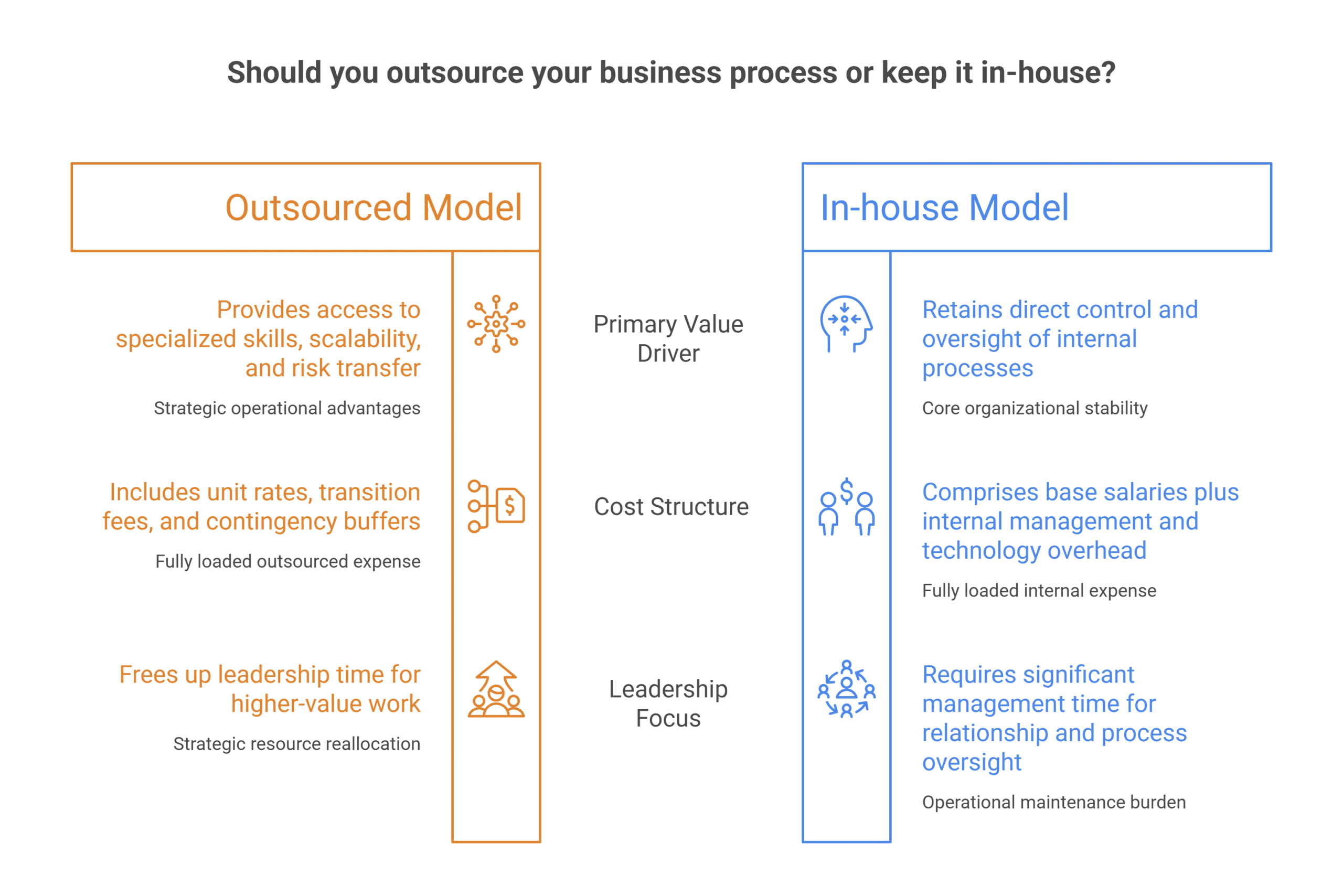
Before requesting proposals, define the scope tightly: process maps, volumes, quality metrics, systems access, hours of coverage, languages, and escalation paths. Then evaluate quotes against a consistent framework:
- Unit rate and what is included (management, QA, tools, backup coverage, reporting).
- One-time transition and setup fees.
- Minimum commitments and ramp-up timeline.
- Pricing for additional volume, after-hours, or scope changes.
- Attrition handling and replacement SLAs.
- Data security, compliance certifications, and audit rights.
- Exit and knowledge-transfer provisions.
- Internal costs you will still carry (relationship management, technology, parallel run).
Construct a simple total-cost model for year one and steady-state years two–three. Include a 10–20% contingency for the categories listed earlier. Compare that fully loaded outsourced cost against the fully loaded in-house alternative (not just base salary). Factor qualitative elements—access to specialized skills, scalability, risk transfer, and leadership time freed for higher-value work—because pure cost is no longer the sole driver for many organizations. Recent surveys show that while cost savings remain important, only about one-third of executives now rank cost reduction as the primary reason for outsourcing, down sharply from earlier years.
Additional Considerations for Virtual Assistants and Smaller Teams
Many U.S. small and mid-sized companies begin with a Virtual Assistant rather than large BPO contracts because the entry barrier is lower and the management overhead is lighter. Full-time offshore managed arrangements typically range from one thousand to twenty-five hundred dollars per month, while part-time packages start lower and U.S.-based managed options command higher rates. The same pricing-model principles and hidden-cost categories apply, so buyers should still clarify what the fee includes and budget internal onboarding time.
Clear statements of work and regular performance reviews keep smaller engagements productive and prevent gradual expansion beyond the original budget. When the assistant later supports related marketing or operational tasks, formal change control protects both cost predictability and service quality. Starting with a well-defined pilot volume allows teams to validate the relationship before scaling.
TaskVirtual: Streamlined Support for Business Operations Outsourcing

Businesses evaluating outsourcing often need flexible, lower-cost capacity for administrative, coordination, and process-support tasks without the overhead of a large dedicated team. TaskVirtual provides outsourced business operations that can handle routine operations work, calendar and inbox management, data organization, and related back-office functions so internal staff can focus on higher-value priorities. The service is designed to fit the same cost-conscious frameworks discussed throughout this guide, offering transparent hourly pricing and scalable engagement levels that align with both 20-hour and full-time scenarios.
1. Specialized Guidance on Process Setup
TaskVirtual’s experienced team helps clients map recurring workflows, prioritize daily and weekly tasks, and establish clear hand-off points so outsourced support integrates smoothly with existing operations. They assist with documentation, preference tracking, and exception handling to reduce the transition friction that commonly inflates first-year costs.
2. Transparent and Accessible Rate Structure
Full-time domestic support can become expensive once benefits and overhead are added, yet TaskVirtual keeps entry costs manageable. Pricing plans start from just $3.12/hour to $14.99/hour, making the service practical for individuals, small teams, and growing companies that need reliable coverage without long-term fixed commitments.
3. End-to-End Operational Coverage
From organizing schedules and managing correspondence to handling data updates, follow-ups, and basic process execution, TaskVirtual addresses the core administrative load that drives many outsourcing decisions. Engagements scale easily from occasional overflow support to consistent weekly hours, matching the volume patterns outlined in the 20-hour and 40-hour scenarios.
4. Continuous Oversight and Performance Tracking
Beyond task completion, TaskVirtual provides regular status updates, reminders, and quality checks so clients maintain visibility without heavy internal management effort. This proactive approach helps limit the governance overhead and attrition-related disruptions that often appear as hidden costs.
5. Established Reliability Across Clients
With 364 positive reviews and a 4.7-star rating on trusted VA platforms, TaskVirtual is recognised as a reliable partner worldwide. Clients count on their expertise to simplify everyday business operations and keep support functions running efficiently.
FAQ
1. What is the average business operations outsourcing cost per hour in 2026?
Basic offshore work often falls in the $8–$16 range; specialized processes run $15–$35+; onshore U.S. rates are typically $25–$45 or higher for comparable roles. All-in rates include provider margin, management, and infrastructure.
2. How much does a full-time outsourced team member cost monthly?
Offshore administrative or back-office FTE pricing commonly sits between $1,200 and $2,800 per month. Specialized roles and nearshore/onshore delivery cost more.
3. What is a typical virtual assistant monthly cost?
Managed full-time offshore virtual assistants frequently range from $1,000 to $2,500 per month. Part-time packages and U.S.-based options sit outside that band.
4. Do most companies still outsource primarily for cost savings?
Cost remains important, but recent surveys indicate only about 34% of executives now cite it as the top driver, down from roughly 70% several years earlier. Talent access, flexibility, and digital capabilities have risen in priority.
Transition, internal management, technology, and early productivity gaps commonly add 10–25% (sometimes more) above the pure service fee in year one.
6. Should I choose hourly or FTE pricing?
Hourly suits variable or unpredictable volume. FTE works better for steady, quality-sensitive work where dedicated knowledge is valuable. Many buyers use hybrids.
Conclusion and Next Steps
Business operations outsourcing cost is no longer a single number on a rate card; it is the sum of the chosen pricing model, location and skill mix, transition investment, ongoing governance, and the internal capacity required to make the arrangement succeed. When those elements are modeled honestly, many U.S. companies still achieve meaningful net savings—often 25–50 percent or more on back-office and administrative functions—while gaining scalability and access to specialized capacity.
Start with a clear process inventory and volume data, match the commercial structure to the workload, budget explicitly for hidden costs, and evaluate structured proposals against a consistent total-cost framework rather than the lowest unit rate. The difference between a well-scoped outsourcing arrangement and a poorly defined one is frequently larger than the difference between the headline rates themselves.
Sources
- Grand View Research, Business Process Outsourcing Market reports (market size 2024–2030 projections)
- U.S. Bureau of Labor Statistics, Occupational Employment and Wage Statistics and Occupational Outlook Handbook (secretaries and administrative assistants wages)
- Deloitte Global Outsourcing Survey findings (shift in primary drivers of outsourcing)
- Industry benchmarks compiled from multiple BPO pricing analyses for 2025–2026 ranges on hourly, FTE, and regional differentials
- Additional references to cost-savings percentages drawn from published analyses of HR and back-office outsourcing outcomes
For such content, visit our website.
 Siddhartha Basu is a Technical Writer at Task Virtual. He loves online games, e-book reading, and Yoga.