Contents
show
How an Amazon PPC Virtual Assistant Optimizes Campaign Bids
Managing Amazon advertising has never been more demanding. With rising competition, fluctuating costs per click, and algorithm shifts, sellers who treat bids as a set-it-and-forget-it task often watch ad spend climb while returns stagnate. An Amazon PPC virtual assistant changes that equation by applying specialized expertise, continuous monitoring, and precise bid adjustments that most solo sellers or generalist teams cannot sustain.
In 2026, the pressure is higher as Amazon’s advertising business continues expanding and paid placements dominate early search results. Sellers relying solely on automated rules or infrequent manual checks leave money on the table. A dedicated Amazon PPC virtual assistant focuses on campaign bid optimization, turning raw data into profitable decisions that improve ACOS, ROAS, and overall efficiency for American sellers.
Understanding Amazon PPC Bidding Fundamentals
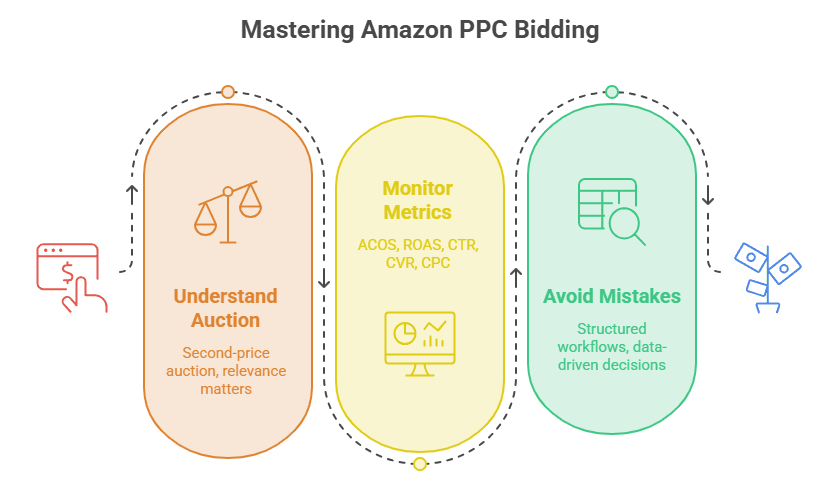
Amazon’s auction system, key performance metrics, and common pitfalls form the foundation of effective bid management. Sellers who grasp these elements can better evaluate and direct the work of an Amazon PPC virtual assistant. A clear understanding also helps set realistic targets that align advertising spend with actual business margins and growth goals.
1. How Amazon’s Auction System Works
Amazon runs a second-price auction for Sponsored Products, Sponsored Brands, and Sponsored Display. Your maximum bid represents the highest amount you are willing to pay for a click, yet you usually pay only enough to beat the next highest bidder plus a small increment. Placement, relevance signals, and historical performance further influence whether your ad appears and in which position.
Relevance factors such as keyword match type, listing quality, and conversion history carry significant weight. A high bid on a poorly converting keyword can still lose to a lower bid with stronger relevance. Experienced Amazon PPC virtual assistants therefore treat bidding as part of a broader system that includes search-term harvesting, negative keyword management, and listing optimization rather than an isolated lever.
2. Key Metrics That Drive Bid Decisions
Successful bid optimization rests on a clear hierarchy of metrics. Advertising Cost of Sales (ACOS) shows the percentage of attributed sales spent on ads, while Return on Ad Spend (ROAS) is its inverse and is often preferred for scaling discussions. Click-through rate (CTR), conversion rate (CVR), and cost per click (CPC) reveal efficiency at each stage of the funnel.
Recent portfolio data from managed accounts shows average ACOS around 27.5% and ROAS near 3.64x across multiple marketplaces, with U.S. accounts frequently running slightly higher ACOS due to competitive intensity. An Amazon PPC virtual assistant monitors these metrics at the campaign, ad group, keyword, and search-term level, then adjusts bids to keep performance inside predetermined target bands while still capturing volume.
3. Common Bidding Mistakes Sellers Make Alone
Many sellers set aggressive automatic bids and walk away, or they raise bids only when sales drop without diagnosing the underlying cause. Others apply the same target ACOS across every campaign regardless of product lifecycle or seasonality. These approaches waste budget on low-intent traffic and miss high-converting opportunities.
A specialized virtual assistant avoids these pitfalls through structured daily and weekly workflows that prioritize data over emotion. Consistent review of search-term performance, placement data, and margin impact prevents the reactive decisions that erode profitability over time.
The Role of an Amazon PPC Virtual Assistant in Bid Strategy

An Amazon PPC virtual assistant brings specialized focus and disciplined processes that most sellers cannot maintain alongside other operational responsibilities. Their role centers on turning complex performance data into precise data analysis and profitable bid decisions every week.
1. Daily Monitoring and Real-Time Adjustments
- Review search-term reports, placement performance, and budget pacing multiple times per week, often daily for active accounts.
- Lower bids or add negatives when a keyword’s ACOS spikes above target.
- Harvest new converting search terms into exact or phrase match campaigns with calibrated bids.
- Maintain continuous attention so high-performing campaigns do not go dark and low-performing ones do not drain budget unnoticed.
2. Aligning Bids with Business Goals and Margins
- Distinguish launch campaigns that can accept higher ACOS to build rank and reviews from mature products that support tighter targets.
- Apply more aggressive bidding to high-margin items while protecting low-margin products.
- Build these distinctions into account structure and bid rules from the start.
- Ensure every dollar of spend supports overall profitability rather than vanity metrics alone.
3. Integrating Human Judgment with Amazon’s Automation Tools
- Layer human oversight on Amazon’s dynamic bidding strategies and rule-based automation.
- Review which automated outcomes actually improved profit and override rules when search volume or competition shifts rapidly.
- Test new bid strategies in controlled experiments.
- Combine platform tools with specialist judgment to outperform pure automation for most mid-sized and growing accounts.
Step-by-Step Process for Optimizing Campaign Bids
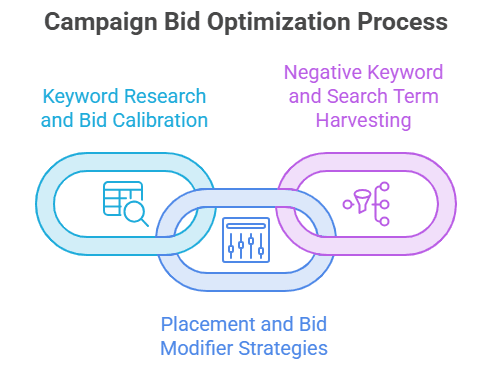
Effective bid optimization follows a repeatable sequence that moves from research and calibration through ongoing refinement. An Amazon PPC virtual assistant executes these steps systematically so improvements compound over time. The process balances discovery of new opportunities with protection of existing profitable spend.
1. Keyword Research and Bid Calibration
Optimization begins with high-quality keyword data drawn from search-term reports, competitor ASINs, and supporting tools. Initial bids are set using historical CPC figures, estimated conversion rates, and target ACOS; for instance, calculating the maximum profitable bid when a keyword converts at roughly 15% and average CPC sits near $1.12. Keywords are then segmented by match type and intent, with higher bids applied to proven exact-match terms and more conservative bids used for broad-match discovery.
2. Placement and Bid Modifier Strategies
Amazon allows bid adjustments for top of search, product pages, and rest of search. Top-of-search placements often convert better but cost more. An Amazon PPC virtual assistant tests modifiers systematically, raising bids 20–50% on top of search for proven high-ROAS keywords while lowering them on product pages if performance lags. They review placement reports weekly and refine modifiers as seasonality or competitive intensity changes.
3. Negative Keyword and Search Term Harvesting Cycles
Every week or two, the assistant harvests converting search terms into higher-precision campaigns and adds non-converting or irrelevant terms as negatives. This process steadily improves overall account efficiency. Over time, the percentage of spend on high-performing exact-match keywords rises, and wasted spend on low-intent queries falls. Consistent harvesting is one of the highest-ROI activities a virtual assistant performs.
Advanced Bid Optimization Techniques Used by Experts

Beyond core adjustments, experienced Amazon PPC virtual assistants employ timing, competitive awareness, and structured testing to extract additional efficiency. These techniques separate average performance from consistently strong results.
1. Dayparting and Budget Pacing Adjustments
- Analyze hourly and daily performance data to identify peak conversion windows by category.
- Raise bids during high-efficiency periods and pull back during low-efficiency hours or days.
- Monitor budget exhaustion rates so strong campaigns do not go dark mid-day while weaker ones continue spending.
2. Competitor and Seasonality-Responsive Bidding
- Track share-of-voice indicators, impression share, and competitive ASIN activity for early signals of change.
- Raise bids proactively on core terms ahead of peak periods such as Prime Day or holiday spikes.
- Scale bids back afterward to protect efficiency, noting that Q4 often delivers stronger returns despite higher absolute spend.
3. Testing Bid Strategies and Attribution Insights
- Run structured tests comparing fixed bids versus dynamic bidding or different target ACOS levels across matched campaigns.
- Examine attribution windows and multi-touch effects so short-term ACOS does not overshadow longer-term customer value.
- Convert test results into account-specific insights that generic rules cannot provide.
Measuring Success and Continuous Improvement
U.S. sellers should benchmark against recent data rather than outdated averages. Portfolio-level figures near 27-30% ACOS and 3.4-3.6x ROAS provide useful starting points, though category and competition create wide variation. An Amazon PPC virtual assistant establishes account-specific targets based on margins, growth stage, and historical performance, then tracks progress weekly. Amazon’s overall advertising revenue reached approximately $56.2 billion in 2024 and continued climbing afterward, reflecting both platform growth and intensifying seller competition.
Transparent reporting builds trust, as 86% of Americans say transparency matters more than ever. Weekly summaries cover bid changes, ACOS/ROAS trends, top movers, and recommended actions, while monthly reviews examine structural improvements and testing results. Once proven on core ASINs, the approach is expanded across related products, with margin adjustments turning individual successes into portfolio-level growth.
TaskVirtual: Your Partner in Amazon PPC Virtual Assistant Services

Managing Amazon advertising campaigns, adjusting bids in real time, and keeping ACOS and ROAS on target can quickly overwhelm busy sellers. From daily search-term reviews to placement modifiers and seasonal bid changes, the work demands consistent attention that most founders cannot sustain alone. TaskVirtual supplies specialized Amazon PPC virtual assistant services that handle campaign bid optimization, keyword harvesting, and performance monitoring so you can focus on product development and overall business growth.
1. Expert Bid Management and Campaign Oversight
TaskVirtual’s trained virtual assistants analyze search-term reports, set calibrated bids based on your margins and targets, and make timely adjustments when performance drifts. They also manage negative keywords, placement modifiers, and structured testing to keep campaigns efficient and scalable.
2. Affordable and Flexible Pricing
Hiring a full-time advertising specialist can be costly, but TaskVirtual keeps professional support accessible. With pricing plans starting from just $3.12/hour to $14.99/hour, their Amazon PPC virtual assistant services fit a wide range of seller budgets and campaign volumes.
3. Full-Spectrum Amazon PPC Optimization Support
From initial keyword research and bid calibration through dayparting, competitor monitoring, and ongoing search-term harvesting, TaskVirtual covers the complete bid-optimization workflow. Their services scale easily whether you need focused help on core ASINs or broader account management.
4. Continuous Monitoring and Performance Assurance
TaskVirtual goes beyond one-time setup by providing regular performance reviews, budget pacing checks, and proactive recommendations. Their ongoing oversight helps protect profitability and captures new opportunities as Amazon’s auction landscape shifts.
5. Proven Track Record of Excellence
With 364 positive reviews and a 4.7-star rating on trusted VA platforms, TaskVirtual is recognised as a reliable partner worldwide. Clients count on their expertise to streamline Amazon PPC bid management and improve advertising efficiency.
FAQ Section
1. How much does an Amazon PPC virtual assistant typically cost?
Specialized Amazon PPC virtual assistants usually charge $15–40 per hour or fixed monthly retainers of $1,000–$4,000 depending on account size and scope. Many sellers find the efficiency gains more than offset the cost.
2. Can a virtual assistant replace Amazon’s automated bidding completely?
No. The best results come from combining platform automation with human oversight, testing, and strategic judgment that pure rules cannot replicate.
3. How quickly can I expect results from bid optimization?
Initial efficiency improvements often appear within 2–4 weeks as wasted spend is reduced. Meaningful ROAS gains and scalable structures usually take 6–12 weeks of consistent work.
4. What tools do Amazon PPC virtual assistants commonly use?
They work inside Amazon Advertising Console and often layer specialized software for bulk operations, advanced reporting, and search-term analysis. The specific stack varies by provider.
5. Is bid optimization enough, or do listings also need attention?
Bid optimization works best when listings are strong. Conversion rate directly affects the maximum profitable bid, so virtual assistants frequently flag listing issues that limit performance.
6. How do I know if my current bids are too high or too low?
Compare current ACOS/ROAS against your target margins and review search-term level performance. Consistent ACOS well above target on high-volume terms usually signals overbidding; low impression share on converting terms often indicates underbidding.
Conclusion and Call to Action
Optimizing Amazon PPC campaign bids is no longer optional for sellers who want sustainable growth. Rising advertising costs, heavier competition, and the dominance of paid placements mean that every click must be earned efficiently. An Amazon PPC virtual assistant brings the specialized focus, daily discipline, and data-driven decision-making required to keep bids aligned with profitability while still capturing market share.
Whether you manage a handful of ASINs or a large catalog, continuous monitoring, structured testing, negative keyword hygiene, and clear alignment with business margins deliver consistent results. If your campaigns feel reactive or ACOS has drifted beyond comfortable levels, evaluate specialized providers carefully and choose one with proven Amazon PPC experience and transparent reporting so advertising becomes a reliable growth engine for your brand.
Sources
- Headline Marketing Agency 2025 Amazon PPC Benchmarks (managed account data)
- Amazon advertising revenue figures reported via Adweek and related financial disclosures
- Sequence Commerce/industry CPC and performance benchmarks referenced in 2025–2026 analyses
- Amazon Small Business Empowerment / Selling Partners reports on independent seller activity
- Statista Amazon advertising revenue historical series
For more such content, visit our website.
 Siddhartha Basu is a Technical Writer at Task Virtual. He loves online games, e-book reading, and Yoga.