Contents
show
Virtual Assistant for Medical Call Answering: A Complete Guide for Clinics (2026)
Missed calls, overwhelmed front desks, and rising patient expectations are pushing clinics to rethink how they handle communication. In 2026, virtual assistant services for medical practice are no longer optional—they’re becoming operational infrastructure. From AI-powered call answering to human-backed scheduling and insurance verification, these services help clinics deliver faster, more reliable patient experiences without expanding in-house staff. Notably, 1 in 3 patients (about 34%) switch providers after a poor experience, according to an Accenture study reported by Becker’s Hospital Review, highlighting how critical responsive communication has become in modern healthcare.
Clinics that fail to respond quickly risk losing patients to competitors who do. This guide breaks down how virtual assistant services for medical practices work, what features matter most, and how to choose the right solution for your clinic. With staffing shortages projected by the U.S. Bureau of Labor Statistics to grow healthcare occupations by 13%, virtual assistants are emerging as a strategic solution to maintain efficiency and patient satisfaction.
What Are Virtual Assistant Services for Medical Practice?
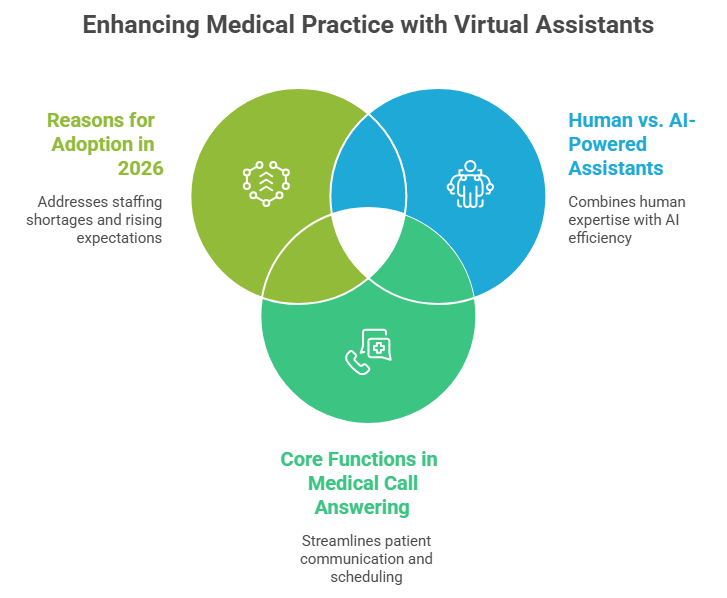
Virtual assistant services in healthcare combine technology and remote support to handle administrative and patient communication tasks efficiently. These services reduce workload on in-house staff while improving responsiveness, especially as research shows that about 70% of physicians spend 10 or more hours per week on administrative tasks. Clinics increasingly rely on them to maintain operational continuity and enhance patient experience.
1. Human vs. AI-Powered Medical Assistants
Virtual assistants in healthcare include human professionals and AI-driven systems that handle administrative and communication tasks. Human assistants manage complex interactions like insurance and patient concerns, while AI tools handle repetitive workflows. Many clinics adopt hybrid models to balance efficiency with personalized care.
2. Core Functions in Medical Call Answering
Medical virtual assistants manage patient calls, appointment scheduling, insurance verification, prescription coordination, and intake documentation. These tasks streamline operations and reduce administrative burden. As a result, clinics can improve response times and overall efficiency.
3. Why Clinics Are Adopting Virtual Assistants in 2026
Healthcare staffing shortages and rising patient expectations are driving the adoption of virtual assistants. The U.S. Bureau of Labor Statistics highlights continued workforce challenges in healthcare. Virtual assistants help clinics maintain service quality without increasing overhead costs.
Key Benefits of Virtual Assistant Services for Medical Practices
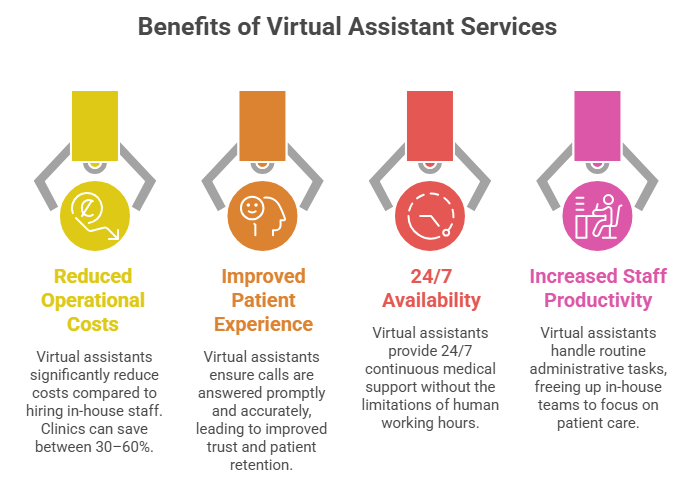
Virtual assistant services deliver measurable improvements in efficiency, cost savings, and patient satisfaction. They allow clinics to optimize operations without expanding internal teams. As demand for faster healthcare communication grows, these benefits become increasingly critical.
1. Reduced Operational Costs
Virtual assistants significantly reduce costs compared to hiring in-house staff with salaries and benefits. Clinics can save between 30–60% depending on service models. This flexibility allows practices to scale without long-term financial commitments.
2. Improved Patient Experience
Timely communication plays a major role in patient satisfaction, with 74% of patients valuing responsiveness according to Statista. Virtual assistants ensure calls are answered promptly and accurately. This leads to improved trust and patient retention.
3. 24/7 Availability Without Burnout
Virtual assistants provide 24/7 continuous medical support without the limitations of human working hours. This ensures patients can reach assistance at any time. Clinics benefit from uninterrupted service without staff fatigue.
4. Increased Staff Productivity
By handling routine administrative tasks, virtual assistants free up in-house teams to focus on patient care. This improves efficiency and reduces workload stress. As a result, staff satisfaction and retention often improve.
Features to Look for in the Best Virtual Assistant Services for Medical Practice

Choosing the right virtual assistant service requires evaluating both technical capabilities and compliance standards. Clinics must ensure the solution integrates smoothly with existing workflows. The right features directly impact efficiency, security, and patient experience.
- HIPAA compliance and strong data security measures as outlined by HHS.
- Seamless integration with EHR/EMR systems for real-time updates.
- Multichannel communication support, including phone, SMS, email, and chat.
- Customizable workflows tailored to clinic-specific processes.
- Reliable uptime and technical support to ensure uninterrupted service.
Use Cases: How Medical Virtual Assistant Services for Private Practices Work
Virtual assistants support a wide range of daily clinical operations, making them highly versatile tools for private practices. They streamline repetitive workflows and improve responsiveness. These use cases highlight their practical value in real-world settings.
- Appointment scheduling, rescheduling, and automated reminders to reduce no-shows by up to 30%.
- Insurance verification and billing assistance to minimize claim denials.
- Patient follow-ups and engagement to improve outcomes and satisfaction.
- Call overflow management during peak hours or staff shortages.
- After-hours support ensures no patient call goes unanswered.
Virtual Medical Assistant Services for Small Practices
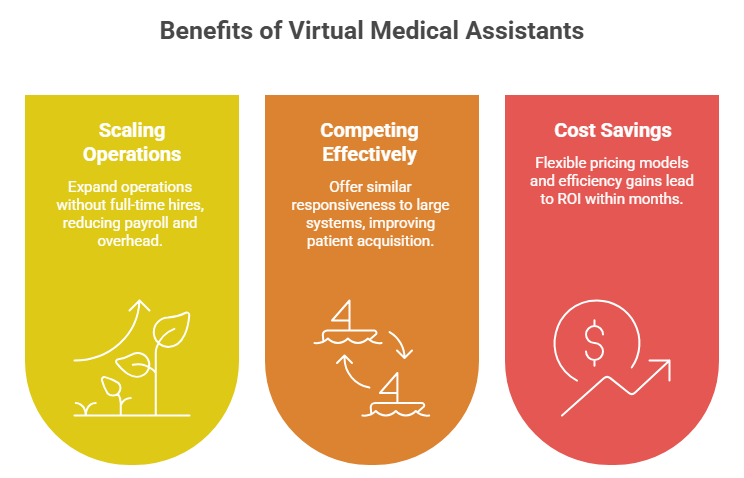
Small practices face unique challenges such as limited budgets and staffing constraints. Virtual assistants offer a scalable solution to manage administrative workloads. They help smaller clinics compete with larger healthcare providers while maintaining efficiency.
1. Scaling Without Hiring Full-Time Staff
Virtual assistants allow small practices to expand operations without committing to full-time hires. This reduces payroll expenses and administrative overhead. Clinics can adjust support levels based on demand.
2. Competing With Larger Healthcare Systems
Large healthcare systems often have dedicated call centers and resources. Virtual assistants enable small practices to offer similar responsiveness. This helps them remain competitive in patient acquisition and retention.
3. Cost Structures and ROI Considerations
Most services offer flexible pricing models such as subscriptions or pay-per-use. Clinics typically see ROI within 3-6 months due to cost savings and efficiency gains. Improved patient retention also contributes to long-term profitability.
Challenges and Limitations to Consider

While virtual assistant services offer significant advantages, they also come with certain limitations. Clinics must evaluate these factors carefully before implementation. Addressing these challenges ensures smoother adoption and better outcomes.
- Initial setup and workflow customization require time and planning.
- Some patients may prefer a brief comparison of a virtual assistant with in-house staff.
- Dependence on technology introduces potential downtime risks.
- Training and onboarding are necessary for optimal performance.
- Data security and compliance must be continuously monitored.
Future Trends in Virtual Assistant Services for Medical Practices
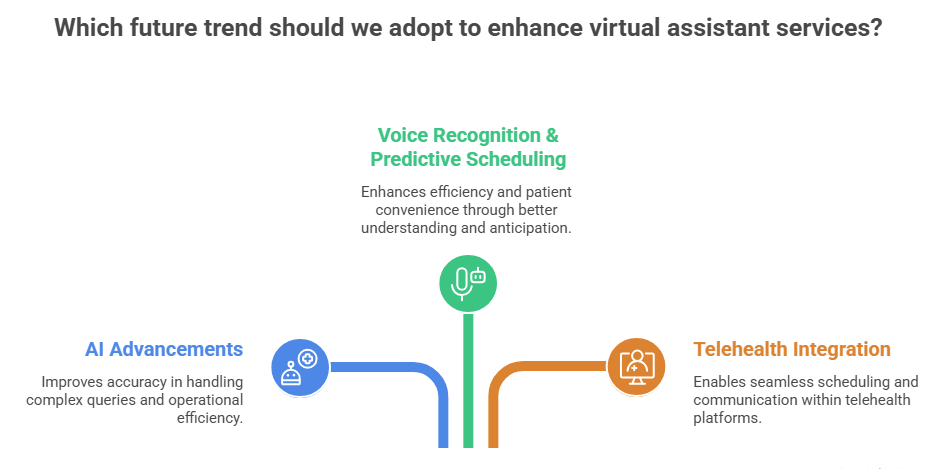
The evolution of virtual assistant technology is rapidly transforming healthcare communication. Innovations in AI and automation are improving efficiency and personalization. Clinics adopting these trends can stay ahead in patient engagement and operational excellence.
1. AI Advancements in Healthcare Communication
AI is becoming more advanced with better natural language processing capabilities. This allows virtual assistants to handle complex patient queries accurately, especially as around 80% of hospitals are already using AI to improve patient care and operational efficiency.
2. Voice Recognition and Predictive Scheduling
Voice recognition systems are evolving to understand accents and medical terminology more effectively. Predictive scheduling uses patient data to anticipate appointment needs. These advancements enhance both efficiency and patient convenience.
3. Integration With Telehealth Platforms
Telehealth adoption continues to rise, with the CDC reporting significant growth. Virtual assistants are increasingly integrated with telehealth systems. This enables seamless scheduling, follow-ups, and patient communication.
How Virtual Assistants Help in Medical Call Answering Service
- Ensure every incoming patient call is answered promptly, reducing missed opportunities and improving patient satisfaction.
- Handle appointment scheduling, cancellations, and rescheduling efficiently without burdening in-house staff.
- Provide accurate information on services, availability, and basic medical queries following predefined scripts.
- Manage call overflow during peak hours and deliver consistent after-hours support.
- Route urgent calls to the appropriate medical personnel, ensuring a timely response for critical cases.
- Maintain detailed call logs and patient interaction records for better follow-up and continuity of care.
TaskVirtual: Your Partner in Medical Virtual Assistant Services

Managing high call volumes, patient scheduling, and administrative coordination can quickly overwhelm clinic staff. From handling appointment requests to ensuring timely patient communication, these responsibilities demand consistency and accuracy. TaskVirtual delivers specialized virtual medical assistant services for proper medical practices that streamline medical call answering and administrative workflows for clinics of all sizes.
1. Expert Consultation and Review
TaskVirtual’s trained medical virtual assistants support clinics in optimizing call handling processes, managing patient scheduling systems, and ensuring smooth communication workflows. They assist with call scripts, patient interaction protocols, and workflow customization tailored to healthcare environments.
2. Affordable and Flexible Pricing
Hiring in-house administrative staff can be costly, but TaskVirtual offers a budget-friendly alternative. With pricing plans starting from just $3.12/hour to $14.99/hour, clinics can access professional support without long-term financial strain.
3. Comprehensive Medical Support Solutions
From appointment bookings through assistant and insurance verification to handling patient follow-ups and call overflow, TaskVirtual provides end-to-end support. Their services are scalable, making them ideal for both small practices and growing healthcare organizations.
4. Ongoing Support and Quality Assurance
TaskVirtual ensures consistent performance through continuous monitoring and updates. Their assistants provide real-time support, maintain communication accuracy, and ensure every patient interaction meets clinic standards.
5. Proven Track Record of Excellence
With 364 positive reviews and a 4.7-star rating on trusted VA platforms, TaskVirtual has built a strong reputation in the virtual assistance space. Clinics rely on their expertise to improve patient communication and streamline operations efficiently.
FAQ Section
1. What are virtual assistant services for medical practice?
They are remote or AI-driven services that handle administrative and communication tasks such as call answering, scheduling, and patient follow-ups.
2. Are medical virtual assistants HIPAA compliant?
Reputable providers are fully HIPAA compliant, ensuring patient data is secure and protected.
3. How much do virtual assistant services cost?
Costs vary but are generally 30–60% lower than hiring in-house staff, depending on usage and features.
4. Can small practices benefit from virtual assistants?
Yes, virtual medical assistant services for small practices are especially valuable for scaling operations without increasing overhead.
5. Do virtual assistants replace human staff?
No, they complement staff by handling repetitive tasks, allowing employees to focus on patient care.
6. What is the ROI of using a medical virtual assistant?
Most clinics see ROI within months through cost savings, reduced no-shows, and improved patient retention.
Conclusion + CTA
The shift toward virtual assistant services for medical practice is accelerating—and for good reason. Clinics that adopt these solutions gain a competitive edge through better patient communication, lower costs, and scalable operations. Whether you’re a solo practitioner or managing a growing clinic, virtual assistants can transform how you handle patient interactions.
If you’re evaluating the best virtual assistant services for medical practice, start by identifying your biggest operational bottlenecks – then choose a solution that aligns with your workflow, compliance needs, and growth goals. Ready to modernize your clinic? Explore virtual assistant solutions today and position your practice for the future of healthcare.
Sources
- Pew Research Center – Mobile Fact Sheet: https://www.pewresearch.org/internet/fact-sheet/mobile/
- U.S. Bureau of Labor Statistics – Healthcare Occupations Outlook: https://www.bls.gov/ooh/healthcare/home.htm
- Statista – Patient Satisfaction and Communication: https://www.statista.com/statistics/1093096/patient-satisfaction-healthcare-communication-us/
- U.S. Department of Health & Human Services – HIPAA: https://www.hhs.gov/hipaa/index.html
- National Institutes of Health – Appointment Reminder Study: https://www.ncbi.nlm.nih.gov/pmc/articles/PMC3540443/
- CDC – Telehealth Usage Report: https://www.cdc.gov/mmwr/volumes/69/wr/mm6943a3.htm
For more such content, follow our website.
 Siddhartha Basu is a Technical Writer at Task Virtual. He loves online games, e-book reading, and Yoga.