Contents
show
Medical Biller Virtual Assistant vs In-House Billing Staff: Which Is Better
Healthcare practices across the U.S. are under mounting pressure to reduce administrative overhead while maintaining accurate, compliant billing processes, making the medical biller virtual assistant an increasingly attractive solution. In fact, administrative expenses account for nearly 25% of total U.S. healthcare spending according to the National Library of Medicine, highlighting the urgency for more cost-efficient billing solutions. With rising labor costs, evolving insurance requirements, and the rapid shift toward digital-first healthcare operations, providers are exploring alternatives to traditional staffing models.
A medical billing and coding virtual assistant offers remote expertise, flexibility, and often lower operational costs compared to in-house teams, while still supporting critical billing functions. However, determining whether a virtual model is superior requires a deeper look at efficiency, compliance, scalability, and long-term financial impact.
What Is a Medical Biller Virtual Assistant?
A medical biller virtual assistant is a remote professional who manages healthcare billing operations without being on-site. With over 35% of U.S. workers now working remotely at least part-time, according to the Pew Research Center, these specialists use digital tools and expertise to streamline revenue cycle management. Their role continues to grow as healthcare adopts more remote workflows.
1. Remote Billing Professionals Explained
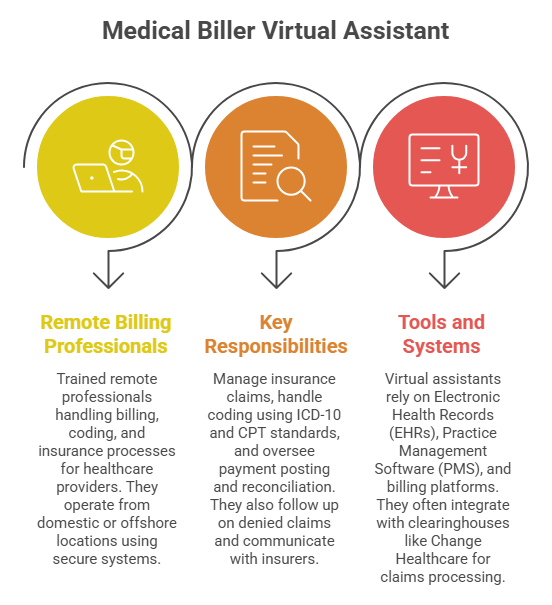
A medical biller virtual assistant is a trained remote professional handling billing, coding, and insurance processes for healthcare providers. They operate from domestic or offshore locations using secure systems. Their role is focused on maintaining accurate and efficient revenue cycle workflows.
2. Key Responsibilities
They manage insurance claims, handle coding using ICD-10 and CPT standards, and oversee payment posting and reconciliation. They also follow up on denied claims and communicate with insurers. Additionally, they assist patients with billing inquiries and account clarifications.
3. Tools and Systems They Use
Virtual assistants rely on EHRs, Practice Management Software (PMS), and billing platforms. They often integrate with clearinghouses like Change Healthcare for claims processing. Secure cloud-based tools and encrypted systems ensure compliance and efficiency.
What Does In-House Billing Staff Offer?
In-house billing staff remains a traditional and widely used model for healthcare practices that prioritize direct oversight and real-time collaboration. These employees work within the physical office environment, allowing closer integration with clinical and administrative teams. While this model offers control, it often comes with higher operational costs and resource requirements.
- In-house staff work onsite and collaborate directly with physicians and administrative teams.
- They provide immediate communication and faster internal coordination for billing issues.
- Direct supervision allows easier monitoring, training, and performance management.
- According to the U.S. Bureau of Labor Statistics, median annual wages reach about $48,780, excluding benefits.
- Additional overhead includes office space, equipment, insurance, and employee benefits.
Cost Comparison: Virtual vs In-House
Understanding the financial implications of each model is critical for making a sustainable decision. While in-house teams involve fixed costs, virtual assistants offer more flexible pricing structures. Evaluating both direct and hidden costs provides a clearer picture of long-term value.
1. Salary vs Service Fees
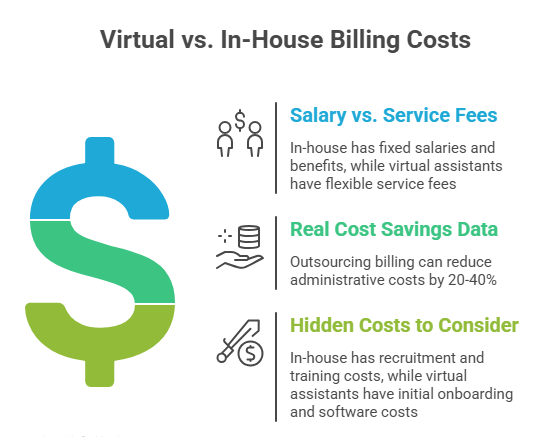
In-house billing requires salaries, benefits, workspace, and equipment investments that increase total costs. Virtual assistants typically charge hourly or monthly service fees based on workload. This flexible pricing model allows practices to align costs with actual billing volume.
2. Real Cost Savings Data
Administrative costs account for nearly 25% of total U.S. healthcare spending, according to the Centers for Medicare & Medicaid Services. Outsourcing billing services through virtual assistants can reduce operational expenses by 20–40% in many cases. These savings make virtual assistants an attractive option for cost-conscious practices.
3. Hidden Costs to Consider
In-house staffing includes recruitment, onboarding, and ongoing training expenses that add up over time. Virtual assistants may require initial onboarding, but they typically reduce long-term HR costs. Software licensing and system integrations should also be factored into both models.
Efficiency and Productivity
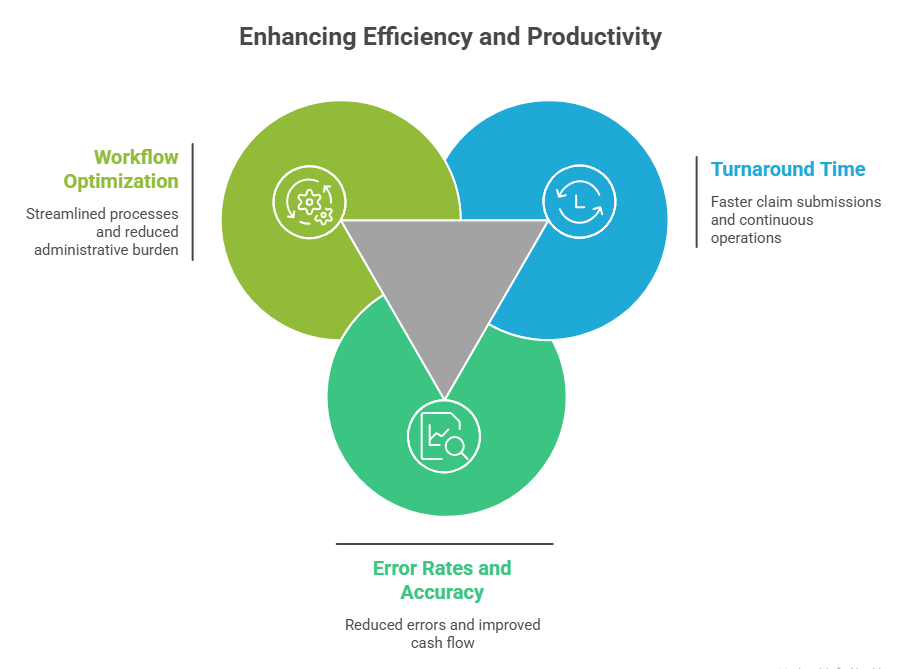
Efficiency directly impacts revenue cycles, claim turnaround times, and overall patient satisfaction. Both virtual and in-house models aim to optimize workflows, but they differ in execution. Understanding how each approach affects productivity is essential for operational success.
1. Turnaround Time
Virtual assistants often work across multiple time zones, enabling near 24/7 billing operations. This allows faster claim submissions and continuous workflow cycles. As a result, practices may experience quicker reimbursements.
2. Error Rates and Accuracy
Medical billing error rates can range from 5–10% depending on the system and expertise level. Specialized virtual assistants often reduce errors due to focused experience. Improved accuracy leads to fewer claim denials and better cash flow.
3. Workflow Optimization
Virtual assistants streamline processes using automation tools and digital tracking systems. They help optimize claim management, reminders, and reporting workflows. This results in improved efficiency and reduced administrative burden.
Compliance and Security Considerations

Maintaining compliance and protecting patient data are critical priorities in healthcare billing operations. Both virtual assistants and in-house teams must adhere to strict regulatory standards. However, the approach to risk management and data security may differ.
- Both models must comply with HIPAA regulations and data protection standards.
- Virtual assistants require secure systems such as VPNs and encrypted platforms.
- In-house staff provides more direct oversight and controlled environments.
- Certification ensures up-to-date knowledge of billing codes and compliance rules.
- Vendor vetting and contractual agreements are essential for outsourced services.
Scalability and Flexibility
Healthcare practices often experience fluctuations in patient volume and billing workload, making scalability a key consideration. Virtual assistants provide a flexible model that adapts quickly to changing needs. This adaptability can significantly improve operational efficiency.
- Virtual assistants allow rapid scaling of billing support during peak periods.
- Practices can reduce workload costs during slower seasons without layoffs.
- The American Medical Association highlights ongoing administrative staffing shortages.
- Remote hiring removes geographic limitations and expands talent access.
- Flexible staffing improves cost control and operational agility.
Training and Certification

Proper training and certification ensure accuracy, compliance, and efficiency in medical billing processes. Both virtual assistants and in-house staff must meet industry standards. Continuous learning is essential due to frequent regulatory updates.
1. Required Skills
Medical billing professionals need strong knowledge of ICD-10 and CPT coding systems, along with insurance policies. They must be proficient in EHR and billing software platforms. Attention to detail and analytical skills are critical for minimizing errors.
2. Certification Options
Common certifications include Certified Professional Biller (CPB) and Certified Coding Specialist (CCS). These credentials validate expertise and improve credibility in the field. Certified professionals are often more accurate and efficient.
3. Courses and Learning Paths
A medical billing virtual assistant course typically covers coding systems, claims processes, and compliance standards. Training programs also include software usage and real-world case scenarios. Continuous education ensures professionals stay updated with industry changes.
Tax and Legal Implications
Understanding tax and legal considerations is essential when choosing between virtual assistants and in-house staff. Each model has different financial and regulatory obligations. Proper planning helps avoid compliance issues and unexpected costs.
- Virtual assistants are typically independent contractors rather than employees.
- Practices are not required to provide benefits or pay payroll taxes for contractors.
- U.S. businesses must issue Form 1099 for eligible contractors.
- International hires may involve additional tax and compliance requirements.
- Legal agreements like Business Associate Agreements (BAA) are essential.
Choosing the Right Billing Model for Your Practice

Selecting between a virtual assistant and in-house staff depends on your practice’s size, budget, and operational complexity. Both options offer distinct advantages, and the right choice often aligns with your long-term growth strategy. Evaluating workflow needs and financial goals will help determine the most effective solution.
1. When a Virtual Assistant Is Ideal
Virtual assistants are best suited for small to mid-sized practices and startups seeking cost efficiency. They are also ideal for rapidly growing clinics needing scalable billing support. Their flexibility allows practices to adapt quickly without heavy overhead.
2. When In-House Staff Is Better
In-house staff is more suitable for large healthcare organizations with complex workflows. They provide real-time collaboration and stronger internal communication. This model works well for practices requiring constant onsite coordination.
How Virtual Assistants Help in Medical Billing
A medical biller virtual assistant plays a vital role in streamlining healthcare billing operations by managing complex tasks with accuracy and efficiency. With specialized billing knowledge and digital tools, medical virtual assistants reduce administrative workload and improve revenue cycle performance. By supporting consistent workflows and compliance standards, they help practices maintain financial stability.
- Medical biller virtual assistants handle end-to-end claim processing, ensuring timely submissions and faster reimbursements.
- They reduce billing errors through accurate coding practices and regular claim audits.
- They manage patient billing inquiries and maintain clear communication regarding payments and insurance coverage.
- They assist in denial management by identifying issues and resubmitting corrected claims efficiently.
- They generate detailed reports and analytics to help practices track financial performance and optimize billing strategies 24/7.
- They improve workflow efficiency by organizing billing data and maintaining consistent documentation processes.
TaskVirtual: Your Partner in Medical Billing Assistance

Managing medical billing operations, insurance claims, and patient records can be overwhelming for healthcare providers juggling clinical responsibilities. From ensuring accurate coding to tracking reimbursements and handling denials, billing tasks demand precision, time, and expertise. TaskVirtual offers specialized medical billing virtual assistant services designed to streamline your revenue cycle and reduce administrative stress.
1. Expert Consultation and Review
TaskVirtual’s experienced virtual assistants support healthcare providers by managing claims, verifying insurance details, and ensuring accurate coding practices. They also assist in auditing billing workflows and identifying inefficiencies to improve reimbursement rates.
2. Affordable and Flexible Pricing
Hiring in-house billing staff can be costly, but TaskVirtual offers budget-friendly solutions with pricing plans starting from just $3.12/hour to $14.99/hour. This flexible structure allows practices to scale services according to their billing volume and needs.
3. Comprehensive Medical Billing Solutions
From claim submission and denial management to payment posting and reporting, TaskVirtual provides end-to-end billing support. Their services are scalable, making them suitable for small clinics as well as growing healthcare organizations.
4. Ongoing Support and Quality Assurance
TaskVirtual ensures consistent billing accuracy through continuous monitoring, updates, and proactive follow-ups. Their assistants provide regular reports and maintain communication to ensure smooth billing operations.
5. Proven Track Record of Excellence
With 364 positive reviews and a 4.7-star rating on trusted VA platforms, TaskVirtual is recognized as a reliable partner in virtual assistance. Healthcare providers trust their expertise to improve billing efficiency and reduce operational costs.
FAQ Section
1. What is a medical biller virtual assistant?
A remote professional who manages billing, coding, and insurance claims for healthcare providers.
2. Are virtual medical billing assistants secure?
Yes, if they comply with HIPAA and use secure systems like VPNs and encrypted software.
3. How much does a medical billing virtual assistant cost?
Costs range from $6 to $50 per hour, depending on location and expertise.
4. Do virtual assistants need certification?
While not always required, certifications like CPB improve credibility and accuracy.
5. Can I hire virtual assistants for medical billing jobs full-time?
Yes, many providers offer full-time or dedicated virtual assistant services.
6. What’s better: virtual or in-house billing staff?
It depends on your practice size, budget, and operational needs—both have clear advantages.
Conclusion + CTA
Choosing between a medical biller virtual assistant and in-house billing staff ultimately comes down to balancing cost, efficiency, and operational control. Virtual assistants offer flexibility, scalability, and reduced overhead, making them ideal for modern, growth-focused practices, while in-house teams provide direct supervision and seamless collaboration for more complex environments.
To make the right decision, evaluate your current billing challenges, budget constraints, and long-term goals. If you’re aiming to streamline operations and reduce costs, exploring virtual billing solutions or a hybrid approach could significantly improve your practice’s financial performance.
 Siddhartha Basu is a Technical Writer at Task Virtual. He loves online games, e-book reading, and Yoga.