Contents
show
Virtual Assistant for Creative Entrepreneurs: Tasks and Benefits
Creative entrepreneurs in the United States—designers, writers, photographers, content creators, coaches, and independent makers – face a constant tension. They thrive on original ideas, client relationships, and artistic output, yet administrative overload steals hours that should fuel growth. A virtual assistant for creative entrepreneurs offers a practical solution that aligns with the rise of remote work, AI-augmented tools, and flexible staffing models in 2026. This approach lets U.S.-based creatives reclaim time without the overhead of full-time hires, turning scattered freelancers into scalable operators.
According to Upwork’s Freelance Forward research, 64 million Americans performed freelance work in 2023, representing 38% of the U.S. workforce and contributing approximately $1.27 trillion in annual earnings. Many of these independents operate in creative fields where billable time directly drives income. Pair that reality with findings that entrepreneurs often devote roughly 36% of their workweek to administrative tasks, and the support case becomes clear. A tech virtual assistant for creative entrepreneurs—or a specialized virtual assistant creative entrepreneurs rely on—handles the operational load so the principal can stay in the creative zone.
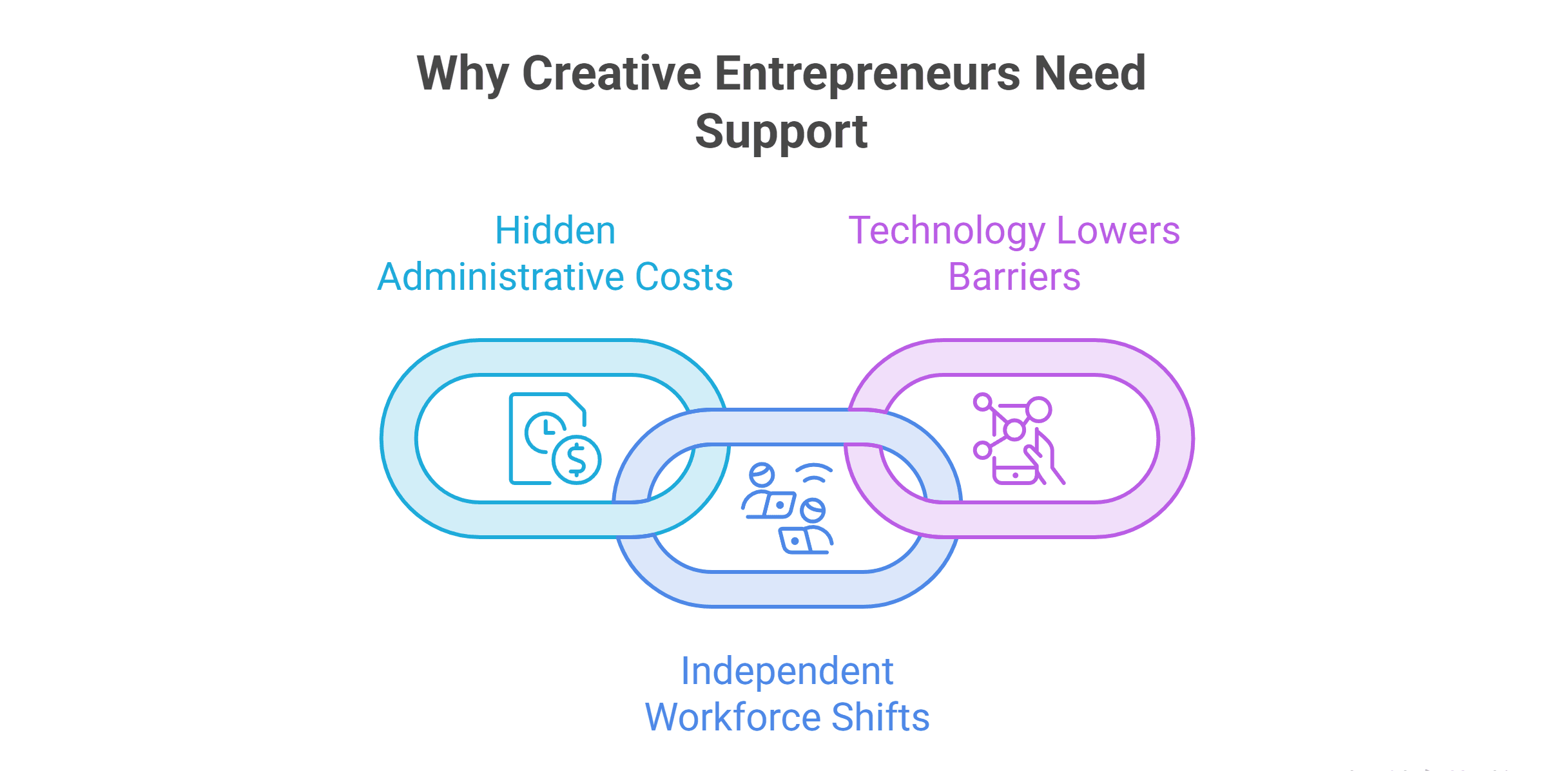
Why Creative Entrepreneurs Need Support Now
Creative work demands deep focus, yet the business side multiplies interruptions through email, invoices, and client logistics. Pew Research Center data show that self-employed workers report higher overall job satisfaction than other U.S. workers – 62% say they are extremely or very satisfied, compared with 51% of non-self-employed workers – yet the administrative burden still erodes that advantage. A virtual assistant for creative entrepreneurs removes this friction so creators can protect the focused time that sustains both income and fulfillment.
1. The Hidden Cost of Doing Everything Yourself
When a photographer spends mornings chasing late payments or a designer updates project trackers instead of refining concepts, the opportunity cost compounds rapidly across weeks and months. Surveys of entrepreneurs consistently place administrative time in the 16–20-hour range per week for many small operators, amounting to nearly half of a full-time role spent on non-creative work. Over a year, the lost capacity can exceed the cost of professional support and reduce both revenue potential and personal well-being.
Creative entrepreneurs also face irregular income cycles and seasonal demand spikes that make permanent staff risky and inflexible. A virtual assistant matches hours to actual need, allowing the principal to scale support only when project volume justifies it. This flexibility preserves cash flow while still delivering the operational reliability required for consistent client delivery.
2. Shifts in the Independent Workforce
The U.S. independent workforce continues expanding as more professionals choose autonomy over traditional employment structures. Bureau of Labor Statistics data track millions of unincorporated self-employed workers across nonagricultural industries, reflecting a structural preference for flexible work arrangements. Creative fields show especially high rates of freelancing, where the ability to control schedules and project selection remains a primary draw.
Upwork research further notes that nearly half of freelancers provide skilled knowledge services, a category that includes marketing, design, writing, and consulting. These professionals increasingly treat virtual support as standard infrastructure rather than a luxury, integrating it into their operating systems the same way they adopt crm & project management software or accounting tools. The result is a more professional and sustainable independent practice.
3. Technology Lowers the Barrier
Modern tools – project management platforms, shared drives, secure password managers, and communication apps – make remote collaboration seamless across distances and time zones. A tech virtual assistant for creative entrepreneurs can operate effectively while integrating with the same systems the principal already uses daily. This shared infrastructure reduces onboarding friction and allows specialized assistants to handle both routine admin and light technical or marketing tasks without constant supervision.
The combination of accessible software and experienced remote talent means U.S. creatives no longer need local hires or expensive office setups to gain reliable operational support. Clear documentation and secure access protocols further streamline the working relationship, turning geographic distance into a minor detail rather than a barrier.
Core Tasks a Virtual Assistant Handles for Creatives

The most effective pairings match the assistant’s strengths to the entrepreneur’s highest-friction activities. Common categories include operations, client experience, marketing support, and light research or content coordination. Clear process documentation ensures consistent quality across these areas while freeing the principal for higher-value creative work.
1. Administrative and Operational Support
- Inbox management and prioritization of incoming messages
- Calendar coordination and meeting scheduling
- Expense logging and basic bookkeeping entries
- Invoice preparation and payment follow-up to streamline financial operations
- Digital file organization and project folder maintenance
2. Client Communication and Onboarding
- Responding to initial inquiries with brand-aligned messaging
- Scheduling discovery calls and sending confirmation details
- Distributing contracts, questionnaires, or intake forms
- Managing follow-up sequences after proposals or meetings
- Maintaining CRM updates for client status and history
3. Marketing and Social Media Coordination
- Scheduling approved posts across platforms
- Gathering and organizing content assets for campaigns
- Tracking basic engagement metrics and reporting trends
- Coordinating with freelancers or agencies on deliverables
- Maintaining content calendars and publication timelines
4. Research, Project Coordination, and Light Technical Help
- Conducting competitive or vendor research under clear guidelines
- Tracking project deadlines and updating status boards
- Collecting client feedback and organizing revision notes
- Sourcing images or assets within defined parameters
- Performing basic website or tool updates as directed
Measurable Benefits for U.S. Creative Businesses
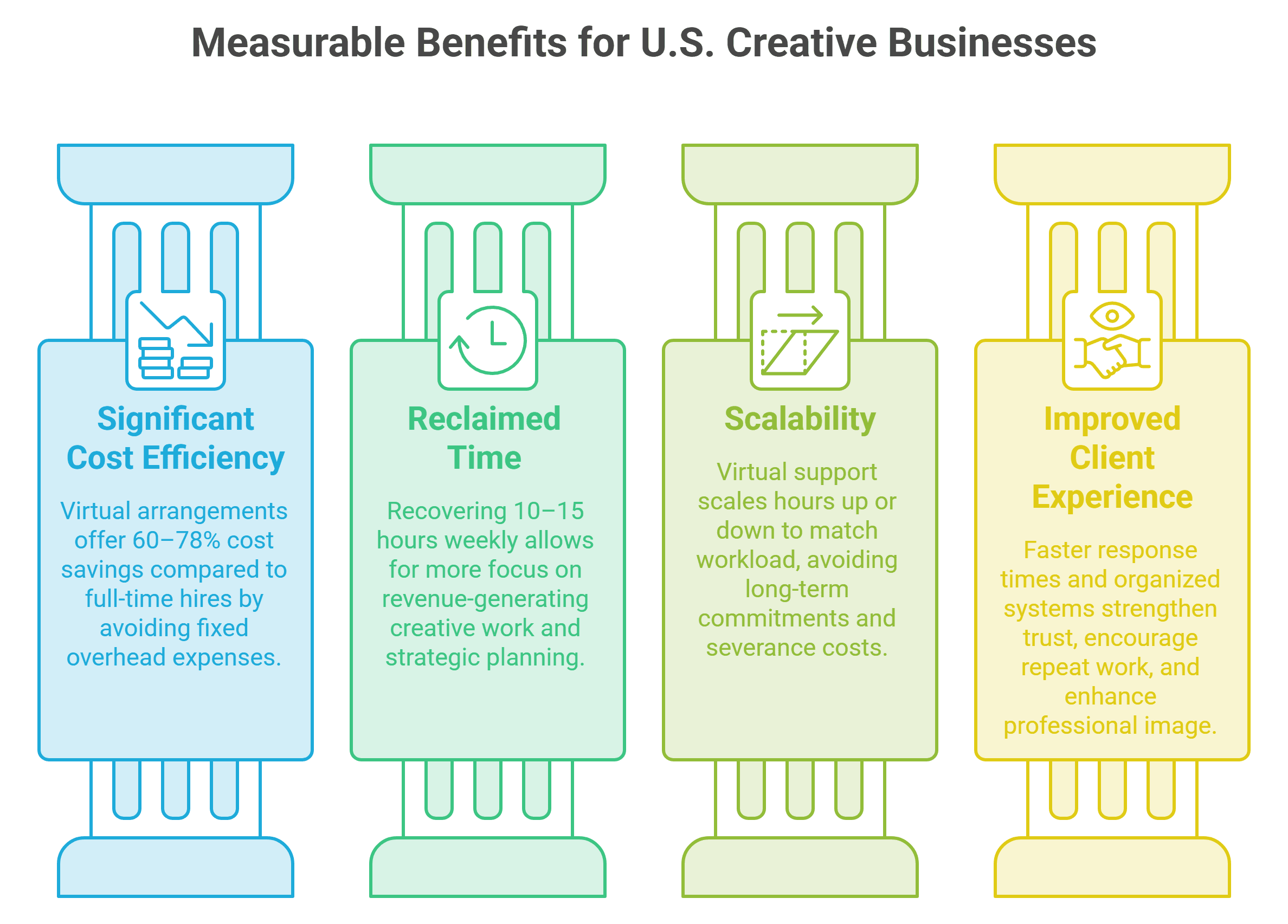
Delegation produces both financial and qualitative returns that compound over time. Cost savings appear first, followed by reclaimed hours that convert into higher-value output and stronger client relationships. These gains help creative entrepreneurs build more resilient and scalable practices without proportional increases in overhead.
1. Significant Cost Efficiency Versus Full-Time Staff
Hiring an in-house administrative employee brings salary, benefits, payroll taxes, equipment, and workspace costs that quickly escalate the total expense. Virtual arrangements typically avoid most of those fixed costs while still delivering reliable support for core operational needs. Industry analyses of virtual assistant services report average cost savings in the 60–78% range compared with equivalent U.S. full-time hires when overhead is included.
For a creative entrepreneur billing at $100–$250 per hour, the math strongly favors outsourcing non-core work. The difference between paying a full-loaded salary package and a flexible hourly or package rate often frees capital that can be reinvested in marketing, tools, or personal capacity. This efficiency becomes especially valuable during slower seasons when fixed staff costs would strain cash flow.
2. Reclaimed Time for Revenue-Generating and Creative Work
Recovering even 10–15 hours weekly compounds quickly into meaningful capacity for client delivery and business development. Those hours can go toward creative production, strategic planning, or the rest that prevents burnout and sustains long-term output. Self-employed workers already report higher fulfillment; protecting creative capacity reinforces that advantage and supports continued satisfaction.
The shift from reactive task-switching to focused blocks of work improves both the quality of creative output and the speed of project completion. Many entrepreneurs find that the first month of consistent support reveals how much fragmented attention previously limited their progress. Over time, the reclaimed hours translate into higher billable capacity or the ability to take on more ambitious projects.
3. Scalability Without Long-Term Commitments
Creative businesses often experience feast-or-famine cycles driven by client demand, seasonal trends, or product launches. A virtual assistant can scale hours up during busy periods and scale down afterward, while a payroll virtual assistant can help manage payroll-related tasks without the burden of severance costs or underutilized payroll. This flexibility reduces fixed expenses and matches support levels precisely to actual workload.
Unlike permanent employees who require ongoing management and benefits regardless of volume, a virtual arrangement allows the entrepreneur to adjust support as the business evolves. The result is greater operational agility and the ability to test new service offerings or marketing initiatives without permanent staffing risk.
4. Improved Client Experience and Professional Image
Faster response times, organized project files, and consistent follow-up create a more polished and reliable operation. Clients notice when communication remains timely and details stay organized, which strengthens trust and encourages repeat work. Over time, stronger systems support better reviews, referrals, and the confidence to raise rates.
A virtual assistant who maintains brand voice and process standards effectively extends the entrepreneur’s professional presence. This consistency reduces the risk of dropped balls during high-volume periods and helps the creative practice present as more established than a purely solo operation might otherwise appear.
How to Choose and Work With a Virtual Assistant

Success depends on clear expectations, strong communication, and the right match of skills to the creative practice’s specific needs. Investing time in selection and onboarding pays dividends in reliability and reduced management overhead. The goal is a collaborative partnership rather than a purely transactional arrangement.
1. Define Needs and Prioritize Tasks
- List the 5–10 activities that consume the most non-creative time or generate the most frustration
- Rank them by impact and frequency to identify the highest-return starting points
- Document processes in simple checklists or short videos so the assistant can replicate quality
2. Evaluate Skills, Experience, and Cultural Fit
- Seek experience with creative clients and familiarity with common tools such as Google Workspace, Asana, Trello, or Canva
- Prioritize strong written communication and overlapping hours for smoother collaboration
- Request relevant samples or references to confirm understanding of visual workflows or client-facing polish
3. Set Clear Communication and Feedback Loops
- Establish preferred channels, response-time expectations, and regular check-in schedules
- Provide constructive feedback early and use shared project boards for transparency
- Treat the relationship as collaborative, so adjustments improve results over time
4. Address Security, Confidentiality, and Legal Basics
- Use NDAs, limit access to sensitive systems, and prefer contractors who understand confidentiality requirements
- Clarify independent-contractor status under U.S. tax rules to maintain proper classification
- Choose platforms or agencies that handle basic background checks and compliance when available
Integrating Technology and AI With Human Support
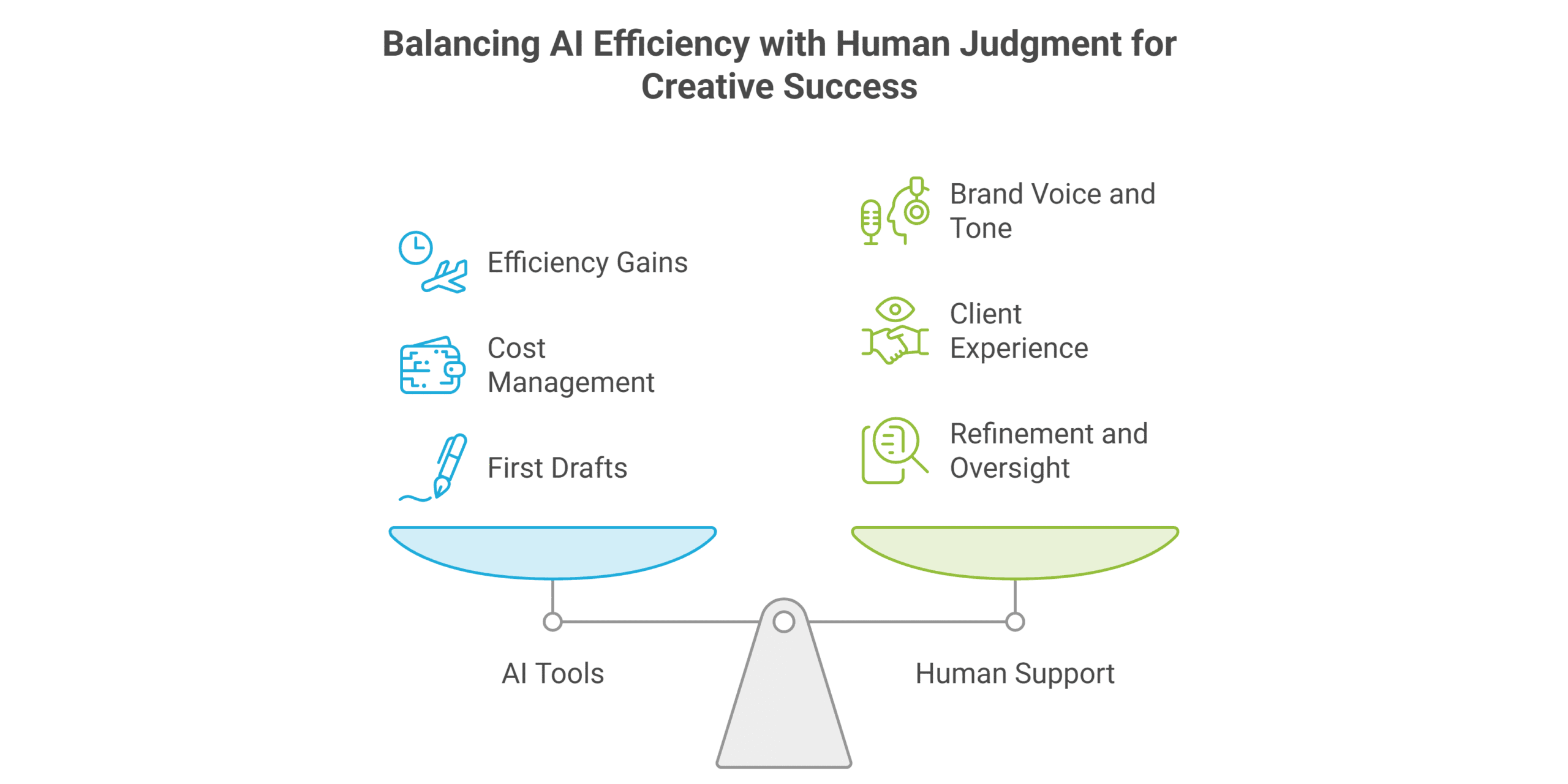
A pure AI tool cannot replace judgment, brand voice, or relationship management, yet the combination multiplies results when guided by a capable human. A tech virtual assistant for creative entrepreneurs can supervise AI outputs, refine drafts, manage tools, and handle exceptions that require context. This hybrid model keeps costs manageable while maintaining human oversight where quality and client experience matter most.
1. Practical Hybrid Workflows
An assistant might use AI for first-draft email replies or social captions, then edit carefully for tone, accuracy, and brand alignment before anything reaches a client or public channel. The same person can monitor automated scheduling tools and intervene when a client needs personal attention or when an exception arises that software cannot resolve. Clear guidelines and review checkpoints prevent over-reliance on automation while still capturing efficiency gains from the technology. This layered approach allows the creative entrepreneur to benefit from speed without sacrificing the personal touch that clients value, and it creates a repeatable system that improves with each iteration of feedback.
2. Future-Proofing the Creative Practice
As AI implementation expands, the value of a skilled human coordinator who understands both technology and the creative process will continue to grow. Entrepreneurs who build these hybrid systems early position themselves for sustained focus on high-value work rather than constant operational firefighting. The combination of human judgment and intelligent tools creates a durable advantage that pure automation or pure manual effort alone cannot match. Over time, this integrated support structure helps the practice adapt to new platforms, tools, and client expectations with less disruption and greater confidence.
Common Challenges and How to Overcome Them
Delegation can feel uncomfortable at first because many creatives worry about loss of control or inconsistent quality. Starting with a limited set of well-documented tasks builds trust gradually and demonstrates results before expanding the scope. Measuring time savings and output quality after the first month provides objective feedback that reduces emotional resistance.
Under-communication of brand standards is another frequent issue that can be solved by investing time up front in style guides, examples, and written processes. Tracking the investment against reclaimed hours and improved client metrics keeps the arrangement data-driven rather than based on gut feeling. With clear expectations and regular feedback, most challenges diminish quickly, and the partnership becomes a reliable part of the creative practice.
TaskVirtual: Reliable Virtual Support for Creative Entrepreneurs
Creative entrepreneurs often juggle client projects, content calendars, invoices, and daily operations while trying to protect focused creative time. TaskVirtual delivers specialized virtual assistant services designed to handle the administrative and operational load so designers, writers, photographers, and independent makers can stay centered on high-value work. Their team supports the exact types of tasks outlined throughout this guide, from inbox management and client onboarding to marketing coordination and light project tracking.
1. Tailored Assistance for Creative Workflows
TaskVirtual’s virtual assistants help manage email prioritization, calendar coordination, invoice follow-ups, and CRM updates while learning the brand voice and preferred tools of each creative practice. They also assist with content asset organization, social scheduling under clear guidelines, and basic research or status tracking so the entrepreneur can maintain momentum on deliverables without constant context switching.
2. Affordable and Flexible Pricing
Hiring a full-time administrative hire can be expensive, but TaskVirtual makes dedicated support cost-effective. With pricing plans starting from just $3.12/hour to $14.99/hour, their services remain accessible for solo creatives and growing independent practices that need scalable help without long-term overhead.
3. Full-Spectrum Operational Coverage
From creating organized project folders and preparing client onboarding materials to coordinating marketing calendars and handling recurring administrative routines, TaskVirtual covers the core support areas creative entrepreneurs need most. Their flexible model adapts whether the requirement is a few focused hours each week or more consistent coverage during busy seasons.
4. Consistent Quality and Proactive Communication
TaskVirtual emphasizes clear updates, process adherence, and timely reminders so nothing falls through the cracks. Their approach aligns with the communication and feedback practices recommended for successful virtual assistant partnerships, helping maintain professional standards and client experience.
5. Proven Track Record of Excellence
With 364 positive reviews and a 4.7-star rating on trusted VA platforms, TaskVirtual is recognized as a reliable partner worldwide. Clients count on their expertise to streamline administrative burdens and free creative capacity for the work that drives growth and fulfillment.
FAQ
1. What does a virtual assistant for creative entrepreneurs typically cost?
Rates vary by location, experience, and specialization. Many U.S. or nearshore assistants charge $15–$40 per hour for general support, with specialized creative experience commanding higher rates. Monthly packages or retainers are common.
2. How many hours should I start with?
Begin with 5–10 hours per week focused on the highest-friction tasks. Expand once systems and trust are established.
3. Can a virtual assistant handle creative tasks like design or writing?
Some can support light design, caption writing, or research under clear direction. Core creative direction and final approval usually remain with the entrepreneur.
4. Is a virtual assistant better than software tools alone?
Tools handle automation; a human assistant manages exceptions, relationships, and judgment calls that software cannot. The combination works best.
5. How do I protect client data when working remotely?
Use secure shared drives with limited permissions, password managers, NDAs, and two-factor authentication. Prefer assistants experienced with confidential information.
6. Will hiring a virtual assistant hurt my creative brand?
When the assistant is properly trained on voice and standards, the opposite occurs: clients experience more consistent professionalism and faster service.
Conclusion
A virtual assistant for creative entrepreneurs is a practical lever that converts administrative drag into focused creative capacity, cost efficiency, and better client experiences. With freelancing already representing a major share of the American workforce and self-employed professionals reporting higher job satisfaction, the infrastructure for support is mature.
Start by auditing your week to identify the tasks that drain energy without requiring your unique talent. Document one or two processes, test a part-time arrangement, and measure the hours returned along with the quality of output. Reclaiming even a fraction of the time currently lost to admin can transform both business results and the creative experience that drew you to entrepreneurship.
Sources
- Upwork Freelance Forward research and press releases on U.S. freelancers (2023 data: 64 million freelancers, 38% of workforce, $1.27 trillion contribution).
- Pew Research Center analyses of self-employed job satisfaction (2023 and 2024 surveys).
- U.S. Bureau of Labor Statistics Current Population Survey data on self-employed and class-of-worker statistics.
- Time etc entrepreneur surveys on administrative time allocation (approximately 36% of workweek).
- Grand View Research and related market analyses on virtual assistant and intelligent virtual assistant market sizing and growth projections.
For more such content, visit our website.
 Siddhartha Basu is a Technical Writer at Task Virtual. He loves online games, e-book reading, and Yoga.