Contents
show
How Medical Scribe Virtual Assistants Reduce Physician Burnout
Physicians in the United States face an ongoing crisis, with nearly 42% reporting at least one symptom of burnout in 2025. Administrative tasks, especially electronic health record documentation, remain a primary driver of this issue. Medical scribe virtual assistants address this burden directly by handling real-time or asynchronous documentation.
These remote professionals and virtual medical scribe assistant services free physicians to focus on patients rather than keyboards. Remote medical scribe solutions offer scalable and cost-effective relief compared to in-person staff. In an era of clinician shortages, they represent a practical high-ROI intervention for sustainable healthcare.
The Physician Burnout Crisis in America
Physician burnout continues to challenge the U.S. healthcare system despite some recent improvements. High administrative loads contribute heavily to emotional exhaustion and reduced job satisfaction. Virtual medical scribe services provide a targeted solution to restore balance.
1. Scope and Trends of Burnout
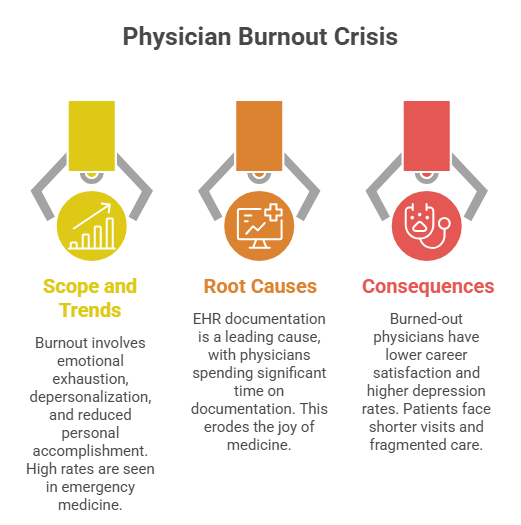
Physician burnout involves emotional exhaustion, depersonalization, and reduced personal accomplishment. In 2025, AMA surveys showed 41.9% of physicians experiencing at least one burnout symptom. Specialties like emergency medicine report the highest rates, highlighting the widespread nature of the issue.
2. Root Causes: Administrative Overload
EHR documentation stands as a leading culprit behind physician burnout. Primary care physicians spend a median of 36.2 minutes on the EHR per visit, including after-hours pajama time. Physicians often log 1-2 additional hours nightly on documentation, eroding the joy of medicine.
3. Consequences for Physicians, Practices, and Patients
Burned-out physicians experience lower career satisfaction and higher depression rates. Turnover costs practices tens of thousands of dollars in recruitment and lost revenue. Patients face shorter visits, reduced empathy, and fragmented care as a result.
Understanding Medical Scribe Virtual Assistants

Medical scribe virtual assistants help ease the documentation workload that contributes to physician burnout. These services use trained professionals or hybrid AI-human models to capture patient encounter details accurately. Virtual medical scribe assistant services provide flexible support tailored to modern healthcare needs.
- A medical scribe virtual assistant remotely documents patient encounters in real-time via audio or video.
- They also handle asynchronous documentation from recordings or notes for greater flexibility.
- Medical virtual scribe assistant services capture HPI, ROS, physical exams, assessments, and plans.
- Remote medical scribes differ from traditional in-clinic scribes by working from anywhere with lower overhead.
- These solutions emphasize HIPAA compliance, specialty-specific training, and seamless EHR integration.
- Virtual options scale easily while maintaining high-quality documentation standards.
- Many providers now blend human expertise with AI for optimal efficiency and accuracy.
How Virtual Medical Scribes Alleviate Documentation Burden
Virtual medical scribe assistant services directly tackle the administrative overload driving physician burnout. By managing charting tasks, they allow doctors to reclaim valuable time during and after patient visits. Remote medical scribe solutions integrate smoothly into existing workflows for measurable relief.
1. Reducing EHR Time and Pajama Hours
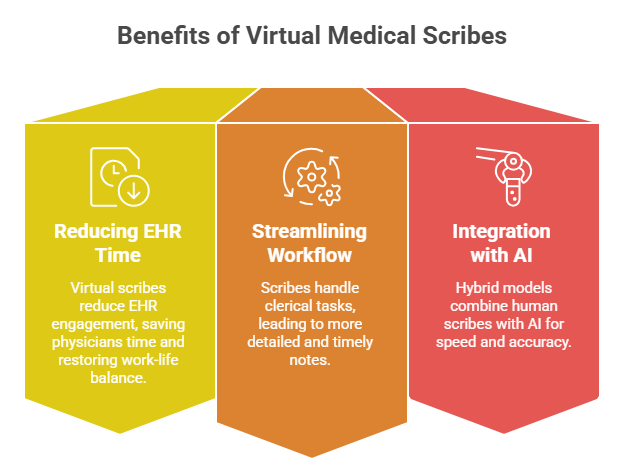
Virtual scribes significantly cut EHR engagement for busy physicians. One study found a mean of 5.6 minutes less total EHR time per appointment with virtual scribe use. This also reduces note time and after-hours pajama time, helping restore work-life balance.
2. Streamlining Workflow and Note Quality
Scribes handle clerical tasks and enable real-time charting during encounters. This approach leads to more detailed, accurate, and timely notes. Team-based documentation can reduce note completion time and support higher visit volumes.
3. Integration with AI for Hybrid Efficiency
Many services combine human scribes with ambient AI listening technology. This hybrid model delivers both speed and clinical accuracy. AI-enhanced tools have demonstrated notable reductions in physician burnout rates across multiple studies.
Proven Impact on Reducing Physician Burnout
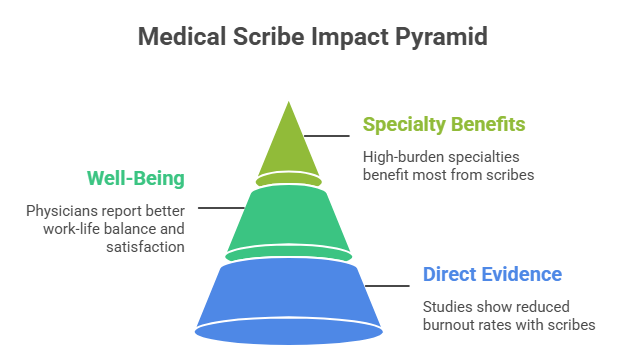
Medical scribe virtual assistants deliver measurable improvements in physician well-being and satisfaction. Research consistently shows reduced burnout symptoms when documentation support is implemented effectively. Remote medical scribe services provide sustainable relief across various practice settings.
1. Direct Evidence from Studies
A University of Wisconsin study linked remote scribes to a 27% lower burnout rate in primary care. Multicenter AI scribe research reported significantly lower odds of burnout after one month of use. Mass General Brigham data revealed a substantial absolute reduction in burnout prevalence.
2. Broader Well-Being Improvements
Physicians using virtual scribes report better work-life balance and reduced stress levels. Many experience higher job satisfaction after the documentation burdens decrease. Up to 65% of doctors note improved overall well-being with consistent scribe support.
3. Specialty-Specific Benefits
High-burden specialties such as primary care, emergency medicine, and oncology benefit most. Virtual solutions work particularly well for telemedicine and distributed care teams. Remote medical scribe options adapt flexibly to specialty-specific documentation needs.
Productivity, Revenue, and Financial ROI
Saved documentation time from medical scribe virtual assistants translates into meaningful productivity gains for practices. Physicians can see more patients without extending their workdays when a medical virtual assistant decreases the administrative loads. Virtual medical scribe assistant services also improve coding accuracy and support better revenue capture. These efficiencies create strong financial returns while reducing costly physician turnover.
Practices achieve substantial ROI through lower overhead compared to in-person scribes and reduced recruitment expenses. Hybrid remote medical scribe models often deliver payback within the first year of implementation. Enhanced efficiency aligns well with value-based care requirements and long-term sustainability goals. Overall, investing in these services strengthens both clinical and financial performance for U.S. healthcare organizations.
Enhancing Patient Experience and Care Quality
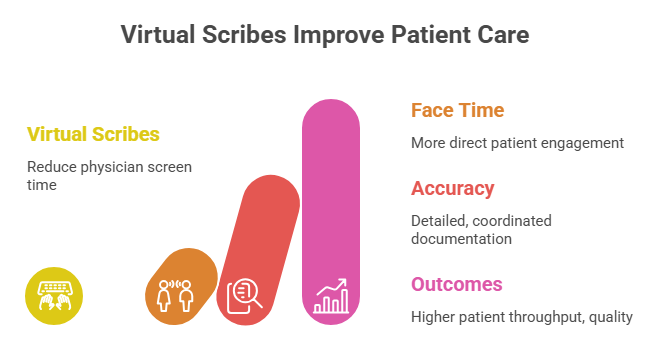
Virtual medical scribe services improve care delivery by reducing physician screen time during visits. This shift allows doctors to build stronger connections with patients while maintaining thorough documentation. Remote medical scribe solutions ultimately support higher-quality interactions and better health outcomes.
1. More Face Time and Better Interactions
Physicians engage more directly with patients when documentation is handled externally. Reduced screen time leads to improved communication and higher patient satisfaction scores. Patients often perceive visits as more personal and attentive with scribe support.
2. Accuracy, Continuity, and Trust
Detailed notes prepared by virtual scribes enhance care coordination across providers. Accurate documentation supports continuity and strengthens patient trust in the process. Privacy measures ensure patients feel comfortable with the scribe’s involvement.
3. Outcomes Data
Scribe programs increase patient throughput without harming satisfaction levels. Better access to care emerges as practices handle higher volumes efficiently. Overall care quality improves through more focused physician attention and comprehensive records.
Implementing Medical Virtual Scribe Assistant Services Successfully
Successful adoption of medical scribe virtual assistants requires careful planning and provider selection. Practices benefit from starting with pilot programs to evaluate the impact on workflow and burnout. Virtual medical scribe assistant services offer scalable options suitable for both large systems and smaller clinics.
- Evaluate HIPAA compliance, EHR integration capabilities, and specialty training when choosing providers.
- Request trial periods or demos to test real-world performance with your team.
- Provide proper training on new workflows and efficient note editing processes.
- Monitor key performance metrics, including EHR time, burnout scores, and productivity gains through tools
- Combine human virtual scribes with AI tools for the best balance of accuracy and speed.
- Address patient privacy concerns transparently and obtain appropriate consent.
- Work closely with vendors to resolve any initial integration or workflow challenges.
The Future of Virtual Scribing in Healthcare
Advancements in AI ambient listening, predictive documentation, and seamless EHR integration will continue expanding capabilities. Hybrid models blending human expertise with technology will likely dominate the field. Regulatory efforts to reduce administrative burden further support broader adoption of medical scribe virtual assistants and remote medical scribe solutions across American healthcare.
How Virtual Assistants Help in Medical Scribe Service

Virtual assistants play a vital role in modern medical scribe services by providing specialized remote documentation support. They help reduce the heavy administrative load on physicians, enabling better focus on patient care and lowering burnout risk. TaskVirtual and similar professional services deliver trained, HIPAA-compliant virtual medical scribe assistants tailored to U.S. healthcare practices.
- Virtual assistants handle real-time or asynchronous charting of patient encounters, including HPI, ROS, physical exams, and care plans.
- They integrate seamlessly with major EHR systems like Epic and Cerner while ensuring accurate and compliant documentation.
- Medical scribe virtual assistants manage after-hours pajama time tasks, freeing physicians for better work-life balance.
- They support hybrid AI-human workflows that combine speed with clinical precision for high-quality notes.
- Virtual assistants enable scalable solutions suitable for solo practices, clinics, and large health systems.
- They improve overall productivity by allowing physicians to see more patients without extending their workday.
TaskVirtual: Your Partner in Medical Scribe Virtual Assistant Services

Physicians overwhelmed by EHR documentation and rising burnout need dependable support. Medical scribe virtual assistants can transform how practices handle patient notes, but finding the right service is crucial. TaskVirtual delivers expert medical scribe virtual assistant services that reduce documentation time, improve accuracy, and help lower physician burnout effectively.
1. Expert Consultation and Review
TaskVirtual’s trained virtual medical scribe assistants handle real-time and asynchronous documentation, capture detailed patient encounters, and ensure seamless EHR integration through a virtual assistant. They manage HPI, ROS, assessments, plans, and specialty-specific requirements with high accuracy.
2. Affordable and Flexible Pricing
Hiring a full-time scribe can be expensive, but TaskVirtual makes it cost-effective. With pricing plans starting from just $3.12/hour to $14.99/hour, their medical scribe virtual assistant services are budget-friendly and accessible for solo practices, clinics, and large healthcare organizations.
3. Comprehensive Medical Scribe Support Solutions
From real-time charting during visits to post-encounter asynchronous notes and after-hours pajama time reduction, TaskVirtual covers it all. Their scalable services adapt to your workflow, whether you need occasional or full-time virtual scribe support.
4. Ongoing Support and Quality Assurance
TaskVirtual provides continuous monitoring, note review, document processing, and proactive adjustments to maintain documentation quality. Their support ensures compliance, accuracy, and minimal physician editing time for stress-free implementation.
5. Proven Track Record of Excellence
With 364 positive reviews and a 4.7-star rating on trusted VA platforms, TaskVirtual is recognised as a reliable partner worldwide. Clients count on their expertise to deliver high-quality medical scribe virtual assistant services and reduce physician burnout.
Conclusion
Medical scribe virtual assistants, remote medical scribe solutions, and virtual medical scribe assistant services offer a proven way to combat the administrative drivers of physician burnout. By reclaiming hours spent on documentation, they restore focus to patient care and improve well-being. These tools also boost productivity and enhance financial sustainability for practices across America.
As burnout rates remain a concern, investing in these solutions becomes essential for the future of medicine. Practices adopting the virtual scribe position position themselves for better retention and higher-quality care. Contact a reputable provider today to begin reducing burnout and reclaiming the joy of practicing medicine.
Sources
- American Medical Association (AMA) Physician Burnout Reports (2025-2026 data).
- JAMA Network Open and related studies on scribes/AI documentation.
- Annals of Internal Medicine and other peer-reviewed time-motion studies.
- University of Wisconsin, Mass General Brigham, and multicenter scribe research.
- Additional data from the Physicians Foundation, MGMA-aligned reports, and ROI analyses.
For more such content, visit our website.
 Siddhartha Basu is a Technical Writer at Task Virtual. He loves online games, e-book reading, and Yoga.