

Contents
show
Key Benefits of Hiring a Real Estate VA
A real estate virtual assistant is no longer just a remote admin who answers emails or updates spreadsheets. In 2026, the best real estate VAs support the full operating rhythm of an agent, broker, investor, property manager, or real estate team: lead follow-up, CRM hygiene, listing coordination, transaction support, marketing execution, database management, appointment setting, and client communication.
The Core Problem: Time Split Between Selling and Operations
This shift matters because the U.S. real estate business is highly relationship-driven, time-sensitive, and operationally demanding. BLS states that real estate brokers and sales agents help clients buy, sell, and rent properties, and that agents must stay current on local markets, financing options, zoning, fair housing laws, and community details. The same BLS profile also notes that many brokers and agents work irregular hours, including evenings and weekends, to accommodate client schedules. (bls.gov)
That creates a practical problem: the work that wins clients is often not the same work that keeps the business organized. A real estate professional may need to prospect, show homes, negotiate offers, attend inspections, respond to clients, update listings, manage documents, post marketing content, follow up with leads, and maintain a CRM all in the same day. Without support, valuable selling time gets buried under administrative and operational tasks.
1. Market Dynamics Favor Speed and Organization
The market also makes speed and consistency more important. NAR’s 2025 Profile of Home Buyers and Sellers reported that first-time buyers dropped to 21%, the lowest share since NAR began collecting the data in 1981, while the median first-time buyer age reached 40. That means many buyers are more cautious, affordability-sensitive, and research-driven. Agents who respond quickly, stay organized, and nurture leads carefully have a stronger chance of converting opportunities.
2. Technology Adoption Requires Consistent Execution
Technology is also reshaping real estate workflows. NAR’s 2025 REALTOR Technology Survey found that the most popular technologies used by REALTORS were eSignature at 79%, social media at 75%, and drone photography/video at 52%. The same survey found that 66% of REALTORS adopt new technology primarily to save time, and 64% adopt it to enhance the client experience. A real estate VA helps turn those tools into consistent execution instead of letting them become another set of platforms the agent has to manage alone.
Google’s official guidance for generative AI features in Search says standard SEO best practices still matter because AI Overviews and AI Mode are rooted in Google’s core ranking and quality systems. It also emphasizes helpful, reliable, people-first content. This guide is built in that spirit: clear definitions, real business use cases, practical hiring advice, contextual internal links, and source-backed statistics for U.S. real estate professionals evaluating whether a real estate virtual assistant is worth the investment.
What Is a Real Estate Virtual Assistant?
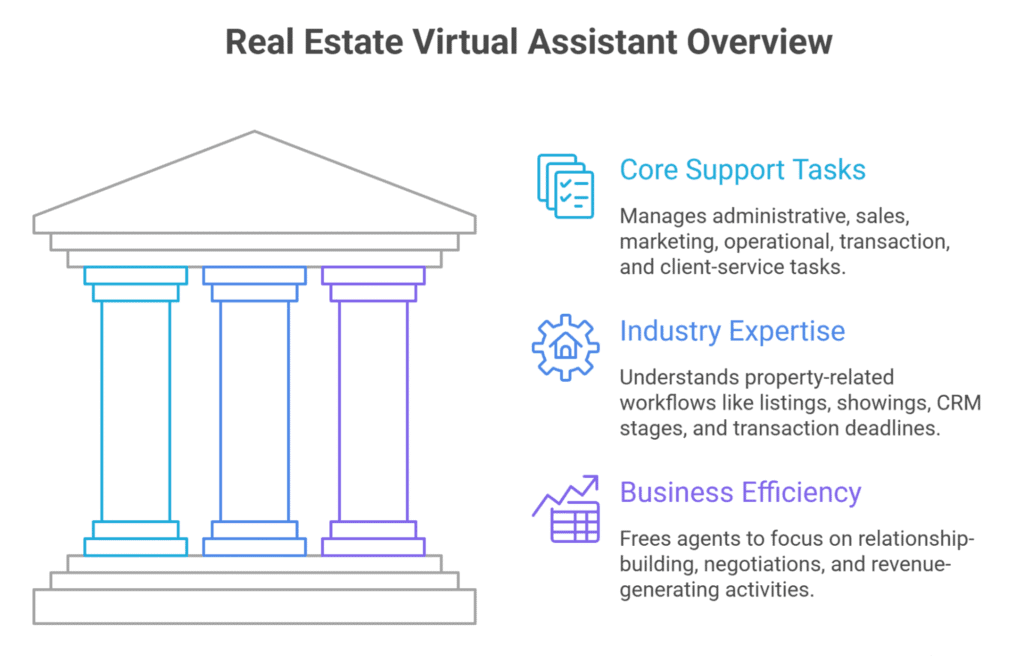
A real estate virtual assistant is a remote professional who supports real estate businesses with administrative, sales, marketing, operational, transaction, and client-service tasks. Unlike a general VA, a real estate VA understands the pace and structure of property-related work: listings, showings, open houses, buyer leads, seller follow-ups, CRM stages, transaction deadlines, MLS-related workflows, and client communication.
1. Definition of a Real Estate Virtual Assistant
A real estate virtual assistant is a remote support specialist who helps agents, brokers, property managers, real estate investors, and real estate teams manage the non-core but essential tasks that keep business moving. These tasks may include calendar management, email organization, database updates, listing coordination, lead follow-up, marketing support, appointment setting, transaction coordination, document tracking, and vendor communication.
The role can be part-time, full-time, hourly, project-based, or assigned through a managed VA company. Some real estate VAs are generalists who handle a wide mix of daily tasks. Others specialize in a narrower function, such as CRM management, transaction coordination, cold calling, blog writing, social media, data entry, or photo editing.
The most important point is that a real estate VA helps free the agent or broker to focus on relationship-building, negotiations, client advisory work, showings, listing presentations, and revenue-generating activity. A deeper explanation of benefits, tasks, and hiring can help clarify how the role fits different business models.
2. How a Real Estate VA Differs from a General VA
A general virtual assistant may be skilled in scheduling, inbox management, data entry, research, and basic business administration. A real estate VA can do many of those things, too, but they bring industry-specific context that makes the support more valuable. They may understand listing details, buyer pipelines, seller lead stages, open-house preparation, CRM tagging, appointment coordination, transaction timelines, and property marketing.
That real estate context reduces the amount of explanation needed. For example, a general VA may understand how to update a spreadsheet, but a real estate VA is more likely to understand why lead source, property interest, budget range, pre-approval status, neighborhood preference, and follow-up date matter inside a CRM. A general VA may be able to schedule calls, but a real estate VA is more likely to understand urgency around showings, inspection windows, contract deadlines, and closing coordination.
This difference becomes especially important as the business grows. When an agent handles only a few active opportunities, manual follow-up may work. As the lead database expands, listings multiply, and clients move through different stages, a real estate VA can help prevent missed details from becoming lost commissions.
3. Why Real Estate Professionals Need Remote Support
Real estate professionals need remote support because the job combines sales, service, compliance, marketing, operations, and local expertise. BLS notes that real estate brokers and sales agents must manage many business details, including advertising and billing, and that organizational skills are important because agents must manage their own time for planning and prioritizing work. (bls.gov)
The workload is also unpredictable. A quiet morning can turn into a busy afternoon with a showing request, offer deadline, inspection issue, seller question, new lead, and lender update all arriving at once. Without support, the agent becomes the bottleneck for every administrative step.
A real estate VA gives the business a support layer. That layer can maintain CRM records, track reminders, prepare listing materials, organize photos, schedule posts, update documents, and keep communication moving while the agent focuses on the activities that require licensing, judgment, negotiation, and client trust.
Key Benefits of Hiring a Real Estate Virtual Assistant
The core benefit of hiring a real estate virtual assistant is not simply “getting help.” The deeper value is building a more consistent business operation around lead management, client experience, marketing, listings, and transaction flow. When the right work is delegated, the agent gains more time for high-value activities while the business becomes less reactive.
1. More Time for Clients, Showings, and Negotiations
- A real estate virtual assistant helps agents protect more time for relationship-building, client advisory work, property showings, listing presentations, and negotiations.
- Buyers and sellers need guidance, reassurance, local insight, and timely communication, which are high-value responsibilities the agent should continue to own directly.
- A VA can handle surrounding support work such as preparing showing schedules, organizing property details, confirming appointments, sending reminders, and updating CRM notes.
- Administrative tasks before and after client meetings can be delegated so the agent is not constantly pulled into document formatting, file organization, or follow-up tracking.
- BLS notes that many brokers and sales agents work full-time, and some work more than 40 hours per week, often including evenings and weekends. (bls.gov)
- A VA cannot remove the irregular nature of real estate work, but they can reduce the routine workload competing for the agent’s attention.
- The biggest benefit is focus: the agent spends more time on licensed, client-facing, revenue-generating work and less time on repeatable administrative tasks.
- Last but not the least, some VA firms like TaskVirtual, Zirtual, Task Bullet, often offers lucrative discounts in the first purchase, and these can give an ace up one’s sleeve as one can test the skills of the Real Estate VA before committing to a particular plan.
2. Better Lead Follow-Up and CRM Discipline
- Lead follow-up is one of the most valuable areas for real estate VA support because many opportunities require multiple touches before they convert.
- A VA can update lead records, assign follow-up dates, tag lead sources, prepare call lists, send approved nurture emails, track responses, and flag hot prospects.
- Many agents do not lose opportunities because they lack market knowledge; they lose them because leads are not followed up on consistently.
- NAR’s 2025 Technology Survey found that social media was the top lead-generating technology at 39%, followed by CRM at 23% and the local MLS at 17%.
- Since real estate leads may come from social media, referrals, open houses, websites, portals, CRM forms, and local networks, database discipline becomes essential.
- A strong VA can help keep names, phone numbers, property preferences, budget ranges, timelines, referral sources, notes, and next steps organized.
- Businesses that need deeper database support can benefit from specialized CRM management handled by a trained real estate VA.
3. Lower Operating Pressure Without Adding Full-Time Staff
- Hiring a real estate VA can reduce operating pressure without requiring the cost, commitment, or management structure of a traditional full-time employee.
- This is especially useful for solo agents, small teams, and brokerages that need flexible support but are not ready for a large in-office staff.
- A business may not need a full-time local assistant, but it may need 10, 20, or 30 hours per week of reliable remote operational support.
- BLS data shows that in 2024, real estate brokers held about 111,300 jobs, real estate sales agents held about 420,900 jobs, and 54% of both groups were self-employed.
- That self-employed structure makes flexible support useful because many real estate professionals must manage both client work and business operations.
- A VA gives agents a way to add support capacity without immediately building a large in-office team.
- The real question is not only “Can I afford help?” but “What is the opportunity cost of doing every support task myself?”
Real Estate VA Tasks You Can Delegate
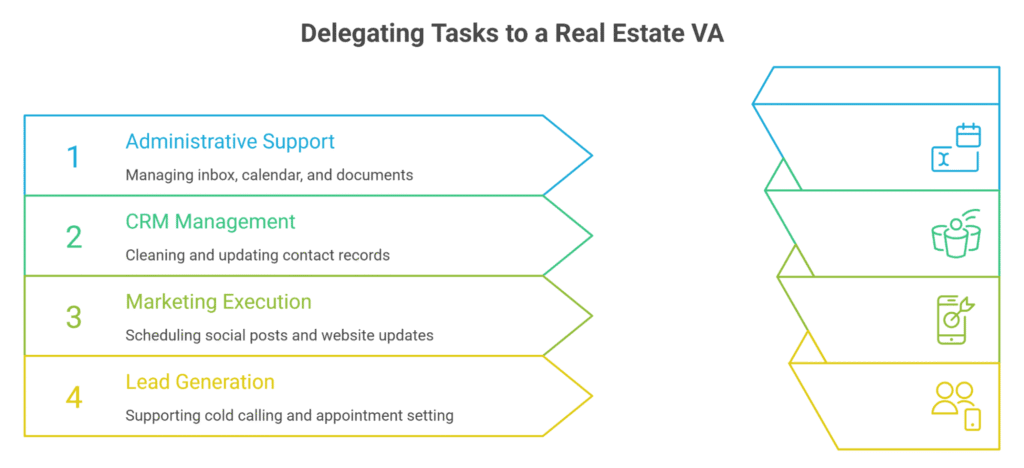
A real estate virtual assistant can handle a wide range of recurring tasks, but delegation works best when the work is clearly defined. The first tasks to delegate should be repeatable, explainable, trackable, and important enough to affect the business. Over time, the VA can move from simple task execution into workflow ownership.
1. Administrative and Listing Support Tasks
Administrative support is often the easiest starting point. A real estate VA can manage inbox organization, calendar coordination, appointment reminders, vendor scheduling, client follow-up reminders, document formatting, file organization, spreadsheet updates, and basic research.
Listing support is especially valuable because listings involve many moving parts. A VA may help gather property details, prepare listing descriptions for review, organize photos, coordinate sign installation, schedule staging or photography, confirm showing instructions, update marketing checklists, and prepare open-house materials.
The VA should not replace licensed professional judgment where licensing rules apply. Instead, they should support the workflow around the licensed work. The agent still owns pricing advice, negotiations, representation, compliance, and client strategy. The VA helps keep the operational pieces moving.
2. CRM, Data Entry, and Database Management
CRM and database management are some of the highest-impact tasks for a real estate VA. A messy database creates missed follow-ups, duplicated contacts, outdated notes, unclear lead stages, and weak marketing segmentation. A clean CRM gives agents a reliable view of who needs attention and when.
A VA can add new leads, clean duplicate records, update contact details, tag leads by source, record property preferences, assign follow-up dates, prepare pipeline reports, and segment buyers, sellers, investors, past clients, and referral partners. They can also help create recurring reminders for birthdays, home anniversaries, check-ins, and long-term nurture campaigns.
Real estate data entry may appear basic, but it is foundational. Without accurate records, marketing campaigns become generic, follow-up becomes inconsistent, and agents rely too heavily on memory. That is why real estate data entry should be viewed as an operating discipline, not a low-value chore.
3. Marketing, Blog Writing, and Online Presence
A real estate VA can support marketing execution by scheduling social posts, preparing listing promotion materials, updating website pages, organizing testimonials, formatting newsletters, repurposing blogs into social snippets, and tracking basic campaign tasks. The agent or marketing strategist should define positioning, but the VA can keep the publishing engine running.
Content support is especially important because real estate decisions are research-heavy. Buyers and sellers often search for neighborhood information, pricing trends, selling timelines, mortgage basics, staging tips, relocation guidance, and local market updates. A VA can help organize content calendars, upload articles, format drafts, source images, and coordinate approvals.
Some real estate VAs specialize in content operations. A business that wants stronger organic visibility may use a real estate blog writing service to support topical authority. Similarly, agents with listing-heavy workflows may use a real estate photo editing service to make property visuals more polished and market-ready.
4. Cold Calling and Lead Generation Support
Cold calling, appointment setting, and lead generation support can also be delegated when the VA is properly trained, and the business follows all applicable laws and platform rules. A real estate cold calling VA may call approved lead lists, confirm interest, update call outcomes, schedule appointments, and flag warm opportunities for the agent.
The goal is not to remove the agent from relationship-building. The goal is to filter and organize early-stage outreach so the agent spends more time with qualified prospects. The VA can help maintain call logs, track objections, update lead status, and ensure no potential opportunity disappears after one attempt.
Because cold calling can affect brand perception, training matters. Scripts should be clear, compliant, respectful, and aligned with the agent’s market. A dedicated guide on why a real estate cold calling VA can be useful may help teams decide whether this specialized support fits their growth strategy.
Specialized Real Estate VA Roles
Not every real estate VA does the same type of work. Some are broad administrative assistants, while others specialize in marketing, prospecting, transaction coordination, CRM management, or visual content support. Choosing the right role prevents mismatched expectations and makes hiring more efficient.
1. Real Estate Administrative Assistant
- A real estate administrative assistant handles the daily coordination work that keeps an agent or team organized.
- Common responsibilities include calendar management, email triage, appointment scheduling, file maintenance, listing checklists, client reminders, vendor coordination, and document tracking.
- This role is ideal for agents who feel constantly busy but cannot point to one specialized bottleneck.
- The assistant becomes the operational backbone for recurring tasks and helps the agent stay prepared.
- Administrative support reduces missed details and supports a more professional client experience.
- This is often the first VA role to hire because it creates immediate relief and improves daily workflow consistency.
- Once the business rhythm improves, the agent can layer on more specialized support, and a deeper explanation of a real estate administrative assistant can help clarify the role’s impact.
2. Real Estate Marketing Virtual Assistant
- A real estate marketing VA focuses on visibility, content, and lead-support workflows.
- They may manage social media calendars, upload blog posts, create basic graphics, coordinate email campaigns, organize listing assets, update website content, compile testimonials, and track campaign deliverables.
- This role is valuable because many agents understand the importance of marketing but struggle to execute consistently.
- NAR’s 2025 technology data shows that social media is widely used and important for lead generation, but consistent posting, asset management, and follow-up require operational discipline.
- A marketing VA is best used for execution rather than high-level brand strategy.
- The agent or marketing lead should define the audience, market positioning, content themes, and conversion goals.
- A real estate marketing virtual assistant can support property promotion, lead nurturing, and online visibility.
3. Virtual Transaction Coordinator
- A virtual transaction coordinator supports the administrative side of transactions from contract to close.
- Their work may include deadline tracking, document collection, communication with parties, inspection scheduling support, appraisal follow-up, checklist updates, and closing coordination.
- This role is different from general admin support because transaction coordination is deadline-sensitive.
- Missing a date, document, or communication can create stress for the client and risk for the deal.
- A transaction coordinator helps keep the process organized while the licensed agent remains responsible for client advice, negotiation, and representation.
- This support is especially helpful for agents managing multiple deals at once.
- A virtual transaction coordinator can give agents a structured workflow with status updates and reminders instead of scattered notes or memory-based tracking.
How Much Does a Real Estate Virtual Assistant Cost?
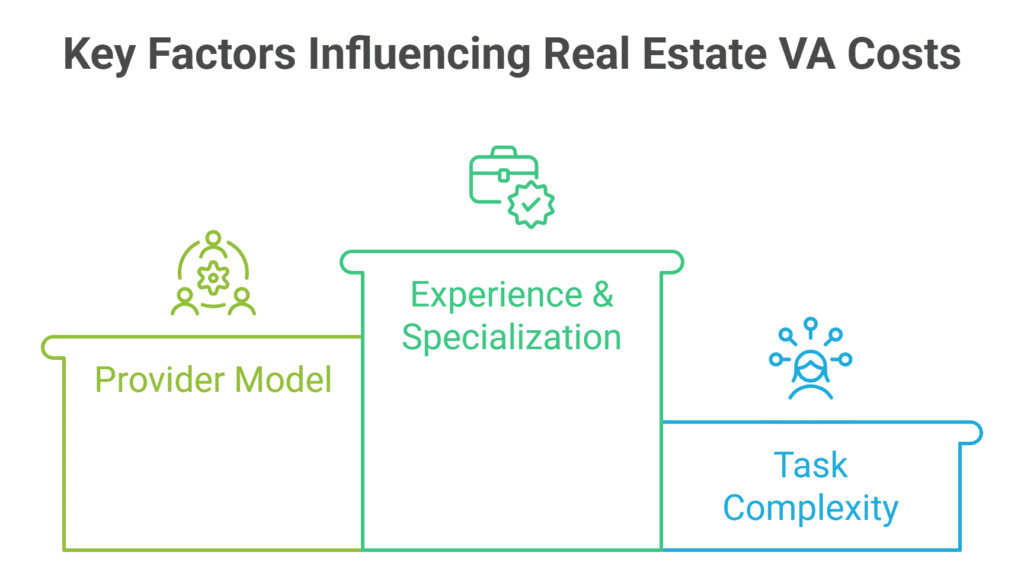
Real estate VA cost depends on experience, specialization, location, provider model, hours, and complexity of tasks. A general admin VA usually costs less than a transaction coordinator, marketing specialist, cold caller, CRM specialist, or highly experienced executive assistant. The right price should be evaluated against saved time, improved follow-up, reduced errors, and increased business capacity.
1. What Affects Real Estate VA Pricing
Pricing varies because the phrase “real estate virtual assistant” can describe many different roles. Simple data entry and scheduling support require a different skill level than transaction coordination, marketing campaign management, CRM cleanup, or cold calling. Specialized real estate knowledge usually increases cost because it reduces training time and improves workflow accuracy.
Provider type also matters. Hiring an independent VA may offer flexibility and direct communication. Hiring through a real estate VA company may include screening, replacement support, account management, quality control, and backup coverage. Those added services can cost more, but may reduce hiring risk.
Time zone coverage, communication expectations, software knowledge, and client-facing responsibilities also affect price. A VA who handles sensitive client communication or deadline-heavy transaction tasks should be evaluated differently from one who only formats spreadsheets or updates files.
2. Is a Real Estate VA Worth the Investment?
A real estate VA is worth the investment when the assistant gives the agent more time for prospecting, client meetings, showings, negotiations, and closing-related work. The ROI is strongest when the VA supports tasks that directly affect speed, consistency, client experience, or lead conversion.
NAR’s 2025 Member Profile reported that the typical REALTOR completed 10 transaction sides in 2024 and had a median gross income of $58,100. REALTORS with 16 or more years of experience had a median gross income of $78,900, while those with two years or less had a median gross income of $8,100. Those numbers show how much experience, consistency, and business systems matter in a commission-driven field.
The VA does not create revenue automatically. The business owner must delegate the right tasks, use clear systems, and measure outcomes. But if VA support prevents missed leads, speeds up response time, improves marketing consistency, and reduces administrative overload, it can become a practical growth investment. A deeper discussion of whether a real estate VA is worth it can help agents evaluate ROI more carefully.
3. Real Estate VA vs. Local Employee
A real estate VA and a local employee serve different needs. A local employee may be better suited for in-office responsibilities, local errands, physical file handling, and tasks requiring constant in-person presence. A VA may be better for digital workflows, flexible support, part-time needs, after-hours coverage, and specialized remote execution.
The comparison should include total cost and management complexity. A local employee may be involved in payroll, benefits, equipment, office space, training, and fixed hours. A VA can offer more flexible capacity, especially for agents who are not ready to hire full-time in-house staff.
However, the best choice depends on the business model. A high-volume team may need both local and virtual support. A solo agent may begin with a VA, build documented systems, and later decide whether a local assistant is necessary.
How to Hire a Real Estate Virtual Assistant

Hiring a real estate virtual assistant should start with role clarity. Many failed VA relationships happen because the agent wants “help with everything” but does not define tasks, tools, hours, or outcomes. Moreover, you can further decide on hiring a freelancer or a real estate VA from firms such as Zirtual, TaskVirtual, MyTasker, etc. A structured hiring process makes it easier to find someone who fits the business needs.
1. Decide What Type of VA You Need
- Before reviewing candidates, list the exact tasks you want to delegate.
- Group tasks into categories such as admin, listings, CRM, marketing, lead generation, transaction coordination, data entry, or customer communication.
- Decide which category creates the most urgent bottleneck before trying to hire for every need at once.
- If your CRM is chaotic, hire for database discipline and follow-up organization.
- If your listings are hard to manage, hire for listing coordination and marketing checklist support.
- If leads are not being contacted consistently, consider a cold calling or inside sales support role.
- Businesses that want experienced support may also consider professional real estate VAs instead of hiring purely on hourly cost.
2. Where to Find Real Estate VAs
- Real estate VAs can be found through managed VA companies, real estate VA agencies, freelancer platforms, referrals, LinkedIn, industry groups, broker networks, and specialized outsourcing providers.
- Agencies may provide screening, replacement support, training, and account management.
- Freelancers may offer more direct communication, flexibility, and a wider range of price points.
- Referrals may provide more trust because the candidate or provider has already worked with someone in your network.
- When comparing providers, review real estate experience, service categories, communication process, training model, replacement policy, security practices, and client reviews.
- Do not choose only based on price because the cheapest option may require constant rework or lack real estate context.
- Agents comparing provider options can use lists of real estate VA companies as a starting point before evaluating fit.
3. Vetting Questions and Test Tasks
- The best vetting process tests how the candidate works, not just what they claim.
- Ask about tools they have used, real estate workflows they understand, how they handle unclear instructions, how they report completed work, and how they protect client information.
- Useful questions include: “How would you organize a messy CRM?” and “What details would you capture from a buyer lead?”
- You can also ask: “How would you prepare for an open house?” and “What would you do if a client asked a question outside your authority?”
- A paid test task can help evaluate accuracy, communication, judgment, and attention to detail.
- Practical test tasks may include cleaning a sample lead list, creating a listing checklist, drafting a follow-up email from approved notes, organizing CRM tags, or building a weekly task board.
- Keep the test realistic and limited so the candidate is evaluated fairly without being asked to complete unpaid business work.
How to Onboard a Real Estate VA
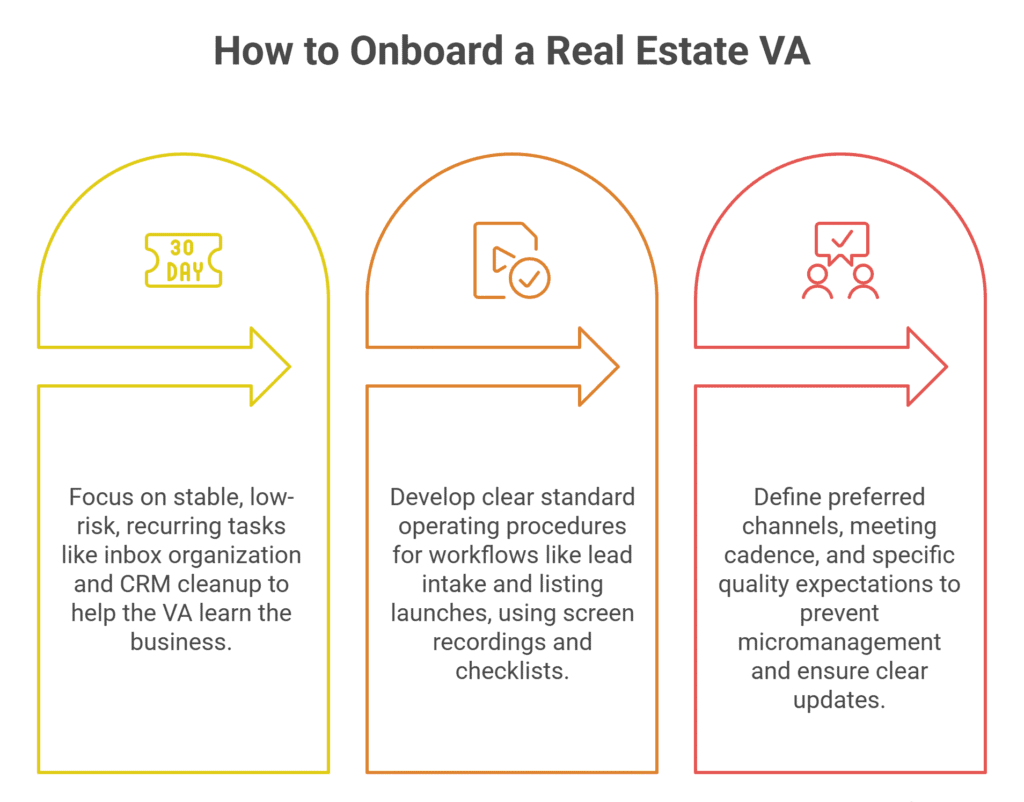
Onboarding determines whether a real estate VA becomes a reliable support partner or another person the agent has to manage. The goal is to give the assistant enough business context, tool access, examples, workflows, and feedback to succeed quickly. A thoughtful onboarding process also protects client experience and reduces preventable mistakes.
1. Build the First 30-Day Plan
The first 30 days should focus on stable, low-risk, recurring tasks. Start with inbox organization, calendar updates, CRM cleanup, file organization, lead tagging, social media scheduling drafts, weekly reports, and listing checklist support. These tasks help the VA learn the business without immediately exposing them to complex client-facing situations.
Create a simple weekly plan for the first month. Start with week one by introducing the business, tools, communication rules, and basic tasks. Add recurring workflows and review quality in week two. During week three, let the VA own a small process with supervision. By week four, evaluate what can be expanded, improved, or documented.”
Do not overload the VA with every overdue task at once. A large backlog may need to be broken into phases.
2. Create SOPs for Recurring Real Estate Workflows
Standard operating procedures are essential for real estate VA success. SOPs should explain the purpose of the task, tools used, step-by-step process, examples of correct work, deadline, review process, and escalation rules. They do not need to be long, but they must be clear.
Useful SOPs include buyer lead intake, seller lead intake, open-house follow-up, CRM updates, listing launch checklist, social media posting, testimonial collection, showing coordination, vendor communication, transaction deadline tracking, and weekly reporting.
Screen recordings are helpful because many real estate workflows are tool-based. A five-minute video showing how to update a CRM or prepare a listing folder can save repeated explanations. Pair the video with a checklist so the VA can complete the work independently.
3. Set Communication and Quality Standards
A real estate VA should know how and when to communicate. Define the preferred channels, daily update format, meeting cadence, response expectations, urgent escalation rules, and approval limits. For example, the VA may be allowed to draft client emails but not send them without approval during the first month.
Quality standards should also be specific. Instead of saying “keep the CRM updated,” define what a complete record includes: name, phone, email, lead source, property interest, budget, timeline, status, notes, and next follow-up date. Instead of saying “help with listings,” define each step from photo organization to marketing checklist completion.
Good communication prevents micromanagement. The agent should not have to ask constantly, “What happened with this?” The VA should provide clear updates on completed work, pending items, questions, and blockers.
Real Estate Marketing, Content, and Visual Support

Marketing is one of the strongest use cases for a real estate virtual assistant because real estate visibility depends on consistency. Agents need to stay visible to buyers, sellers, past clients, referral partners, and local audiences. A VA can help manage the execution layer so marketing does not disappear during busy transaction periods.
1. Social Media and Listing Promotion
- A real estate VA can help prepare social media calendars, schedule posts, organize listing photos, format captions, publish open-house reminders, collect testimonials, and repurpose market updates into short posts.
- They can help track whether posts support listings, buyer education, seller education, local content, referrals, or personal brand visibility.
- NAR’s social media resource cites its technology survey showing that 87% of REALTORS use Facebook, 62% use Instagram, 48% use LinkedIn, and 25% use YouTube.
- These channels can create visibility, but only if someone manages posting, formatting, asset organization, and follow-up consistently.
- The VA should work from approved brand guidelines, brokerage rules, and compliance expectations.
- Real estate advertising can involve fair housing considerations, MLS rules, state-specific requirements, and brokerage standards.
- The VA can execute the workflow, but the agent or broker should approve sensitive claims and client-facing content.
2. Blog Writing and Local SEO Support
- A real estate VA can support blog publishing by collecting topic ideas, organizing outlines, uploading drafts, formatting posts, sourcing approved images, adding internal links, and tracking publishing calendars.
- Some VAs can draft content, but expert review is important because real estate advice should be accurate, local, and compliant.
- Local SEO content can cover neighborhood guides, moving tips, home-selling timelines, market updates, buyer education, seller preparation, relocation content, investment basics, and frequently asked questions.
- This type of content helps demonstrate expertise and answer real client questions.
- A VA can help keep the content process moving even when the agent is busy with showings, negotiations, and transaction deadlines.
- A real estate blog writing service can be useful when the business wants more search visibility but lacks time to plan, draft, format, and publish consistently.
- The strongest content workflow combines local expertise from the agent with structured production support from the VA or content team.
3. Photo Editing and Listing Presentation
- Property visuals matter because buyers often form first impressions online before scheduling a showing.
- A VA or specialized service may help organize images, rename files, coordinate photo editing, prepare listing folders, and ensure marketing assets are ready before launch.
- Photo editing support may include brightness correction, color balancing, sky replacement where allowed, object removal where ethical and compliant, resizing, formatting, and image organization.
- The key is accuracy because listing photos should enhance the presentation without misrepresenting the property.
- A VA can help coordinate turnaround times so property visuals are ready for listing launches, social promotion, brochures, and email campaigns.
- Strong visual organization also helps agents reuse listing assets across MLS entries, websites, social media, open-house flyers, and client presentations.
- A dedicated real estate photo editing service can support agents who manage multiple listings and need faster turnaround on visual assets.
Data, CRM, and Transaction Coordination
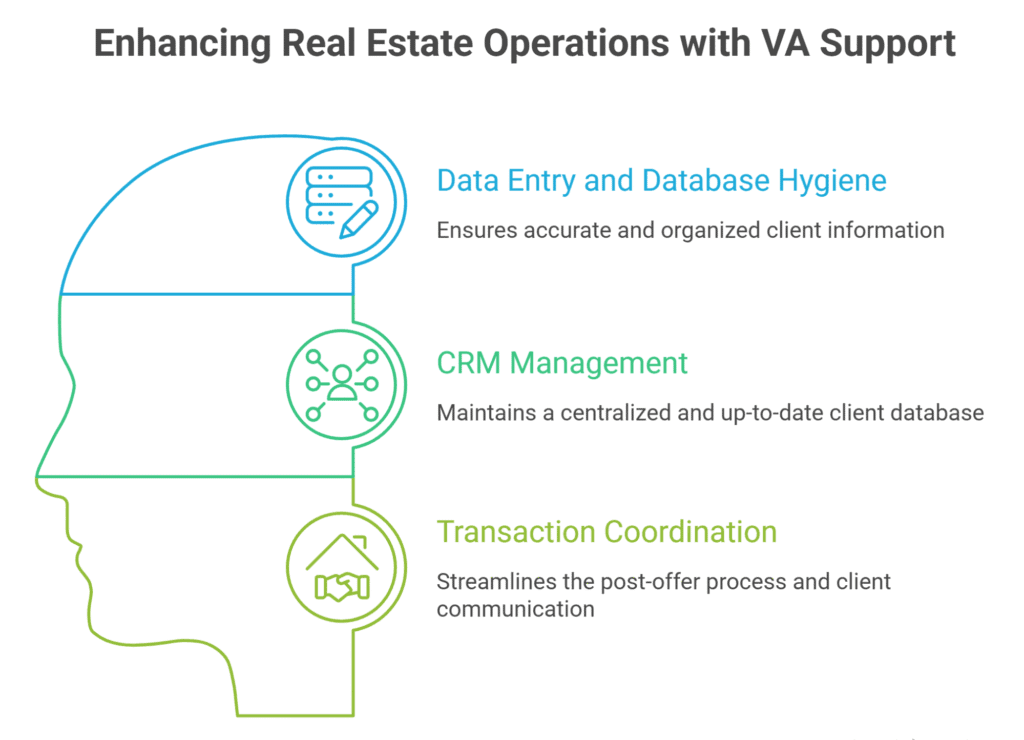
Data quality, CRM discipline, and transaction coordination are three areas where real estate VA support can directly reduce stress. These workflows are not always visible to clients, but they strongly affect client experience. When the back end is organized, the front end feels smoother.
1. Real Estate Data Entry and Database Hygiene
Real estate data entry includes adding new leads, updating client details, logging communication, entering property preferences, recording lead sources, cleaning duplicate records, and maintaining transaction data. Accurate data helps agents follow up with the right person at the right time.
Database hygiene is also important for marketing. If past clients, buyer leads, seller leads, investors, renters, and referral partners are all mixed together, campaigns become less relevant. A VA can segment lists so the agent can send better messages.
Data entry should be treated as a quality-control function. Incorrect phone numbers, outdated statuses, missing notes, or duplicate contacts can create confusion. Strong real estate data entry supports better follow-up, reporting, and client management.
2. CRM Management by a VA
A CRM is only useful if it is accurate and actively maintained. A real estate VA can help make the CRM the central source of truth for leads, clients, past customers, referral partners, and transaction contacts.
CRM support may include pipeline updates, task reminders, lead scoring, email tagging, drip campaign setup, birthday and anniversary reminders, referral tracking, and monthly cleanup. The VA can also prepare reports showing new leads, overdue follow-ups, active opportunities, and inactive contacts.
For agents who struggle to maintain their database consistently, real estate CRM management by a VA can be one of the highest-leverage services because it improves follow-up discipline and reduces reliance on memory.
3. Transaction Coordination Support
Transaction coordination support helps keep deals organized after an offer is accepted. A VA or transaction coordinator may track deadlines, collect documents, coordinate with lenders and title companies, schedule inspection-related tasks, update checklists, and remind the agent of pending items.
The agent still owns professional judgment and client representation, but the coordinator helps prevent administrative gaps. This is especially valuable when multiple transactions are active at the same time.
Transaction support can also improve client experience. Buyers and sellers often feel anxious between contract and close. Organized updates, timely reminders, and clean documentation make the process feel more controlled.
Security, Compliance, and Quality Control
Hiring a real estate virtual assistant requires trust, but trust should be supported by systems. Real estate businesses handle personal information, financial details, contracts, access instructions, and sensitive client communication. A secure delegation process protects both the client and the business.
1. Secure Access and Password Management
- Real estate teams should never share passwords casually through email, chat, or spreadsheets.
- A password manager should be used so access can be granted, tracked, changed, and removed securely.
- Role-based access helps ensure the VA only sees the tools and data needed for their work.
- Two-factor authentication should be enabled wherever possible to reduce unauthorized access risk.
- Separate user accounts are better than shared logins because they create clearer accountability.
- Access should be reviewed regularly, especially when the VA’s role changes or a workflow ends.
- Offboarding should include password resets, access removal, file transfer, and confirmation that sensitive information has been returned or deleted according to policy.
2. Compliance Boundaries for Real Estate Work
- Real estate is regulated, and rules may vary by state, brokerage, MLS, and transaction type.
- A VA should not perform tasks that legally require a real estate license unless they are properly licensed and permitted to do so.
- The agent or broker should clearly define what the VA may and may not do before assigning client-facing or listing-related tasks.
- Common support areas may include scheduling, data entry, file organization, document preparation for review, marketing coordination, and administrative follow-up.
- Higher-risk areas may include pricing advice, negotiation, contract interpretation, representation, and statements about property value or legal obligations.
- Brokerage policies matter and should be checked before assigning sensitive communication or transaction-related work.
- The safest approach is to document task boundaries and require approval for any communication that could affect compliance, representation, pricing, or contractual obligations.
3. Quality Review and Performance Checks
- Quality control should be built into the workflow from the beginning rather than handled only after mistakes occur.
- Early work should be reviewed closely, then oversight can be reduced as the VA proves accuracy and reliability.
- Checklists, templates, examples, and recurring reviews can improve consistency across admin, CRM, listing, marketing, and transaction tasks.
- Useful quality checks include CRM completeness, follow-up accuracy, listing checklist completion, document naming consistency, response time, task turnaround, error rate, and client feedback.
- The goal is not simply to catch mistakes; it is to design workflows that prevent common mistakes.
- Feedback should be constructive and specific so the VA understands what correct work looks like.
- A VA who receives clear examples and review notes can improve quickly, while vague feedback makes performance harder to correct.
How to Choose the Right Real Estate VA Company or Provider
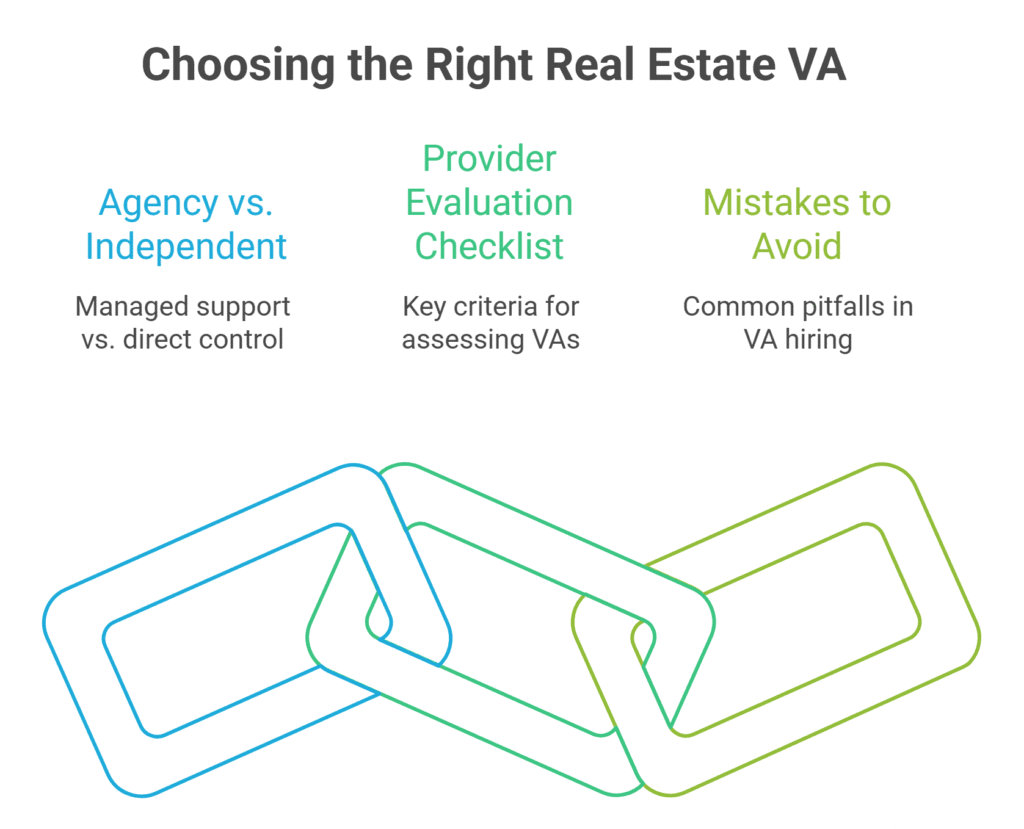
Choosing the right provider is about fit, not just price. A real estate VA should understand your business model, service area, workload, tools, communication expectations, and growth goals. The right provider should also be transparent about experience, scope, pricing, training, and replacement support.
1. Agency vs. Independent Real Estate VA
An agency or managed VA company may be a good fit if you want screening, backup support, training, management, and replacement options. This can reduce hiring friction, especially for agents who have never hired remote support before.
An independent VA may be a good fit if you want direct control, flexible terms, and a closer one-to-one working relationship. However, you may need to manage recruitment, training, quality control, and backup planning yourself.
Neither option is automatically better. The right choice depends on your experience, workload, budget, and tolerance for management. A busy agent who wants fast implementation may prefer a managed provider. A business owner with strong systems may succeed with an independent VA.
2. Provider Evaluation Checklist
Before hiring, evaluate whether the provider has real estate experience, clear service descriptions, transparent pricing, client references, security practices, communication standards, and replacement policies. Ask which tools their VAs commonly use and whether they have experience with CRMs, listing workflows, transaction support, lead follow-up, and marketing execution.
Also, ask how the provider handles training, performance issues, time tracking, reporting, and confidentiality. A good provider should be able to explain how work will be assigned, reviewed, and improved.
If you are comparing multiple options, use a scorecard. Rate each provider on real estate expertise, service fit, communication, pricing, flexibility, security, reviews, and onboarding support. A curated list of top real estate VA companies can help create an initial shortlist.
3. Mistakes to Avoid When Choosing a VA
A written task list is essential before hiring. Don’t choose only by hourly rate. Every VA cannot handle every real estate task—select specialists carefully based on your needs. Broad access without trust and security systems in place creates unnecessary risk. Client-facing work should wait until the VA fully understands your standards and brokerage rules.
Another mistake is failing to measure success. If you do not track response time, completed tasks, CRM improvements, lead follow-ups, or hours saved, it becomes difficult to know whether the VA is producing value.
The best provider relationship starts with clear expectations. Define the role, begin with manageable tasks, review performance, and expand responsibility gradually.

FAQ Section
1. What does a real estate virtual assistant do?
A real estate virtual assistant supports agents, brokers, investors, and property managers with remote tasks such as scheduling, CRM updates, lead follow-up, listing coordination, marketing support, data entry, transaction support, and client communication.
2. Is hiring a real estate VA worth it?
Hiring a real estate VA is worth it when the assistant helps reduce administrative overload, improves lead follow-up, keeps the CRM organized, supports marketing consistency, and gives the agent more time for clients, showings, negotiations, and revenue-generating work.
3. What tasks should I delegate to a real estate VA first?
Start with low-risk recurring tasks such as inbox organization, calendar management, CRM cleanup, lead tagging, file organization, listing checklists, social media scheduling drafts, weekly reports, and appointment reminders.
4. Can a real estate VA handle cold calling?
Yes, a real estate VA can support cold calling if they are trained, use approved scripts, follow applicable laws and platform rules, update call records accurately, and escalate qualified or sensitive conversations to the licensed agent.
5. How do I onboard a real estate VA?
Onboard a real estate VA with a 30-day plan, tool access, SOPs, screen-recorded task walkthroughs, communication rules, approval limits, quality standards, and weekly feedback. Start with simple recurring tasks before assigning complex workflows.
6. Should I hire an independent VA or a real estate VA company?
Hire an independent VA if you want direct control and already have strong systems. Choose a real estate VA company if you want screening, replacement support, training, account management, or a faster hiring process with less recruitment burden.
Conclusion: Build a Real Estate Business That Is Easier to Scale
A real estate virtual assistant can help agents and brokers build a more organized, responsive, and scalable business. The value is not limited to saved time. A strong VA can improve CRM discipline, lead follow-up, listing coordination, marketing consistency, transaction organization, and client communication.
The best results come from matching the VA role to the business need. An administrative VA may be right for daily organization. A marketing VA may be right for visibility and content execution. A cold calling VA may support prospecting. A transaction coordinator may help manage contract-to-close workflows. A CRM-focused VA may protect the database that powers future business.
Real estate professionals operate in a competitive, relationship-driven market where responsiveness and organization matter. NAR reported that 88% of all home buyers used an agent or broker in its 2025 buyer and seller profile, showing that professional guidance remains central to the transaction experience. The agents who combine strong client advisory skills with reliable operational support are better positioned to serve clients well and grow sustainably.
Ready to hire a real estate virtual assistant? Start by listing the recurring tasks that consume your week, group them by admin, CRM, marketing, lead generation, and transaction support, then choose the VA role that removes the biggest bottleneck first.
Sources List
- U.S. Bureau of Labor Statistics — Real Estate Brokers and Sales Agents: duties, work environment, pay, employment, self-employment share, and outlook.
- National Association of REALTORS® — 2025 Member Profile summary: REALTOR® income, transaction sides, sales volume, and experience data.
- National Association of REALTORS® — 2025 Profile of Home Buyers and Sellers: first-time buyer share, buyer age, down payment data, seller data, and agent usage.
- National Association of REALTORS® — 2025 REALTOR® Technology Survey: eSignature, social media, drone photography/video, technology adoption, CRM, MLS, and lead-generation technology data.
- National Association of REALTORS® — Social Media resource summarizing REALTOR® platform usage from NAR technology research.
- National Association of REALTORS® — Highlights from the 2025 Profile of Home Buyers and Sellers: inventory, affordability, mortgage-rate context, and buyer/seller market conditions.
- Google Search Central — official guidance on generative AI features in Search and SEO best practices for AI Overviews and AI Mode.
- Google Search Central — guidance on creating helpful, reliable, people-first content.
 Siddhartha Basu is a Technical Writer at Task Virtual. He loves online games, e-book reading, and Yoga.