Contents
show
Digital marketing VA vs marketing agency: which to choose
American businesses face a clear choice when scaling online presence: hire a digital marketing VA or partner with a full marketing agency. Rising competition, AI-driven tools, and tighter budgets have made this decision more urgent than ever. U.S. digital advertising revenue reached $258.6 billion in 2024 and climbed to nearly $294.6 billion in 2025, according to the Interactive Advertising Bureau (IAB) and PwC reports. Small and mid-sized companies cannot ignore these channels, yet most cannot afford oversized teams or inefficient spending.
A digital marketing virtual assistant offers dedicated, flexible support at a fraction of traditional costs, while agencies deliver specialized teams and strategy depth. Choosing correctly affects cash flow, speed of execution, and long-term results. This guide breaks down costs, capabilities, control, scalability, and real-world fit so U.S. decision-makers can select the model that matches their stage and goals without wasting resources on the wrong structure.
Understanding a Digital Marketing VA
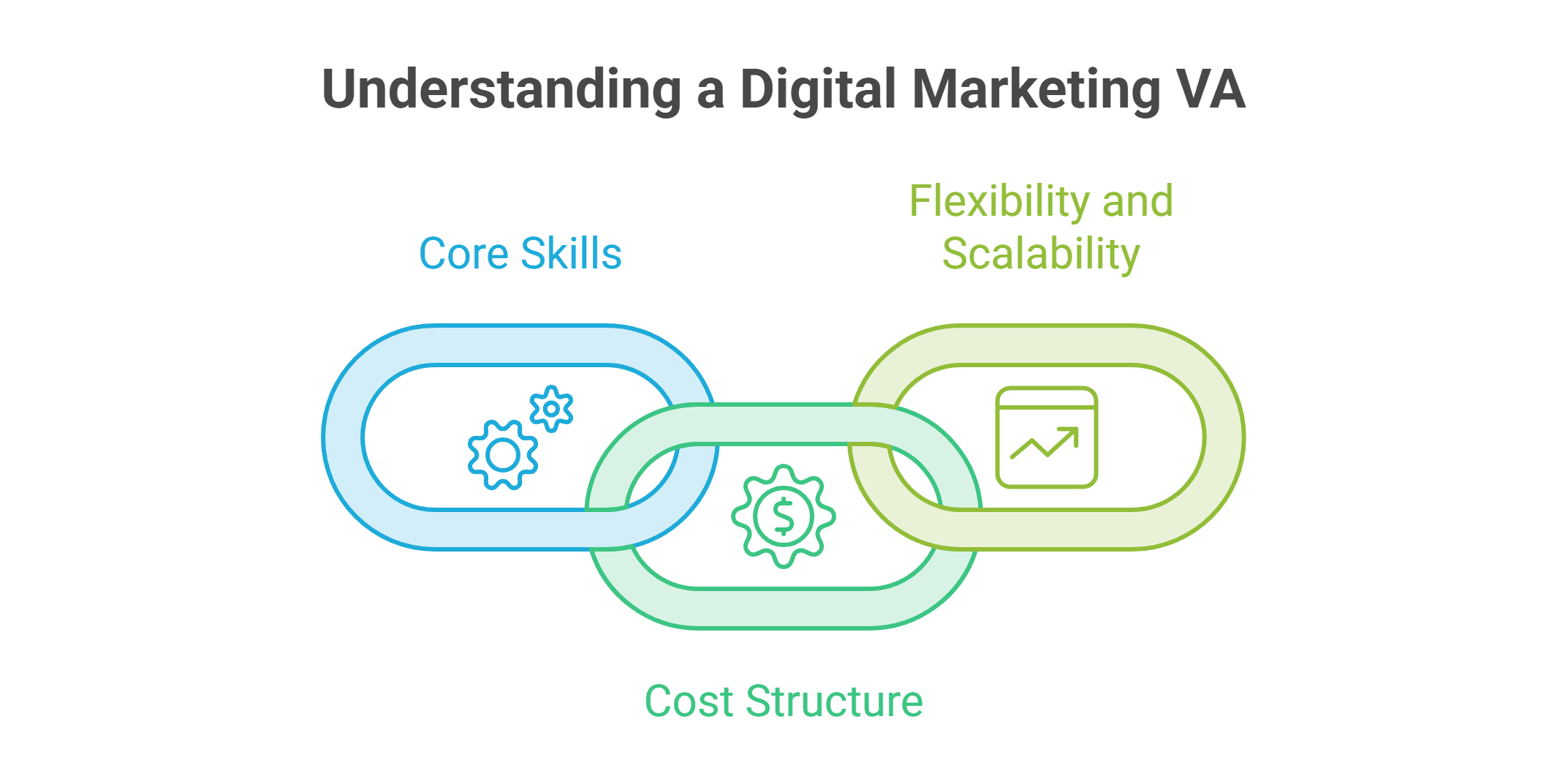
A digital marketing VA is a remote professional or small team focused on execution tasks such as social media management, content creation, SEO support, email campaigns, basic paid ads, analytics reporting, and community engagement. Many VAs specialize in platforms like Meta, Google, LinkedIn, or email tools and work full-time or part-time exclusively for one or a few clients.
1. Core Skills and Typical Responsibilities
Digital marketing VAs handle day-to-day work that keeps campaigns running. They schedule posts, write or edit content, manage ad accounts under guidance, track key metrics, optimize landing pages for conversion rate improvements, and maintain CRM lists. Experienced VAs also perform competitor research, set up tracking pixels, generate monthly reports, and support basic A/B testing to improve performance over time.
Because they operate remotely, communication happens through Slack, Asana, or email, and they adapt quickly to the client’s preferred tools and brand voice. This hands-on focus makes them especially effective for consistent channel maintenance, tactical optimization, and reliable weekly output that keeps marketing momentum steady without requiring a full internal team.
2. Cost Structure and Pricing Models
Pricing for digital marketing VAs typically ranges from $1,200 to $5,500 per month for full-time dedicated support, depending on location and experience. Offshore talent from Latin America or the Philippines often falls on the lower end, while U.S.-based VAs command higher rates. Part-time arrangements of around 20 hours per week commonly cost $600–$2,000 monthly and still deliver meaningful output for focused priorities.
Clients pay only for the hours or retainer agreed upon, with no benefits, payroll taxes, or office overhead. This model delivers roughly 160 dedicated hours per month at effective rates far below agency or full-time employee costs, giving budget-conscious businesses a clear and predictable expense structure that scales with actual needs.
3. Flexibility and Scalability Advantages
VAs scale with business needs. Start with 10–15 hours weekly for social media and content, then expand to full-time as campaigns grow and results justify the investment. Contracts are usually month-to-month or short-term, allowing easy adjustment if priorities shift or seasonal demand changes.
Businesses retain direct control over strategy while the VA executes. This setup suits founders who want hands-on involvement without hiring full-time staff and who need the ability to pivot quickly based on performance data, new product launches, or sudden market opportunities.
Understanding a Marketing Agency

A marketing agency provides access to a coordinated team of specialists rather than a single remote worker. Clients benefit from collective experience across strategy, creative, media, and analytics. This structure supports more complex campaigns and longer-term planning than most individual VAs can deliver alone.
1. Range of Services and Team Expertise
- Agencies typically offer full strategy development and multi-channel campaign management that aligns marketing activity with business goals.
- Creative production teams handle design, copy, video, and brand assets under consistent guidelines.
- Specialists manage advanced analytics, attribution modeling, and conversion rate optimization.
- Clients gain access to experts who stay current on algorithm changes, privacy regulations, and emerging platforms.
- Full-service firms cover SEO, paid content marketing, email, and brand work, while boutique agencies focus on one or two high-impact disciplines such as performance marketing or content strategy.
2. Pricing Models and Typical Retainers
- Agency retainers for small to mid-sized U.S. businesses commonly start at $2,000–$8,000 per month for focused services.
- Comprehensive programs often rise to $10,000–$25,000 or more each month depending on scope and team size.
- Median retainers in recent analyses hover around $6,450 monthly across varied engagements.
- Pricing frequently includes media management fees of 10–15% of ad spend plus project-based add-ons for extra work.
- Contracts often run 6–12 months with defined scopes, and work outside the original agreement incurs additional charges.
3. Strategic Depth and Process Maturity
- Agencies bring established processes, proprietary tools, and cross-client pattern recognition that reduce trial-and-error.
- Teams conduct thorough audits and develop multi-quarter roadmaps with clear milestones.
- Senior oversight ensures campaigns stay aligned with broader business objectives.
- Formal documentation and approval layers support brand consistency across greater efforts.
- The structured approach lowers the learning curve for clients but can introduce slower decision cycles when multiple people must review every change.
Cost Comparison: Digital Marketing VA vs Marketing Agency
Cost remains one of the strongest factors in the decision. A dedicated digital marketing VA delivers exclusive hours at a lower total expense. Agencies charge more for specialized talent, infrastructure, and strategic oversight that many growing businesses eventually need.
1. Monthly and Annual Cost Ranges
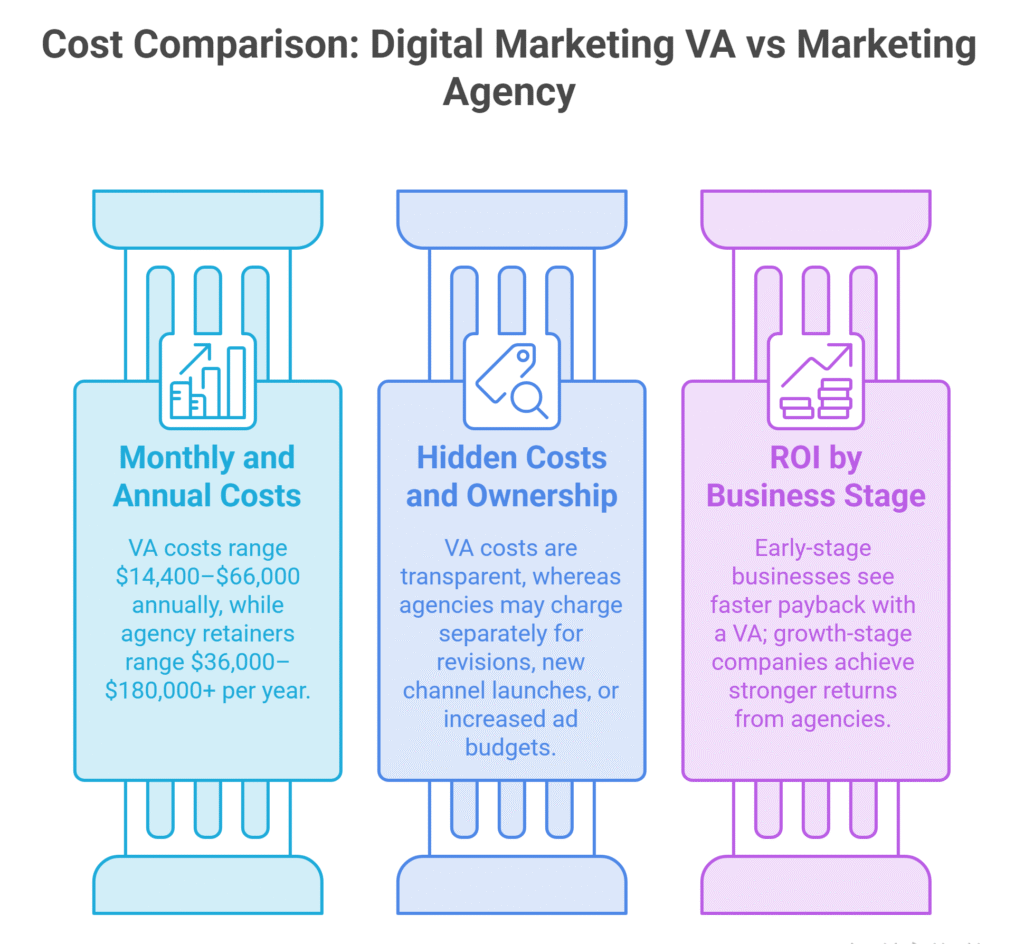
A full-time marketing VA typically costs $14,400–$66,000 annually. An equivalent agency retainer often runs $36,000–$180,000+ per year before ad spend or extras. For example, a $2,000 monthly VA provides roughly 160 dedicated hours; a $5,000 agency retainer may allocate only 20–60 hours of shared specialist time across multiple clients. Effective hourly rates for VAs frequently land between $8–$30, versus $50–$250+ for agency talent. These differences become especially significant for businesses operating on constrained marketing budgets.
2. Hidden Costs and Total Cost of Ownership
VA costs are transparent: compensation, tools, and light management time. Agencies may include tool licenses and creative production in the retainer but often charge separately for revisions, new channel launches, or increased ad budgets. Internal management time differs as well—VAs require more direct oversight from the business owner, while agencies handle their own project management. Fully loaded in-house marketing roles compound the comparison further. The Bureau of Labor Statistics reports a median annual wage of $166,790 for marketing managers in May 2025, before benefits, taxes, and overhead that can push total costs well above $200,000.
3. ROI Considerations by Business Stage
Early-stage and cash-conscious businesses often see faster payback with a VA because more budget reaches actual execution and media. Growth-stage companies with complex multi-channel needs or high ad spend frequently achieve stronger returns from agencies through specialized expertise and proven playbooks. Tracking return on ad spend, customer acquisition cost, and lifetime value remains essential under either model. Consistent measurement allows businesses to adjust the engagement as results become clear.
Control, Communication, and Decision Speed
The level of day-to-day involvement a business wants strongly influences the right choice. Some leaders prefer to stay close to every decision and creative detail. Others want to set direction and then step back while professionals handle the details.
1. Direct Oversight with a Digital Marketing VA
- Clients set priorities and approve content in real time through direct one-to-one communication.
- Tactics can be adjusted quickly without waiting for formal review cycles.
- Founders who understand their brand deeply retain full strategic ownership.
- Faster testing of new ideas and quicker responses to performance changes become possible.
2. Structured Processes with an Agency
- Agencies use account managers, creative briefs, and scheduled review meetings.
- Formal feedback loops support consistency across larger teams and multiple campaigns.
- Clients receive professional documentation and clear deliverables each month.
- Minor changes can move more slowly because multiple people must review and approve them.
3. Collaboration Style Fit
- Businesses that value agility and personal working relationships lean toward VAs.
- Companies that prefer documented strategy and senior input favor agencies.
- Matching the collaboration style to leadership capacity improves long-term satisfaction.
- Reduced day-to-day involvement is easier to achieve with a well-run agency relationship.
Expertise, Specialization, and Quality of Output
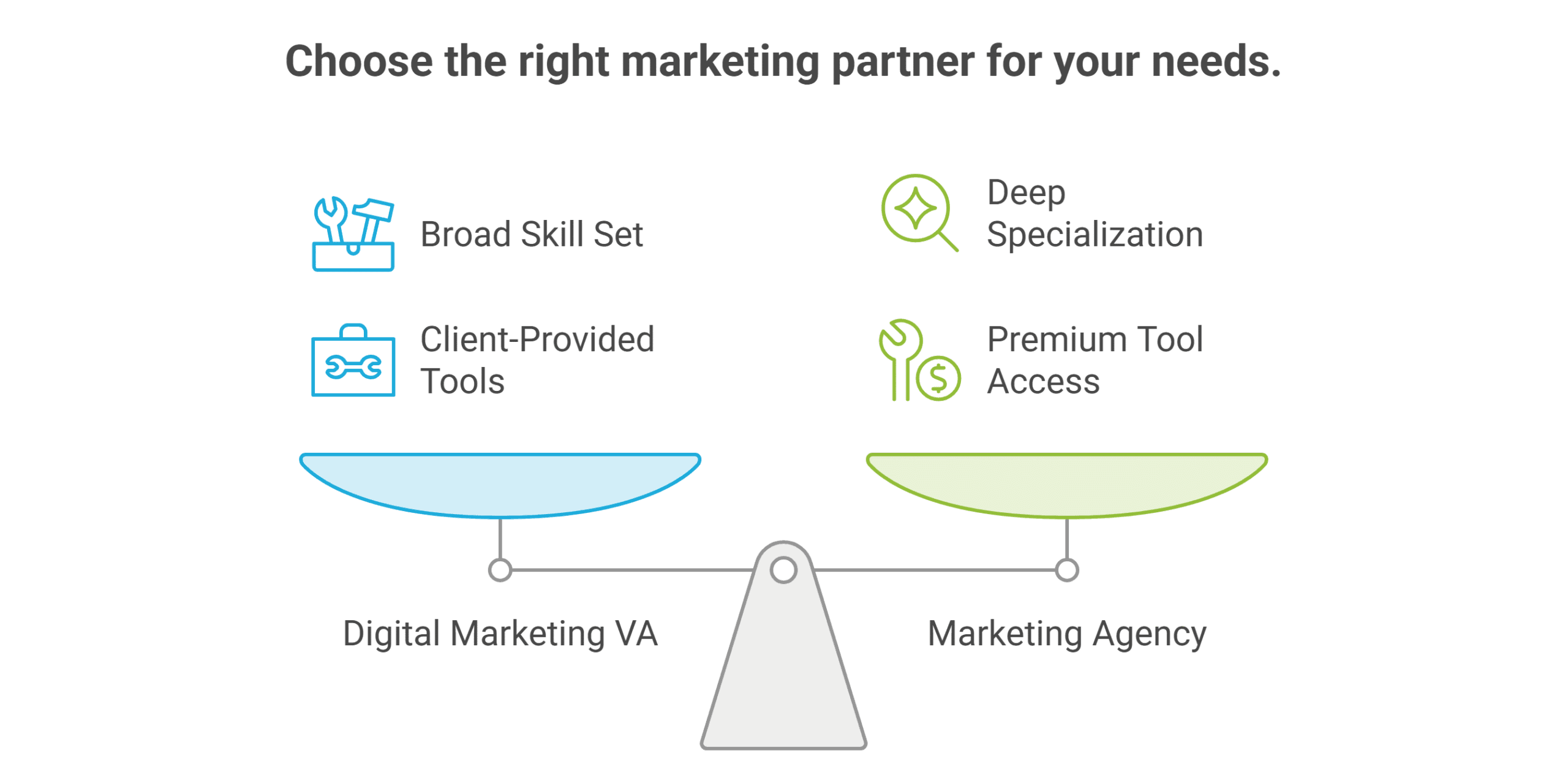
Skill depth and specialization differ significantly between the two models. Understanding these differences helps businesses match the partner to the complexity of their marketing needs. Neither option is universally superior; the right fit depends on current goals and available internal expertise.
1. Breadth vs Depth Trade-offs
A single digital marketing VA typically offers solid generalist or mid-level specialist skills across a few channels. Agencies assemble specialists for technical SEO work, advanced media buying, high-production creative, and sophisticated attribution modeling. Complex campaigns involving multiple platforms, strict compliance, or enterprise-level tracking usually benefit from agency depth. The choice depends on whether the business needs broad execution support or deep expertise in specific areas.
2. Access to Tools and Continuous Learning
Agencies often maintain licenses for premium platforms and invest in ongoing training across their teams, giving clients access to advanced software and up-to-date methods at no extra cost. VAs usually work with client-provided tools or more affordable stacks and stay current through self-directed learning, industry updates, and direct client feedback. Both models can produce high-quality work when the right talent is selected, thoroughly briefed, and regularly evaluated against clear performance standards.
Scalability, Risk, and Long-Term Flexibility

Business needs change over time, so the chosen model must adapt without creating major disruption. Growth, seasonal shifts, or new product lines all test how easily a partner can expand or contract support. Evaluating scalability and risk early prevents costly transitions later.
1. Scaling Up or Down
- VAs can increase or decrease hours or bring in specialized freelancers with relatively little friction.
- Agencies expand scope through additional retainers or project fees when larger launches require more capacity.
- Both models support growth, yet VAs generally carry a lower fixed monthly commitment.
- Seasonal or campaign-based needs are often easier to accommodate with flexible VA arrangements.
2. Continuity and Knowledge Retention
- A dedicated VA develops deep institutional knowledge of the brand, audience, and past campaigns over time.
- Agencies document processes and can transfer accounts between team members, lowering single-person risk.
- Hybrid models that pair a VA for daily execution with occasional agency strategy combine the strengths of both.
- Clear processing of documents for accounts, assets, and results protects knowledge regardless of the model used.
3. Risk Management
- VAs create dependency on one person or a small group, which strong standard operating procedures and backups can reduce.
- Agencies carry contractual and reputation risk if results lag, but larger firms usually maintain service continuity.
- Clear KPIs, regular performance reviews, and reasonable exit clauses protect the business in either relationship.
- Businesses can adjust course more easily when expectations and measurement frameworks are established from the start.
When to Choose a Digital Marketing VA or a Marketing Agency
A digital marketing VA fits best for startups, solopreneurs, and small businesses with clear priorities and limited budgets. Ideal scenarios include consistent social media and content needs, basic paid campaign management under owner direction, email nurture sequences, and regular reporting. Companies comfortable directing strategy and reviewing work weekly extract maximum value. Many U.S. small businesses allocate 7–8% of revenue to marketing under common Small Business Administration guidance ranges; a VA stretches that budget further into execution.
Agencies suit businesses ready for multi-channel strategy, higher ad spend, or specialized campaigns that require senior expertise. Mid-market firms launching new products, entering competitive categories, or needing brand-level creative often see stronger outcomes. When internal bandwidth for oversight is limited and professional processes matter, agencies deliver structure and specialized talent that a single VA cannot match. The investment tends to pay off when the complexity of the marketing mix exceeds what one person can manage effectively.
Hybrid Approaches and Emerging Trends
- Many American companies now combine both models by using a digital marketing VA for daily execution and an agency for quarterly strategy or specialized projects.
- AI tools are changing the landscape by automating research, first-draft content, and basic search optimization tasks.
- These tools allow both VAs and smaller agency teams to deliver more output with the same or fewer hours.
- Businesses that test hybrid arrangements for 90 days often find a cost-effective balance between hands-on control and strategic depth.
TaskVirtual: Your Partner in Digital Marketing Virtual Assistance

Managing digital marketing tasks such as social media scheduling, content creation, campaign tracking, SEO support, and reporting can quickly become overwhelming for busy founders and small teams. Jumping between platforms, keeping up with algorithm changes, and maintaining consistent output often pulls time away from core business activities. TaskVirtual supplies skilled digital marketing virtual assistants who help businesses execute daily marketing work efficiently while staying aligned with overall goals.
1. Expert Digital Marketing Execution Support
TaskVirtual’s trained virtual assistants assist with content calendars, social media management, basic ad account monitoring, email sequence setup, and performance reporting. They help organize priorities, follow brand guidelines, and keep campaigns moving so owners can focus on strategy and growth decisions.
2. Affordable and Flexible Pricing
Hiring full-time marketing staff or committing to high agency retainers can strain budgets, but TaskVirtual keeps support accessible. With pricing plans starting from just $3.12/hour to $14.99/hour, their services remain budget-friendly for startups, small businesses, and growing companies that need reliable digital marketing help without high fixed costs.
3. Comprehensive Digital Marketing Support Solutions
From creating and scheduling social content and managing community engagement to supporting SEO tasks, tracking key metrics, and handling routine campaign adjustments, TaskVirtual covers the core execution work most businesses need. Their scalable approach works whether you require occasional project help or consistent ongoing marketing support.
4. Ongoing Support and Quality Assurance
TaskVirtual provides regular updates, clear communication, and proactive follow-through on assigned marketing tasks. Their structured processes help ensure deadlines are met, brand standards are maintained, and marketing activities stay coordinated without constant supervision.
5. Proven Track Record of Excellence
With 364 positive reviews and a 4.7-star rating on trusted VA platforms, TaskVirtual is recognised as a reliable partner worldwide. Clients count on their expertise to streamline digital marketing execution and free up time for higher-level business priorities.
FAQ
1. How much does a digital marketing VA cost compared to an agency?
Full-time digital marketing VAs typically range from $1,200–$5,500 monthly. Agency retainers for comparable scope often start at $2,000–$8,000 and climb higher for full service.
2. Can a digital marketing VA handle paid advertising?
Yes, experienced VAs manage Google and Meta campaigns, optimize budgets, and report results. Complex multi-channel or high-spend programs usually benefit from agency specialists.
3. Which option offers better ROI for small businesses?
Most small U.S. businesses achieve stronger short-term ROI with a VA because more budget reaches execution and media. Agencies can outperform when specialized expertise drives higher conversion rates.
4. How long does it take to see results with either model?
Foundational work such as content and SEO often shows progress in 3–6 months. Paid campaigns can generate faster feedback loops of weeks when properly managed.
5. Is it possible to switch from a VA to an agency later?
Yes. Clear documentation of accounts, assets, and performance history makes transitions straightforward under either model.
6. Do agencies or VAs provide better strategy?
Agencies generally lead on high-level strategy and multi-channel planning. Strong digital marketing VAs excel at tactical execution and can contribute ideas when given context.
Conclusion and CTA
Choosing between a digital marketing VA and a marketing agency depends on budget, desired control, required expertise, and growth stage. VAs deliver dedicated hours, flexibility, and lower cost for execution-focused needs. Agencies supply specialized teams, strategic frameworks, and process maturity for more complex programs. U.S. businesses operating in a $294.6 billion digital advertising environment must match the model to their actual requirements rather than default to either extreme.
Evaluate your monthly marketing budget, the channels that matter most, and how much time you can devote to oversight. Start with a short trial of the preferred option, set clear KPIs, and review results after 90 days. The right partner—whether a skilled digital marketing VA or a capable agency—turns marketing spend into measurable growth. Assess your needs today and take the next step toward scalable digital results.
Sources
- Interactive Advertising Bureau (IAB) / PwC Internet Advertising Revenue Report (2024 and 2025 full-year data)
- U.S. Bureau of Labor Statistics, Occupational Employment and Wage Statistics (May 2025 marketing managers data)
- Statista reporting on U.S. digital advertising revenue and digital advertising agencies
- Common Small Business Administration guidance ranges on marketing budget as a percentage of revenue (widely referenced across industry analyses)
For more such content, visit our website.
 Siddhartha Basu is a Technical Writer at Task Virtual. He loves online games, e-book reading, and Yoga.