

Contents
show
How an Account Management Virtual Assistant Benefits Your Team
American businesses face mounting pressure to deliver seamless client experiences while controlling costs and maximizing limited internal resources. Account managers often juggle relationship building, reporting, renewals, upselling, and administrative follow-ups, leaving little bandwidth for high-value strategic work. An account management virtual assistant addresses this exact gap by providing specialized remote support focused on client success and operational excellence.
In today’s hybrid and distributed work environment, integrating a dedicated account management virtual assistant is increasingly a practical growth lever, while Stanford research found that hybrid employees were 33% less likely to quit. Companies can free teams to deepen relationships and grow revenue instead of routine coordination, supporting leaner operations and customer-centric strategies.
What an Account Management Virtual Assistant Does
An account management virtual assistant specializes in supporting client relationship operations rather than general administrative duties. This role focuses on the day-to-day activities that keep accounts healthy and account managers effective. Understanding the specific scope helps teams deploy the support where it creates the most value.
1. Core Responsibilities in Client Relationship Support
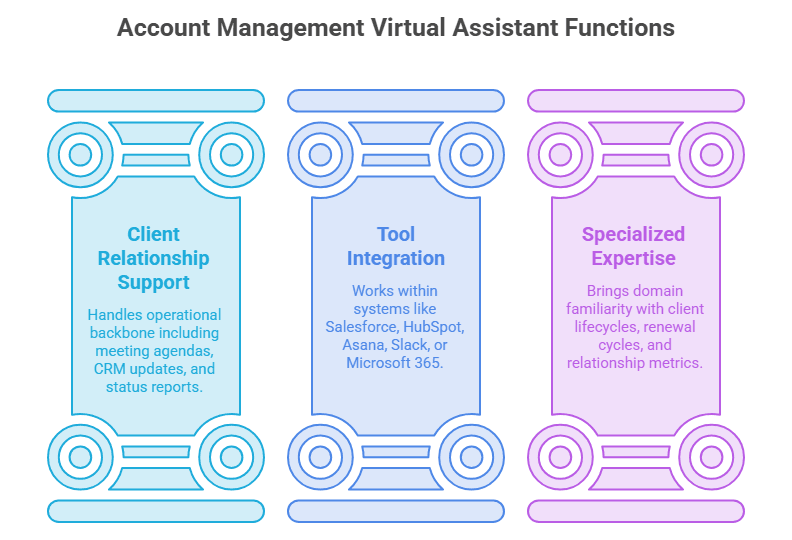
An account management virtual assistant handles the operational backbone of client accounts. Typical duties include preparing meeting agendas and notes, tracking action items, updating CRM records, scheduling follow-ups, and monitoring contract milestones. They also manage routine client communications, gather feedback, and compile status reports so account managers can focus on strategy and problem-solving.
By maintaining accurate account histories and ensuring timely touchpoints, the virtual assistant helps prevent dropped balls that erode trust. This consistent support creates a more reliable client experience and reduces the risk of overlooked opportunities or compliance issues.
2. Integration with Existing Tools and Workflows
Modern account management virtual assistants work inside the same systems your team already uses—Salesforce, HubSpot, Asana, Slack, or Microsoft 365. They update records in real time, generate pipeline reports, and flag at-risk accounts based on defined criteria. This seamless integration means the assistant becomes an extension of the team rather than a separate silo.
Clear documentation of processes and access protocols allows the virtual assistant to operate effectively from day one while protecting data security and client confidentiality. When systems and permissions are set up thoughtfully, the assistant can maintain data accuracy, support reporting cadence, and coordinate across platforms without creating friction for the internal team.
3. Specialization Versus General Virtual Support
Unlike a general administrative virtual assistant, an account management virtual assistant brings domain familiarity with client lifecycle stages, renewal cycles, and relationship metrics. Many develop expertise in specific industries or software platforms, enabling faster onboarding and higher-quality output. This specialization delivers more targeted value for teams whose success depends on strong, ongoing client relationships.
The focused skill set also means the virtual assistant understands the language of account health, expansion potential, and retention risk. As a result, the support feels more strategic and less transactional, helping the entire account management function operate with greater consistency and insight.
Account Management Virtual Assistant for Team Efficiency
Account managers frequently spend large portions of their week on tasks that do not require their full expertise. An account management virtual assistant removes much of that operational load so the team can redirect energy toward higher-impact work.
1. Freeing Account Managers for High-Value Activities
- Account managers regain hours previously spent on routine coordination and data upkeep.
- They gain capacity for deeper client conversations and solution design.
- Reduced context-switching lowers decision fatigue and improves focus.
- The team can prioritize proactive planning and revenue-generating initiatives more consistently.
2. Streamlining Reporting and Data Management
- The virtual assistant compiles regular performance dashboards and key metrics.
- Account records stay current, improving visibility into account health.
- Manual reporting effort decreases while data accuracy increases.
- Better information quality supports faster and more confident decision-making.
3. Enhancing Cross-Team Coordination
- The assistant tracks inter-departmental action items and routes requests efficiently.
- Information flows more smoothly between sales, product, support, and finance.
- Bottlenecks decrease because follow-ups no longer rely solely on the account manager.
- Alignment on client priorities improves without constant managerial intervention.
Boosting Customer Retention and Loyalty
Strong client relationships drive sustainable growth, yet many teams struggle to maintain consistent engagement amid competing priorities. An account management virtual assistant strengthens the operational foundation of retention efforts. This support helps organizations act earlier, respond more reliably, and deepen value delivered to existing clients.
1. Proactive Relationship Maintenance
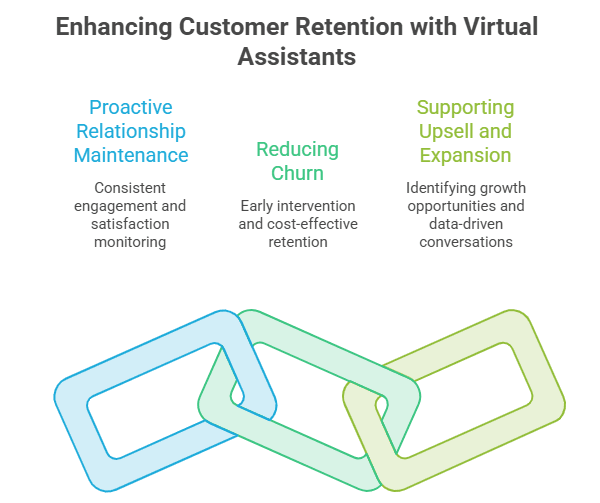
Strong retention starts with consistent, thoughtful engagement. An account management virtual assistant supports regular check-ins, personalized follow-ups, and timely responses to client inquiries while monitoring satisfaction signals and flagging accounts that need attention before issues escalate. Research consistently shows the financial impact of retention: according to a Bain & Company analysis widely referenced in Harvard Business Review, increasing customer retention rates by just 5% can increase profits by 25% to 95%, depending on the industry.
2. Reducing Churn Through Better Visibility
Many accounts slip away because warning signs go unnoticed amid busy schedules. A dedicated virtual assistant maintains closer day-to-day awareness of account activity, contract timelines, and communication patterns, enabling earlier intervention. Retaining existing customers is far more cost-effective than acquiring new ones, as multiple studies indicate that acquiring a new customer can cost five to 25 times more than retaining an existing one.
3. Supporting Upsell and Expansion Opportunities
Beyond retention, the virtual assistant can identify and prepare expansion opportunities by tracking product usage, noting client goals, and compiling relevant case studies or success metrics. Account managers then enter conversations armed with data and context, increasing the likelihood of successful upsells and cross-sells that deepen the relationship.
Cost Savings and Scalability Advantages

Hiring additional full-time staff is not always the most efficient way to expand account support capacity. An account management virtual assistant offers a more flexible and cost-effective alternative that aligns support levels with actual demand.
1. Lower Overhead Compared with Full-Time Hires
- Organizations avoid the full burden of salary, benefits, office space, and equipment costs.
- Support is typically provided on a flexible hourly or project basis at a lower total cost.
- Fixed overhead associated with underutilized permanent roles is reduced.
2. Flexible Capacity for Growth or Seasonal Demand
- Teams can increase or decrease support volume based on client load or renewal cycles.
- Capacity adjusts without the lag and expense of traditional recruiting.
- The model provides elasticity during growth phases or seasonal peaks.
3. Reduced Risk and Faster Onboarding
- Companies can test the model with limited initial commitment.
- Onboarding centers on process documentation and system access rather than lengthy hiring cycles.
- Experienced virtual assistants often shorten the learning curve compared with training new internal hires.
Supporting Remote and Hybrid Team Structures
Distributed work is now a permanent feature of many American workplaces. An account management virtual assistant fits naturally into these structures by operating through the same digital tools and collaboration practices used by internal teams. This alignment supports continuity and productivity regardless of physical location.
1. Aligning with Modern Work Preferences
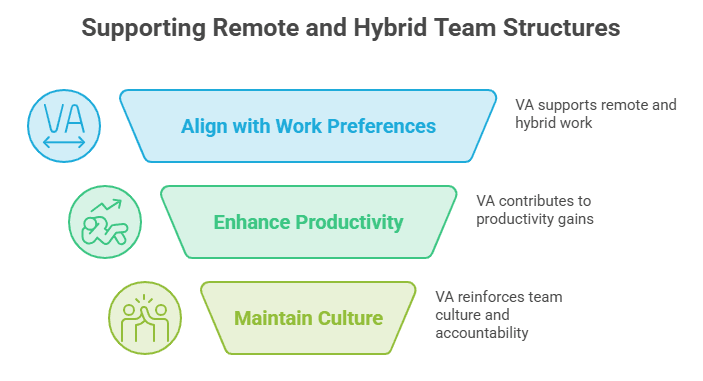
Remote and hybrid work remain significant features of the U.S. labor market. Bureau of Labor Statistics data show telework rates consistently in the low-to-mid 20% range in recent periods, with millions of workers performing at least some of their jobs from home. An account management virtual assistant collaborates through shared platforms and agreed time zones, supporting continuity across distributed teams.
2. Productivity Insights from Remote Arrangements
Research from the Bureau of Labor Statistics examining industry-level data found a positive association between increases in remote work and total factor productivity growth. A one-percentage-point rise in the share of remote workers correlated with measurable productivity gains after accounting for prior trends. Pew Research Center findings further indicate that among workers whose jobs can be done remotely, a large majority work remotely at least some of the time, and many value the arrangement highly.
3. Maintaining Culture and Accountability
Successful integration requires clear expectations, regular check-ins, and shared performance metrics. When managed well, the virtual assistant becomes a reliable team member who reinforces process discipline and accountability. Consistent communication rhythms and transparent goals help the role strengthen rather than dilute team culture, even in fully distributed settings.
Implementation of Account Management Virtual Assistant

Implementing specialized virtual support works best when approached systematically. Clear scoping, thoughtful selection, and ongoing management turn the role into a durable operational asset.
1. Defining Scope and Success Metrics
- Map the specific tasks currently consuming account managers’ time.
- Identify which activities can be delegated effectively without losing quality.
- Establish measurable outcomes such as time saved, response speed, data accuracy, or retention indicators.
2. Selecting and Onboarding the Right Support
- Prioritize candidates or providers with client-facing experience and CRM proficiency.
- Look for industry or tool familiarity that shortens the learning curve.
- Use structured onboarding with documented processes, system access, and initial supervised tasks.
3. Establishing Communication and Feedback Loops
- Schedule regular sync meetings and define preferred communication channels.
- Create simple escalation paths for urgent or complex issues.
- Provide ongoing feedback so the virtual assistant’s work stays aligned with evolving needs.
4. Measuring Impact and Iterating
- Track quantitative results such as administrative hours saved and retention metrics.
- Collect qualitative feedback from account managers and, where appropriate, clients.
- Use the data to refine responsibilities and expand the role over time.
TaskVirtual: Your Partner in Account Management Support

Keeping client relationships strong while managing reporting, CRM updates, renewals, and cross-team coordination can quickly overwhelm even experienced account managers. TaskVirtual delivers expert account management virtual assistant service that helps teams handle the operational side of account management so internal staff can focus on strategy, relationship depth, and growth.
1. Specialized Account Support Guidance
TaskVirtual’s trained virtual assistants assist with CRM maintenance, meeting preparation, action-item tracking, and status reporting. They help organize client data, monitor account health signals, and support consistent follow-up so account managers stay focused on high-value conversations and problem-solving.
2. Affordable and Flexible Pricing
Hiring a full-time account coordinator can be costly, but TaskVirtual makes specialized support accessible. With pricing plans starting from just $3.12/hour to $14.99/hour, their services remain budget-friendly for growing teams and established organizations alike.
3. Full-Scope Account Management Solutions
From updating records and compiling performance dashboards to coordinating renewals and preparing expansion insights, TaskVirtual covers the essential operational tasks of account management. Their scalable approach adapts whether a team needs part-time help or ongoing dedicated support.
4. Continuous Oversight and Reliability
TaskVirtual provides regular updates and proactive coordination so nothing falls through the cracks. Their structured support helps maintain data accuracy, timely client touchpoints, and clear visibility into account status without adding stress to the core team.
5. Established Record of Client Satisfaction
With 364 positive reviews and a 4.7-star rating on trusted VA platforms, TaskVirtual is recognised as a reliable partner worldwide. Clients count on their expertise to streamline account operations and strengthen overall team performance.
FAQ Section
1. What is the difference between a general virtual assistant and an account management virtual assistant?
A general virtual assistant handles broad administrative tasks. An account management virtual assistant focuses specifically on client relationship operations, CRM maintenance, retention support, and account coordination, bringing more relevant domain experience.
2. How much time can an account management virtual assistant typically save the team?
Savings vary by scope, but many teams reclaim significant weekly hours previously spent on reporting, scheduling, data entry, and follow-up coordination, allowing managers to prioritize strategic client work.
3. Is client data secure when working with a virtual assistant?
Reputable providers and independent professionals follow strict confidentiality agreements, use secure tools, and adhere to data protection best practices. Proper access controls and NDAs further mitigate risk.
4. Can a virtual assistant handle complex or sensitive client interactions?
Routine and prepared communications are well suited to virtual support. High-stakes or nuanced conversations remain with the account manager, while the assistant prepares materials and handles logistics.
5. How quickly can a team see results after hiring an account management virtual assistant?
With clear processes and focused onboarding, many teams notice reduced administrative burden and improved organization within the first few weeks. Deeper retention and efficiency gains typically appear over one to three months.
6. What industries benefit most from this type of support?
Any organization with ongoing client relationships—SaaS, professional services, agencies, financial services, healthcare providers, and B2B product companies—can gain meaningful value from specialized account management support.
Conclusion and Call to Action
An account management virtual assistant delivers measurable gains in efficiency, retention, cost control, and scalability. By absorbing operational load, the role enables account managers to focus on the high-impact work that strengthens client relationships and drives revenue. Teams that implement the model with clear processes and consistent collaboration position themselves for more sustainable growth and stronger client outcomes.
If your organization is ready to reclaim strategic capacity, begin by documenting the non-strategic tasks that consume the most time, then explore qualified account management virtual assistant support. The right partnership can produce clear improvements in both team effectiveness and client results.
Sources
- Bain & Company / Harvard Business Review analysis on customer retention and profit impact
- U.S. Bureau of Labor Statistics – Telework data and productivity research on remote work
- Pew Research Center – Surveys on remote work prevalence and worker preferences
- Additional industry analyses on virtual support cost structures and operational efficiency (cross-referenced with primary economic principles)
For more such content, visit our website.
 Siddhartha Basu is a Technical Writer at Task Virtual. He loves online games, e-book reading, and Yoga.